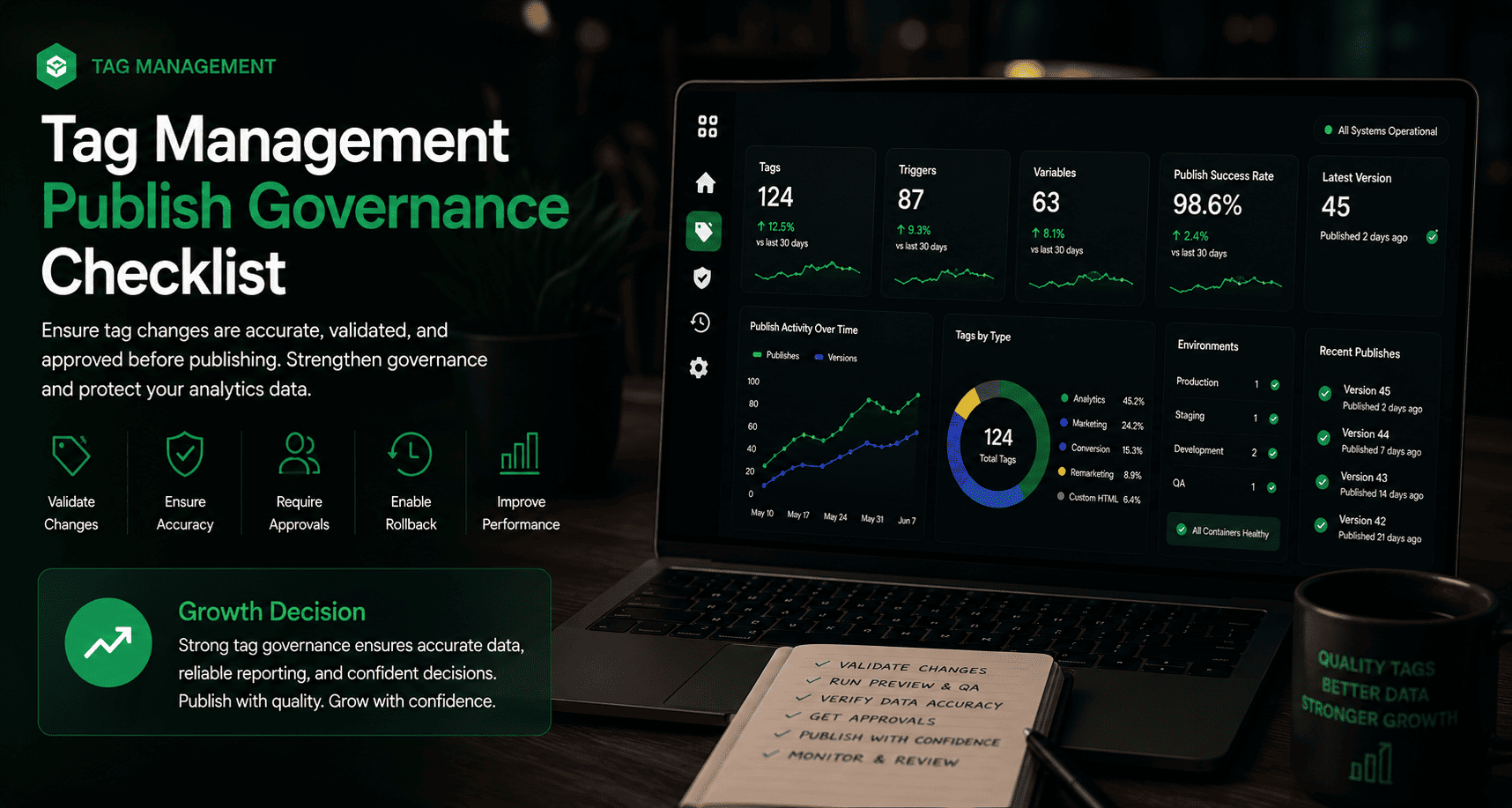
Tag Management Publish Governance Checklist
Tag management changes directly impact analytics accuracy, SEO reporting, and conversion tracking. Before publishing new tags or container updates, teams should validate governance, approvals, and deployment quality.
This checklist helps teams review whether tag management changes are ready to publish safely and confidently.
Why Tag Governance Matters
Broken tags affect reporting Incorrect triggers create tracking gaps Duplicate tags distort analytics Publishing errors impact SEO measurement Missing approvals increase risk Rollback issues slow recovery Governance improves deployment trust
- Broken tags affect reporting
- Incorrect triggers create tracking gaps
- Duplicate tags distort analytics
- Publishing errors impact SEO measurement
- Missing approvals increase risk
- Rollback issues slow recovery
- Governance improves deployment trust
Container Review
Workspace validation Version comparison Container structure review Environment check Folder organization Naming consistency
- Workspace validation
- Version comparison
- Container structure review
- Environment check
- Folder organization
- Naming consistency
Tag & Trigger Validation
Tag firing checks Trigger accuracy Variable review Consent validation Duplicate prevention Dependency checks
- Tag firing checks
- Trigger accuracy
- Variable review
- Consent validation
- Duplicate prevention
- Dependency checks
Preview & QA
Preview mode Browser testing Event verification Network checks Conversion validation Cross-page QA
- Preview mode
- Browser testing
- Event verification
- Network checks
- Conversion validation
- Cross-page QA
Governance & Approval
Owner review Approval confirmation Stakeholder visibility Documentation updates Audit notes Release signoff
- Owner review
- Approval confirmation
- Stakeholder visibility
- Documentation updates
- Audit notes
- Release signoff
Rollback & Monitoring
Version backup Rollback plan Error monitoring Reporting checks Post-publish validation Issue escalation
- Version backup
- Rollback plan
- Error monitoring
- Reporting checks
- Post-publish validation
- Issue escalation
Final Recommendation
Tag management changes should pass QA, governance review, and publishing controls before release. Strong deployment discipline reduces tracking risk and improves analytics reliability.
Workspace ownership
Evidence to review: Workspace name, change reason, owner, affected event or report, and approval state.
- Check that the workspace has a named owner, reason for release, and affected business signal before any publish recommendation is written.
- Hold publish when ownership, reason, or affected signal is missing.
- Workspace ownership is supported by visible inputs and the caveat is clear.
Change inventory
Evidence to review: Tag changes, trigger changes, variable changes, sequencing changes, deleted items, and affected reports.
- Compare the planned tag, trigger, variable, and sequencing changes with the reporting or campaign signals they can alter.
- Hold publish when the release changes a measurement signal that is not named in the change summary.
- Change inventory is supported by visible inputs and the caveat is clear.
Preview proof
Evidence to review: Preview session, event timeline, tag firing proof, parameter proof, error notes, and test timestamp.
- Require preview or debug proof for the exact journey that the release is expected to affect.
- Hold publish when the proof covers a nearby page or event but not the affected journey.
- Preview proof is supported by visible inputs and the caveat is clear.
Collision and sequencing risk
Evidence to review: Trigger overlap, sequencing dependency, blocking trigger, consent state, and duplicate event check.
- Review whether a new or edited tag can fire twice, fire too early, fire too late, or depend on a tag that has not run.
- Hold publish when collision or sequencing risk can change the recorded event.
- Collision and sequencing risk is supported by visible inputs and the caveat is clear.
Rollback path
Evidence to review: Previous version, rollback owner, affected reports, monitoring window, and post-publish check.
- Confirm the team knows which version to restore and which reports must be checked after rollback.
- Hold publish when rollback ownership or post-publish validation is missing.
- Rollback path is supported by visible inputs and the caveat is clear.
Sample review note
10X should review Tag Management Publish Governance Checklist, compare the decision evidence with the caveats, and keep the next recommendation approval-gated until the reviewer accepts it.