
Every engineering team has someone who figured out the perfect workflow. The data engineer who discovered exactly how to query BigQuery for user metrics without hitting rate limits. The frontend developer who cracked the ideal React boilerplate that works across all projects. The automation specialist who wrote the precise sequence for PDF manipulation that handles edge cases everyone else misses.
This expertise exists, it's valuable, and it's almost certainly trapped. In Slack messages. In personal script collections. In the mental models of individuals who may switch teams or leave the company tomorrow. When that happens, the knowledge evaporates. The next person starts from scratch, rediscovering solutions through the same painful trial and error, solving problems the team already solved six months ago.
Traditional documentation doesn't save you. Wiki pages drift out of sync with implementations. README files describe workflows that no longer exist. The critical details, the parameter values that actually work, the error handling that makes the difference, these live in places documentation never reaches. The institutional knowledge that should compound over time instead resets with every personnel change.
Skills offer an escape from this cycle. Not just better documentation, but a fundamental reconception of how teams capture and share expertise with AI systems.
When someone packages a workflow as a skill, the entire team gains that capability permanently, version-controlled, reviewable, improvable, and impossible to lose.
The Documentation Problem
Why Traditional Approaches Fail
Understanding why traditional documentation fails AI workflows reveals why skills work. The failure isn't about laziness or poor processes. It's structural, built into how we separate documentation from implementation.
Consider a workflow for generating animated images using AI models. The process requires precise sequencing. Generate a static image with specific composition constraints using one model. Pass that image to another model with carefully tuned animation parameters. Handle base64 encoding correctly. Manage API rate limits. Parse responses with proper error handling. Get any of these details wrong and the workflow fails silently or produces garbled output.
The engineer who figured this out knows these details. They live in working code, in tested error handlers, in parameter combinations that emerged through experimentation. The documentation tries to capture this but immediately starts diverging. The engineer optimizes the implementation, discovers a better parameter value, adds handling for a new error case. The code changes. The documentation doesn't. Within weeks, following the runbook produces different results than running the actual implementation.
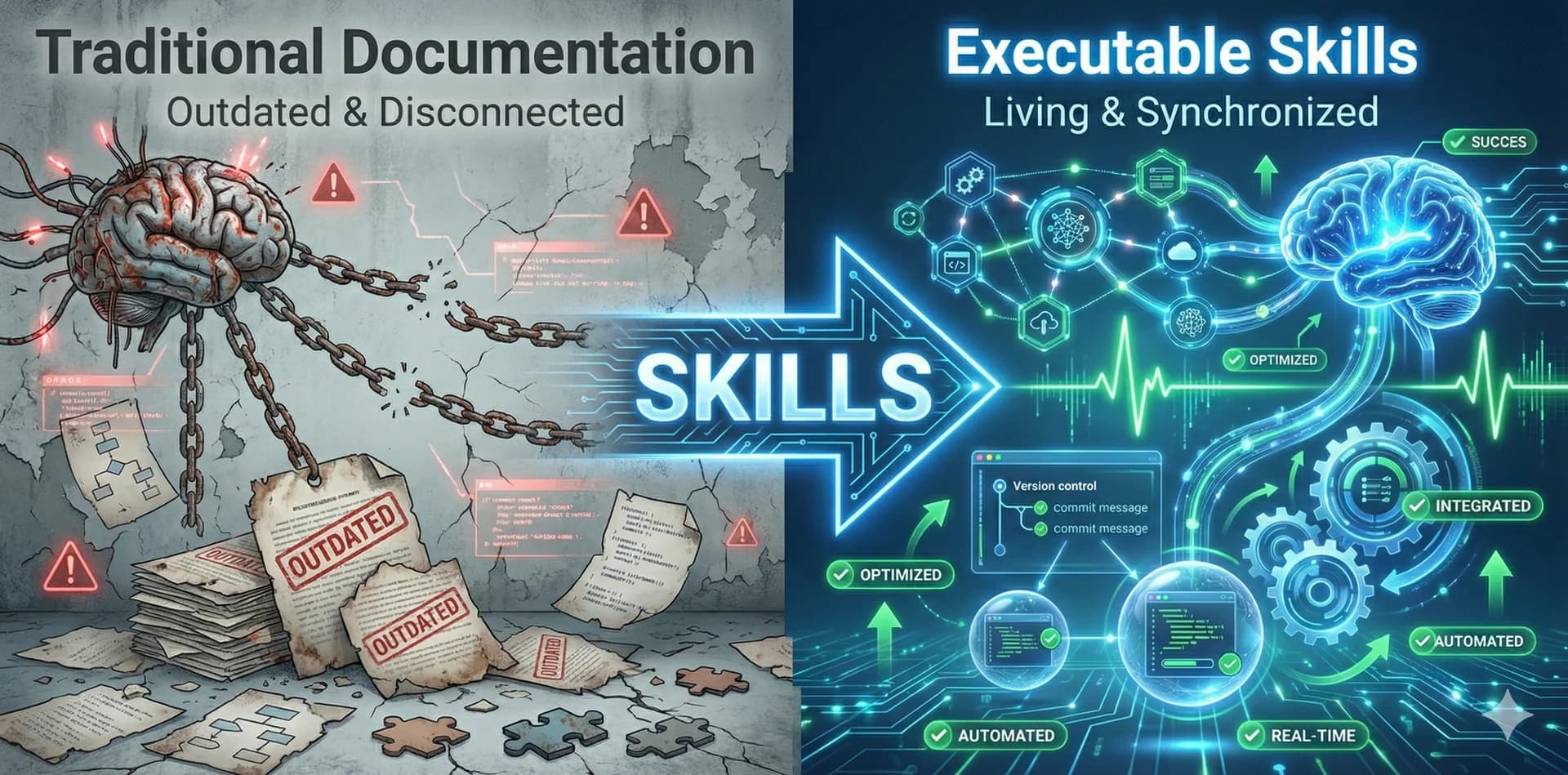
Why traditional documentation fails: the inevitable drift between written instructions and actual implementation, where critical details live only in code and tribal knowledge.
The Anatomy of Production Skills
Patterns that Make Skills Maintainable
Well-designed skills follow consistent patterns that make them maintainable and effective. Understanding these patterns transforms skill creation from guesswork into engineering.
At the root sits SKILL.md, the heart of every skill. This file contains two essential parts. The frontmatter written in YAML defines metadata that determines when and how the skill activates. The body written in markdown provides instructions that the agent follows once triggered.
The frontmatter requires exactly two fields. The name identifies the skill uniquely. The description serves as the primary triggering mechanism, helping the agent understand when to use this skill. This description carries enormous weight. It must explain both what the skill does and when to use it.
Scripts: Deterministic Reliability
The scripts directory contains executable code for tasks requiring deterministic reliability or operations being repeatedly rewritten. This pattern solves a specific problem. When the agent tackles certain tasks from scratch each time, it might produce slightly different implementations, introduce subtle bugs, or waste tokens reconstructing the same logic.
References: Context On Demand
The references directory stores documentation and reference material intended for loading into context only when needed. This implements progressive disclosure for detailed information the agent might require but shouldn't have in memory constantly.
Assets: Output Resources
The assets directory contains files not intended for loading into context but rather used within the output the agent produces. This distinction matters enormously for context efficiency.
The Creation Process
From Understanding to Production
Creating effective skills follows a systematic process refined through building hundreds of skills across different domains. This process works whether you're packaging existing expertise or developing new capabilities.
Understanding Through Examples
Gather specific examples of how the skill will be used. The goal is clarity about the functionality the skill should support.
Plan Reusable Content
Analyze examples and identify what scripts, references, and assets would make repeated execution easier.
Initialize Structure
Create the directory structure, generate SKILL.md templates with proper frontmatter, and establish the foundation.
Implement the Skill
Create identified resources and write SKILL.md. Focus on information that would benefit another AI agent.
Validate
Check YAML frontmatter format, required fields, and naming conventions. Fix any issues and revalidate.
Iterate
Use the skill on actual tasks, notice struggles or inefficiencies, identify improvements, and test again.
Design Principles
Context Efficiency and Appropriate Freedom
Two fundamental principles guide effective skill design: treating context as a public good and setting appropriate degrees of freedom.
Context efficiency recognizes that the agent's attention span is finite and shared. Skills compete with conversation history, other skill metadata, and the user's actual request for this limited resource.
Effective skills minimize their footprint while maximizing their value. This means challenging every piece of information. Does the agent really need this explanation? Does this paragraph justify its token cost? Default to assuming the agent is already very smart. Add only the context it doesn't have.
Appropriate freedom matches the specificity to task characteristics. Different tasks need different levels of constraint:
- High freedomText-based instructions when multiple approaches are valid
- Medium freedomStructured patterns with parameters when preferred approach exists
- Low freedomSpecific scripts when operations are fragile or consistency critical
Think of the agent exploring a path. A narrow bridge with cliffs on both sides needs specific guardrails. You provide exact steps. An open field allows many routes. You provide the destination and principles, letting the agent find its way.
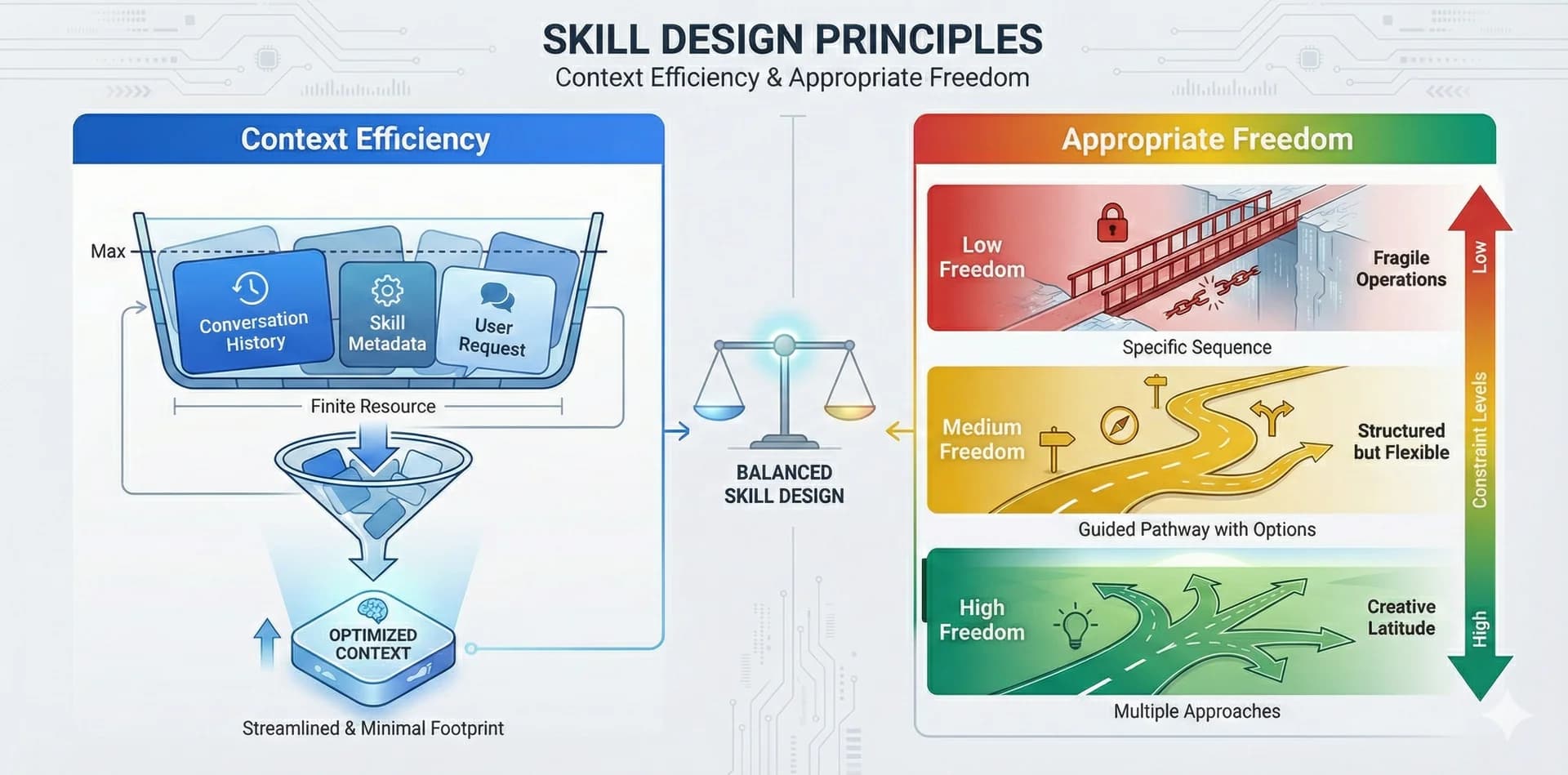
The spectrum of freedom in skill design: from high freedom text instructions to low freedom deterministic scripts.
From Individual Discovery to Collective Capability
The transformation from personal expertise to team asset happens through systematic packaging and distribution. Understanding this transformation reveals why skills succeed where traditional knowledge sharing fails.
Consider the animated image generation workflow. One engineer invested hours discovering that two-step approach, learning which composition constraints produce animation-friendly images, testing parameter combinations, building error handling for API quirks. This knowledge has immense value, but in traditional patterns, it remains isolated.
Packaged as a skill, the transformation is complete. SKILL.md captures the high-level workflow. TypeScript files in scripts handle API interactions with tested error handling. Reference documentation explains the reasoning behind composition choices. The entire package becomes installable, reviewable, and improvable.
Version Control and Collaborative Improvement
Skills gain exponential value through Git-based distribution. Unlike proprietary platforms or custom sharing systems, Git provides a battle-tested infrastructure that teams already trust.
Version control means every change lives in history. You can see when someone modified the workflow, what changed, and why through commit messages. Regressions are easily identified and rolled back. The skill's evolution becomes transparent and auditable.
This distribution pattern creates compounding returns. One person packages a workflow as a skill and shares it. Three teammates install and use it. One identifies an improvement and submits a pull request. The enhanced skill benefits everyone. Another uses it as a template for related workflows, creating a second skill building on established patterns. The library grows organically, each addition informed by previous work.
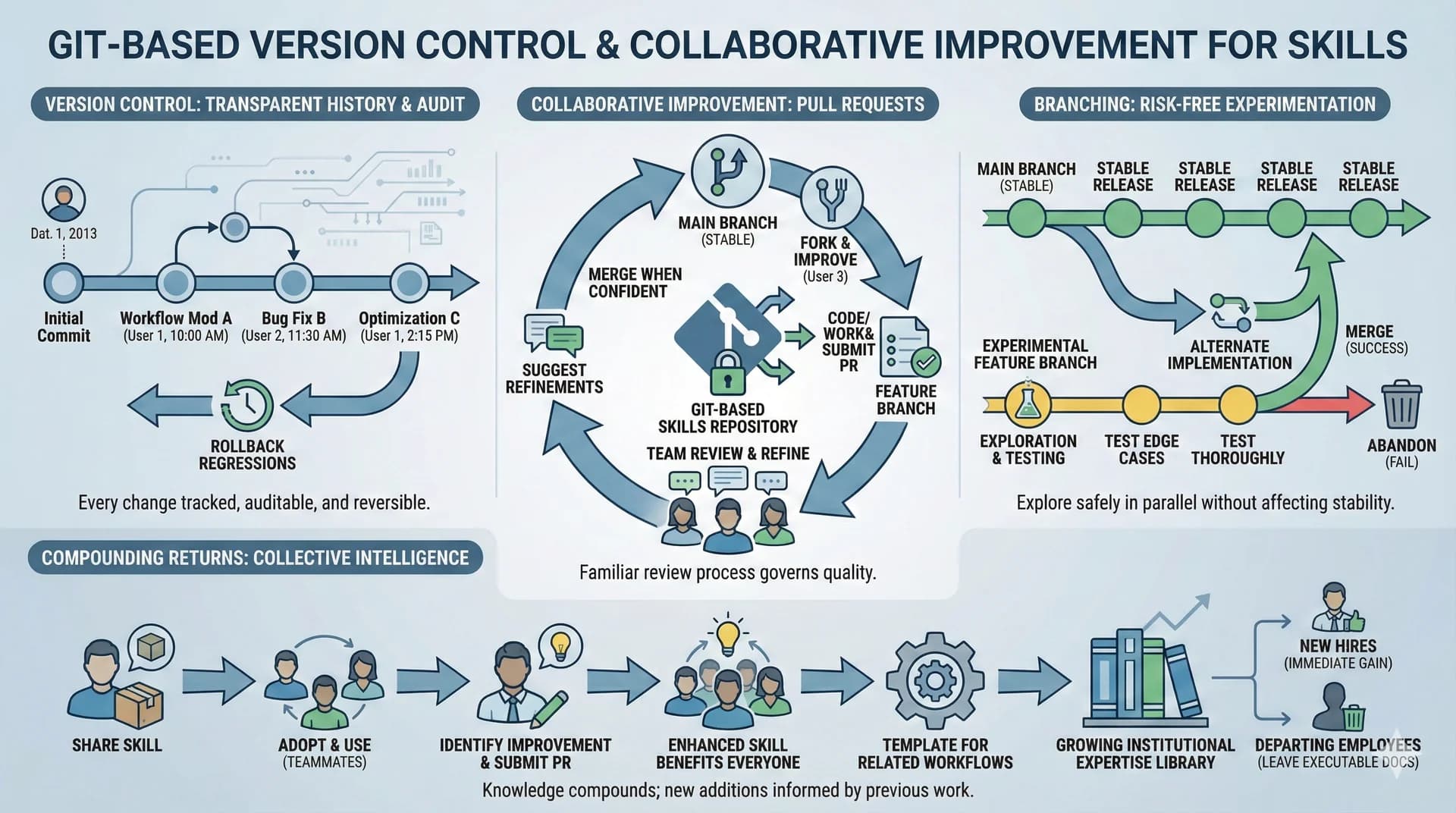
How skills compound through collaborative improvement: from individual creation through pull requests to team-wide benefit.
Security Through Separation
Distributing AI workflows presents immediate security challenges. These workflows require API keys, service credentials, and access tokens. Embedding secrets in skill files makes safe sharing impossible. Even private repositories shouldn't contain production credentials.
Skills solve this through configuration separation following the twelve-factor principles. Store configuration in the environment, not in code. Skills expect credentials as environment variables that each developer configures locally.
This creates clear security boundaries. The skill repository contains executable logic: workflow steps, API interaction code, parameter specifications, and documentation. It contains zero secrets. Anyone can clone the repository, read the code, understand the workflow, and decide whether to use it, all without security concerns.
Team Adoption and Cultural Transformation
The measure of any team tool is organic adoption. Skills prove their value when teammates start using them immediately for real work, solving actual problems, generating real output.
What makes adoption sustainable is exceptionally low barriers to experimentation. Installing a skill takes minutes and requires no commitment. If it doesn't prove useful, removal is equally trivial. This try-before-invest pattern encourages exploration.
Teams develop cultures around skill contribution. Some make skill creation part of onboarding, with new hires packaging workflows they develop as skills, learning the system while contributing value. Others include skill reviews in sprint ceremonies, celebrating new additions and discussing improvements.
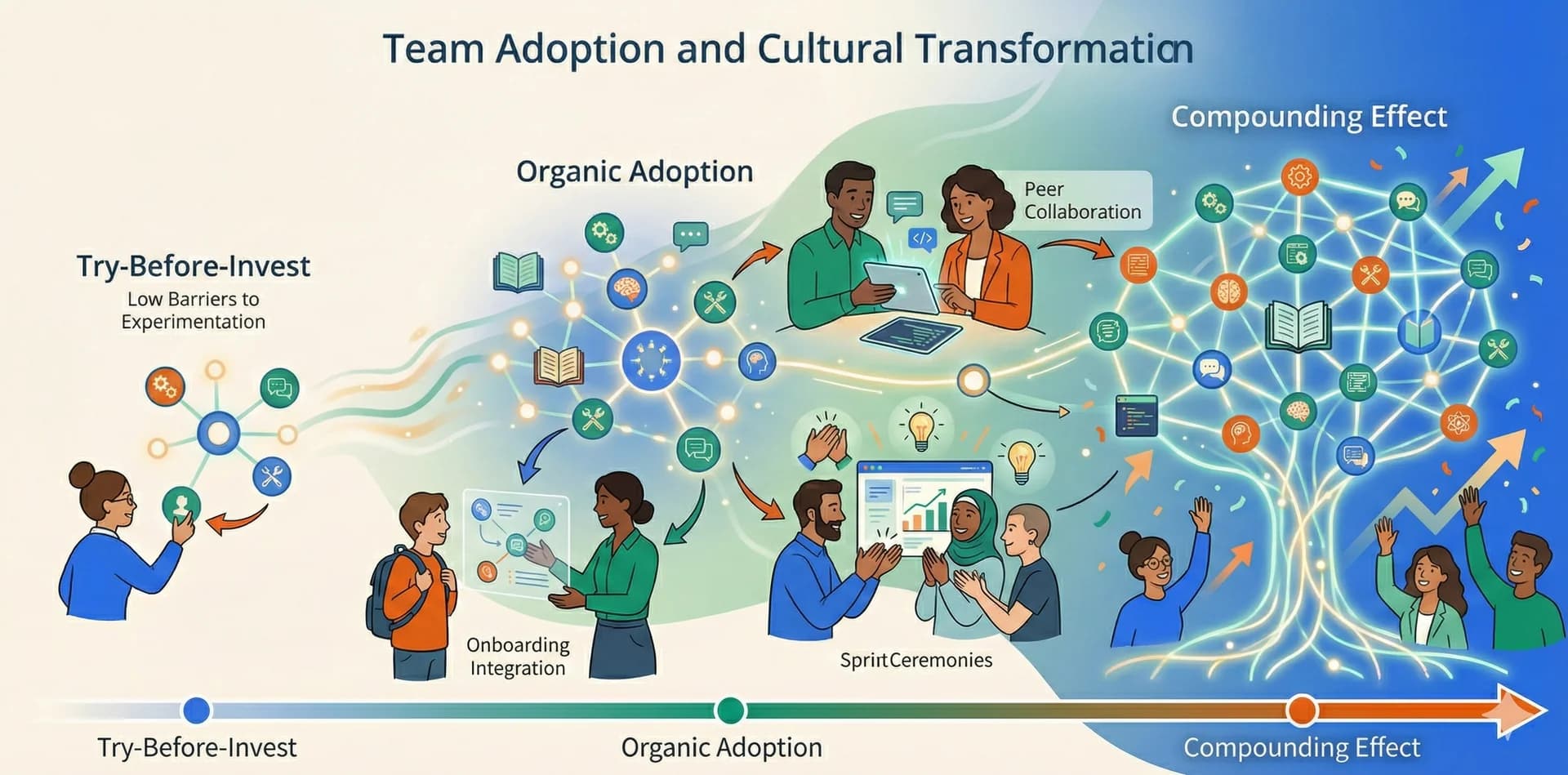
The journey from individual adoption to team culture: how skills transform from novel tools to essential team infrastructure through organic growth and collaborative improvement.
The Executable Documentation Future
Skills represent more than a feature or workflow management technique. They point toward a future where documentation and implementation converge into unified artifacts synchronized by definition.
This convergence solves endemic software development problems. Documentation goes stale when separated from code. Tribal knowledge evaporates when isolated in individual minds. Best practices fail to spread when trapped in inaccessible formats. Skills address all simultaneously by making expertise executable, version-controlled, and shareable through mechanisms teams already trust.
The barrier to entry remains remarkably low. Write clear instructions and basic code, and you can create skills. No specialized knowledge required, no complex frameworks to master, no steep learning curves.
This isn't about better runbooks or smarter documentation practices. It's about fundamentally transforming how teams capture, share, and scale expertise in an AI-augmented world. From tribal knowledge to version-controlled intelligence. From isolated discoveries to collective capabilities. From documentation that decays to specifications that execute.
The question isn't whether your team will adopt executable documentation. It's whether you'll lead that adoption or catch up later.
Share this article
Help others discover this content.
Written by the 10X Team
Building the future of AI-powered workflows. We help teams package their expertise into skills that scale.
Explore our skills libraryReady to Transform Your Workflows?
Explore our library of AI skills and start building more efficient processes today.
Explore Skills