
Three months ago, one engineer on our team spent an entire weekend figuring out how to generate animated images using Google's AI models. The process was frustrating. Direct animation attempts produced inconsistent results. The models seemed unpredictable. Parameters that worked for one image failed for another.
By Sunday evening, a breakthrough arrived. The secret wasn't trying to animate directly. It was a two-step dance: generate a static image with very specific constraints first, then animate that controlled composition. Suddenly, the outputs became consistent, professional, and predictable.
That engineer used this workflow for their project demo. The animated visuals looked incredible. Teammates asked how they did it. The engineer shared a Slack message with some code snippets and parameter suggestions. A few people tried to replicate it. Most got stuck on subtle details. The workflow remained mostly isolated.
Two weeks ago, we ran an internal workshop on something called skills. Not just a demo of the animation workflow, but teaching the entire team how to package discoveries like this into sharable, executable formats. What happened next surprised us.
The Weekend Discovery
Where individual expertise begins
Within days of the workshop, the animation skill was being used across product demos, marketing campaigns, and documentation. More importantly, teammates started packaging their own discoveries. This is the story of that transformation, what we learned about turning individual expertise into team capability, and why this approach worked when traditional documentation failed.
💡The Animation Breakthrough
The Problem We All Recognized
Knowledge trapped in isolation
Every team meeting revealed the same pattern. Someone would mention solving a tricky problem. Others would say “Oh, I dealt with that last month” or “I wrote a script for that.” The knowledge existed. It just lived in isolated pockets across the team.
Our wiki contained dozens of outdated guides. README files described workflows that no longer matched actual implementations. Slack searches returned fragments of solutions scattered across channels and direct messages. The critical details—the ones that make workflows actually work—existed only in the minds of whoever figured them out originally.
Dozens
Outdated wiki guides
Scattered
Solutions in Slack
Lost
Expertise on departure
When people left the team, their expertise vanished with them. New hires spent weeks rediscovering solutions to problems the team had already solved. Even experienced members often worked around knowledge gaps rather than asking who knew how to do something, simply because they didn't know what they didn't know.
The animated image workflow exemplified this perfectly. One person had cracked it. The solution involved non-obvious insights: why minimalist composition matters for animation, which color palette constraints prevent artifacts, and how to structure API calls to handle rate limits. None of this was documented anywhere.
Why Skills Made Sense
Documentation that can't drift
Skills appealed to us for a specific reason: they're both human-readable and machine-executable. The same markdown file that explains a workflow to a teammate is exactly what the AI agent reads to execute it. Documentation and implementation can't drift apart because they're literally the same artifact.
Traditional Documentation
- •Translates code into prose
- •Drifts from implementation
- •Misses edge cases
- •Goes stale quickly
Skills
- •Human-readable AND executable
- •Same artifact for both
- •Version controlled
- •Improves through use
The files organize naturally. Scripts contain code that should execute deterministically. References hold documentation that loads only when needed. Assets store templates and resources used in outputs. This structure feels familiar to developers while serving a specific purpose for AI workflows.
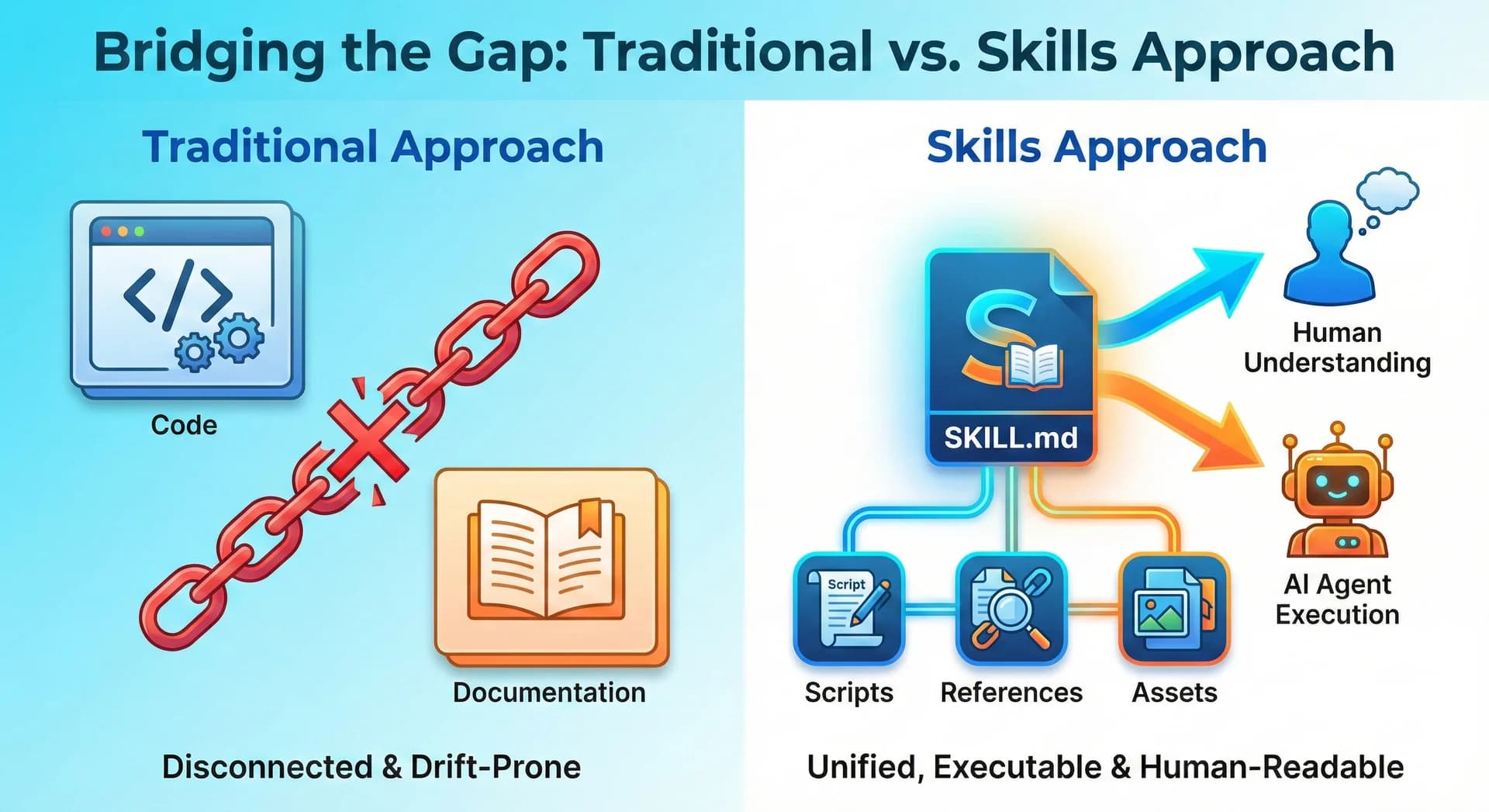
The journey from isolated expertise to collective capability: skills provide both human-readable documentation and machine-executable instructions in a single artifact that can't drift apart.
The Workshop Experience
Two hours that changed everything
Twenty-three teammates joined the workshop. Some were curious about skills in general. Others specifically wanted to use the animation workflow. A few had workflows of their own they were considering packaging.
Workshop Flow
Opening Question
'Who's figured out a complex workflow in the past three months that you wish other people could easily use?' Nearly everyone raised their hand.
Live Demonstration
Showed the animation workflow in action. Not just the final result, but the journey from inconsistent outputs to reliable, professional animations.
Deep Dive Q&A
Why does minimalist style help? Why center the composition? Why limit colors? Each insight came from experimentation, not documentation.
Hands-On Creation
Walked through creating a simplified skill together. Someone suggested a PDF workflow. We built it in fifteen minutes.
The key moment came when someone who didn't create the animation skill installed and used it successfully. They described the image they wanted. The skill guided the agent through generation with appropriate constraints. They received professional results. No knowledge transfer needed beyond skill installation. The workflow just worked.
Beyond the Animation Skill
Four new skills in two weeks
The workshop's bigger impact was teammates recognizing workflows they could package. Within two weeks, the team had created four new skills beyond the animation example.
Data Export Processor
Customer success needed specific data formats extracted from various sources. Packaged transformations, conversions, and validation steps.
Customer SuccessCompliance Report Generator
Pulls data from multiple systems, applies formatting rules, checks completeness, produces reports matching regulatory requirements.
Compliance TeamBrand Asset Applier
Knows where assets live, which versions to use, typography rules, and available templates. Makes branded outputs accessible to everyone.
Design TeamBigQuery Analysis Pattern
Table relationships, specific filters, aggregation methods, and output formatting. Other analysts can now run these analyses without rediscovering the technique.
Data AnalyticsEach new skill followed patterns established in the workshop. Clear SKILL.md explaining the workflow. Supporting code in scripts for deterministic operations. Reference documentation for detailed knowledge. The structure felt consistent even though workflows varied dramatically.
Cultural Shifts We Noticed
Beyond just having more skills
The workshop created cultural changes beyond just having more skills. Teammates started thinking differently about knowledge sharing. When someone figured out a complex workflow, the question shifted from “Should I document this?” to “Should I package this as a skill?”
🔍Code Reviews Evolved
When someone built particularly clever workflow logic, reviewers would ask “Could this be a skill?” Not everything should be, but the question made sense to ask.
🎓Onboarding Transformed
Install the team's skills, and you gain access to workflows that previously required tribal knowledge transfer. Senior team members noticed new hires becoming productive faster.
👤Departures Feel Different
When people left, they left behind not just code but packaged expertise. Their discoveries persisted as executable workflows. The knowledge loss that usually accompanies turnover diminished significantly.
The skills library became a form of team documentation that actually stayed current. When workflows changed, skills changed with them because they were the workflows. The traditional problem of stale documentation simply didn't apply.
What Made This Work
Transferable lessons for other teams
Reflecting on why the workshop succeeded reveals transferable lessons for other teams considering similar approaches.
Concrete Example
Started with a real problem the team faced. Animated image workflow provided tangible value.
Complete Journey
Showed the evolution, not just the result. Teammates saw the process as achievable.
Accessible Creation
If you can write clear instructions and basic code, you can create skills. No specialized knowledge.
Familiar Tools
GitHub for version control. Pull requests for improvements. Standard patterns teammates already trusted.
Immediate Value
Two-hour investment paid dividends that same week. Quick demonstration justified the time.
Concise Support
Provided written guides for skill creation patterns. Not overwhelming, just reference material.
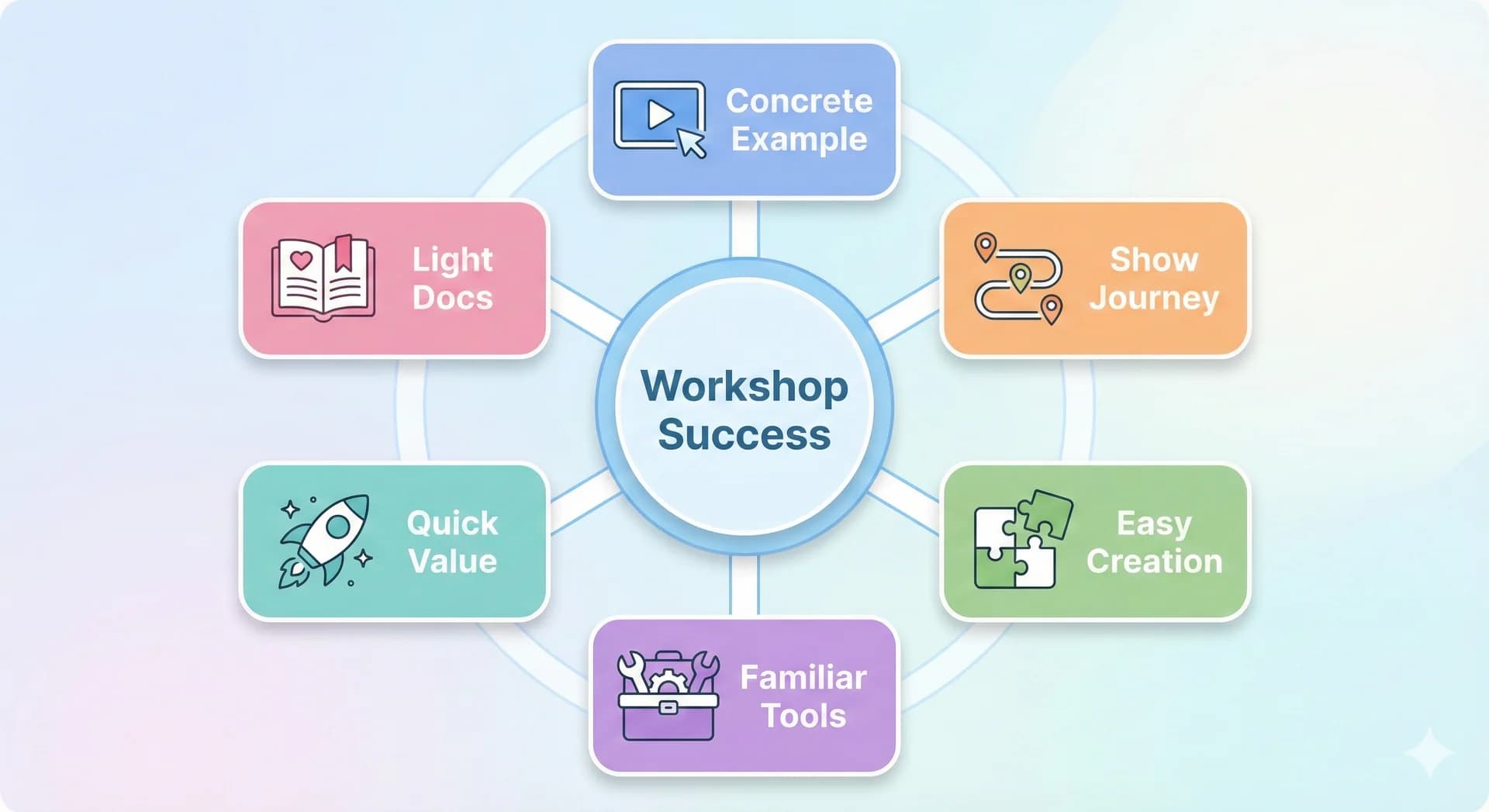
Organic adoption across a 23-person engineering team: exponential growth, active contributors, and self-sustaining improvement cycles powered by concrete examples and immediate value.
Challenges We Encountered
Honest reflection on difficulties
Not everything went smoothly. Understanding challenges helps other teams plan similar approaches.
⚠Conceptual confusion
Resolution: Some teammates initially confused skills with traditional documentation. Demonstrating actual execution helped clarify.
⚠When to create skills
Resolution: Developed heuristics: if three people would benefit, if workflow has non-obvious complexity, if maintaining consistency matters.
⚠Quality variation
Resolution: Early skills varied in polish. Addressed through gentle code review feedback and establishing patterns through example.
⚠Security concerns
Resolution: Some teammates wanted to include API keys. Reinforced environment variable patterns and explained why secrets must stay local.
⚠Uneven adoption
Resolution: Not everyone created skills. Decided this was fine—value comes from both creation and usage. Not everyone needs to be a creator.
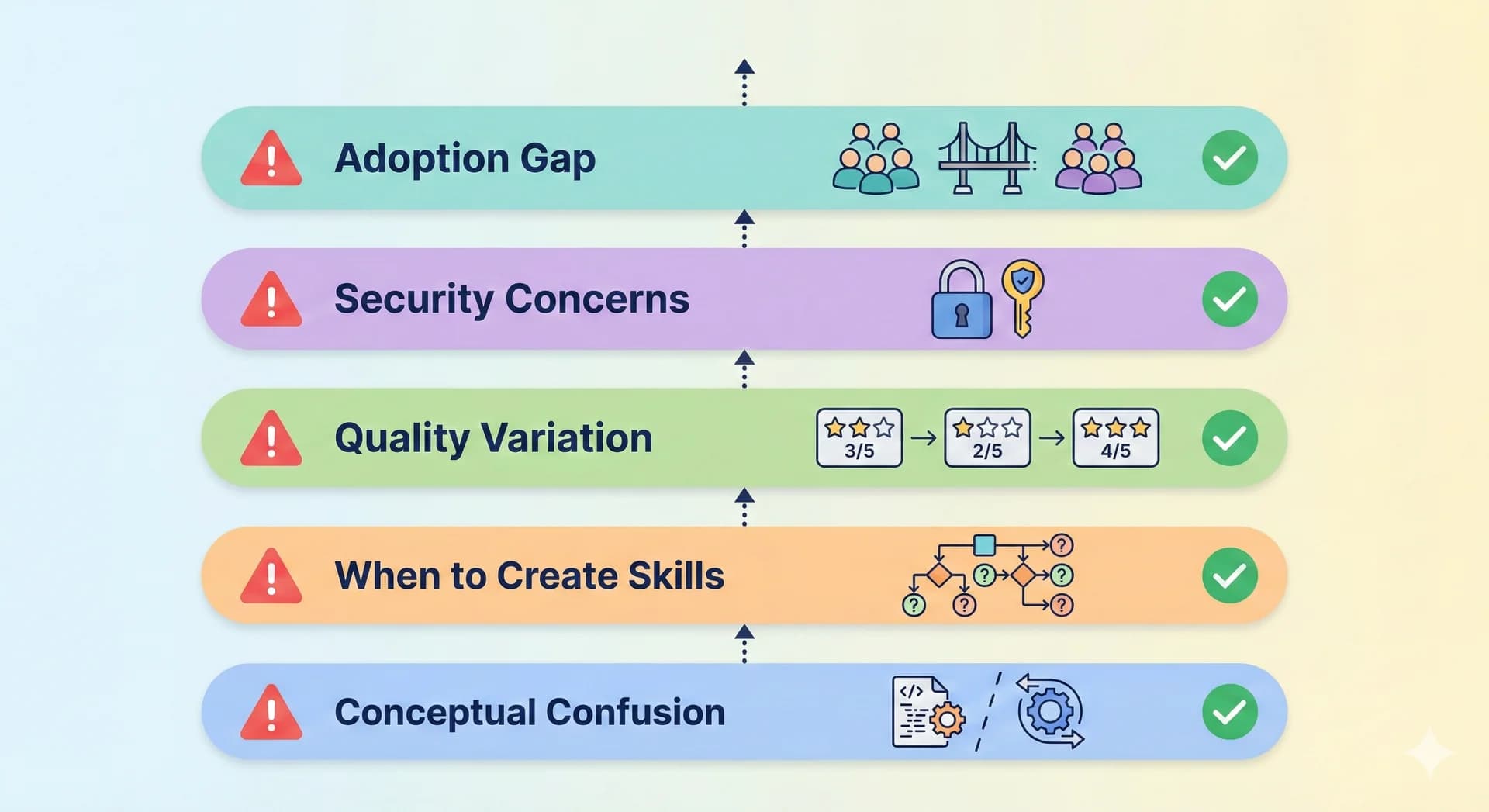
Honest reflection on challenges: from conceptual confusion to quality variation, each obstacle provided learning opportunities that strengthened the team's approach to skill creation.
The Learnings
Practical guidance for your team
Teams considering similar workshops can benefit from what we learned:
Start with one compelling example that solves a real problem your team faces
Make the workshop hands-on—walk through creating a skill together
Provide clear patterns, but don't over-prescribe
Address security explicitly with environment variable patterns
Plan for ongoing support: Slack channel, reference guides, code review help
Start small with adoption expectations
Be patient with cultural change
From Workshop Event to Team Culture
The compounding effects
The workshop was three months ago, but its effects continue compounding. The skills library grows. Quality improves through iteration. More teammates contribute. Knowledge sharing feels more natural and effective than ever.
The animated image skill that started everything has evolved through community contributions. It now handles more use cases, produces better quality, and includes documentation refined through actual usage. No single person could have made it this good alone. Collective improvement made the difference.
Most satisfying is seeing knowledge sharing transform from an occasional occurrence to a cultural norm. When expertise emerges, someone packages it. When skills exist, people use them. When improvements are possible, teammates contribute. The virtuous cycle sustains itself.
Teams wondering whether to invest in similar training should consider what percentage of their expertise remains isolated in individual minds. If the answer is significant, the investment makes sense. Two hours to change how knowledge transfers yields enormous returns.
The Fundamental Insight
Expertise wants to be shared. The barrier isn't willingness; it's having good mechanisms.
From one engineer's weekend discovery
to team capability used across dozens of projects.
That's the power of making knowledge executable.
Share this article
Help others discover this content.
Written by the 10X Team
Building the future of AI-powered workflows. We help teams package their expertise into skills that scale.
Explore our skills libraryReady to Transform Your Workflows?
Explore our library of AI skills and start building more efficient processes today.
Explore Skills