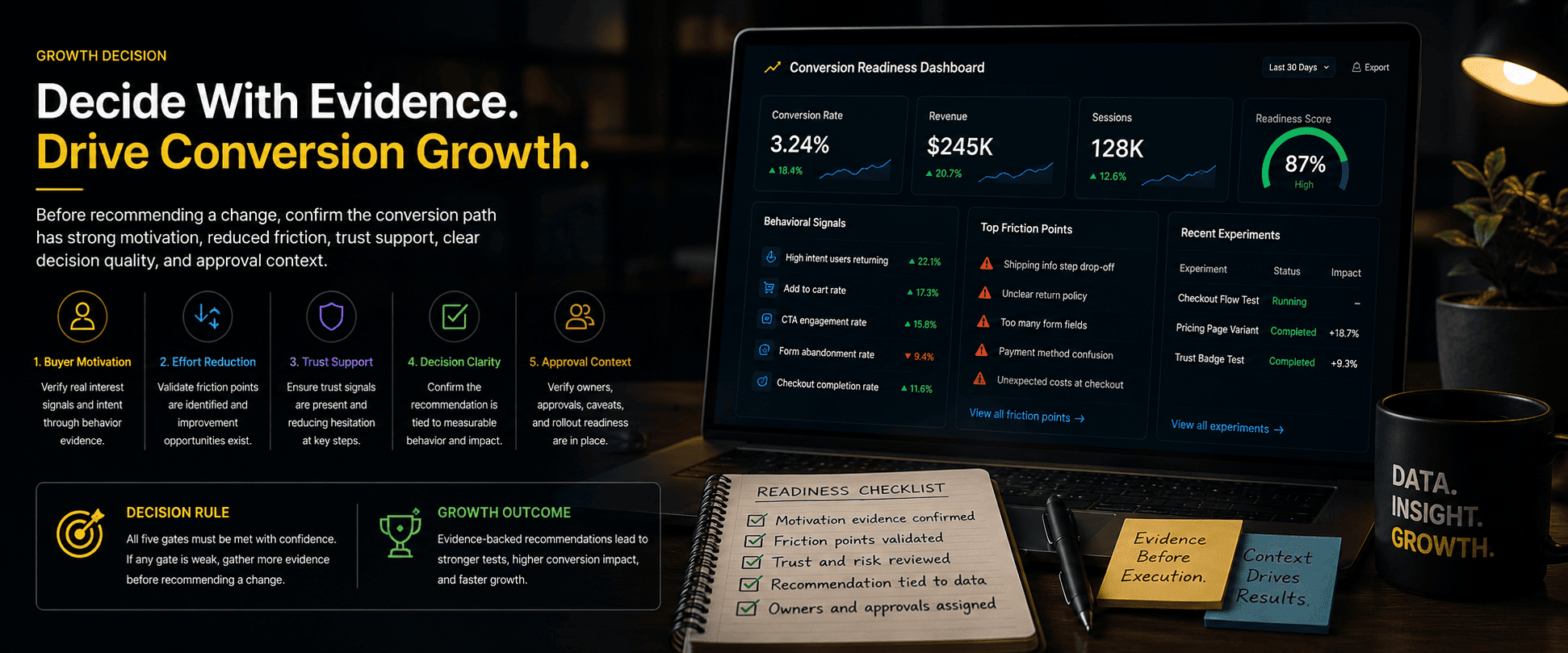
Behavioral Conversion Readiness Checklist
Behavioral data can make conversion opportunities look obvious. A page gets more repeat visits, a CTA receives more clicks, users scroll deeper, or checkout starts increase. Those signals may matter, but they do not automatically prove that a page, offer, or experiment should change. Buyer behavior must be reviewed with motivation, effort, trust, decision quality, measurement confidence, and approval context before it becomes a recommendation.
The Behavioral Conversion Readiness Checklist helps conversion leads decide whether a recommendation is ready, should be held, or needs more evidence. The checklist keeps the team from treating surface activity as proof. It asks whether the buyer has a visible reason to act now, whether the path removes unnecessary effort, whether trust risk is addressed, and whether the proposed action has an owner and execution boundary.
The goal is not to recommend more changes. The goal is to recommend the right change when the evidence is strong enough.
What This Checklist Decides
The checklist answers one practical question: does the conversion path have enough buyer motivation, effort reduction, trust support, decision clarity, and approval context to justify a change? A pass means the recommendation is tied to visible behavior and downstream evidence. A hold means the caveat could change the action.
- Approve: Motivation, friction, trust, conversion quality, and ownership support the proposed change.
- Hold: One or more readiness gates are weak enough to change the recommendation.
- Send back for evidence: The team needs stronger analytics, session notes, customer research, experiment notes, or approval review.
- Re-scope: The issue is an operating, measurement, or revenue-quality problem rather than a page or message problem.
Confirm Buyer Motivation
The first gate is motivation readiness. Before recommending a conversion change, the reviewer should confirm that the target buyer has a visible reason to take the requested action now. Motivation can appear in repeated visits, qualified traffic, product engagement, offer interaction, return behavior, or buyer language from research and sales calls.
If the motivation source is missing or does not match the action, hold the recommendation and request sharper buyer evidence.
- Does Google Analytics show qualified traffic reaching the conversion path?
- Do product analytics show meaningful in-product or on-page behavior?
- Do session notes show buyers trying to solve a real problem?
- Do sales call notes confirm urgency, objection, or decision language?
- Does the motivation match the action being recommended?
Review Effort And Friction
Interested buyers can still fail to convert when the path creates unnecessary effort. The checklist should review whether the experience removes confusion, extra steps, support gaps, and unclear next actions for buyers who are already motivated.
Friction evidence is strongest when analytics, session notes, and research point to the same barrier. If the issue is not repeatable, the recommendation should remain caveated.
- Are users looping between sections or pages?
- Do heatmaps show hesitation near forms, pricing, or CTAs?
- Do session recordings show repeated clicks, field errors, or checkout exits?
- Is the page asking for action before explaining process or value?
- Does the recommendation solve the exact friction observed?
Check Trust Risk And Belief Gaps
Conversion depends on emotional and logical belief. A page may create curiosity, but buyers still need proof, credibility, price context, process clarity, and risk reduction before taking action. The reviewer should name the risk the buyer perceives and confirm that the page addresses it.
If the buyer has not been given enough proof, process, or next-step clarity, do not recommend more traffic as the first fix. The stronger recommendation may be a message, proof, or trust review.
- Does the page explain the promise, problem, pain, proof, and process?
- Are reviews, guarantees, examples, or credibility cues visible where buyers need them?
- Do customer research notes reveal unresolved objections?
- Does pricing or effort framing make the decision easier?
- Would more traffic scale confusion instead of conversion?
Separate Operating Leaks From Funnel Leaks
A weak conversion path is not always a page problem. Sometimes the issue is operational: no follow-up, no promotion, weak delivery, unclear lead routing, or no owner. The checklist should separate a funnel leak from an operating leak before recommending copy, layout, or offer changes.
If the operating owner or follow-up path is unclear, mark the recommendation as a process fix before a creative fix. Fixing the page will not solve a broken handoff.
- Is the post-conversion path working?
- Does lead flow reach the right owner?
- Is follow-up happening on time?
- Does delivery quality match the promise?
- Is customer-result feedback visible?
Validate Conversion And Revenue Quality
Not every tracked event should drive a recommendation. The reviewer should separate decision-driving conversions from diagnostic events and caveated attribution signals. A video start, scroll, or button click can help explain behavior, but it should not be treated like purchase intent unless downstream outcomes support it.
When conversion quality is unknown, keep the recommendation caveated until the downstream source is reviewed.
- Does the tracked conversion match the business decision?
- Can the event connect to lead quality, order quality, or revenue movement?
- Is commerce or payment context available when the recommendation references payback?
- Are attribution caveats visible?
- Does the recommendation rely on a diagnostic event instead of a decision-driving outcome?
Attach Approval Boundaries
Every behavioral conversion recommendation should have a reviewer, evidence label, hold condition, and execution boundary before it becomes an implementation task. This prevents follow-up from moving forward before the reviewer accepts the approval rule.
- Name the evidence source supporting the recommendation.
- Document the caveat that could change the action.
- Assign the owner for testing, implementation, or research follow-up.
- State what stays held if approval is not granted.
- Keep 10X recommendations reviewable and approval-gated.
Final Decision Rule
The Behavioral Conversion Readiness Checklist should end with a clear approve, hold, send-back, or re-scope decision. Approve the recommendation only when motivation, effort reduction, trust support, conversion quality, and ownership all support the next action.
If multiple gates fail, address them in dependency order: operating failures before message friction, message friction before motivation or effort. A process gap can invalidate creative recommendations, so fix the evidence layer before changing the page, offer, or experiment path.
Message friction and belief gaps
Evidence to review: Promise, problem, pain, proof, process, price or effort concern, objection coverage, and call-to-action clarity.
- Review whether the page builds enough emotional and logical belief before it asks for action.
- If the buyer has not been given enough proof, process, or next-step clarity, do not recommend more traffic as the first fix.
- Message friction and belief gaps is supported by visible inputs and the caveat is clear.
Operating failure modes
Evidence to review: Implementation status, lead flow, delivery quality, follow-up owner, and customer-result feedback.
- Separate a funnel leak from an operating leak, such as no follow-up, no promotion, weak delivery, or no owner.
- If the operating owner or follow-up path is unclear, mark the recommendation as a process fix before a creative fix.
- Operating failure modes is supported by visible inputs and the caveat is clear.
Commerce and revenue quality
Evidence to review: Product performance, order quality, payment signal, cash timing, and margin or payback caveat.
- Connect campaign or funnel movement with commerce and payment context before judging quality.
- If revenue quality or cash timing is missing, avoid turning source movement into a payback conclusion.
- Commerce and revenue quality is supported by visible inputs and the caveat is clear.
Conversion quality and measurement confidence
Evidence to review: Conversion action, diagnostic event, downstream quality source, attribution caveat, and value signal.
- Separate decision-driving conversions from diagnostic events and caveated attribution signals.
- If conversion quality is unknown, keep the recommendation caveated until the downstream source is reviewed.
- Conversion quality and measurement confidence is supported by visible inputs and the caveat is clear.
Motivation readiness
Evidence to review: Buyer intent source, action requested, motivation signal, offer context, and confidence caveat.
- Confirm the target buyer has a visible reason to take the requested action now.
- If the motivation source is missing or does not match the action, hold the recommendation and request sharper buyer evidence.
- Motivation readiness is supported by visible inputs and the caveat is clear.
Sample review note
10X should review Behavioral Conversion Readiness Checklist, compare the decision evidence with the caveats, and keep the next recommendation approval-gated until the reviewer accepts it.