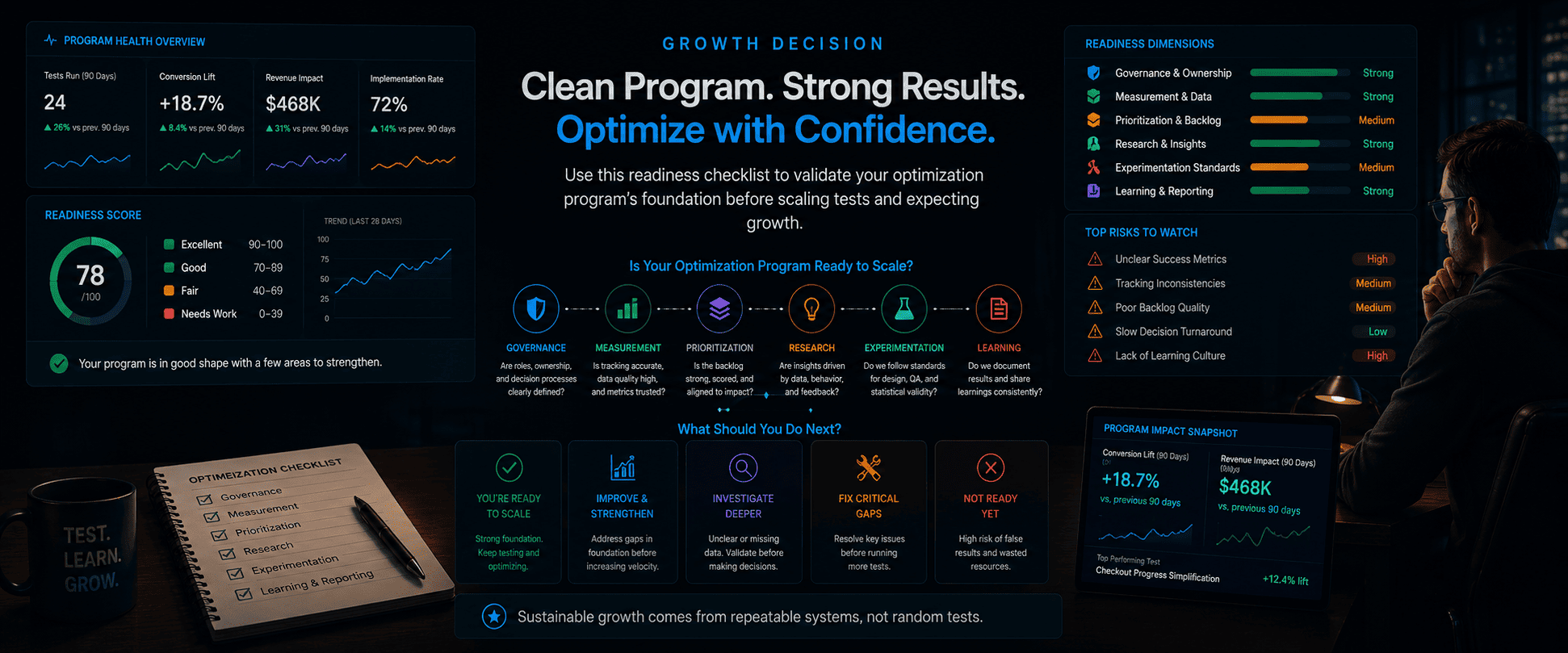
Optimization Program Hygiene Readiness Checklist
Conversion optimization programs often fail because of operational issues rather than testing quality. Teams may have strong ideas, capable analysts, and sufficient traffic, but poor governance, inconsistent tracking, unclear ownership, and weak prioritization can prevent meaningful progress. An Optimization Program Hygiene Readiness Checklist helps determine whether the foundation of the optimization program is strong enough to support reliable experimentation and decision-making.
The objective is not to evaluate a single experiment. The objective is to assess whether the broader optimization process can consistently produce trustworthy results, actionable insights, and measurable business impact.
Governance and Ownership
Clear owner exists for the optimization program. Roles and responsibilities are documented. Decision approval process is defined. Experiment launch authority is established. Stakeholders understand success criteria. Testing priorities align with business goals.
- Clear owner exists for the optimization program.
- Roles and responsibilities are documented.
- Decision approval process is defined.
- Experiment launch authority is established.
- Stakeholders understand success criteria.
- Testing priorities align with business goals.
Measurement Readiness
Primary conversion metrics are documented. Secondary metrics are defined. Analytics tracking is validated. Tag management implementation is audited. Attribution rules are understood. Data quality monitoring is active.
- Primary conversion metrics are documented.
- Secondary metrics are defined.
- Analytics tracking is validated.
- Tag management implementation is audited.
- Attribution rules are understood.
- Data quality monitoring is active.
Experiment Backlog Quality
Testing opportunities are prioritized consistently. Hypotheses are documented before launch. Research supports experiment ideas. Business impact estimates exist. Duplicate tests are prevented. Backlog review process is maintained.
- Testing opportunities are prioritized consistently.
- Hypotheses are documented before launch.
- Research supports experiment ideas.
- Business impact estimates exist.
- Duplicate tests are prevented.
- Backlog review process is maintained.
Research and Insight Collection
User behavior data is reviewed regularly. Funnel analysis is available. Customer feedback is collected. Session recordings are reviewed. Heatmap analysis is available. Insights are documented centrally.
- User behavior data is reviewed regularly.
- Funnel analysis is available.
- Customer feedback is collected.
- Session recordings are reviewed.
- Heatmap analysis is available.
- Insights are documented centrally.
Experiment Design Standards
Control and variation definitions are clear. Success metrics are established before launch. Sample size requirements are calculated. Segmentation plans are documented. QA procedures are defined. Decision rules are agreed upon.
- Control and variation definitions are clear.
- Success metrics are established before launch.
- Sample size requirements are calculated.
- Segmentation plans are documented.
- QA procedures are defined.
- Decision rules are agreed upon.
Implementation Readiness
Development resources are available. Design resources are available. Launch checklists are maintained. Rollback procedures exist. Change logs are recorded. Technical dependencies are understood.
- Development resources are available.
- Design resources are available.
- Launch checklists are maintained.
- Rollback procedures exist.
- Change logs are recorded.
- Technical dependencies are understood.
Reporting and Documentation
Experiment results are archived. Wins, losses, and inconclusive tests are documented. Learning repository is maintained. Reporting templates are standardized. Stakeholder updates are scheduled. Historical results are searchable.
- Experiment results are archived.
- Wins, losses, and inconclusive tests are documented.
- Learning repository is maintained.
- Reporting templates are standardized.
- Stakeholder updates are scheduled.
- Historical results are searchable.
Program Health Indicators
Testing velocity is measured. Implementation rate is tracked. Decision turnaround time is monitored. Experiment quality reviews occur regularly. Resource bottlenecks are identified. Program impact is measured against business outcomes.
- Testing velocity is measured.
- Implementation rate is tracked.
- Decision turnaround time is monitored.
- Experiment quality reviews occur regularly.
- Resource bottlenecks are identified.
- Program impact is measured against business outcomes.
Final Readiness Assessment
The optimization program should be considered ready when ownership, measurement, governance, prioritization, experimentation standards, and reporting processes are consistently maintained. If multiple checklist areas fail validation, teams should improve operational hygiene before increasing testing volume. Strong optimization programs are built on reliable processes, not just successful experiments.
Conversion quality and measurement confidence
Evidence to review: Conversion action, diagnostic event, downstream quality source, attribution caveat, and value signal.
- Separate decision-driving conversions from diagnostic events and caveated attribution signals.
- If conversion quality is unknown, keep the recommendation caveated until the downstream source is reviewed.
- Conversion quality and measurement confidence is supported by visible inputs and the caveat is clear.
Operating failure modes
Evidence to review: Implementation status, lead flow, delivery quality, follow-up owner, and customer-result feedback.
- Separate a funnel leak from an operating leak, such as no follow-up, no promotion, weak delivery, or no owner.
- If the operating owner or follow-up path is unclear, mark the recommendation as a process fix before a creative fix.
- Operating failure modes is supported by visible inputs and the caveat is clear.
Tracking and goal hygiene
Evidence to review: Primary event, secondary diagnostic events, value metric, goal tree owner, data-quality caveat, and last validation date.
- Verify that primary and diagnostic events still measure the decision the team wants to make.
- If the goal tree or event quality is unclear, hold the recommendation until measurement ownership is confirmed.
- Tracking and goal hygiene is supported by visible inputs and the caveat is clear.
Backlog balance
Evidence to review: Quick wins, learning tests, strategic bets, expected lift range, effort estimate, and owner capacity.
- Confirm the backlog contains a deliberate mix of low-risk fixes, learning tests, and larger opportunities.
- If the backlog is not balanced, reclassify candidate tests before approving the next item.
- Backlog balance is supported by visible inputs and the caveat is clear.
Risk and sample control
Evidence to review: Traffic level, risk class, retest threshold, non-inferiority rule, minimum sample caveat, and rollback owner.
- Check whether the test can be interpreted safely given traffic, risk, and sample limitations.
- If sample, traffic, or risk control is weak, keep the recommendation in review mode and name the next evidence needed.
- Risk and sample control is supported by visible inputs and the caveat is clear.
Sample review note
10X should review Optimization Program Hygiene Readiness Checklist, compare the decision evidence with the caveats, and keep the next recommendation approval-gated until the reviewer accepts it.