When to use it
A product or growth team has a conversion surface with multiple prompts, proof elements, descriptions, support cues, and next-step nudges; the reviewer needs to decide which cues help the action and which need evidence or approval.
Diagnostic Workflow
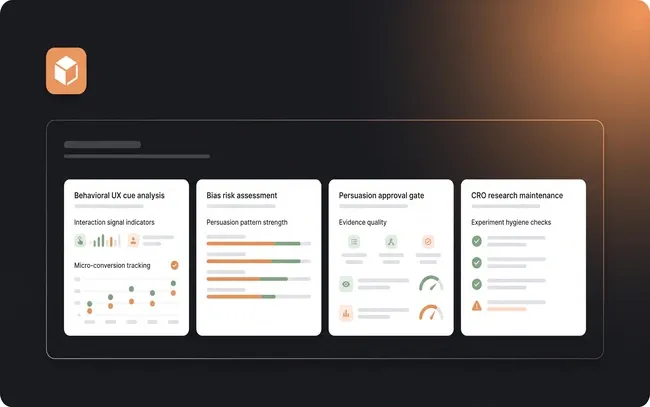
A structured review workflow for evaluating whether conversion UI cues support intended buyer actions through source credibility, description clarity, motivation, efficacy, trust, and reinforcement.

Decision frame
Review whether conversion UI cues support the intended action through source credibility, description clarity, motivation, efficacy, trust, and reinforcement without overclaiming causality.
A product or growth team has a conversion surface with multiple prompts, proof elements, descriptions, support cues, and next-step nudges; the reviewer needs to decide which cues help the action and which need evidence or approval.
10X should review Behavioral Conversion UX Cue Review, compare the decision evidence with the caveats, and keep the next recommendation approval-gated until the reviewer accepts it.
A product or growth team has a conversion surface with multiple prompts, proof elements, descriptions, support cues, and next-step nudges; the reviewer needs to decide which cues help the action and which need evidence or approval.
Decision: Review whether conversion UI cues support the intended action through source credibility, description clarity, motivation, efficacy, trust, and reinforcement without overclaiming causality.
10X should review Behavioral Conversion UX Cue Review, compare the decision evidence with the caveats, and keep the next recommendation approval-gated until the reviewer accepts it.
| Check | Action | Signal |
|---|---|---|
| Review whether the page builds enough emotional and logical belief before it asks for action. | If the buyer has not been given enough proof, process, or next-step clarity, do not recommend more traffic as the first fix. | Message friction and belief gaps |
| Connect campaign or funnel movement with commerce and payment context before judging quality. | If revenue quality or cash timing is missing, avoid turning source movement into a payback conclusion. | Commerce and revenue quality |
| Separate observed inputs from assumptions before treating a scenario as decision evidence. | If the model is sensitive to an assumed number, keep the recommendation as a scenario until the source is verified. | Funnel math and scenario quality |
| Map each cue to the specific behavior it is supposed to support before calling it a conversion improvement. | If the cue purpose is unclear, keep the cue as a hypothesis and do not approve implementation. | Cue purpose fit |
| Check whether the interface makes the next step understandable and makes the buyer feel capable of completing it. | If the buyer may not understand or feel able to complete the action, fix clarity and support before adding persuasion. | Description and efficacy support |
| Review whether trust cues and reinforcement reduce risk after the buyer chooses the next step. | If trust or reinforcement is missing at the risk point, hold conversion claims until the cue is reviewed. | Trust and reinforcement cues |
For Behavioral Conversion UX Cue Review, this prevents a false-ready read: Some conversion problems are not page problems; they are execution problems around action, marketing cadence, delivery, or follow-up. The reviewer should hold the action when the operating owner or follow-up path is unclear, mark the recommendation as a process fix before a creative fix.
For Behavioral Conversion UX Cue Review, this prevents a false-ready read: A funnel leak can be a belief problem rather than a traffic problem; the page may create curiosity without resolving trust, fit, or effort objections. The reviewer should hold the action when the buyer has not been given enough proof, process, or next-step clarity, do not recommend more traffic as the first fix.
For Behavioral Conversion UX Cue Review, this prevents a false-ready read: Revenue-informed analysis should distinguish sales activity, cash timing, and durable customer quality. The reviewer should hold the action when revenue quality or cash timing is missing, avoid turning source movement into a payback conclusion.
For Behavioral Conversion UX Cue Review, the reviewer should approve only the next step tied to message friction and belief gaps. If the required evidence for message friction and belief gaps is not visible, the output should be a hold note.
No. For Behavioral Conversion UX Cue Review, 10X can draft the recommendation or follow-up, but execution stays approval-gated.
Need a second opinion?
Ask your favorite AI to review this 10X page, or send the question to our team.