How to verify prospect list specificity for interpretable results
An outreach campaign that generates high acceptance rates but produces zero booked calls can look like a message or offer problem when it is actually a list problem. The reviewer should verify that the prospect list is specific enough to make both acceptance rate and response quality interpretable. A list built on a broad LinkedIn search for marketing directors followed by a filter for company size produces a pool of prospects who share almost nothing beyond a job title. The campaign can't diagnose if message works for a specific segment because the segment is too broad to generate a pattern. The reviewer should check if list uses enough filters to create segment-level interpretability: industry, company stage, known pain point, visible trigger event, and relationship distance from sender.
The reviewer should also verify that the list is stable before judging any other metric. A list that changes composition between weekly sends because new prospects are added from a different search query or a different filter creates a moving baseline where the acceptance rate reflects list composition changes, not message quality changes. The reviewer should freeze the list definition for review period and verify that same filter logic has been applied consistently. If the segment isn't stable, the reviewer should refine the list before rewriting the offer, changing the message, or increasing volume. A list that can't be described in terms that would allow a second person to rebuild it from same sources isn't a defined list. It is a set of contacts.
- Verify prospect list uses enough filters for segment-level interpretability: industry, stage, trigger, distance.
- Check list composition is stable across weekly sends and flag any composition drift as a measurement variable.
- Freeze the list definition and verify same filter logic produced each prospect in the review period.
- Refine the list before rewriting the offer or changing volume if the segment isn't stable or interpretable.
How to diagnose first-message fit against the prospect's decision posture
The first outreach message must match the prospect's likely decision posture. A prospect who is actively evaluating solutions for a known problem will engage with a direct message that references their specific situation. A prospect who isn't yet aware they have the problem the sender solves will ignore same message because the sender is offering a solution to a problem the prospect doesn't recognize. The reviewer should check if message style matches the prospect's stage by verifying the personalization cue references a visible trigger the prospect would acknowledge, the framing matches the permission level the relationship distance permits, and the message asks for a reply at the right commitment level for first interaction.
The reviewer should also check if message sequence has been tested before handing it to automation or a team member. A message template that the founder wrote and sends manually may work for founder because the founder's profile, reputation, and personal context carry a weight the template alone does not. When same template is sent by a different sender or through an automation tool, the context that made it work evaporates. The reviewer should require a message variant test with intended sender before approving the handoff. If response quality is below the threshold that makes the follow-up path viable, the reviewer should run a message variant test that isolates one variable including the personalization depth, the ask commitment level, or the value proposition before handing the sequence to automation or scaling volume.
- Verify message personalization references a visible trigger the prospect would acknowledge, not a generic field.
- Check message ask matches the commitment level the relationship distance permits for a first interaction.
- Require a message variant test with intended sender before approving handoff to automation or a team member.
- Run a single-variable message test if response quality is below the threshold that makes the follow-up path viable.
How to confirm the offer handoff from conversation to booked call
The gap between an accepted conversation and a booked call is where most outreach campaigns lose their return. The reviewer should confirm that the handoff from conversation to offer to booked call is visible as a measurable path, not a series of ad hoc decisions the sender makes differently each time. The offer asset must be relevant to conversation context. A prospect who discussed a specific operational problem should receive a case study or asset that addresses that problem, not a generic demo link. The booking path must require the lowest possible commitment from prospect. A link to a calendar with available times converts at a higher rate than a request to suggest a time that works.
The reviewer should also check if offer handoff timing is appropriate for conversation depth. A prospect who accepted a connection request yesterday and hasn't yet replied to a follow-up message should not receive a calendar link. A prospect who has exchanged three messages and expressed interest in learning more should receive the offer before conversation cools. The reviewer should map the handoff sequence from first accepted conversation through the booked call and verify that each step is documented with a trigger condition, not left to sender judgment. If the offer handoff is unclear, the reviewer should draft a handoff fix before changing prospecting volume. A campaign that generates more conversations but converts none of them to calls isn't a volume problem. It is a handoff problem, and sending more volume through a broken handoff generates more conversations that still don't convert.
- Verify offer asset matches specific conversation context the prospect engaged with, not a generic link.
- Check booking path requires the lowest possible commitment including a calendar link with visible availability.
- Map full handoff sequence and verify each step has a documented trigger condition, not sender judgment.
- Draft a handoff fix before changing prospecting volume if the offer handoff path is unclear or undefined.
How to separate operating failure from funnel or message problems
An outreach campaign that generates conversations but no booked calls can have a message problem, an offer problem, or an operating failure, and the fix for each is different. The reviewer should rule out operating failures before diagnosing any message or offer issue. An operating failure means the sequence is broken at a mechanical level: the follow-up message did not send, the calendar link returned an error, the CRM did not record the prospect's reply, the sender missed the notification window and replied too late. These failures aren't marketing problems. They are execution problems, and no amount of message or offer optimization can fix a sequence that doesn't execute.
The reviewer should test full outreach sequence from prospect's perspective by creating a test profile and sending full sequence through each trigger. If the follow-up doesn't arrive, the calendar link doesn't load, or the CRM doesn't record the interaction, the failure is operational. The reviewer should classify each operational failure by the affected step, the root cause, and the fix, and verify the fix before any message or offer test proceeds. If operating failures are classified as message problems, the team will optimize the message while the sequence continues to break silently. The first diagnostic question is always: did the sequence execute as designed? If the answer is no, the operating failure is constraint regardless of what the message analytics show.
- Test full outreach sequence with a test profile and verify each mechanical step executes as designed.
- Classify failure as operating including missing sends, broken links, CRM gaps, and response-delay failures.
- Deploy and verify the operating fix before conducting any message or offer optimization test.
- Separate operating failures from message problems before diagnosing why conversations don't convert to calls.
How to verify tracking completeness and gate the handoff approval
An outreach campaign that can't be tracked from invite sent through revenue closed generates activity without generating accountability. The reviewer should confirm that the tracking system captures full lifecycle of each prospect: invites sent, invites accepted, first messages sent, replies received, offers made, calls booked, calls held, deals created, and revenue closed. If any stage in the lifecycle is missing from tracking, the campaign can't answer the question of which lever is constraint. A campaign that shows a declining acceptance rate needs a different fix than a campaign that shows a strong acceptance rate but declining call-booking rate. If the tracking can't separate those two signals, the campaign manager is guessing.
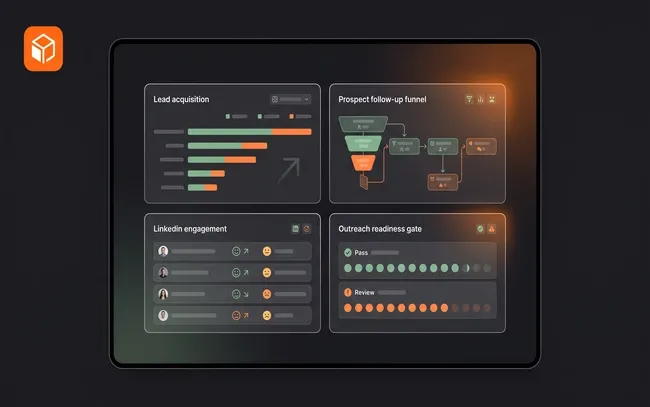
The reviewer should produce one of three outputs. Approved when the prospect list is specific and stable, the first message matches the prospect's decision posture with tested variants, the offer handoff from conversation to booked call is documented with trigger conditions, operating failures are ruled out with verified fixes for any broken step, and the tracking system captures full prospect lifecycle with auditability from invite to revenue. Held when any gate fails and the missing evidence or fix is named. Returned when the outreach process has fundamental gaps including a list that can't be defined, a message that produces no response, or a handoff path that doesn't exist that prevent a person, automation, or AI layer from taking over without reducing quality. No outreach volume increase, message template change, or automation handoff should proceed without reviewer acceptance of the readiness review.
- Confirm the tracking system captures full lifecycle from invite through revenue with no missing stages.
- Verify tracking can separate acceptance rate decline from call-booking rate decline to identify the constraint lever.
- Produce approved, held, or returned based on whether all five outreach readiness gates pass with verified fixes.
- Return when fundamental gaps in list, message, or handoff prevent any handoff without quality reduction.
Sample Review Note
All five diagnostic gates were checked for this Outreach Handoff Readiness review. The prospect list was verified as specific and stable by confirming enough filters for segment-level interpretability, checking composition consistency across sends, and freezing the list definition for review period. First-message fit was diagnosed by verifying the personalization references a visible prospect trigger, the ask matches the relationship distance, and a message variant test was conducted with intended sender before handoff approval. The offer handoff from conversation to booked call was confirmed by mapping full sequence with documented trigger conditions, verifying the offer asset matches the conversation context, and checking the booking path requires the lowest possible commitment. Operating failures were separated from message problems by testing full sequence with a test profile, classifying each broken step by root cause, and deploying verified fixes before any message test. Tracking completeness was verified by confirming full lifecycle from invite to revenue is captured with auditability, and the output was produced as approved, held, or returned.
Recheck triggers include a change in the prospect list definition or filter logic, a new message template or sender change, a handoff path modification including a new calendar tool or offer asset, an operating failure discovered during a test-profile audit, a tracking system migration or stage definition change, or a response rate or booking rate that crosses the threshold that signals a constraint lever has shifted. If a recheck is needed, any outreach volume increase, message change, or automation handoff should be paused until the reviewer accepts the updated evidence.