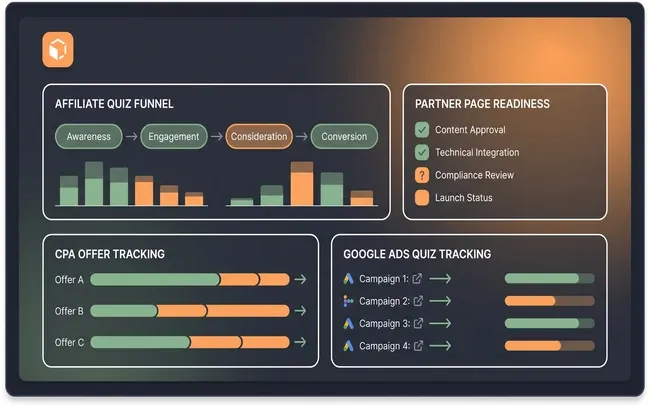
How to read this workflow
Use this workflow when a growth team is reviewing a quiz-led affiliate funnel before changing offers, quiz questions, result pages, traffic budget, Google Ads setup, email follow-up, or the approved next optimization. The core decision: should the funnel scale, pause, retest, or be repaired? The answer depends on which constraint binds first -- audience fit, offer selection, page clarity, quiz logic, result-to-offer mapping, email readiness, traffic intent, tracking confidence, or approval state.
Audience and Offer Fit
A quiz funnel can look clean at every screen and still fail because the visitor does not match the offer set. Creative improvements wash out against a fundamental mismatch between what the visitor needs and what the offer provides. The audience-fit check prevents teams from spending optimization effort on the wrong layer.
What to check:
Decision rules:
- Whether the audience has a demonstrated reason to take the quiz
- Whether the offers match the visitor's likely readiness and intent stage
- Whether commission margin supports the required traffic cost
- Whether the page promise aligns with the audience expectation from the traffic source
- If audience or offer fit is uncertain, hold scale and request an offer-fit review before adding traffic.
- If offer fit changes, compare it with at least one supporting input before writing the recommendation.
Quiz Logic and Result Mapping
The quiz functions as a recommendation system. Each question should narrow the visitor toward a result bucket that maps to a specific offer. When questions do not change the result, the quiz produces ambiguous data -- the team cannot distinguish a bad offer from a confused classification or a measurement gap.
What to check:
Decision rules:
- Whether each question changes the result bucket assignment
- Whether result buckets guide a single offer recommendation
- Whether answer choices create real distinctions or cosmetic variety
- Whether disqualification logic exists for visitors who should not receive an offer
- If the result-to-offer path is weak, repair the quiz logic before changing budget or follow-up.
- If the model is sensitive to an assumed number, keep the recommendation as a scenario until the source is verified.
Destination-Page Trust and Next Step
The destination page must continue the promise the quiz result created. When the page headline contradicts the result language, the visitor experiences a trust break. The quiz already invested effort from the visitor -- they answered questions expecting a specific recommendation. A page that ignores that recommendation wastes built trust and makes the offer click feel adversarial.
What to check:
Decision rules:
- Whether the page headline matches quiz result language
- Whether proof elements support the specific recommendation
- Whether the call to action connects directly to the selected offer
- Whether compliance risk exists in the page-to-offer handoff
- If the page promise and quiz result disagree, fix the page or result path before retesting.
- If page promise match changes, compare it with at least one supporting input before writing the recommendation.
Email Follow-Up Readiness
The email sequence is a continuation layer, not an independent channel. When follow-up messages change the frame the quiz established, the subscriber perceives a generic pitch rather than a personalized recommendation. Deliverability issues compound this -- weak sender reputation means the follow-up never arrives regardless of content quality.
What to check:
Decision rules:
- Whether the first follow-up continues the quiz result language
- Whether autoresponder setup and segmentation match result buckets
- Whether seed testing confirms inbox placement
- Whether open-rate trends support continued sending
- If follow-up readiness is weak, hold traffic changes and repair the email system first.
- If the operating owner or follow-up path is unclear, mark the recommendation as a process fix before a creative fix.
Traffic and Conversion Confidence
Traffic intent and tracking quality determine how strongly the team can trust funnel conclusions. Mismatched paid intent sends the wrong visitor into the quiz. Incomplete tracking makes real improvements invisible. The review should produce a confidence label -- strong, caveated, or not ready -- that governs how aggressively the team acts.
What to check:
Decision rules:
- Whether traffic source intent matches the quiz promise
- Whether result-level and offer-click events are measured (not just page visits)
- Whether the conversion tag fires correctly and attributes to the right source
- Whether policy state allows continued spend
- If tracking confidence is weak, label the recommendation as a retest or measurement repair.
- If the buyer has not been given enough proof, process, or next-step clarity, do not recommend more traffic as the first fix.
Review checklist
Use these checks to keep the recommendation approval-gated before the team changes the page, campaign, workflow, or reporting setup.
- Visitor path mapped from audience intent to measured outcome
- Audience and offer fit reviewed before creative fixes
- Quiz logic produces useful result-to-offer decisions
- Page and email follow-up continue the quiz promise
- Tracking confidence determines recommendation strength
- Recommendation labeled strong, caveated, or not ready
- Follow-up actions approval-gated until reviewer accepts finding
Worked Example
Audience notes and offer inventory look directionally aligned, but quiz answers do not clearly separate visitor needs and the destination page headline changes the result promise.
The funnel should not scale yet. The first constraint is result-path clarity, with page promise mismatch as the immediate continuation issue. Traffic and tracking can support a retest after those two repairs are reviewed.
Draft a quiz logic repair, page promise repair, and result-level retest condition. Hold scale until the reviewer accepts the repairs and measurement caveat. The binding constraint sits upstream -- fixing downstream layers first would waste effort and produce misleading retest data.
Because result-level tracking is partial, the review cannot yet prove which result bucket would perform best after repair.
Approval boundary
10X identifies the first constraint and drafts repair or retest recommendations, but scale decisions, page edits, email changes, and tracking changes remain approval-gated. Follow-up requires explicit acceptance of both the finding and its caveats before implementation.
Sample review note
10X should review Affiliate Quiz Funnel Quality Review Workflow, compare the decision evidence with the caveats, and keep the next recommendation approval-gated until the reviewer accepts it.