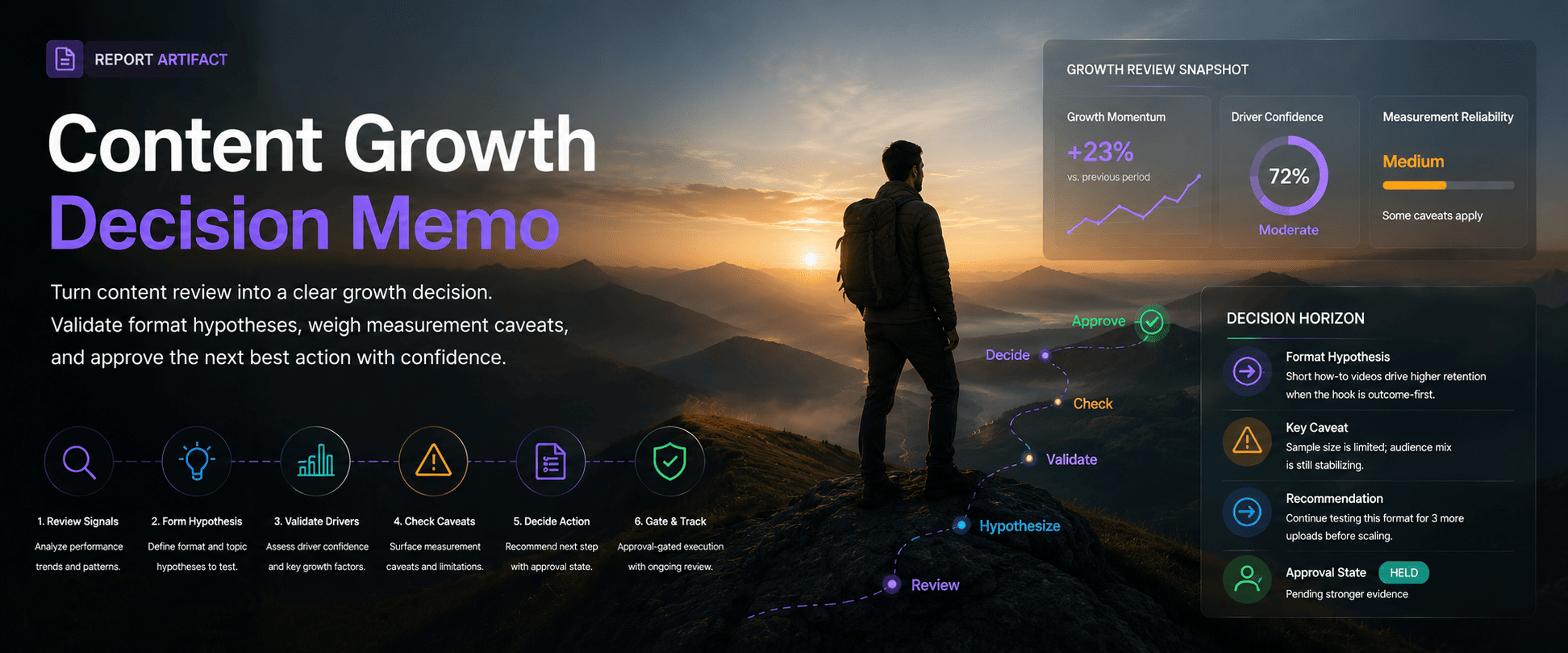
Why content growth reviews often fail
Content growth reviews frequently fail because teams confuse visible movement with proven understanding. A temporary increase in clicks, impressions, watch time, or engagement can create the appearance of growth even when the underlying reason remains unclear.
This creates dangerous publishing decisions. Teams may increase production volume, expand repurposing workflows, change topic direction, or scale a content format before understanding whether the observed movement was actually repeatable.
The Content Growth Decision Memo exists to prevent those false-positive growth reads. The purpose of the memo is not simply to summarize analytics. The goal is to isolate what changed, estimate how reliable the interpretation is, identify what remains uncertain, and determine whether the next publishing action should move forward.
Growth signals are not the same as growth understanding
A useful growth review separates observed movement from assumed cause.
For example, a content team may see:
However, those signals alone do not prove why the movement happened.
The increase may have been caused by:
A useful memo should make the distinction between evidence and interpretation visible before any publishing decision becomes operational policy.
- Higher click-through rates
- Increased impressions
- Stronger retention on a specific format
- More returning viewers
- Improved engagement on repurposed assets
- A stronger topic
- Better timing
- Improved packaging
- Recommendation-system volatility
- Audience familiarity with the creator
Format hypothesis validation
One of the most important parts of a content growth review is testing the format hypothesis correctly.
A format hypothesis is the belief that a specific structure, style, pacing model, topic framing, editing approach, or publishing format contributed to the observed performance movement.
Weak growth reviews often treat correlation as proof.
For example:
“This format worked, so the team should produce more videos like this.”
That conclusion may be premature because the review may not have isolated the actual decision variable.
- The topic already had visible demand
- The hook created stronger curiosity
- The title improved audience targeting
- The packaging aligned better with viewer expectations
- The recommendation system surfaced the content to a more qualified audience
Measurement caveats should stay visible
A strong growth review keeps uncertainty visible instead of hiding it behind confident recommendations.
Many content decisions fail because caveats disappear once the publishing recommendation is written. Teams begin acting as if the interpretation is already confirmed even though the evidence may still be incomplete.
Common measurement caveats include:
The memo should keep these caveats attached directly to the recommendation so the next publishing decision remains reviewable instead of assumed.
- The test sample may be too small
- The audience segment may not be stable yet
- The growth movement may be temporary
- The recommendation system may still be recalibrating
- The test may have changed multiple variables simultaneously
- The engagement movement may not support downstream business outcomes
Packaging changes growth interpretation
Content packaging changes how performance data should be interpreted.
A useful idea can underperform because the audience does not immediately understand:
This means weak performance does not always indicate weak ideas.
Sometimes the content itself is valuable, but the title, hook, thumbnail, opening sequence, or positioning creates confusion before the viewer understands the value proposition.
The memo should explain whether the review believes the growth issue relates to:
Without this distinction, the team may incorrectly revise the content strategy instead of improving the packaging layer.
- Who the content is for
- Why it matters
- What outcome the viewer should expect
- Why the topic deserves attention now
- The content idea itself
- Audience targeting
- Format structure
- Packaging clarity
- Distribution timing
Experiment approval logic
Not every positive result should trigger immediate scaling.
A strong Content Growth Decision Memo should define:
This approval logic prevents temporary performance movement from becoming long-term publishing strategy before the evidence becomes operationally reliable.
- What finding appears reliable
- What still remains unproven
- What action is approved immediately
- What should remain isolated for additional testing
- What requires another experiment cycle before expansion
What should remain on hold
A mature growth review should also identify what should not change yet.
Holding actions is often more important than approving actions because scaling weak assumptions creates operational instability.
The memo may recommend holding:
Keeping these actions blocked until stronger evidence appears protects the publishing workflow from reacting too aggressively to incomplete growth interpretation.
- Production-volume increases
- Repurposing expansion
- Additional format rollout
- Topic broadening
- Publishing cadence increases
- Audience repositioning
Example growth decision output
Recent uploads showed stronger retention and improved engagement on shorter educational formats.
Moderate confidence. The review suggests that packaging clarity and stronger topic targeting contributed more than production frequency.
The recommendation system may still be recalibrating audience targeting, and the test sample remains limited.
Continue testing the current packaging direction for the next three uploads while preserving the existing publishing cadence.
Do not increase production volume or expand into additional topic categories until audience consistency improves.
The growth lead owns the next format validation review before additional scaling decisions are approved.
Final governance note
10X should review the Content Growth Decision Memo, compare the observed evidence with the measurement caveats, and keep the next publishing recommendation approval-gated until the reviewer accepts the interpretation.
Sample review note
10X should review Content Growth Decision Memo, compare the decision evidence with the caveats, and keep the next recommendation approval-gated until the reviewer accepts it.