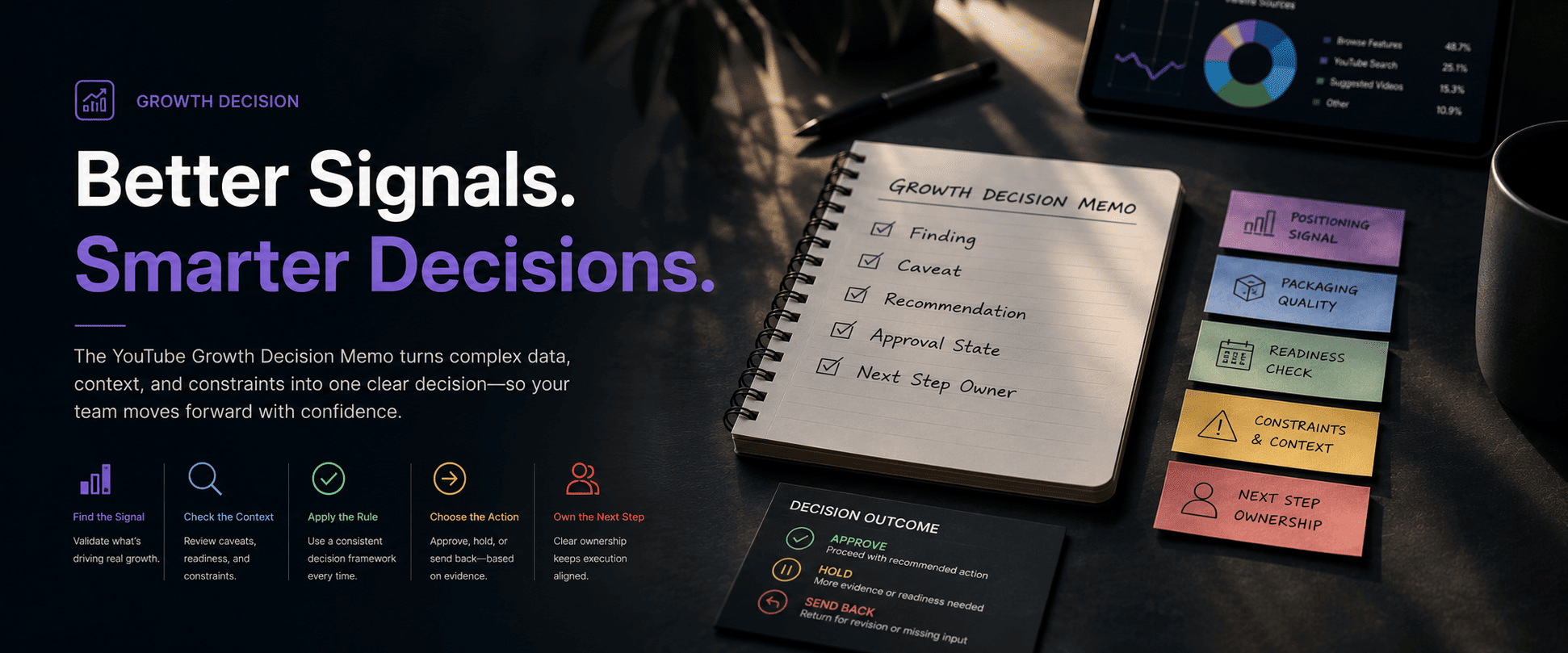
YouTube Growth Decision Review Workflow
The YouTube Growth Decision Memo exists to separate positioning evidence from operational assumptions before publishing, packaging, or repurposing decisions move forward. In this workflow, the reviewer is not approving growth activity itself; the review determines whether the evidence is reliable enough to justify a change in publishing direction, production allocation, or channel positioning strategy.
The memo acts as a governance-controlled decision layer between analytics interpretation and operational execution. Every recommendation must remain tied to reviewable evidence, visible caveats, production readiness constraints, and an approval state that clarifies what action is authorized, delayed, or returned for additional validation.
Positioning Signal Validation
The review begins by evaluating whether the channel positioning is stable enough for the recommendation system and intended audience to interpret the content consistently. Weak YouTube growth frequently reflects positioning instability rather than production inconsistency.
The reviewer should avoid treating temporary performance movement as positioning validation until audience consistency and recommendation-system behavior remain operationally reliable across multiple uploads.
- Review whether audience retention patterns remain aligned across related uploads.
- Check whether the recommendation system is surfacing videos to the intended audience segment.
- Validate whether engagement quality reflects audience relevance instead of broad low-intent visibility.
- Compare content performance against the expected topic lane and viewer expectation.
- Review whether recent publishing changes introduced audience confusion or topic drift.
Packaging and Expectation Governance
Packaging review exists to determine whether the content promise, viewer expectation, and delivered outcome remain operationally aligned. A useful idea can underperform when the title, thumbnail, hook, or framing fails to communicate why the content matters to the intended audience.
Before approving a publishing adjustment, the reviewer should validate:
This workflow prevents packaging assumptions from becoming operational decisions before the audience-response evidence is fully validated.
- Whether the packaging clearly signals who the content is for.
- Whether the opening sequence fulfills the expectation created by the title and thumbnail.
- Whether the content package supports the recommendation-system classification process.
- Whether click behavior aligns with retention quality.
- Whether post-click behavior supports the implied promise made by the package.
Production Readiness and Operational Constraints
Growth recommendations should not move directly into execution without validating whether the publishing system can sustain the proposed change. Production calendars, workflow dependencies, and operational constraints must remain visible before cadence increases or repurposing initiatives are approved.
The reviewer should evaluate:
A recommendation should remain in hold status when operational readiness depends on assumptions that were not validated during the review process.
- Whether the production workflow can sustain the proposed publishing frequency.
- Whether editing, scripting, and packaging resources are operationally available.
- Whether repurposing workflows introduce quality or context-preservation risk.
- Whether production delays could compromise recommendation timing.
- Whether CRM or operator notes reveal constraints not visible in platform analytics.
Repurposing Review and Context Preservation
Repurposing governance exists to ensure that adaptation workflows preserve the original strategic value of the source content. A high-performing long-form asset should not be reduced into disconnected social fragments that remove the insight, positioning, or proof point responsible for the original engagement.
The reviewer should hold the recommendation when:
This control layer prevents distribution expansion from weakening the strategic clarity of the original content.
- The repurposed asset changes the meaning of the source content.
- The adaptation removes critical audience context.
- The target platform favors different viewer behavior than the source environment.
- The content package no longer communicates the intended recommendation clearly.
- The workflow cannot explain why the adapted version should perform reliably in the new channel.
Approval-Gated Recommendation Logic
Every YouTube Growth Decision Memo should remain approval-gated. The reviewer should explicitly define:
The approval structure prevents downstream teams from interpreting conditional growth observations as finalized strategic direction.
- What finding is operationally reliable.
- What caveat must remain attached to the recommendation.
- What publishing or packaging action is approved immediately.
- What stays blocked pending additional evidence.
- Who owns the next review action.
Operational Importance of the Memo
The YouTube Growth Decision Memo is not a reporting summary. It is a structured governance artifact that protects publishing systems from scaling assumptions into operational strategy before audience alignment, packaging quality, positioning clarity, and production readiness are validated. By keeping findings, caveats, readiness constraints, and recommendation ownership connected inside a single workflow, the review process allows growth teams to scale only the actions that remain operationally defensible after evidence review.
Sample review note
10X should review YouTube Growth Decision Memo, compare the decision evidence with the caveats, and keep the next recommendation approval-gated until the reviewer accepts it.