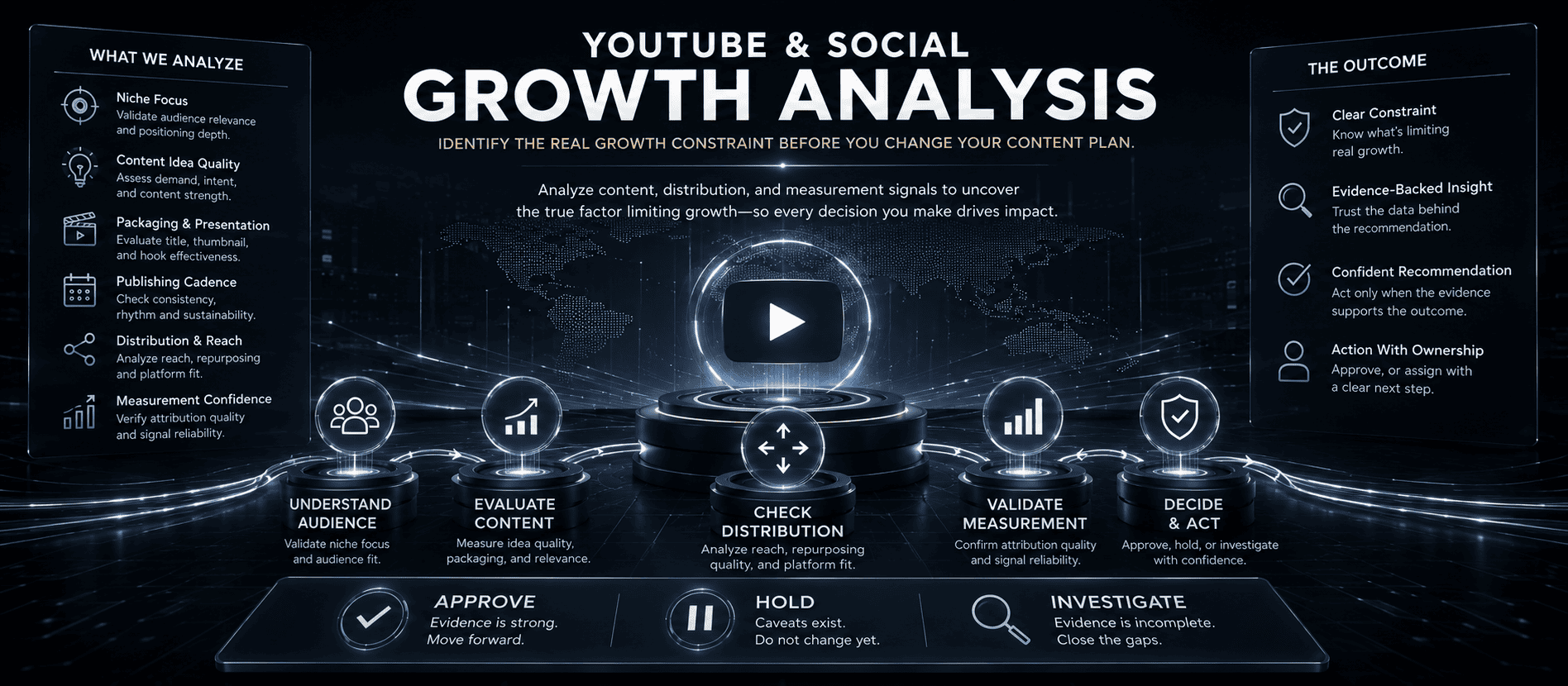
YouTube and Social Growth Analysis Framework
YouTube and social growth analysis exists to help marketing teams identify which operational constraint is actually limiting audience expansion before publishing, spend, workflow, or reporting changes move forward. In enterprise publishing systems, visible engagement alone is not reliable enough to justify strategic adjustment without validating the evidence quality behind the observed performance pattern.
The analysis framework acts as a governance-controlled review layer connecting content performance, packaging quality, audience alignment, distribution behavior, repurposing effectiveness, and measurement confidence into a single operational decision system. Its purpose is not to produce isolated platform metrics, but to determine which underlying condition is preventing sustainable growth.
Why Growth Signals Need Operational Qualification
Marketing teams often react to declining visibility, unstable retention, or inconsistent engagement before identifying whether the real constraint comes from audience positioning, weak packaging, poor distribution sequencing, or unreliable attribution logic.
The reviewer should evaluate whether:
Without this qualification process, operational teams frequently overcorrect the wrong system variable and unintentionally weaken audience trust, workflow efficiency, or recommendation-system consistency.
- The channel positioning is specific enough for audience expectations to remain stable.
- Content ideas align with searchable audience demand instead of temporary visibility spikes.
- Publishing cadence supports content quality rather than reducing strategic clarity.
- Repurposed assets preserve the original context that created the engagement signal.
- Measurement systems accurately explain the relationship between content interaction and business outcomes.
Niche Focus and Audience Alignment Review
One of the most common causes of unstable YouTube and social growth is audience-positioning fragmentation. Growth becomes inconsistent when publishing systems mix unrelated content directions, inconsistent messaging structures, or conflicting audience expectations inside the same content workflow.
The recommendation should remain in hold status when:
This governance layer ensures that publishing systems scale stable audience understanding instead of temporary algorithmic exposure.
- The audience segment changes significantly between publishing cycles.
- Video topics attract low-intent visibility instead of qualified audience interaction.
- The recommendation system cannot consistently classify the channel positioning.
- Content themes compete against each other instead of reinforcing a recognizable expertise layer.
- The growth recommendation depends on assumptions that were not validated during review.
Content Packaging and Distribution Controls
Packaging decisions influence whether viewers immediately understand why the content matters, who it serves, and whether it is relevant enough to continue watching. Titles, thumbnails, publishing order, and social distribution framing all affect how the recommendation system interprets content quality and audience satisfaction.
The operational review should validate:
A packaging adjustment should not move into execution until the recommendation remains evidence-supported across both YouTube and connected social environments.
- Whether the title and thumbnail communicate a clear viewer outcome.
- Whether publishing sequences reinforce the intended audience journey.
- Whether distribution messaging matches the actual content promise.
- Whether social reposts preserve the context that generated the original engagement.
- Whether the publishing workflow prioritizes strategic clarity over output volume.
Repurposing and Workflow Governance
Repurposing controls exist to prevent teams from converting isolated content success into disconnected cross-platform publishing. A successful YouTube asset may fail operationally when shortened, reframed, or distributed into a platform where audience expectations and engagement behavior are significantly different.
The reviewer should hold the recommendation when:
This review structure keeps repurposing decisions tied to operational logic rather than reaction-driven growth assumptions.
- The repurposed asset removes the insight responsible for the original engagement.
- The adapted format changes audience interpretation without updating qualification caveats.
- The workflow cannot explain why the content should perform reliably in the new platform.
- Distribution sequencing introduces context loss between publishing environments.
- The next promotional step lacks visible evidence ownership.
Measurement Confidence and Attribution Validation
Growth recommendations should remain approval-gated until measurement systems can reliably explain which activity influenced the observed outcome. Metrics without attribution context often create misleading confidence, especially when engagement quality and business impact move in different directions.
The reviewer should validate:
This prevents operational teams from scaling incomplete conclusions into long-term marketing direction.
- Whether analytics systems preserve the original source context behind reported growth.
- Whether engagement quality aligns with CRM or conversion evidence where available.
- Whether reporting summaries retain caveats instead of flattening operational uncertainty.
- Whether measurement gaps are visible before scaling distribution or spend.
- Whether the recommendation includes a named owner responsible for the next validation step.
Why the Framework Matters Operationally
YouTube and social growth analysis is not a channel-performance summary. It is a governance-controlled operational framework that identifies which system constraint should be solved before changing publishing, workflow, spend, packaging, or reporting direction.
By keeping evidence quality, audience alignment, attribution confidence, distribution logic, and approval ownership connected inside a single review structure, the framework allows marketing teams to scale only the recommendations that remain defensible after validation.
Sample review note
Review youtube and social growth analysis signals, name the caveat, and draft one recommendation the marketer can approve, hold, or assign.