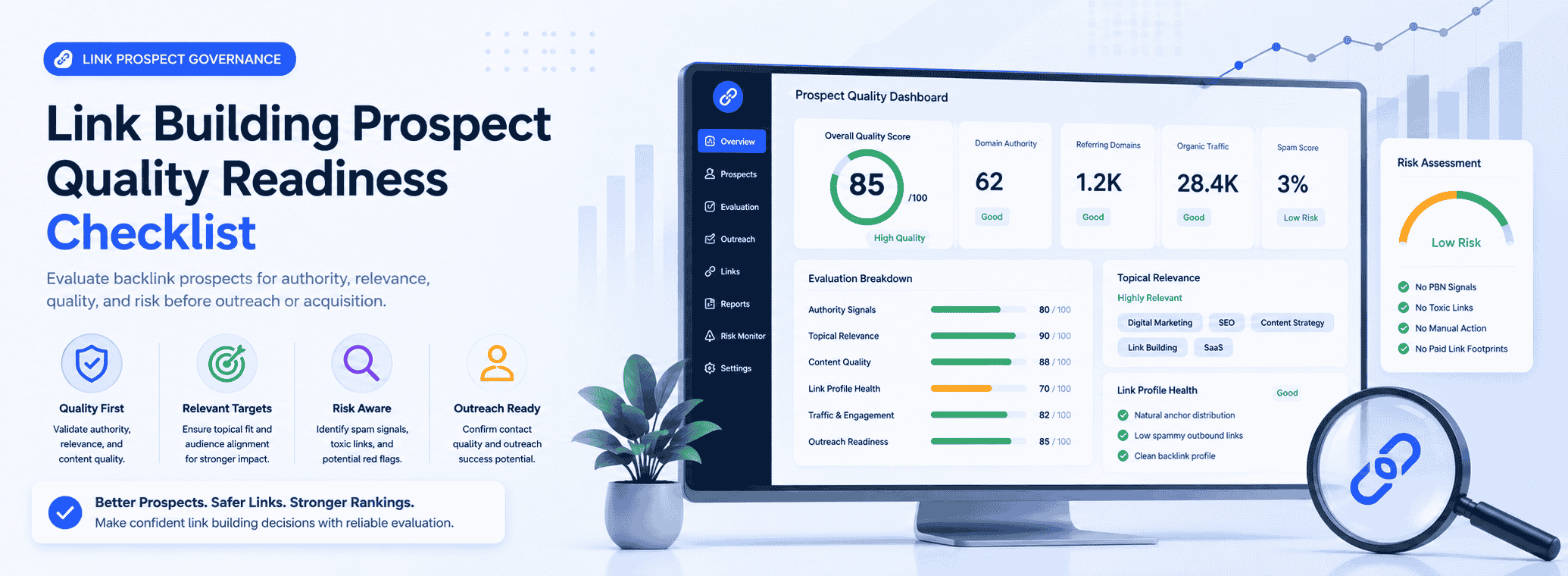
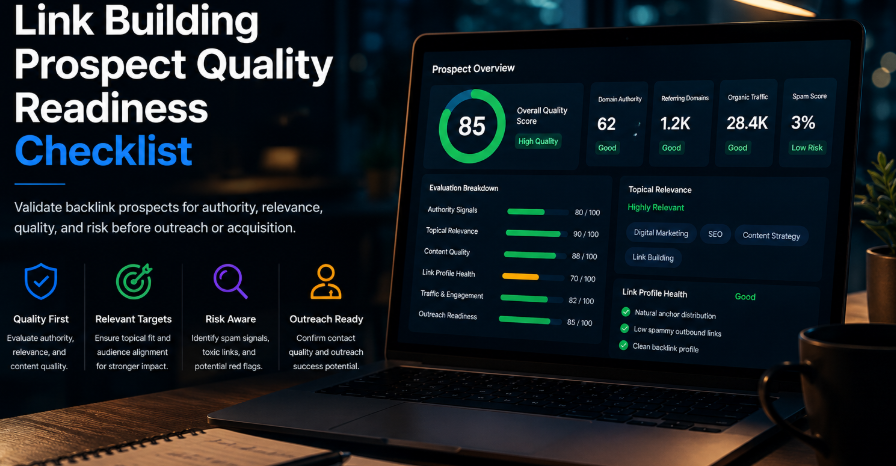
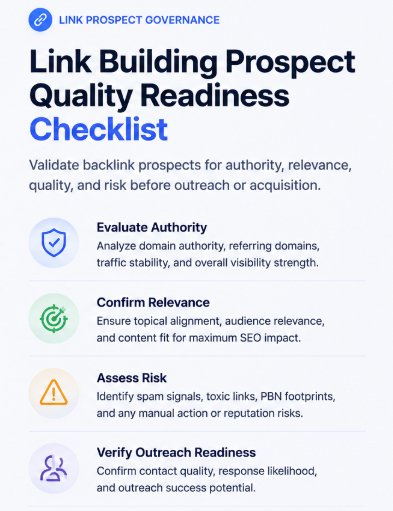
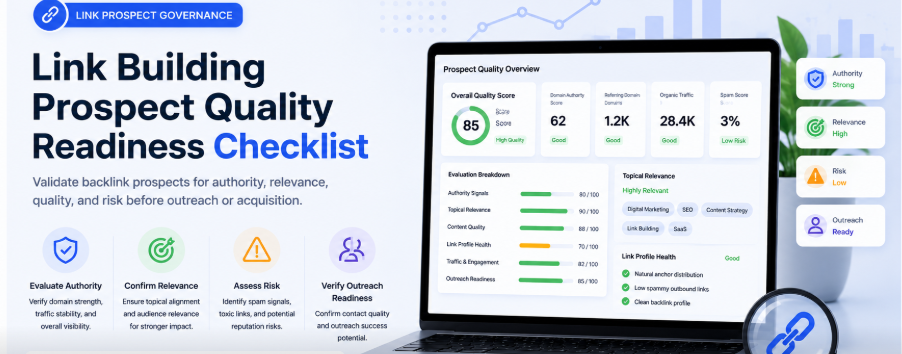
Link Building Prospect Quality Readiness Checklist
Link building should not begin just because a prospect list exists. A list may contain publishers with high authority metrics, available contacts, or familiar websites, but that does not mean the prospects are qualified enough for outreach. Poor prospect quality can waste outreach time, create weak placements, increase backlink risk, and make SEO recommendations look safer than the evidence allows.
The Link Building Prospect Quality Readiness Checklist helps SEO teams decide whether a prospect list is ready for outreach or should stay held because of relevance, authority, relationship, risk, or tracking gaps. The goal is not to approve more prospects. The goal is to approve only the prospects where the topic, audience, link context, outreach path, and ownership are clear enough to support a safe campaign.
If a prospect is included only because it has a high domain metric or an available contact, the recommendation should stay caveated until the reviewer confirms why the link would make sense for the reader and the target asset.
What This Checklist Decides
The checklist answers one practical question: is the prospect list qualified enough for outreach? A pass means the list has visible topic relevance, credible authority signals, natural link context, relationship fit, and a tracking owner. A hold means the list could create weak placements or backlink risk if outreach begins too soon.
- Approve: Prospects are relevant, credible, contextually useful, and trackable through outreach and placement review.
- Hold: Relevance, authority, placement context, relationship fit, or tracking ownership is incomplete.
- Send back for evidence: The team needs stronger source quality, spam risk, audience, or link context review.
- Refine list: Remove low-fit prospects before outreach starts.
Check Topic Relevance First
Topic relevance should be confirmed before authority metrics are used to justify outreach. A prospect should cover the topic, audience, or buyer problem that makes the asset worth citing. If the publisher’s content does not connect naturally to the asset, outreach is likely to feel forced even if the domain looks strong.
- Does the prospect URL cover a related topic?
- Does the publisher speak to the audience the asset was built for?
- Does the prospect page match the search intent or buyer problem?
- Would the target asset add useful context for the reader?
- Is there a reviewer note explaining why this prospect belongs on the list?
Hold the prospect when the only reason for outreach is a high domain metric, an available contact, or broad industry similarity. Relevance is not a label; it should be visible in the page topic, audience match, and citation logic.
Use Authority As One Signal, Not The Whole Decision
Authority metrics can help prioritize a prospect list, but they should not replace quality review. A high authority score can hide weak editorial standards, irrelevant content, thin pages, poor audience fit, or unnatural outbound link behavior. The reviewer should compare authority with visible source credibility.
- Review domain or page-level authority metrics.
- Check whether the publisher has stable traffic or visibility signals.
- Inspect page quality, editorial standards, and publication category.
- Look for signs of spam, thin content, or irrelevant outbound linking.
- Document the authority caveat if quality signals are mixed.
Authority is useful when it supports a relevant, credible placement. It is risky when it becomes the reason to ignore weak page quality or poor editorial context.
Review Link Context And Placement Risk
A qualified prospect should have a natural place where the link could appear. The reviewer should inspect the expected placement, surrounding topic, anchor context, disclosure need, and risk label before outreach begins. This prevents the team from chasing placements that would look paid, forced, irrelevant, hidden, or disconnected from the reader’s job.
- Where would the link appear on the prospect site?
- Would the surrounding content support a natural citation?
- Does the anchor context describe the asset honestly?
- Is a disclosure needed for the relationship or placement type?
- Would the link help the reader, or only serve the SEO campaign?
If the link would not make sense in context, the prospect should stay held. A relevant publisher can still be a poor outreach target if the placement itself would be unnatural.
Confirm Relationship And Outreach Fit
Outreach quality depends on the relationship source. A cold outreach message, partner introduction, prior contributor relationship, media contact, or customer relationship all require different language and expectations. The outreach path should not overstate familiarity, value, or authority.
- What is the contact source?
- Is there a prior relationship or only a cold contact?
- What real reason does the publisher have to care?
- Is personalization based on visible evidence?
- Who owns the message, follow-up, and opt-out handling?
Hold outreach when personalization is generic, misleading, or not tied to a real reason for the publisher to engage. A good prospect can still become a bad campaign if the outreach message creates trust risk.
Track Ownership Before Outreach Starts
A prospect list should be auditable after outreach begins. Without tracking ownership, the team may lose visibility into which prospects were contacted, which placements went live, which source labels were used, and which links need post-placement review.
- Assign an owner for outreach status.
- Track placement status and source label.
- Record follow-up timing and response state.
- Document accepted, rejected, held, and removed prospects.
- Schedule post-placement review for live links.
Hold the list when it cannot be audited after outreach starts. Tracking protects the campaign from duplicate outreach, unclear ownership, and unreviewed placements.
Common Failure Modes This Prevents
The most common failure is treating topic relevance as settled before checking the actual page, audience, and citation reason. Another failure is letting authority metrics make the prospect look safer than it is. A third failure is moving into outreach before the link context and placement risk are approved.
- Approving prospects because domain metrics look strong.
- Ignoring weak page quality or irrelevant editorial context.
- Requesting links that do not help the reader.
- Using generic outreach that overstates relationship value.
- Losing auditability after outreach begins.
Final Approval Rule
A Link Building Prospect Quality Readiness Checklist should end with a clear approve, hold, or send-back decision. Approve outreach only when topic relevance, authority quality, link context, relationship fit, and tracking ownership are visible enough to support the campaign.
If any area is weak, keep the recommendation caveated and assign the missing review. Strong link building is not about contacting the largest possible list. It is about earning placements that are relevant, credible, natural, and traceable from prospect review through post-placement governance.