Why Spreadsheet Model Readiness Matters Before Decision-Making
Marketing teams frequently rely on spreadsheets to transform exported platform data into reporting, forecasting, campaign analysis, SEO reviews, content performance evaluations, and executive summaries. While spreadsheets remain one of the most flexible analytical tools available, they also introduce risk when formulas, lookup logic, source references, or aggregation methods are not reviewed before recommendations are made.
A spreadsheet can appear polished while still producing incorrect conclusions. Missing rows, broken formulas, duplicate lookup matches, incorrect pivot configurations, hidden filters, or inconsistent validation rules can all distort reporting outputs. Once those outputs enter campaign planning, SEO prioritization, content investment decisions, or budget allocation discussions, the impact of spreadsheet errors extends far beyond the workbook itself.
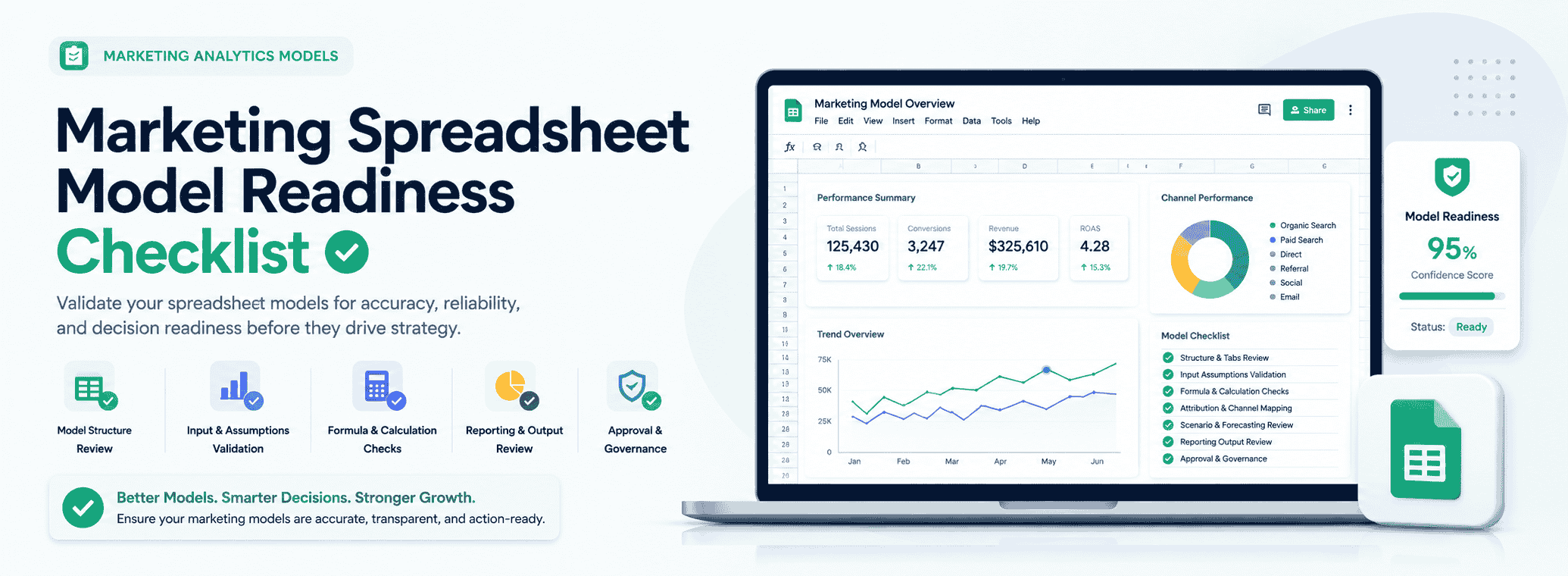
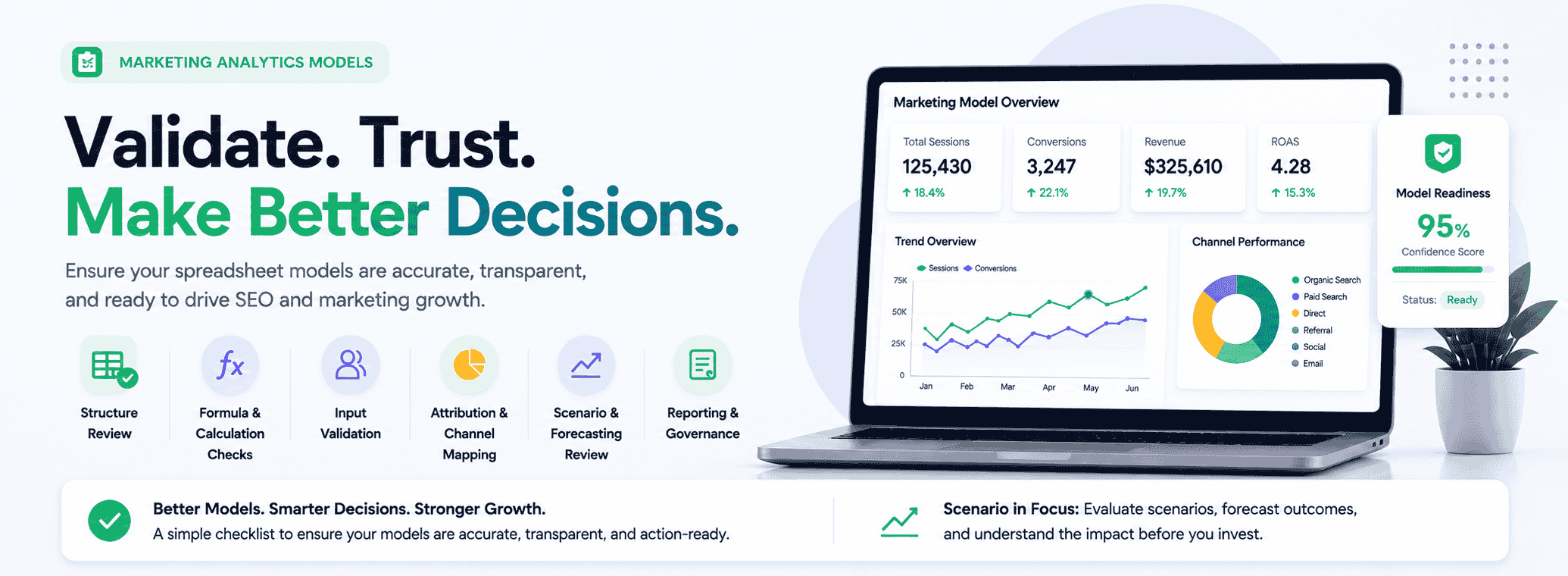
The purpose of a Marketing Spreadsheet Model Readiness Checklist is to determine whether a workbook is reliable enough to support an OpenAnalyst recommendation. Rather than reviewing appearance alone, the checklist focuses on structural integrity, formula coverage, aggregation logic, validation controls, and governance visibility.
Start With Source Table Control
Every spreadsheet model depends on the quality and stability of its source data. Before reviewing formulas, pivots, or visual outputs, the reviewer should confirm that the workbook references a controlled and predictable source table.
Many spreadsheet failures begin when formulas reference loose ranges instead of structured tables. When new rows are added, formulas may not expand automatically. When blank rows appear inside imported exports, calculations may become inconsistent. When users manually copy and paste data into worksheets, historical assumptions about table structure may no longer remain valid.
- Confirm that source data exists in a structured table format.
- Review whether new records are included automatically.
- Check for hidden rows, blank records, or manual exclusions.
- Verify that imported exports follow a consistent structure.
- Document refresh requirements and update ownership.
If source-table control cannot be validated, downstream outputs should remain unapproved regardless of how sophisticated the rest of the workbook appears.
Review Formula Coverage And Calculation Integrity
Formula reliability represents the core of spreadsheet model readiness. Even small formula errors can propagate through dozens of worksheets and influence strategic recommendations.
The review should determine whether calculated columns cover all intended records and whether formulas remain consistent throughout the workbook. Particular attention should be given to copied formulas, manually overridden cells, inconsistent references, and mixed calculation methods.
- Confirm formulas cover all applicable rows.
- Review relative and absolute references.
- Check for manually overwritten calculations.
- Validate summary formulas and aggregation methods.
- Inspect error-producing functions and exception handling.
Formula reviews should not focus solely on whether calculations return values. The more important question is whether those values accurately represent the business logic behind the recommendation.
Validate Pivot Tables Against The Business Question
Pivot tables often become the primary source of insight inside marketing workbooks. They summarize campaign performance, traffic movement, conversion behavior, content engagement, and SEO visibility trends. However, pivot outputs are only trustworthy when their configuration aligns with the question being asked.
Reviewers should evaluate whether pivot rows, columns, filters, values, and calculated fields support the intended recommendation. Incorrect aggregation settings can significantly distort interpretation.
- Review row and column selections.
- Validate aggregation methods such as SUM, COUNT, or AVERAGE.
- Inspect filter logic and exclusion criteria.
- Confirm calculated fields match reporting objectives.
- Verify pivot refresh behavior.
A pivot configured incorrectly can generate a convincing narrative while concealing important performance differences across campaigns, channels, content groups, or SEO segments.
Check Lookup Joins For Accuracy
Modern marketing spreadsheets frequently combine data from multiple exports. Campaign reports may be joined with conversion data. SEO exports may be enriched with content metadata. CRM extracts may be merged with advertising performance information.
These joins often depend on functions such as VLOOKUP, XLOOKUP, INDEX-MATCH, or Power Query transformations. A single mismatch can affect hundreds or thousands of records.
The readiness review should evaluate:
- Duplicate lookup keys.
- Missing matches.
- Incorrect field mapping.
- Fallback value behavior.
- Data-type inconsistencies.
- Join completeness.
Lookup logic should remain transparent enough that another reviewer can reproduce the result without relying on undocumented assumptions.
Confirm Validation Controls Exist Throughout The Workbook
Reliable spreadsheet models make failure visible. They contain controls designed to identify missing data, calculation errors, unexpected values, and structural inconsistencies before recommendations reach decision-makers.
Validation controls act as early-warning systems. Instead of assuming the workbook is functioning correctly, they actively verify that assumptions remain true.
- Cross-foot totals against source exports.
- Highlight missing values automatically.
- Flag unexpected calculation outputs.
- Validate row counts between worksheets.
- Compare summary totals against source systems.
Without validation controls, reviewers may unknowingly approve recommendations built on incomplete or corrupted analytical inputs.
Separate Reporting Convenience From Decision Readiness
A workbook can be useful for exploration without being ready for operational decision-making. Marketing teams often use spreadsheets to investigate trends, test assumptions, and explore performance patterns. Exploratory analysis serves an important purpose, but it should not automatically become recommendation evidence.
Decision-ready models require stronger controls than exploratory workbooks. They must demonstrate formula integrity, source reliability, lookup accuracy, validation coverage, and governance visibility.
The checklist therefore separates:
- Exploration from recommendation.
- Draft analysis from approved reporting.
- Diagnostic outputs from decision-driving evidence.
- Internal notes from stakeholder-facing conclusions.
This distinction prevents incomplete analytical work from being interpreted as finalized business guidance.
Document Assumptions And Caveats Clearly
Every spreadsheet model contains assumptions. Some assumptions relate to attribution logic. Others relate to campaign grouping, content categorization, conversion definitions, reporting windows, or lookup relationships.
A readiness review should identify and document these assumptions explicitly. Recommendations become more trustworthy when reviewers understand the limitations attached to the evidence.
- Document data freshness limitations.
- Identify manual intervention steps.
- Highlight known reporting gaps.
- Record unresolved validation concerns.
- Explain assumptions influencing calculations.
Caveats should remain attached to recommendations rather than hidden in separate documentation. This helps stakeholders evaluate risk before acting on the findings.
Review Ownership And Governance Controls
Spreadsheet readiness extends beyond technical accuracy. Governance determines whether future updates remain reliable after the original creator leaves the project or transfers responsibility.
The review should establish who owns the workbook, who approves modifications, and how changes are documented. Governance controls reduce operational risk by ensuring analytical logic remains traceable over time.
- Assign workbook ownership.
- Document review responsibilities.
- Track version history.
- Protect critical calculation areas.
- Maintain approval visibility.
Without ownership controls, even well-built spreadsheet models gradually lose trust as modifications accumulate and documentation becomes outdated.
Require Approval Before Recommendations Move Forward
A completed checklist should not automatically trigger implementation changes. Instead, the review process should determine whether the workbook provides enough evidence to support approval.
Recommendations should remain approval-gated until reviewers confirm that source data, formulas, pivot outputs, lookup joins, and validation controls meet the required standard.
Approval decisions typically fall into three categories:
- Approve – Evidence supports the recommendation.
- Hold – Additional validation or clarification is required.
- Send Back – Structural issues prevent trust in the model.
This approval framework protects decision quality by ensuring recommendations remain evidence-based rather than spreadsheet-driven assumptions.
Operational Importance Of Spreadsheet Model Readiness
Marketing organizations increasingly depend on spreadsheets to bridge data exports, campaign reporting, SEO analysis, forecasting models, content evaluations, and executive reporting. While spreadsheet flexibility makes rapid analysis possible, it also introduces opportunities for hidden errors that can influence major business decisions.
A Marketing Spreadsheet Model Readiness Checklist establishes the controls necessary to evaluate trust before action occurs. Source-table integrity, formula coverage, pivot accuracy, lookup reliability, validation controls, ownership visibility, and approval governance combine to create a framework for analytical confidence.
Instead of assuming that spreadsheet outputs are correct because they look professional, reviewers validate whether the underlying model deserves trust. This creates an environment where recommendations remain reviewable, reproducible, transparent, and operationally accountable before they influence campaign budgets, SEO priorities, content investments, or reporting decisions.