Analytics recommendations are only as reliable as the measurement layer behind them. A recommendation may look current, but if events are stale, parameters are missing, warehouse exports changed, CRM states are disconnected, or reporting comparisons drifted, the team may be making SEO and growth decisions from incomplete evidence.
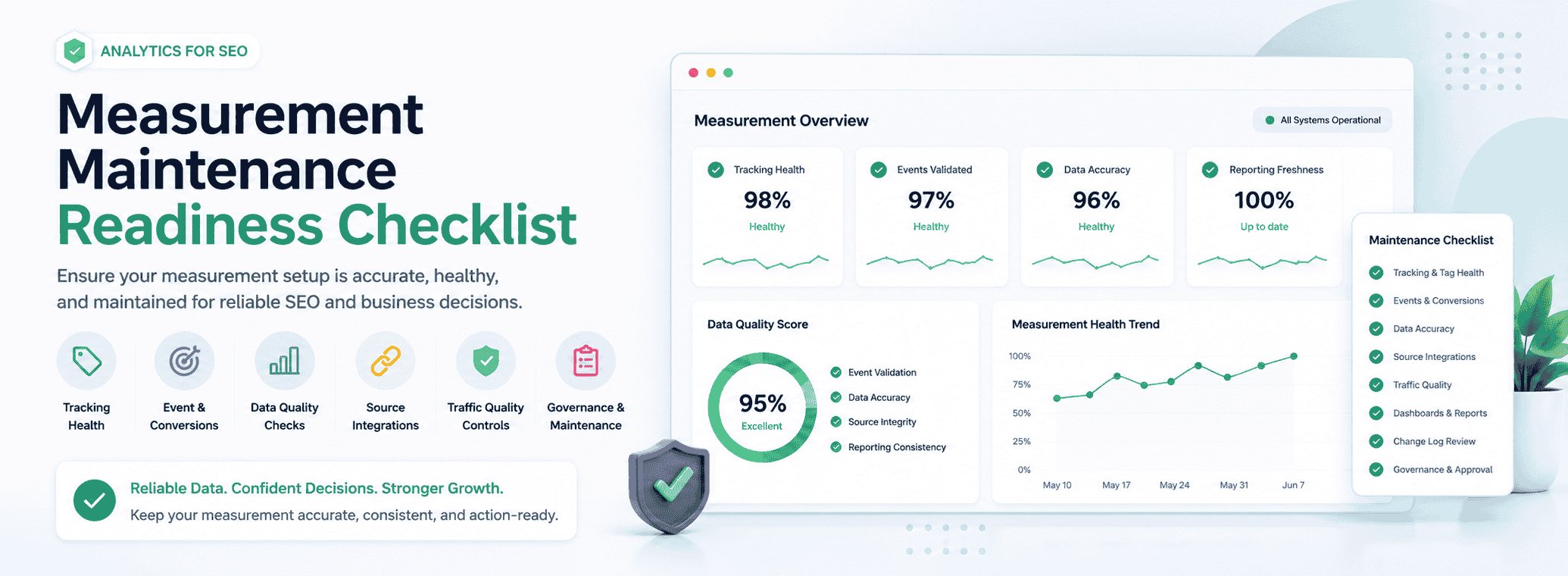
The Measurement Maintenance Readiness Checklist helps teams decide whether measurement evidence is complete enough to keep analytics recommendations current after tracking, warehouse, CRM, or reporting changes. It is a pass-hold checklist, not a generic QA list. The goal is to verify that decision-driving data is still healthy before the team changes pages, links, indexation rules, campaigns, or reporting language.
If the evidence layer is incomplete, the correct output is a hold note with an owner and review date, not an approved recommendation.
What This Checklist Decides
The checklist answers one practical question: is the measurement system ready to support the next analytics recommendation? A pass means the required evidence is visible, current, and connected to the decision. A hold means the missing source could change the recommendation.
- Approve: Event health, warehouse exports, CRM states, reporting surfaces, and owner notes support the recommendation.
- Hold: A missing or unclear measurement input could change the next action.
- Send back for evidence: The team needs validation, reconciliation, or owner review before the recommendation can move forward.
- Assign repair: A failed check needs a named owner, due date, and approval or rollback decision.
Start With The Measurement Plan
The measurement plan defines which events drive which decisions. Without it, the team cannot judge whether tracking is complete or whether a missing field matters. The reviewer should confirm that the current recommendation still maps to the right events, parameters, lead states, and reporting outputs.
- Which events are decision-driving for this recommendation?
- Which parameters are required for segment, source, or journey analysis?
- Which event order fields prove the user path is captured correctly?
- Which reports or dashboards use this measurement logic?
- Who owns the maintenance review if something fails?
This keeps the checklist tied to decision quality instead of treating every tracking issue as equally important.
Validate Event And Parameter Health
An event can fire correctly while still carrying empty, renamed, duplicated, or incomplete parameters. That creates false confidence because the dashboard may show activity while downstream analysis silently loses the context needed for decisions.
- Confirm decision-driving events still match the measurement plan.
- Check that required parameters are present and populated.
- Review event order fields for journey and sequence analysis.
- Detect missing, duplicated, renamed, or wrongly timed events.
- Attach recent test proof and an owner note to the review log.
Hold the recommendation when an event is missing, duplicated, sent in the wrong state, or no longer supports the recommendation. Partial tracking should not be treated as decision-ready evidence.
Check Warehouse Export Freshness And Schema
Warehouse exports can run successfully while returning stale or incomplete data. A query may still execute even when columns, tables, freshness timestamps, or source fields no longer reflect the live tracking state. That makes warehouse maintenance a critical part of recommendation readiness.
- Verify table definitions and required fields are current.
- Check freshness timestamps and export windows.
- Confirm session, source, medium, campaign, and identity fields are available.
- Review query ownership, cost boundaries, and failure handling.
- Confirm the export supports journey, session, and source analysis.
Warehouse risk should block a recommendation when query scope, freshness, cost, or ownership is unclear enough to change the decision. Plausible data is not enough if the source may be stale.
Review CRM Lead-State Connections
Lead volume is not the same as lead quality. A campaign, page, or SEO recommendation may show more submissions, but without CRM qualification, offline state, or identity joins, the team cannot know whether those leads are business-quality evidence.
- Confirm qualification stages are mapped and current.
- Check offline conversion paths and sales acceptance states.
- Validate identity joins between analytics and CRM records.
- Separate raw lead volume from qualified lead movement.
- Name any attribution or lifecycle caveat before approval.
This prevents the team from treating a lead increase as growth when the increase may include spam, low-fit contacts, or unqualified submissions.
Validate Reporting Templates And Comparisons
Reports can drift even when the underlying data is healthy. Saved comparisons, segment definitions, dashboards, and exports should still answer the same stakeholder question they were built for. If a segment was redefined or a comparison disappeared, the trend line may be comparing different populations without warning.
- Confirm saved comparisons are active and visible.
- Check segment definitions against the reviewed recommendation.
- Validate recurring dashboards and export destinations.
- Review whether stakeholders can still see caveats and notes.
- Document report changes in the maintenance log.
A reporting comparison is safe to use only when it is active, visible, aligned with the stakeholder question, and documented in the review log.
Attach Failed Checks To Ownership
Every failed check should produce an owner, review date, and approval or rollback decision. Otherwise, the checklist becomes a list of concerns without operational follow-through.
- Tracking owner: Repairs event, parameter, and tag issues.
- Warehouse owner: Reviews schema, freshness, query cost, and exports.
- CRM owner: Validates lead states, identity joins, and offline conversions.
- Reporting owner: Maintains templates, comparisons, dashboards, and delivery paths.
- Decision owner: Approves whether the recommendation can move forward.
Final Approval Rule
The Measurement Maintenance Readiness Checklist should end with a clear pass, hold, or send-back decision. Approval means the evidence layer supporting the recommendation is intact. It is not a rubber stamp on the recommendation itself.
If event health, warehouse exports, CRM connections, and reporting surfaces are current, the next evidence-backed recommendation can move forward. If any required input is missing or contradicted, keep tracking, reporting, and campaign changes on hold until the failed check is repaired and reviewed.