What Is a Backlink Risk Decision Memo?
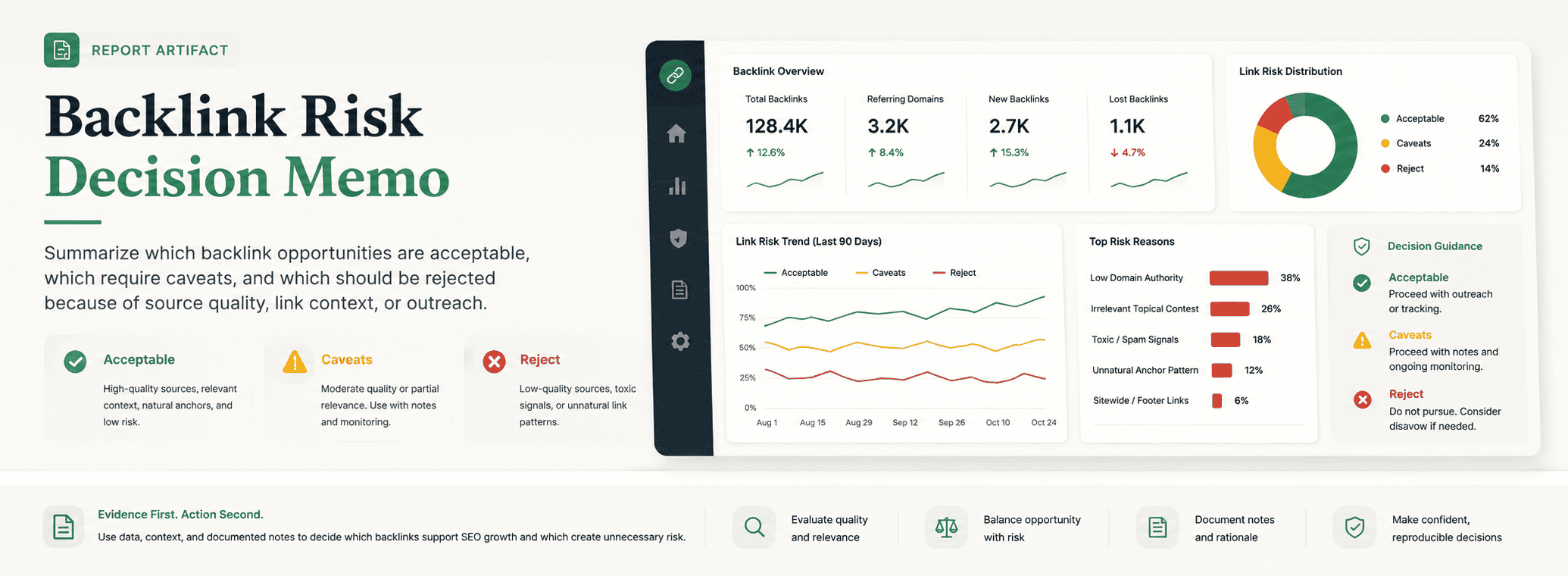
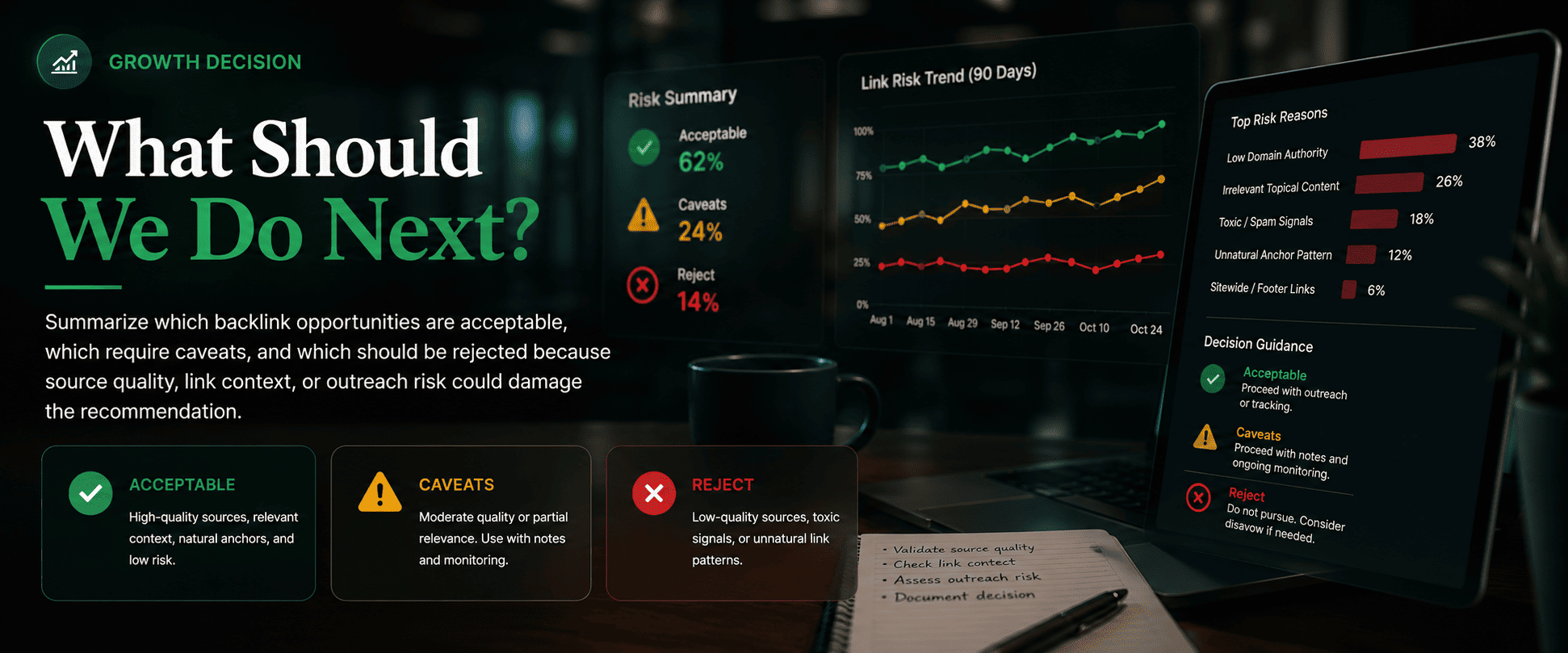
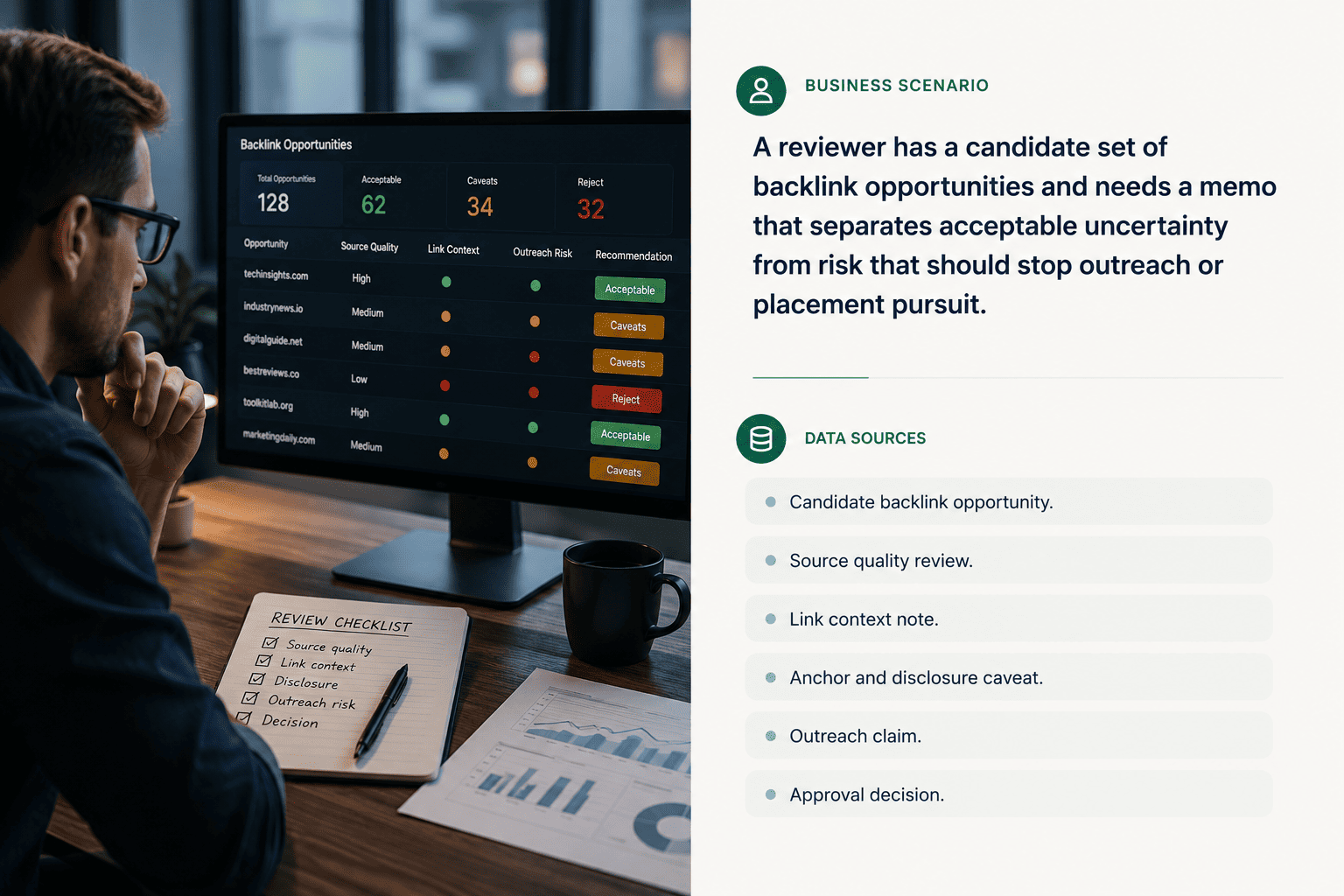
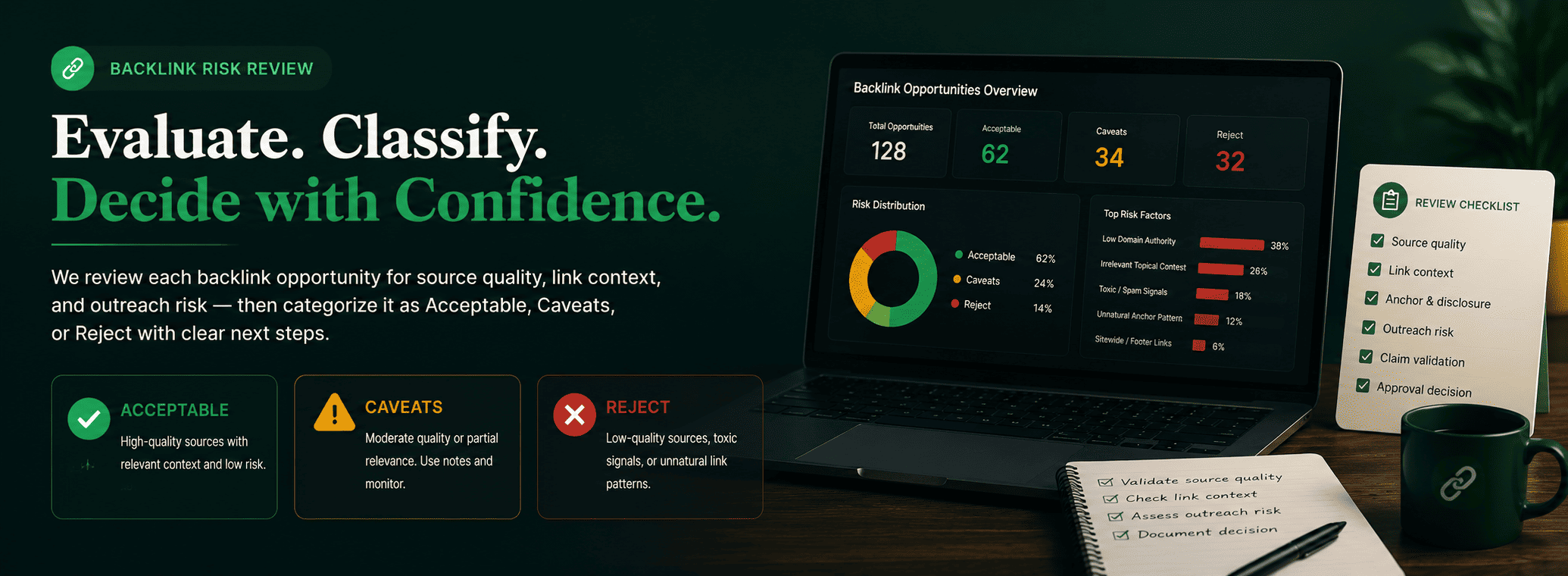
A Backlink Risk Decision Memo is a structured review document used to evaluate whether a backlink opportunity should move forward, remain under review, require revision, or be rejected entirely. Before outreach begins, SEO teams need evidence that the source, placement context, anchor strategy, and outreach approach support long-term authority growth without introducing unnecessary risk.
The purpose of the memo is not to count backlink opportunities. Its purpose is to determine whether a proposed backlink can be pursued safely, whether caveats remain unresolved, and whether the opportunity supports a legitimate SEO objective.
Backlink Opportunity Classification
Not every backlink opportunity carries the same value or risk profile. The first step of the review process is classifying the opportunity based on how the link would be acquired and the role it serves within the referring site.
- Useful editorial citation.
- Relationship-based mention.
- Directory or listing placement.
- Contributed content opportunity.
- Low-value or weak-source placement.
- Reject-worthy opportunity.
The memo should clearly document why the opportunity belongs to a specific category and how that classification affects risk and expected value.
Source Quality and Editorial Review
Source quality remains one of the most important factors in backlink evaluation. A link opportunity should be assessed based on audience value, editorial standards, topical relevance, and long-term credibility rather than domain metrics alone.
The review should evaluate:
- Topical relevance to the target website.
- Editorial review standards.
- Content quality consistency.
- Audience legitimacy and engagement.
- Historical publishing patterns.
If source quality cannot be verified, the recommendation should remain approval-gated until additional evidence is collected.
Link Context and Placement Analysis
The value of a backlink depends heavily on where and how it appears. A high-quality source can still create risk when placement feels artificial, misleading, or disconnected from the surrounding content.
- Review whether the link adds value to readers.
- Validate contextual relevance.
- Check surrounding content quality.
- Evaluate placement visibility and usefulness.
- Identify signs of engineered or manipulative linking.
Links that exist primarily for ranking influence rather than reader value should be flagged for revision or rejection.
Anchor Text Risk Assessment
Anchor text should accurately describe the destination while maintaining a natural profile across the backlink portfolio. Over-optimized anchor patterns can introduce unnecessary risk and distort the intent of the recommendation.
- Review branded anchor distribution.
- Identify exact-match concentration.
- Evaluate commercial keyword usage.
- Assess contextual anchor relevance.
- Document anchor-related caveats.
The memo should explain whether the proposed anchor strategy supports a natural linking pattern or requires adjustment before outreach proceeds.
Outreach Claims and Disclosure Validation
Outreach communication should accurately represent the relationship between the parties involved. Unsupported claims about partnerships, endorsements, authority, or performance can introduce both reputational and operational risk.
- Review outreach messaging accuracy.
- Validate disclosure requirements.
- Identify unsupported authority claims.
- Confirm relationship descriptions.
- Document communication caveats.
Any outreach approach that depends on misleading positioning should remain on hold until corrected.
Approval, Monitor, Hold, and Reject Decisions
The final responsibility of the Backlink Risk Decision Memo is to produce a decision-ready outcome. Every opportunity should conclude with a clearly documented recommendation.
- Approve: Source quality, context, and outreach approach support the opportunity.
- Monitor: Opportunity is acceptable but requires observation.
- Revise: Adjustments are required before outreach begins.
- Hold: Evidence is incomplete or risk remains unresolved.
- Reject: The opportunity introduces unacceptable risk.
A complete Backlink Risk Decision Memo should document opportunity classification, source quality findings, placement analysis, anchor-text considerations, outreach caveats, approval status, ownership, and next-step recommendations. This ensures backlink decisions remain evidence-driven before resources are committed to acquisition efforts.