What Is a GA4 Foundation Acquisition Signal Memo?
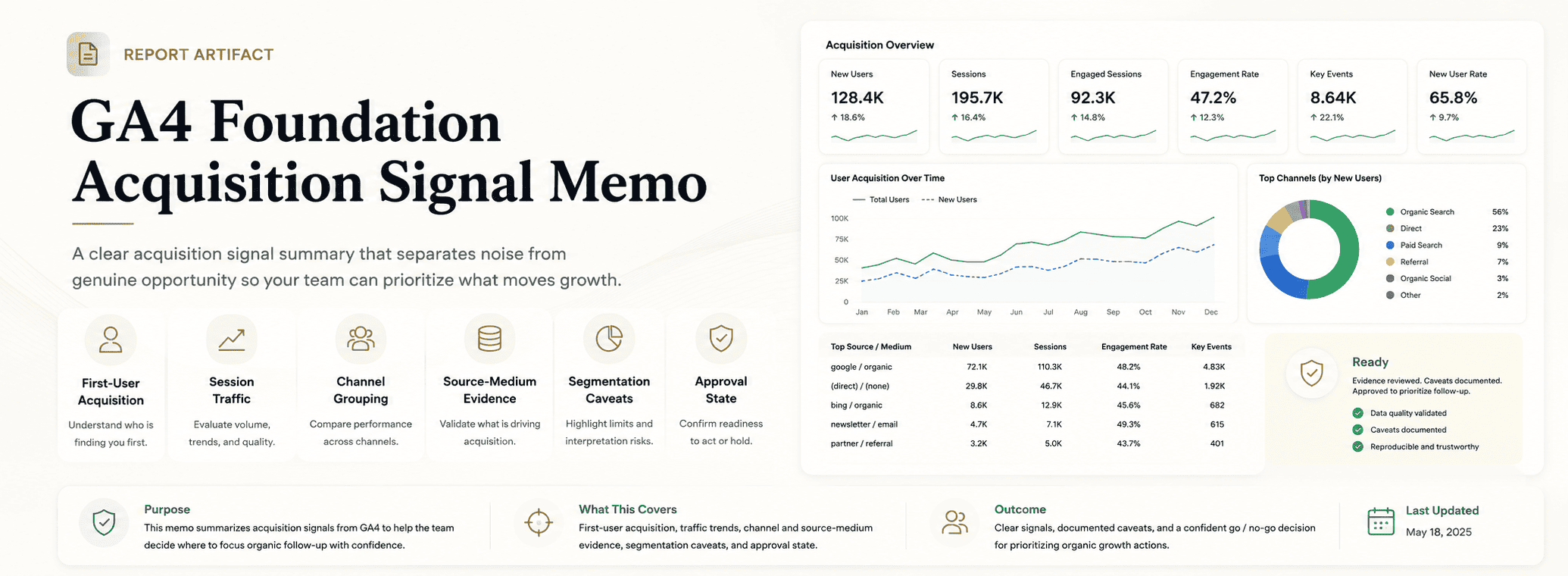
A GA4 Foundation Acquisition Signal Memo is a structured review document used to determine whether acquisition data is reliable enough to support SEO prioritization, traffic analysis, reporting decisions, or growth investigations. Before teams react to traffic movement, they need confidence that acquisition signals accurately represent user behavior rather than reporting artifacts, attribution inconsistencies, or configuration issues.
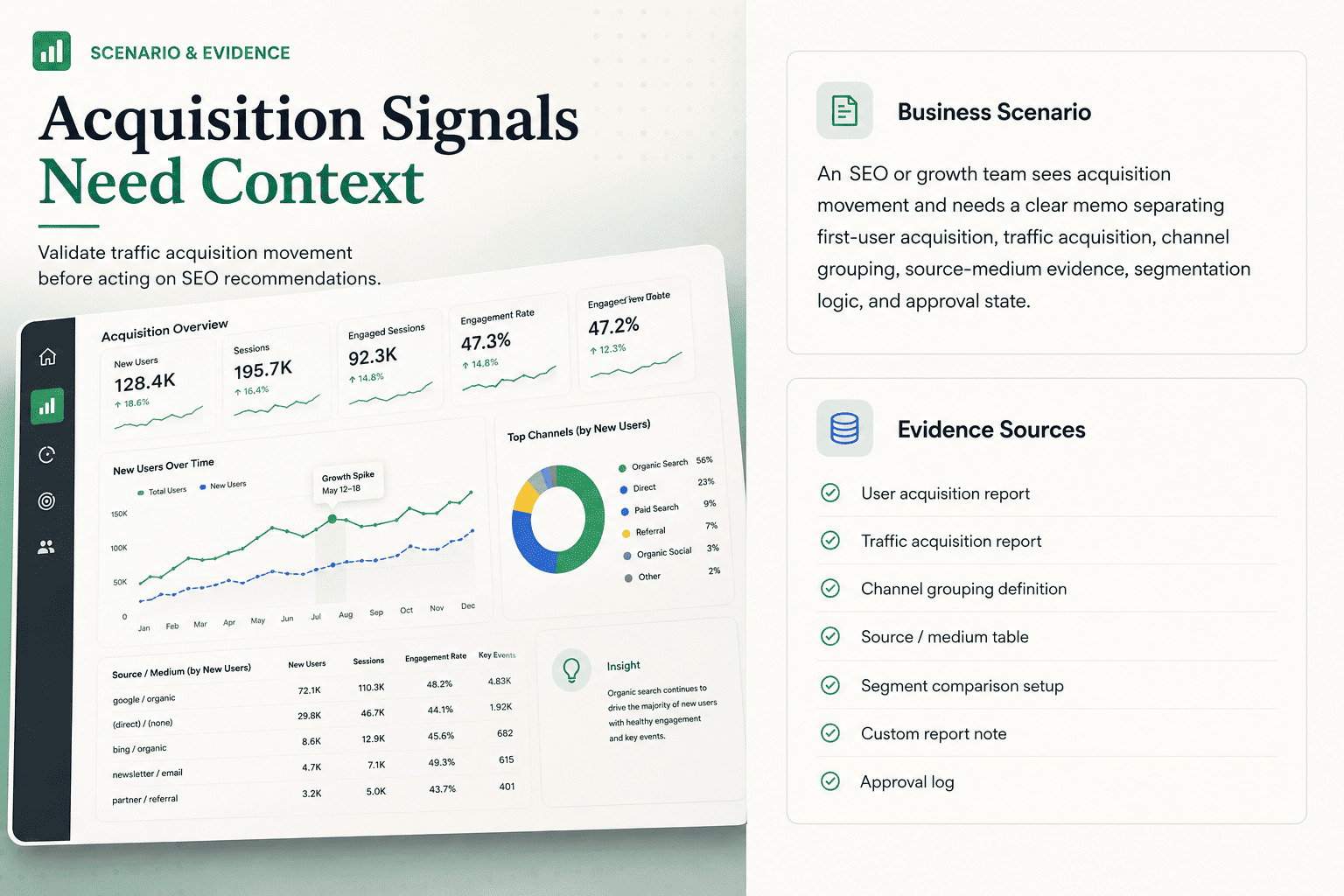
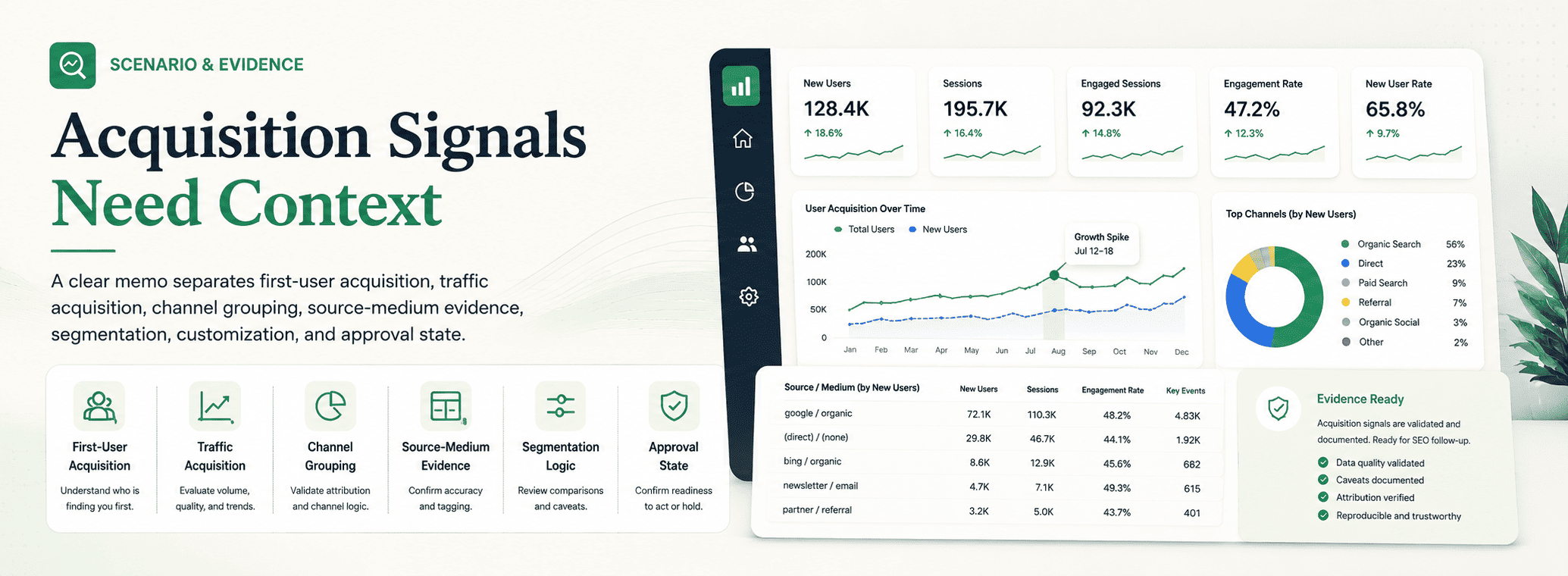
The memo separates first-user acquisition, traffic acquisition, channel grouping, source-medium evidence, segmentation logic, report customization, and approval status into a single decision framework. Its purpose is not to summarize traffic trends. Its purpose is to determine whether the acquisition signal is trustworthy enough to influence the next action.
First-User Acquisition vs Traffic Acquisition
One of the most common causes of acquisition analysis errors is treating first-user acquisition and traffic acquisition as interchangeable metrics. These reports answer different questions and should not automatically be interpreted as the same growth signal.
- First-user acquisition explains where users originally discovered the website.
- Traffic acquisition explains how sessions are currently arriving.
- Differences between the reports may indicate attribution complexity rather than growth opportunities.
- SEO decisions should account for the reporting scope being used.
- The memo should document when acquisition stories diverge.
If first-user and traffic-acquisition findings support different conclusions, the recommendation should remain approval-gated until the discrepancy is explained.
Channel Grouping and Source-Medium Validation
Channel growth signals should never be interpreted without validating how traffic sources are classified. Default channel groups provide useful summaries, but source-medium evidence is often required before assigning business meaning to a reported change.
The memo should review:
- Default channel grouping definitions.
- Source-medium relationships.
- Campaign tagging consistency.
- Referral classification accuracy.
- Organic search attribution integrity.
A channel increase is not automatically an SEO opportunity. The acquisition memo should verify whether source-level evidence supports the reported movement before follow-up work is approved.
Segmentation and Comparison Review
Acquisition findings often depend on segments, comparisons, filters, and date selections. Without documenting these configurations, the same report may produce different conclusions when reviewed by another stakeholder.
- Validate audience segments used during analysis.
- Review comparison settings and date ranges.
- Document report-level filters.
- Identify excluded traffic sources.
- Confirm findings remain consistent across comparable views.
The memo should clearly state which segmentation decisions influenced the reported acquisition signal and whether those choices introduce interpretation risk.
Report Reproducibility and Customization Controls
A reliable acquisition signal should be reproducible by another analyst using the same reporting configuration. Customized reports, hidden dimensions, modified channel groupings, and saved explorations can introduce interpretation challenges when documentation is incomplete.
- Review customized report settings.
- Validate saved exploration logic.
- Identify hidden dimensions or filters.
- Document channel-group modifications.
- Record configuration details required for reproduction.
If another reviewer cannot reproduce the acquisition finding, the recommendation should remain on hold until documentation is completed.
SEO Opportunity Validation
Acquisition movement often creates pressure to adjust pages, content priorities, technical SEO initiatives, or reporting workflows. However, not every acquisition signal represents an actionable SEO opportunity.
The acquisition memo should evaluate whether:
- The movement is statistically meaningful.
- Organic search contributed to the change.
- Traffic quality supports the observed increase.
- Engagement signals reinforce the acquisition finding.
- The proposed SEO action matches the available evidence.
This prevents teams from treating temporary traffic fluctuations as confirmed growth opportunities.
Approval, Hold, and Evidence Requests
The final purpose of the GA4 Foundation Acquisition Signal Memo is to produce a decision-ready outcome. Every acquisition finding should end with an approval state and a named owner responsible for the next action.
- Approve: Acquisition evidence supports the recommended follow-up.
- Hold: Caveats exist that materially affect interpretation.
- Request Evidence: Additional validation is required before prioritization.
A complete memo should summarize acquisition findings, segmentation caveats, source-medium evidence, channel interpretation, reproducibility notes, approval status, ownership, and next-step recommendations. This structure ensures acquisition signals remain evidence-driven before SEO resources are committed.