Growth Reporting Executive Memo Clarity
Decide whether an executive reporting memo makes the decision, evidence, caveat, and requested approval clear enough before the team changes priorities.
Decide whether an executive reporting memo makes the decision, evidence, caveat, and requested approval clear enough before the team changes priorities.
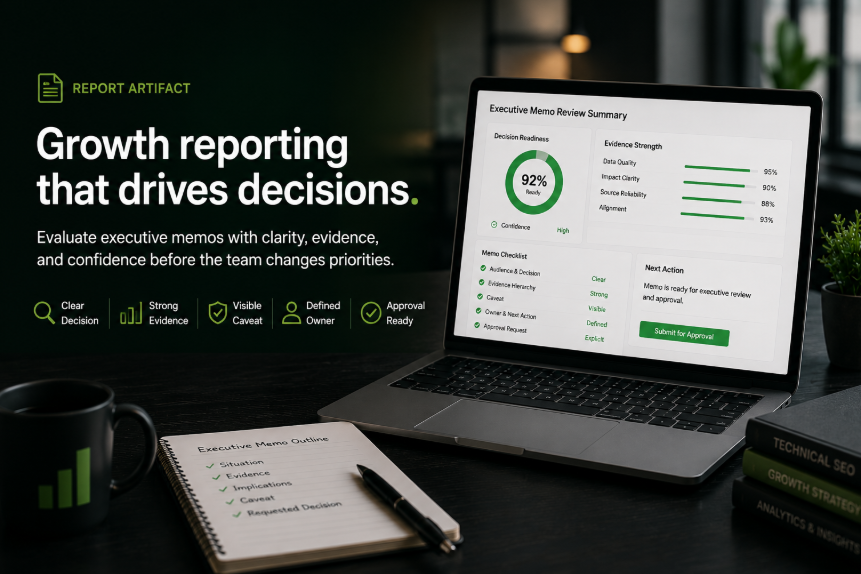
Three steps to a confident decision
Understand which business situation this page was built for and confirm it matches your current context.
Go item by item — each check has a clear pass/hold condition so you know exactly what qualifies.
Use the growth decision statement and analyst questions to brief your team and move forward with confidence.

Growth Reporting Executive Memo Clarity
Decide whether an executive reporting memo makes the decision, evidence, caveat, and requested approval clear enough before the team changes priorities.

What this page helps a team decide
The SEO lead needs to brief executives or growth leads on a reporting recommendation, but the memo must make the audience, action, evidence hierarchy, caveat, and approval request obvious before follow-up moves forward, so the review should tie the answer to the page, link, or indexation decision.
- Executive brief.
- Reporting memo.
- Dashboard export.
- Analytics extract.
- Reviewer notes.
- Approval log.
What analysts ask before deciding
What decision is the SEO lead trying to make for growth reporting executive clarity: approve, hold, or send back for evidence?
Which input would make the marketer trust the growth reporting executive clarity read enough to change the page, link, or indexation decision?
What caveat should stay visible before the team changes the page, link, or indexation decision?
Who owns the next action if the review is approved, and what stays on hold if it is not?
What usually goes wrong
- The SEO lead treats executive audience and desired action as settled before checking name the executive reader, the requested decision, and the action that should change if the memo is approved.
- The recommendation skips the narrative flow caveat, so the next step looks safer than the evidence allows.
- Follow-up moves forward before the action title and evidence match approval rule is accepted.
What 10x.in checks
- Name the executive reader, the requested decision, and the action that should change if the memo is approved.
- Arrange the memo so the reader can follow the situation, evidence, implication, caveat, and requested approval without hunting.
- Use section titles that state the takeaway and make the supporting evidence prove that takeaway.
- Choose memo, slide, or dashboard density based on whether the artifact will be read, presented, or monitored.
- Test whether the memo can be stated plainly with the caveat and approval request intact.
OpenAnalyst should review Growth Reporting Executive Memo Clarity, compare the decision evidence with the caveats, and keep the next recommendation approval-gated until the reviewer accepts it.
FAQ
What must be clear before an executive reporting memo is ready?
The memo must identify the reader, requested decision, evidence hierarchy, caveat, owner, and approval state before it asks the team to change priorities. In this review, the answer should be tied back to the operating rule rather than left as advice. The analyst should state what changes, what stays held, and what evidence would make the recommendation stronger.
When should the memo stay in review instead of going to executives?
Keep it in review when the action is unclear, the evidence order hides the caveat, or the memo asks for approval before explaining the decision risk. In this review, the answer should be tied back to the operating rule rather than left as advice. The analyst should state what changes, what stays held, and what evidence would make the recommendation stronger.
How do action titles improve memo clarity?
Action titles make the takeaway reviewable by stating the claim each section supports, so the reviewer can compare the title against the evidence and caveat. In this review, the answer should be tied back to the operating rule rather than left as advice. The analyst should state what changes, what stays held, and what evidence would make the recommendation stronger.
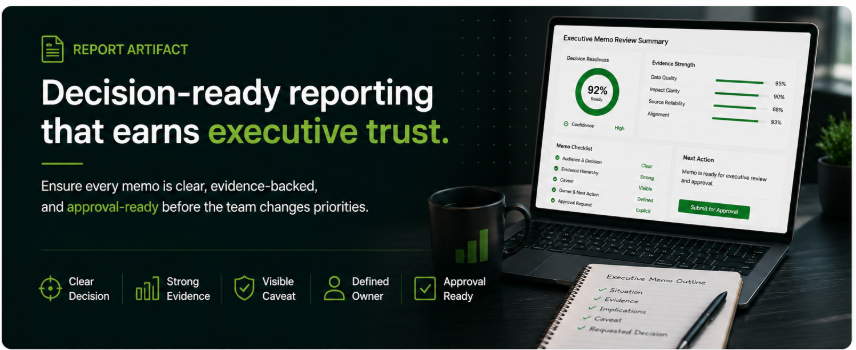
What this report artifact decides
This report artifact helps an SEO lead, growth analyst, or reporting owner decide whether an executive reporting memo is clear enough to support a business decision before the organization changes priorities, budgets, implementation order, or reporting expectations.
The review is not only about whether the reporting is technically accurate. It is about whether the memo communicates the recommendation clearly enough for executives, department leads, or stakeholders to understand the situation, the supporting evidence, the remaining uncertainty, and the requested approval action without needing additional clarification meetings.
In this workflow, the memo should explain what changed, why it matters, what evidence supports the recommendation, what caveat still exists, who owns the next action, and what should remain on hold until approval is granted.
Why executive memo clarity matters
Executive reporting often fails because the recommendation is buried under dashboards, charts, exports, or narrative context. Stakeholders may understand the metrics but still not understand the actual decision being requested.
A strong executive memo reduces ambiguity by making the recommendation reviewable. The audience should be able to identify:
- The exact decision being requested.
- The evidence supporting the recommendation.
- The caveat or uncertainty that still exists.
- The operational risk if the recommendation is ignored.
- The owner responsible for the next action.
- The approval state required before follow-up begins.
Without those elements, reporting becomes informational instead of operational, which creates delays, misalignment, or priority confusion across SEO, analytics, growth, product, or executive teams.
When to use this workflow
Use this review when an SEO or growth team needs to present a recommendation to leadership, but the organization must confirm that the reporting memo is decision-ready before stakeholders act on it.
Common scenarios include:
- An SEO lead wants approval to change content priorities.
- A growth analyst recommends reallocating investment toward a higher-performing channel.
- A reporting team needs executive approval before technical implementation begins.
- A weekly or monthly growth review introduces a major caveat or performance concern.
- An analytics review recommends holding, pausing, or accelerating a campaign or initiative.
The workflow becomes especially important when executives are reviewing multiple reports quickly and may not inspect raw dashboards, exports, or supporting evidence directly.
Inputs the analyst should inspect
The reviewer should compare the recommendation against multiple reporting inputs before approving the memo for executive distribution.
- Executive brief
- Reporting memo
- Dashboard export
- Analytics extract
- Reviewer notes
- Approval log
No single dashboard or export should determine the recommendation alone. The memo should connect evidence together into a reviewable narrative that executives can evaluate quickly.
How to evaluate the memo
1. Confirm the audience and requested decision
The memo should clearly identify who the executive reader is and what action they are being asked to approve.
For example:
- Approve increased investment in organic growth.
- Hold implementation until tracking reliability improves.
- Prioritize technical SEO fixes before content expansion.
- Pause a campaign because attribution evidence is incomplete.
If the requested action is unclear, the recommendation should remain in review.
2. Review the evidence hierarchy
The memo should organize evidence in a way that supports the decision logically.
The reader should understand:
- What happened.
- What evidence supports the observation.
- Why the evidence matters.
- What uncertainty still exists.
- What approval is being requested.
Executive readers should not need to search through dashboards or appendices to identify the recommendation.
3. Keep the caveat visible
Strong reporting does not hide uncertainty. A memo should state the caveat directly and explain how it affects confidence in the recommendation.
Examples include:
- Tracking delays.
- Partial attribution visibility.
- Incomplete crawl coverage.
- Sample-size limitations.
- Conflicting analytics sources.
The recommendation should remain approval-gated until the reviewer accepts the remaining uncertainty.
4. Confirm ownership and approval state
The memo should identify:
- Who owns the next action.
- What changes if the recommendation is approved.
- What remains on hold if the recommendation is rejected.
This prevents the memo from becoming advisory content without operational accountability.
Checks before approval
- Name the executive reader and requested decision clearly.
- Arrange the memo so the evidence supports the recommendation logically.
- Use section titles that communicate takeaways instead of generic labels.
- Make the caveat visible near the recommendation.
- Ensure the approval request is explicit and reviewable.
- Verify that the recommendation matches the evidence hierarchy.
- Confirm that ownership and follow-up responsibilities are visible.
Common failure modes
- The memo assumes executives already understand the operational context.
- The recommendation appears before the evidence is explained.
- The caveat is hidden in supporting notes or appendices.
- The reporting artifact contains too much dashboard detail without a clear takeaway.
- The memo asks for approval without identifying operational risk.
- The next owner or approval state is missing.
Recommended output
The final memo review should include:
- The requested decision.
- The intended audience.
- The evidence hierarchy.
- The operational implication.
- The remaining caveat.
- The owner responsible for follow-up.
- The approval state.
This structure keeps the recommendation actionable, reviewable, and operationally aligned across executive, growth, SEO, analytics, and implementation teams.
OpenAnalyst should keep recommendations approval-gated until the reviewer accepts the evidence, caveat, owner, and operational implication.
What happens next
If the memo is approved, the organization can move forward with the recommended change, escalation, implementation, or reporting action using the documented evidence and approval state.
If the memo is not approved, the team should hold follow-up activity until the recommendation, evidence hierarchy, caveat, and ownership structure become clear enough for executive review.
The goal of this workflow is not only better reporting. The goal is decision-ready reporting that reduces ambiguity before the organization changes priorities or commits resources.