Product Analytics Decision Memo
Summarize whether product analytics evidence supports a product, growth, or reporting recommendation and what must stay caveated before action.
Summarize whether product analytics evidence supports a product, growth, or reporting recommendation and what must stay caveated before action. The proof gate for this route is: Product analytics memo with decision question, evidence summary, caveat, recommendation, owner, and approval state.. The page is not asking the analyst to produce a generic audit. It is asking for a decision-ready product analytics memo that can be reviewed by a product, analytics, or growth owner.
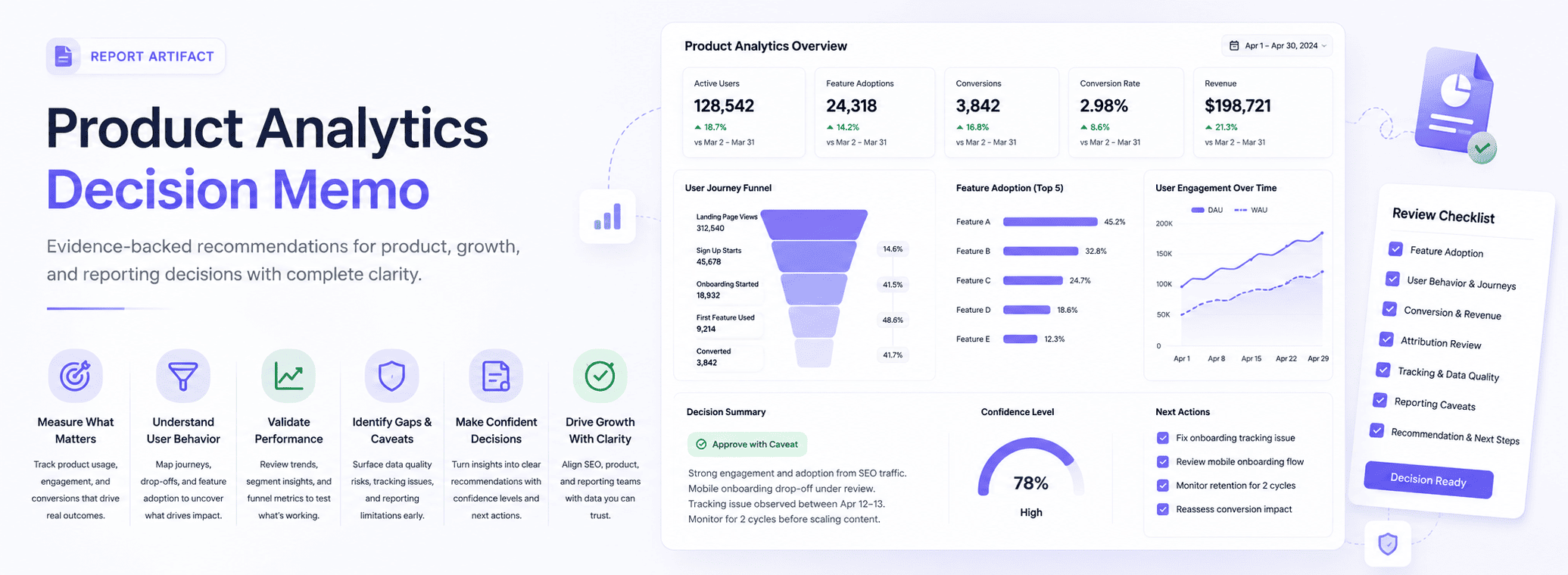
Three steps to a confident decision
Understand which business situation this page was built for and confirm it matches your current context.
Go item by item — each check has a clear pass/hold condition so you know exactly what qualifies.
Use the growth decision statement and analyst questions to brief your team and move forward with confidence.
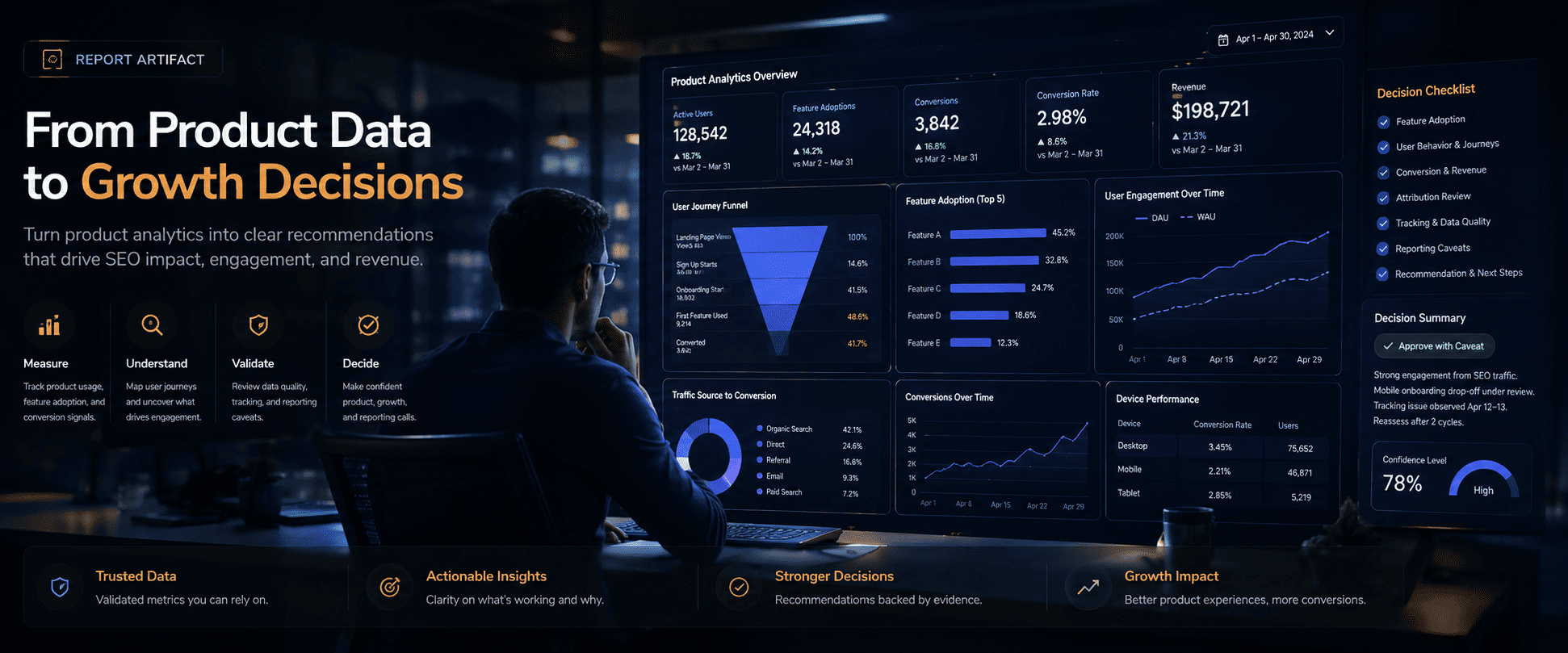
Product Analytics Decision Memo
Summarize whether product analytics evidence supports a product, growth, or reporting recommendation and what must stay caveated before action. The proof gate for this route is: Product analytics memo with decision question, evidence summary, caveat, recommendation, owner, and approval state.. The page is not asking the analyst to produce a generic audit. It is asking for a decision-ready product analytics memo that can be reviewed by a product, analytics, or growth owner.
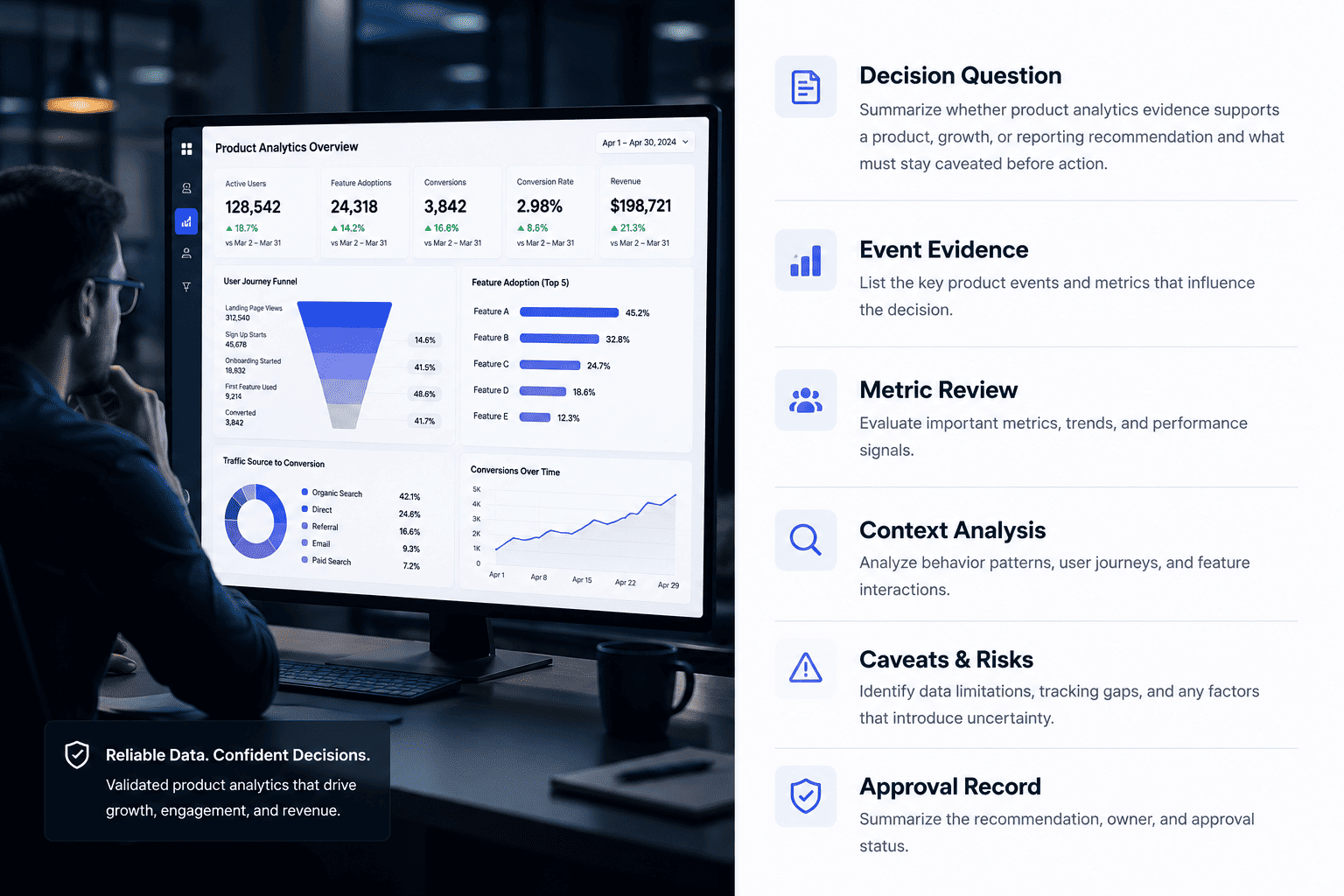
What this page helps a team decide
The ecommerce marketer needs a concise decision memo that converts product behavior evidence into a reviewed recommendation with data caveats, owner, and next step before changing the page, link, or indexation decision.
- decision question
- event evidence
- metric readout
- cohort analysis
- analysis notes
- business context
- approval record
What analysts ask before deciding
What decision is the ecommerce marketer trying to make for product analytics: approve, hold, or send back for evidence?
Which input would make the marketer trust the product analytics read enough to change the page, link, or indexation decision?
What caveat should stay visible before the team changes the page, link, or indexation decision?
Who owns the next action if the review is approved, and what stays on hold if it is not?
What usually goes wrong
- The report artifact is treated as generic content instead of a growth decision.
- The recommendation skips the source caveat, so the next step looks safer than the evidence allows.
- Follow-up moves forward before the reviewer accepts the approval rule.
What 10x.in checks
- Start with the decision question, owner, and action boundary before reading product metrics.
- Tie each evidence point to the decision and name the caveat that could reverse it.
- Make the recommendation, owner, approval state, and monitoring requirement explicit.
OpenAnalyst should review Product Analytics Decision Memo, compare the decision evidence with the caveats, and keep the next recommendation approval-gated until the reviewer accepts it.
FAQ
What makes the decision memo useful?
It starts with one decision question and then maps evidence, caveats, owner, and approval state to that decision. A memo that only summarizes dashboards is not specific enough to approve action. The practical test is whether the evidence, caveat, and owner are clear enough for a reviewer to approve the next step without guessing.
How should caveats appear in the memo?
Caveats should be part of the evidence matrix, not hidden at the end. The reviewer needs to see which caveat could reverse the recommendation before approving the next step. The practical test is whether the evidence, caveat, and owner are clear enough for a reviewer to approve the next step without guessing.
When is evidence adjacent but not decision-driving?
Evidence is adjacent when it describes related behavior but does not support the proposed action. In that case, the memo should write a caveated read and request the evidence that would actually change the decision. The practical test is whether the evidence, caveat, and owner are clear enough for a reviewer to approve the next step without guessing.
Can the memo approve multiple action types at once?
Only if each action has its own owner and approval state. Product, tracking, reporting, and campaign actions should not be bundled into one vague next step. The practical test is whether the evidence, caveat, and owner are clear enough for a reviewer to approve the next step without guessing.
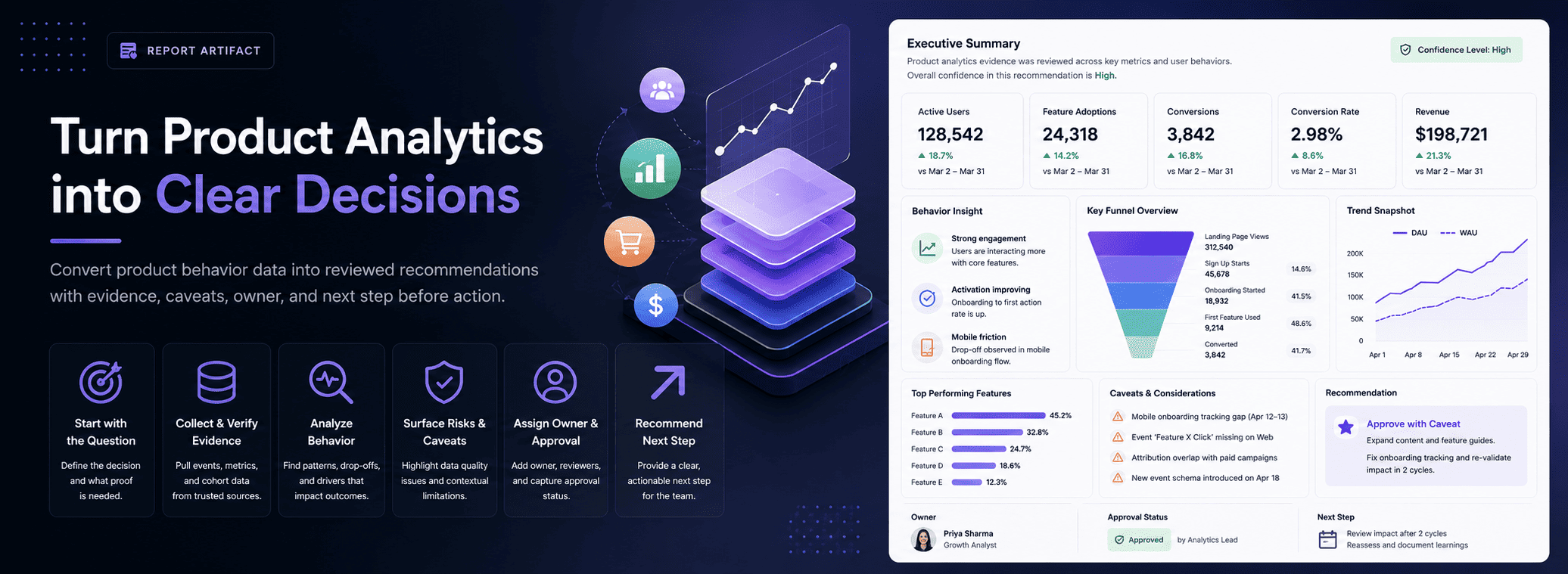
What this diagnostic workflow decides
A Shopify collection page should not receive SEO priority just because it targets a category keyword. The page has to be the right owner for the search intent, the product grid has to support the buyer’s job, and the evidence has to show that improving the page is likely to matter. This diagnostic workflow helps an ecommerce team decide whether a collection page should be approved for SEO work, held until more evidence is available, or sent back because another page type should own the demand.
The decision matters because collection pages often sit at the intersection of SEO, merchandising, internal linking, conversion, and reporting. A change to the collection description, product ordering, indexation, FAQ block, or internal links can affect how shoppers understand the category and how search engines interpret the page. The goal is not to make every collection page longer. The goal is to decide which collection pages deserve focused SEO attention because they match buyer intent and have enough commercial evidence to justify the work.
When a Shopify collection page deserves SEO priority
A Shopify collection page deserves SEO priority when the query demand is category-led, the page can satisfy the buyer’s comparison or selection need, and the store has enough product coverage to make the page useful. If the searcher is looking for a group of products, a collection page may be the right destination. If the searcher is looking for one exact product, model, ingredient, feature, or SKU, a product page or supporting article may be a better owner.
The review should start with search intent ownership. The team should look at the query and keyword table, current ranking URLs, and the collection page inventory to confirm whether search demand belongs to a collection page. A collection page is stronger when the searcher expects to browse options, compare styles, evaluate use cases, or choose between product types.
- Approve SEO priority when the query is category-led, the collection has enough product coverage, and the page can help buyers choose between relevant options.
- Hold the recommendation when the opportunity looks real but the team does not yet have enough traffic, revenue, product-fit, or internal-link evidence.
- Send the review back when the query appears to belong to a product page, article, comparison page, or another collection with stronger intent alignment.
Priority also depends on commercial usefulness. A collection with organic impressions but poor product fit may not be ready for more SEO investment. A page with fewer visits but strong revenue context, clear buyer intent, and strong internal-link opportunities may deserve attention sooner. The workflow should separate visibility from value. Traffic shows that searchers can reach the page. It does not prove that the page is the right commercial priority.
Inputs the reviewer should check before approval
The review should use evidence from the collection page inventory, query data, Search Console, GA4, product coverage notes, collection content blocks, internal link maps, order context, and the approval log. Each input answers a different part of the decision.
- Collection page inventory: Confirms which Shopify collection URL is being reviewed and whether similar collections compete for the same demand.
- Query and keyword table: Shows whether the search demand is broad, category-led, comparison-led, or product-specific.
- Search Console page data: Shows impressions, clicks, query patterns, and whether the existing page already has organic visibility.
- GA4 organic traffic data: Helps the reviewer understand whether users who land on the page behave like qualified shoppers.
- Product coverage notes: Shows whether the collection has enough relevant products to satisfy the buyer’s expectation.
- Collection content blocks: Checks whether the page explains selection criteria, value, objections, and use cases without becoming generic filler.
- Internal link map: Reviews whether the collection has enough contextual and navigational support from related pages.
- Order context: Adds revenue evidence before the page is treated as a commercial SEO priority.
- Approval log: Records the decision, caveat, owner, and next step before implementation begins.
The internal link map is especially important. A collection page may be a good SEO opportunity but still lack enough internal support to perform well. If the page is buried, linked with vague anchor text, or disconnected from related buying paths, content edits alone may not solve the problem. The reviewer should check whether relevant category pages, product pages, buying guides, and navigation elements support the collection.
Order context and revenue evidence help the team avoid prioritizing pages only because they have keyword volume. If a collection attracts visits but the products do not match buyer expectations, the recommendation should stay cautious. If the page has commercial value but weak visibility, SEO work may be justified when the collection has strong product fit and internal-link support.
How to judge the collection page itself
A strong Shopify collection page does more than list products. It helps the shopper understand why this collection exists, which products belong in it, how to choose between options, and what objections should be resolved before purchase. The page should support the buyer’s decision without distracting from the product grid.
The reviewer should check whether the collection explains the category clearly. For simple product groups, a short description may be enough. For complex or high-consideration categories, the page may need comparison points, selection guidance, use cases, FAQs, and stronger internal links. The right level of content depends on the buyer’s need, not on a fixed word count.
- Does the collection page match the target search intent better than a product page or article?
- Does the visible product set support the promise of the query?
- Does the page help buyers compare options without turning into a generic blog post?
- Does the collection content answer the objections that would slow down a purchase?
- Do internal links help users and search engines understand why this page matters?
- Is there enough revenue or order context to justify prioritizing this page now?
The product grid should also match the search intent. If the query suggests a specific style, use case, price range, size, ingredient, or compatibility requirement, the visible products should support that expectation. If the grid feels too broad, too thin, or mismatched, adding SEO copy will not fix the buyer experience. In that case, the recommendation may need merchandising input before content work begins.
The page should also avoid turning into a generic article. A collection page can include useful guidance, but it still has to behave like a shopping page. The content should help users choose products, understand differences, and move toward purchase. If the content becomes disconnected from the product set, the page may lose clarity for both shoppers and search engines.
Approve, hold, or send back for evidence
The output of this workflow should be a clear decision: approve, hold, or send back for evidence. Approval means the reviewer accepts that the collection page is the right owner for the search demand and that the next SEO action is justified. The next action may involve rewriting the collection description, adding buyer-focused FAQs, improving internal links, adjusting content blocks, or documenting indexation and reporting expectations.
- Approve: The collection page is the right owner for the query, has enough product coverage, and has evidence to support SEO priority.
- Hold: The page may deserve attention, but the team needs more query, traffic, revenue, product-fit, or internal-link evidence.
- Send back: The recommendation is missing a required proof point or assigns the demand to the wrong page type.
A hold decision means the opportunity may be real, but the evidence is not strong enough yet. The team may need more Search Console data, GA4 context, product coverage notes, internal-link review, or revenue evidence before changing the page. Holding the recommendation is useful when the risk of acting too early is higher than the cost of waiting.
A send-back decision means the recommendation is missing a required proof point or appears to assign the query to the wrong page type. For example, if the demand is product-specific, the reviewer may send the recommendation toward a product page SEO conversion review instead. If the issue is weak internal support, the next step may belong in an internal link architecture review. If the main question is whether the opportunity is commercially meaningful, the team may need an organic revenue signal review before approving collection page work.
Common failure modes to avoid
The biggest failure is treating the workflow as a generic content task. A Shopify collection page SEO priority review is a growth decision, not a writing assignment. The team should not approve page changes just because a keyword exists or because a competitor has more text on a similar page.
- Generic content approval: The team approves more copy without proving that the collection page should own the search demand.
- Hidden caveat: The recommendation skips uncertainty, making the next step look safer than the evidence allows.
- Weak product fit: The collection ranks or receives impressions, but the product grid does not satisfy the buyer’s job.
- Missing internal-link support: The page is treated as a priority, but related pages do not reinforce it.
- Premature implementation: Copy, links, FAQs, or templates change before the reviewer accepts the approval rule.
Another common failure is hiding the caveat. If the evidence is incomplete, the recommendation should say so clearly. A reviewer should be able to see what is observed, what is uncertain, and what still needs approval. This is especially important when the next step could affect merchandising, page templates, internal links, or reporting expectations.
A third failure is moving into implementation before the approval rule is accepted. OpenAnalyst should produce a reviewable content and priority note, then wait for the page owner to approve the update. This keeps diagnosis separate from implementation and prevents the team from changing collection pages without agreement on the evidence.
Reviewer checklist for Shopify collection page SEO priority
Before the page owner approves SEO work, the reviewer should confirm that the recommendation is specific, evidence-backed, and connected to a clear next action. The checklist should make the decision easy to audit later.
- Confirm the collection page is the right owner for the target search intent.
- Check whether search demand belongs to a collection page rather than a product page or supporting article.
- Review whether the collection explains enough value, selection criteria, and objections for the buyer’s intent.
- Check whether the visible product set and support content satisfy the buyer job on the page.
- Connect collection priority with internal-link support and revenue evidence.
- Keep the caveat visible if the evidence does not fully support implementation.
- Assign the next action to the correct owner before copy, links, FAQs, or indexation decisions change.
What should happen after approval
Once the review is approved, the next action should have a clear owner. SEO may own the query intent, content brief, internal-link recommendation, and measurement plan. Ecommerce or merchandising may own product coverage, grid quality, filters, and collection structure. Content may own the collection description, FAQs, and buyer guidance. Analytics may own the reporting view that shows whether the update changes qualified traffic or revenue signals.
- SEO owner: Confirms query intent, priority keyword set, internal-link opportunity, and measurement plan.
- Merchandising owner: Confirms product coverage, collection structure, filters, and visible product fit.
- Content owner: Updates collection copy, FAQs, comparison guidance, and buyer-facing explanations.
- Analytics owner: Tracks organic traffic quality, revenue context, and post-update performance signals.
- Page owner: Approves the final recommendation and keeps the implementation aligned with the decision record.
The approval log should record the decision, source evidence, caveats, owner, and next step. This makes the workflow easier to audit later. If the update improves visibility but not buyer quality, the team can revisit product fit, internal links, or conversion context. If the page improves qualified traffic and revenue signals, the same diagnostic pattern can be applied to other collection pages in the store.
The best outcome is not simply a longer Shopify collection page. The best outcome is a page that deserves to own the search demand, helps buyers choose from the product set, receives the right internal support, and has a clear reason to be prioritized now. This workflow keeps the team focused on that decision before time is spent rewriting copy, changing links, or adjusting the page structure.