Recommendation Currency Review Memo for SEO Decisions and Analytics Follow-Up
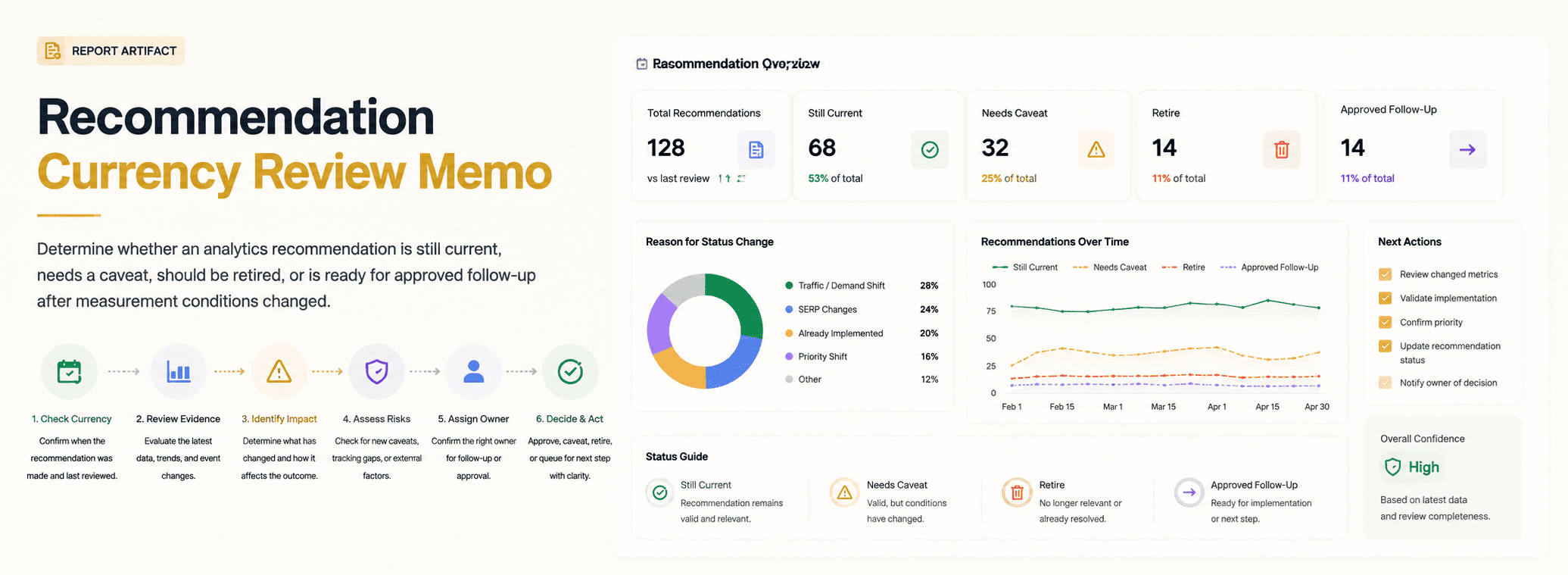
SEO recommendations are often accurate when they are written, but they can lose strength when measurement conditions change. Rankings shift, content gets updated, analytics fields are renamed, CRM connections improve, stakeholder questions change, and business-quality data may confirm or weaken the original read. A recommendation currency review memo helps the team decide whether an existing analytics recommendation is still current, needs a caveat, should be retired, or is ready for approved follow-up.
This review is important because an old recommendation should not move into implementation simply because it is still sitting in a backlog. The team needs to know whether the original assumption still matches the current evidence chain. A recommendation from a year ago can still be current if the metric basis, source definition, and business context remain stable. A recommendation from last week can become stale if a tracking change or reporting update changes the meaning of the evidence.
The purpose is not to rewrite every recommendation from scratch. The purpose is to protect decision quality. The memo should restate what was originally recommended, explain what changed, compare old and current evidence, assign a confidence movement, and name the next approved action.
What Recommendation Currency Means
Recommendation currency is the degree to which an analytics recommendation still reflects the latest measurement source, report behavior, business-quality input, and reviewer confidence. It is not based on calendar age alone. Currency depends on whether the evidence that supported the original recommendation still supports the same action today.
A recommendation may remain current when the original metric definition, source configuration, stakeholder need, and business context are unchanged. It may need a caveat when new evidence lowers confidence but does not fully disprove the recommendation. It may need retirement when the old evidence no longer exists in a usable form or the original action is no longer justified.
- Current: The original recommendation still matches the latest evidence and can remain active.
- Caveated: The recommendation may still be useful, but confidence has changed and the limitation must stay visible.
- Retired: The evidence no longer supports the action, or the recommendation has been replaced by a newer decision.
- Approved follow-up: The recommendation has been revalidated and can move into the next action with owner approval.
- Unreviewable: The evidence chain is broken, incomplete, or no longer comparable.
Why This Memo Matters for SEO and Analytics Teams
SEO decisions often depend on evidence from Search Console, GA4, crawl reports, ranking snapshots, CRM states, payment records, and product usage reports. If any of those sources change, the recommendation may need to be reviewed before the team changes a page, internal link, indexation rule, content block, or reporting narrative.
Without a currency review, teams can act on stale assumptions. They may approve a content update for a page whose search opportunity has already changed. They may keep a technical recommendation alive even though the affected URLs were redirected. They may treat an old conversion insight as reliable even though the CRM field or attribution logic has changed. In each case, the issue is not effort. The issue is that the decision is no longer anchored to current evidence.
- Rankings may have moved since the recommendation was written.
- Search demand may have shifted toward a different page type or query pattern.
- Analytics fields may have changed definitions.
- CRM or payment data may now confirm or weaken the original conclusion.
- Stakeholders may be asking a different decision question than before.
- Prior approvals may limit what follow-up work is allowed.
- Implementation may have already changed the original conditions.
Evidence to Include in a Recommendation Currency Review
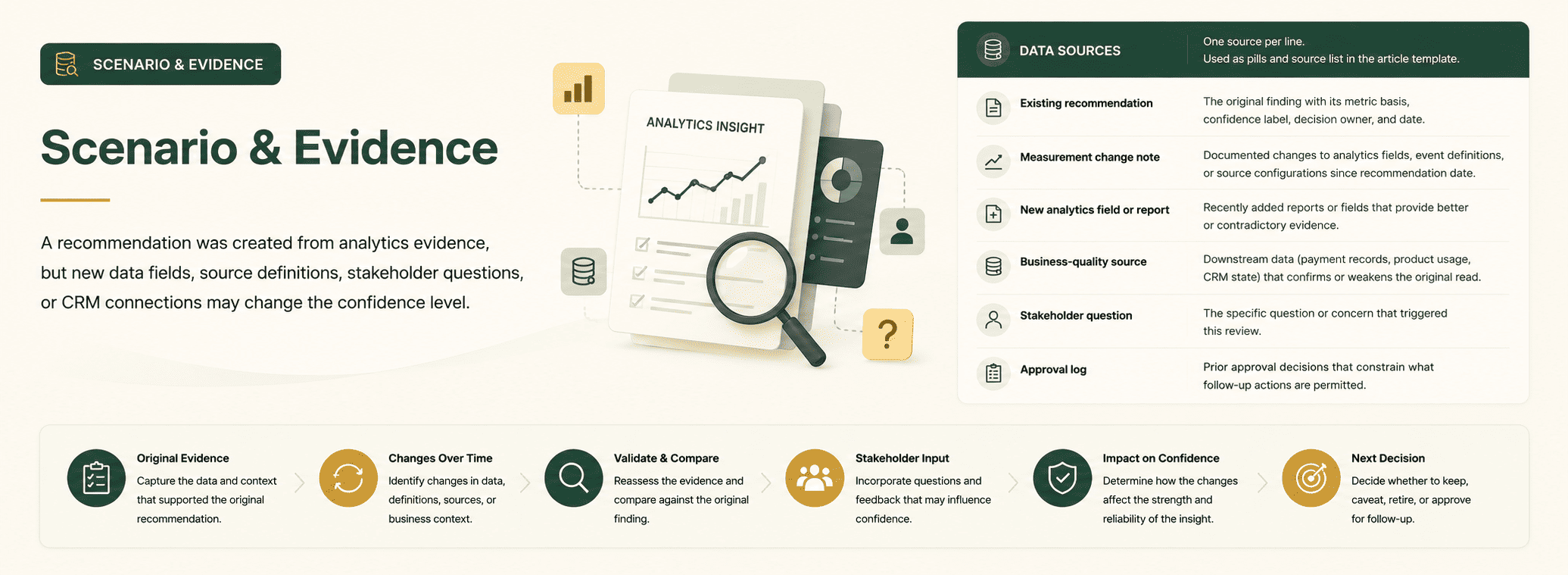
A strong memo should show the reviewer exactly what changed and why that change matters. It should not rely on a vague statement like “data has changed.” The memo should identify the original recommendation, the measurement change, the new evidence, the business-quality source, the stakeholder question, and the approval state.
- Existing recommendation: The original finding, metric basis, confidence label, decision owner, and recommendation date.
- Measurement change note: Any documented changes to analytics fields, event definitions, source settings, or reporting logic.
- New analytics field or report: Any recently added report that provides better, newer, or contradictory evidence.
- Business-quality source: Downstream evidence such as payment records, product usage, lead quality, or CRM state.
- Stakeholder question: The specific concern that triggered the currency review.
- Approval log: Prior decisions that define whether the team can refresh, caveat, retire, retest, or proceed.
The memo should separate observed inputs from assumptions. If Search Console shows a traffic change, say that directly. If the team believes the change is caused by a content update, label that as an interpretation unless the evidence proves it. This distinction keeps the recommendation useful during review because the decision owner can see what is known, what changed, and what still needs validation.
How to Review Recommendation Currency
1. Restate the Original Recommendation
Start by summarizing the recommendation exactly enough that the reviewer understands what action was proposed and why it seemed reasonable at the time. Include the original metric basis, confidence label, owner, and expected outcome. The reviewer should not have to search through old notes to understand the baseline.
- What action was recommended?
- Which metric or source supported it?
- What assumption made the recommendation reasonable?
- Who approved or requested the original review?
- What outcome was expected?
2. Identify What Changed
Next, explain why the recommendation is being reviewed now. The trigger may be a new GA4 report, a Search Console trend, a crawl change, a ranking movement, a CRM update, a release note, or a stakeholder question. The memo should make the trigger visible so the review does not look arbitrary.
3. Compare Old Evidence With Current Evidence
The core of the review is the comparison between the original evidence and the current evidence. This is where the memo should show whether the recommendation became stronger, weaker, unchanged, or unreviewable. The comparison should use the same source where possible, but it should also acknowledge when the source itself changed.
- Compare original and current Search Console trends.
- Check whether GA4 reports still support the same behavior pattern.
- Review crawl reports for current technical status.
- Check ranking snapshots for changed visibility or SERP intent.
- Use CRM, payment, or product usage data to test business quality.
- Review owner comments and timestamps for implementation context.
4. Assign a Currency Status
After comparison, the memo should assign a clear status. This is what turns the review from background analysis into a growth decision. The team should choose refresh, caveat, retire, retest, no change, or approved follow-up rather than rewriting the recommendation by default.
- No change: The recommendation remains current and the original action still fits.
- Refresh: The recommendation is still relevant, but the evidence or scope should be updated.
- Caveat: The recommendation remains useful, but confidence is reduced or conditional.
- Retest: The team needs a new measurement window before approving action.
- Retire: The recommendation no longer supports action.
- Approved follow-up: The recommendation is current and ready for the next owner to act.
When to Add a Caveat Instead of Refreshing
A caveat is useful when new evidence changes confidence but does not prove that the recommendation should be rewritten or retired. For example, a recommendation may still point in the right direction, but a new reporting field may show that the expected impact is smaller than originally believed. In that case, the team can keep the recommendation while making the reduced certainty visible.
This matters because refreshing too early can erase useful institutional memory. The original recommendation may explain why a decision was made, what evidence was available, and what risk the team accepted. A caveat preserves that context while warning future reviewers that the recommendation should not be treated as fully settled.
When to Retire a Recommendation
A recommendation should be retired when the old metric definition, source behavior, stakeholder decision, or business-quality context no longer supports the action it originally justified. Retirement is appropriate when the evidence gap is structural rather than temporary. If the source changed so much that the old and current data cannot be compared, the recommendation should not remain active as if nothing changed.
- The original metric no longer exists in its prior form.
- The affected page, link, or indexation state has already changed.
- The stakeholder decision moved in a different direction.
- Business-quality evidence now contradicts the original read.
- The recommendation has been replaced by a newer approved finding.
What the Reviewer Should See at the End
The final memo should make the next step obvious. A reviewer should be able to see what changed, how confidence moved, what caveat remains, who owns the next action, and what stays on hold if approval is not granted.
- The original recommendation and assumption.
- The changed field, report, source, or stakeholder context.
- The current evidence and business-quality signal.
- The confidence movement: stronger, weaker, unchanged, or unreviewable.
- The currency status: current, caveated, retired, retest, refresh, or approved follow-up.
- The owner responsible for the next action.
- The approval state that controls implementation.
Final Takeaway
A recommendation currency review memo helps SEO and analytics teams avoid acting on stale evidence while preserving recommendations that still support growth. It keeps the decision tied to current measurement conditions instead of backlog age or old confidence labels.
The best review does not rewrite the recommendation by default. It restates the original assumption, compares it against current evidence, names the confidence movement, and assigns a clear next action. That structure helps the team decide whether to keep, caveat, refresh, retire, retest, or approve follow-up with less ambiguity.
When recommendation currency is reviewed carefully, SEO decisions become easier to trust. The team can see what changed, what still holds, and what should happen next before anyone changes a page, link, indexation rule, or reporting narrative.