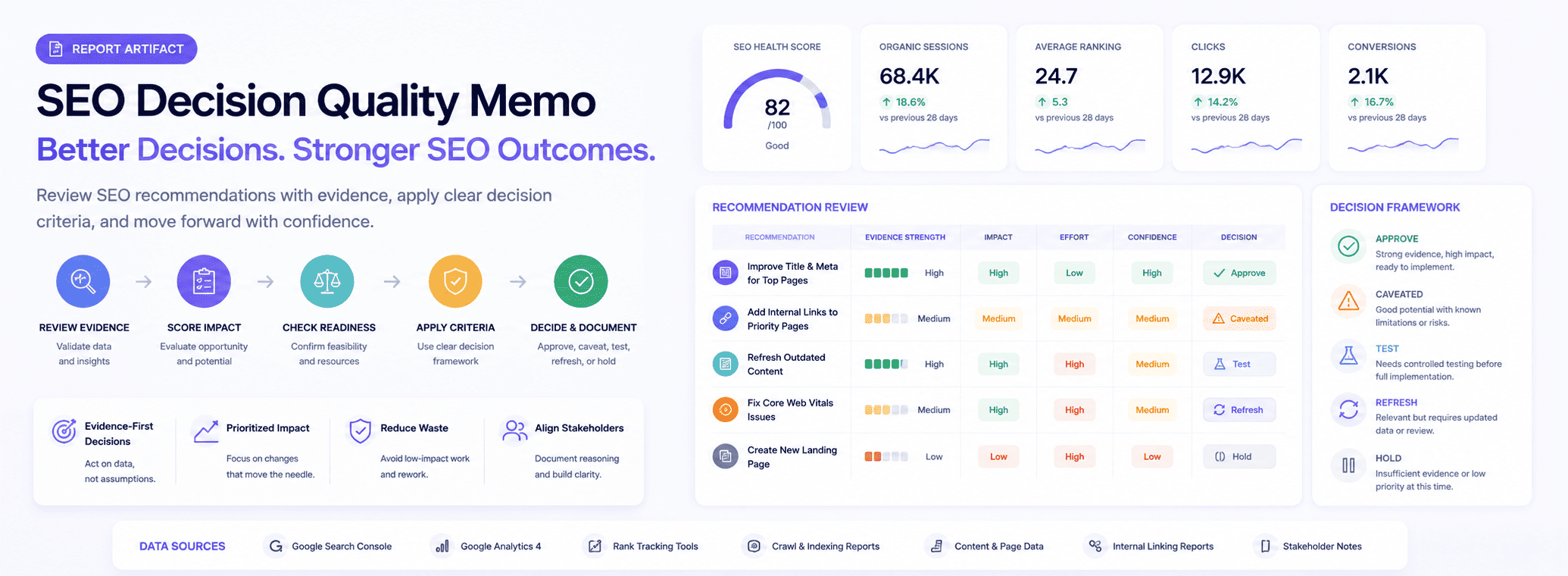
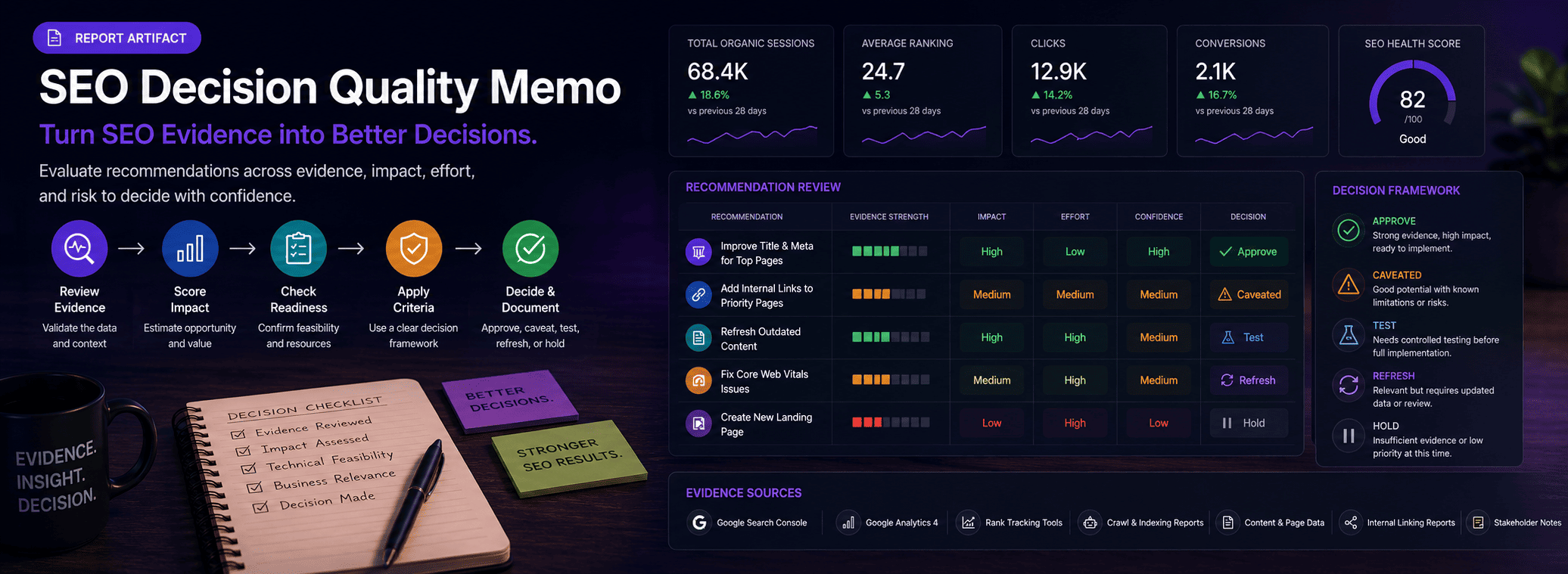
SEO Decision Quality Memo: Reviewing Recommendations Before Action
SEO teams make decisions every week across content updates, indexing priorities, internal linking, technical fixes, reporting changes, and page optimization. Some recommendations deserve immediate approval. Others require testing, additional validation, or a pause because the evidence is incomplete.
An SEO decision quality memo helps separate strong recommendations from weak assumptions. It documents what should move forward, what needs caveats, what deserves additional testing, what should be refreshed with updated evidence, and what should be held until the supporting data becomes stronger.
For analytics-driven SEO teams, this memo creates decision clarity. It reduces unnecessary implementation work and helps teams prioritize changes based on measurable evidence instead of urgency or opinion.
Why SEO Decision Quality Matters
Search optimization includes many moving parts. Rankings shift, competitors update pages, search intent evolves, and performance changes over time.
Without a structured review process teams may:
- Approve weak recommendations too quickly
- Delay valuable opportunities
- Prioritize based on opinions instead of evidence
- Make updates without validating likely impact
- Create inconsistent decision patterns
- Waste implementation cycles on low-impact work
A decision memo improves consistency and makes reasoning visible.
Core Categories for Reviewing SEO Recommendations
A useful SEO memo reviews recommendations through practical evidence categories:
- Search visibility impact
- Ranking movement
- Traffic performance
- Content quality
- Technical SEO
- Indexation behavior
- Internal linking opportunity
- Business relevance
- Execution readiness
1. Review Search Visibility Evidence
Start by checking whether available search data supports the recommendation clearly.
Review:
- Impressions
- CTR trends
- Average ranking movement
- Page visibility trend
- Keyword clusters
- Competitor movement
Example:
A page may be getting impressions but low CTR. That may support title optimization. But if impressions are unstable and rankings recently changed, the recommendation may require more testing before rollout.
2. Review Traffic and Engagement Signals
SEO recommendations should connect to real behavior.
Check:
- Organic sessions
- Bounce trends
- Scroll depth
- Conversion activity
- Landing page engagement
- Page retention trends
If rankings improve but engagement drops, decision quality may require deeper review.
3. Review Technical SEO Evidence
Many SEO actions involve technical implementation.
Validate:
- Indexation status
- Crawl coverage
- Canonical tags
- Redirect logic
- Page speed
- Structured data
- Mobile usability
Technical recommendations should be backed by clear diagnostics before approval.
4. Review Content Optimization Recommendations
Content updates often feel urgent, but not every update deserves immediate action.
Review:
- Search intent match
- Top-ranking competitor patterns
- Keyword coverage
- Heading structure
- Content freshness
- Depth and authority signals
Example:
A content refresh may be valuable, but if rankings remain stable and traffic is rising, the recommendation may move into test or refresh later instead of immediate approval.
5. Review Internal Linking Recommendations
Internal links impact crawl paths and page authority.
Check:
- Link coverage
- Anchor relevance
- Orphan pages
- Navigation opportunities
- Link depth
- Supporting cluster pages
Strong link recommendations should connect directly to measurable SEO opportunity.
6. Review Business and Conversion Relevance
SEO decisions should align with business outcomes.
Review:
- Revenue contribution
- Lead quality
- Priority page impact
- Brand visibility
- Conversion behavior
- Strategic value
A technically correct recommendation may still be low priority if business value is weak.
Decision Classification Framework
Approve
- Evidence strongly supports action
- Expected impact is clear
- Implementation is ready
Caveated
- Mostly supported
- Known limitations exist
- Proceed carefully with documentation
Test
- Potentially valuable
- Needs controlled validation first
Refresh
- Recommendation may still matter
- Evidence needs updated review
Hold
- Data does not support action
- Priority is unclear
- Execution risk is high
Recommended Memo Workflow
- Collect recommendation
- Review evidence sources
- Score impact
- Check technical readiness
- Document risk or caveats
- Assign decision category
- Review with stakeholders
- Track next action
Common SEO Decision Quality Issues
- Low evidence confidence
- Old ranking data
- Technical assumptions without validation
- Weak business relevance
- Competing stakeholder priorities
- No testing framework
- Urgency overriding evidence
Final Takeaway
An SEO decision quality memo helps analytics and SEO teams make stronger decisions with confidence.
It creates a practical framework for approving, caveating, testing, refreshing, or holding SEO recommendations based on measurable evidence.
When teams review recommendations through clear analytics and decision criteria, SEO execution becomes more consistent, more strategic, and easier to prioritize.