Tag Management Implementation Risk Memo
Write a tag management implementation risk memo that separates blocking, caveated, and monitored risks across data layer, ecommerce, cross-domain, sequencing, formatting, and approval evidence.
Summarize which tag management implementation risks should block analysis, which should be caveated, and which can move forward with approval.

Three steps to a confident decision
Understand which business situation this page was built for and confirm it matches your current context.
Go item by item — each check has a clear pass/hold condition so you know exactly what qualifies.
Use the growth decision statement and analyst questions to brief your team and move forward with confidence.

Tag Management Implementation Risk Memo
Summarize which tag management implementation risks should block analysis, which should be caveated, and which can move forward with approval.

What this page helps a team decide
The SEO lead needs a decision memo that turns data layer, ecommerce, cross-domain, sequencing, formatting, and script risks into a prioritized hold, caveat, or approval recommendation before changing the page, link, or indexation decision.
- implementation notes
- data layer map
- ecommerce event test
- cross-domain settings
- tag sequencing rules
- formatting variables
- affected reports
- approval log
What analysts ask before deciding
What decision is the SEO lead trying to make for tag management implementation risk: approve, hold, or send back for evidence?
Which input would make the marketer trust the tag management implementation risk read enough to change the page, link, or indexation decision?
What caveat should stay visible before the team changes the page, link, or indexation decision?
Who owns the next action if the review is approved, and what stays on hold if it is not?
What usually goes wrong
- The report artifact is treated as generic content instead of a growth decision.
- The recommendation skips the source caveat, so the next step looks safer than the evidence allows.
- Follow-up moves forward before the reviewer accepts the approval rule.
What 10x.in checks
- Classify each implementation issue by the signal it can distort and the decision that would change if the signal is wrong.
- Check whether data layer and ecommerce values are complete, current, and mapped to the event being analyzed.
- Review whether cross-domain behavior can fragment sessions, revenue, attribution, or referral context before using journey data.
- Check whether tags depend on prior tags, formatted variables, or transformed values that can change the event payload.
- Turn the risk memo into a prioritized fix list without changing tags, reports, campaigns, or pages until the owner approves.
OpenAnalyst should review Tag Management Implementation Risk Memo, compare the decision evidence with the caveats, and keep the next recommendation approval-gated until the reviewer accepts it.
FAQ
How should the implementation risk memo classify issues?
Classify each issue by the signal it can distort, the decision it can change, the proof available, the severity, the owner, and the approval state. Do not classify by technical category alone. A data layer field, cross-domain setting, trigger, sequence, or formatting rule becomes high severity when it can change the recommendation.
What risks should block analysis instead of becoming caveats?
Block analysis when data layer, ecommerce, cross-domain, sequencing, or formatting issues can reverse the recommendation or make the affected signal unreliable. A block is appropriate when the report can produce a confident-looking conclusion that would change after implementation QA. The memo should name the affected signal and fix owner required before analysis continues.
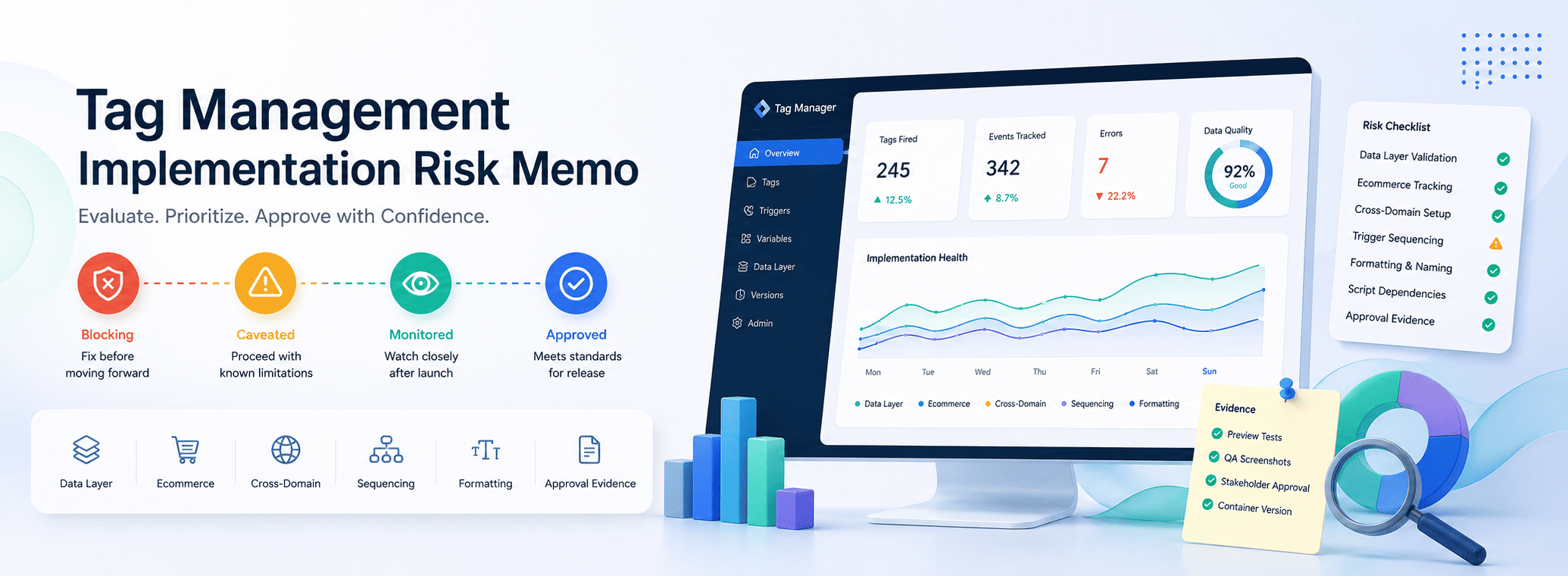
Tag Management Implementation Risk Memo for Analytics and SEO Teams
A tag management implementation can appear fully operational during launch preparation because tags fire, analytics dashboards begin collecting traffic, and early testing shows expected events. In reality, the highest-impact implementation risks usually surface later after traffic begins scaling, campaigns go live, revenue attribution becomes inconsistent, or dashboards begin showing unreliable patterns.
That is why a tag management implementation risk memo matters. It creates a structured record of what is verified, what still needs review, what can launch with caveats, and what requires monitoring after deployment.
For analytics for SEO teams, this documentation is especially valuable. SEO decisions depend on accurate event tracking and trustworthy reporting. Organic traffic may increase, rankings may improve, and landing pages may perform well, but if analytics tracking breaks at implementation level, performance becomes difficult to trust and optimization decisions become slower and riskier.
A clear implementation risk memo gives engineering, SEO, analytics, and marketing teams one shared view before launch.
Why Tag Management Risk Documentation Is Important Before Release
Modern websites often rely on multiple analytics systems, consent tools, ad platforms, ecommerce tracking layers, and custom event architecture. Tag managers make deployment easier, but they also create dependency chains.
A single issue inside the data layer can affect:
- SEO landing page attribution
- GA4 event reporting
- Revenue dashboards
- Paid campaign conversion measurement
- Remarketing audience accuracy
- Cross-domain funnel analysis
Without a risk memo, teams may discover implementation issues only after reporting becomes unreliable.
A documented memo helps:
- Identify launch blockers early
- Prioritize issues clearly
- Reduce stakeholder confusion
- Create accountability
- Protect reporting accuracy
- Support faster post-launch fixes
Core Risk Areas to Review
A practical implementation memo should divide risk into separate categories. This helps teams understand root causes instead of grouping everything into general tracking problems.
- Data layer structure
- Ecommerce implementation
- Cross-domain tracking
- Trigger sequencing
- Formatting consistency
- Consent dependencies
- Approval evidence
- Post-launch monitoring readiness
1. Data Layer Risk Review
The data layer is the foundation for tag management. Most analytics tags depend on structured values being available exactly when events fire.
If variables load incorrectly or arrive late, dashboards may show incomplete or misleading numbers.
Common data layer risks include:
- Missing page metadata
- Incorrect product IDs
- Revenue values unavailable
- Event payload duplicates
- Null variables during navigation
- Wrong variable naming
- Schema mismatch between templates
- Delayed dynamic values
Example:
An SEO landing page successfully receives organic traffic. A user adds a product to cart. The tag fires correctly, but product ID and category are missing from the payload. Analytics records the event, but ecommerce reporting becomes incomplete.
That should be documented clearly inside the memo with severity level and ownership.
2. Ecommerce Tracking Risks
For SEO programs tied to revenue, ecommerce tracking quality is critical.
Traffic growth without conversion accuracy leads to poor business decisions.
Review every step:
- Product list impressions
- Click tracking
- Add-to-cart
- Checkout start
- Shipping selection
- Payment selection
- Purchase confirmation
- Refund tracking
Validate:
- Revenue values
- Tax
- Currency
- Discount fields
- Coupon data
- Transaction IDs
A mismatch between analytics and ecommerce backend should be classified carefully.
High-value purchase confirmation failures often become blocking issues.
3. Cross-Domain Tracking Risks
SEO user journeys often move across:
- Main site
- Checkout platform
- Subdomains
- External booking tools
- Knowledge centers
- Regional domains
Cross-domain configuration failures break session continuity.
Common warning signs:
- Self-referrals
- Direct traffic spikes
- Lost UTM parameters
- Session restarts
- Unexpected referral attribution
- Funnel abandonment between domains
Example:
Organic traffic lands on a product page, then checkout happens on another domain. If linker settings fail, analytics may assign revenue incorrectly.
That directly impacts SEO reporting.
4. Tag Sequencing and Dependency Risks
Tags may be configured correctly but still fail because they fire in the wrong order.
Review:
- Consent scripts
- Analytics base tags
- Custom HTML tags
- Marketing pixels
- Conversion scripts
- Event listeners
Risk examples:
- Analytics loads before consent approval
- Purchase tag fires before revenue values load
- Duplicate custom listeners trigger twice
- Delayed page scripts break event timing
Sequencing should be tested using preview tools and browser validation.
5. Formatting and Taxonomy Risks
Even when events fire correctly, inconsistent formatting creates reporting problems.
Check:
- Event naming standards
- Parameter casing
- Category structure
- Campaign naming
- Custom dimensions
- Legacy variable cleanup
Example:
One team tracks “purchase_complete” while another tracks “purchaseCompleted.”
Analytics receives both and reporting becomes fragmented.
Document every inconsistency before release.
6. Consent and Compliance Risks
Consent management affects data quality and compliance.
Review:
- Banner firing logic
- Consent mode
- Regional behavior
- Storage permissions
- Marketing tag blocking
- Analytics fallback behavior
Improper consent handling can distort traffic reporting and create compliance risk.
7. Approval Evidence and Documentation
Every important implementation decision should have supporting evidence.
- Browser QA screenshots
- Preview mode tests
- Analytics validation
- Stakeholder review notes
- Container version reference
- Release timestamps
- Approval owner names
This improves accountability and makes future troubleshooting faster.
Risk Classification Framework
A useful memo separates findings into three categories.
Blocking Risks
- Revenue tracking broken
- Critical variables missing
- Cross-domain sessions failing
- Consent dependency broken
Caveated Risks
- Minor taxonomy inconsistency
- Non-critical reporting limitation
- Known issue with documented workaround
Monitored Risks
- Low-priority tracking gap
- Expected post-launch validation
- Performance observation item
This helps teams align faster and prioritize clearly.
Post-Launch Monitoring Recommendations
After deployment continue checking:
- Real-time analytics
- Organic landing page conversions
- Revenue reporting
- Cross-domain session continuity
- Error spikes
- Duplicate event trends
Early monitoring catches hidden issues before reporting drift grows.
Final Takeaway
A tag management implementation risk memo gives analytics and SEO teams a reliable launch framework.
It creates visibility across data layer health, ecommerce measurement, sequencing, formatting, approvals, and post-launch monitoring.
For analytics-driven SEO teams, accurate reporting matters as much as traffic growth. A documented risk memo reduces avoidable errors, improves stakeholder confidence, and protects reporting quality as traffic scales.