Attribution Decision Readiness Review
Decide whether the attribution evidence is ready to support a channel, budget, reporting, or journey recommendation before moving to action.
Decide whether the attribution evidence is ready to support a channel, budget, reporting, or journey recommendation before moving to action.
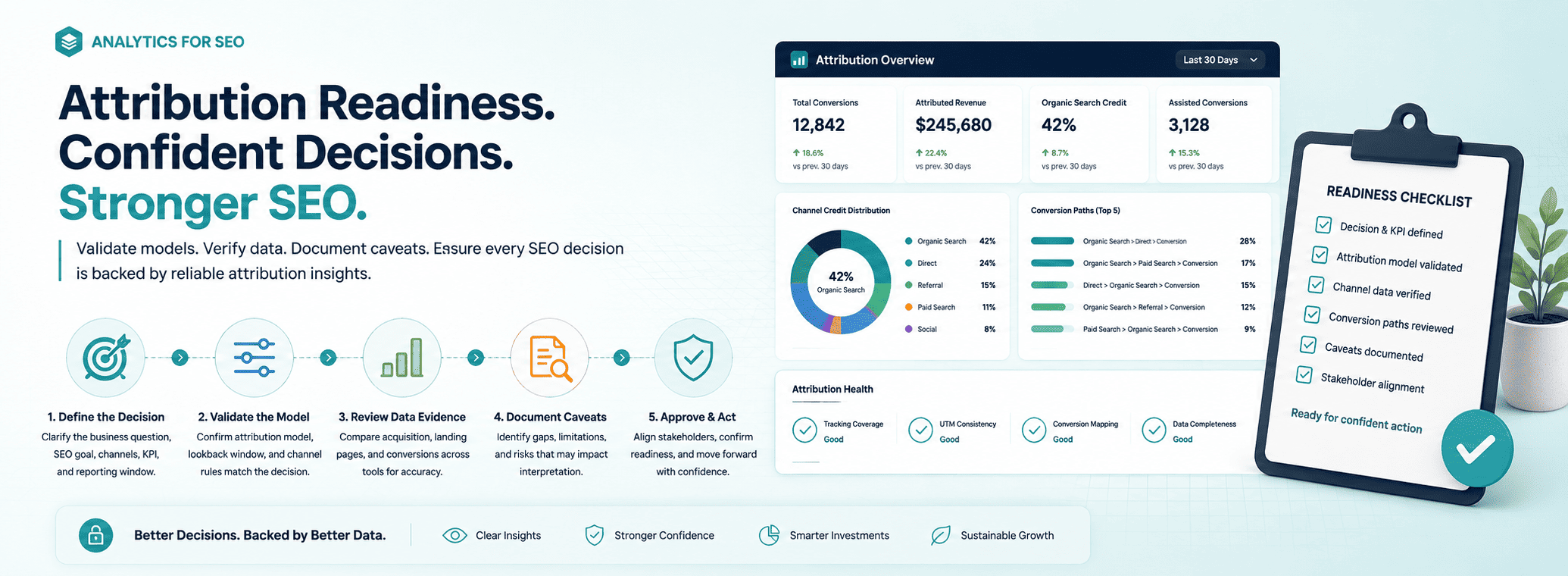
Three steps to a confident decision
Understand which business situation this page was built for and confirm it matches your current context.
Go item by item — each check has a clear pass/hold condition so you know exactly what qualifies.
Use the growth decision statement and analyst questions to brief your team and move forward with confidence.

Attribution Decision Readiness Review
Decide whether the attribution evidence is ready to support a channel, budget, reporting, or journey recommendation before moving to action.

What this page helps a team decide
A growth team is reviewing performance movement and needs to decide whether attribution evidence is strong enough to support a recommendation, or whether missing sources and model caveats should keep follow-up on hold.
- Analytics source scope.
- Conversion and revenue context.
- Channel touchpoint evidence.
- Customer journey notes.
- Identity and consent boundaries.
- Approval state.
What analysts ask before deciding
What decision is the SEO lead trying to make for attribution: approve, hold, or send back for evidence?
Which input would make the marketer trust the attribution read enough to change the page, link, or indexation decision?
What caveat should stay visible before the team changes the page, link, or indexation decision?
Who owns the next action if the review is approved, and what stays on hold if it is not?
What usually goes wrong
- The SEO lead treats decision scope fit as settled before checking name the exact recommendation the attribution evidence is supposed to support before judging any channel movement.
- The recommendation skips the source completeness check caveat, so the next step looks safer than the evidence allows.
- Follow-up moves forward before the model and window caveat approval rule is accepted.
What 10x.in checks
- Name the exact recommendation the attribution evidence is supposed to support before judging any channel movement.
- Compare the visible analytics evidence with the supporting business context needed for the recommendation.
- Review whether the attribution model, lookback window, identity boundary, or channel grouping can bias the read.
- Separate the evidence-backed finding from the action it might imply so the reviewer can approve the next step.
- Separate decision-driving conversions from diagnostic events and caveated attribution signals.
OpenAnalyst should review Attribution Decision Readiness Review, compare the decision evidence with the caveats, and keep the next recommendation approval-gated until the reviewer accepts it.
FAQ
How do we know attribution decision readiness is strong enough?
It is strong enough when the decision scope, required sources, model caveat, customer context, and approval owner are all visible in the memo. If any of those are missing, the output should stay caveated. In this review, the answer should be tied back to the operating rule rather than left as advice. The analyst should state what changes, what stays held, and what evidence would make the recommendation stronger.
Which source gap should hold the recommendation?
Hold the recommendation when missing spend, conversion, revenue, CRM, customer, or journey context could reverse the channel, budget, reporting, or journey conclusion. In this review, the answer should be tied back to the operating rule rather than left as advice. The analyst should state what changes, what stays held, and what evidence would make the recommendation stronger.
When should the model or window caveat block action?
Block action when the attribution model, lookback window, identity boundary, or channel grouping could materially change channel credit. The reviewer should approve the caveat before any follow-up. In this review, the answer should be tied back to the operating rule rather than left as advice. The analyst should state what changes, what stays held, and what evidence would make the recommendation stronger.
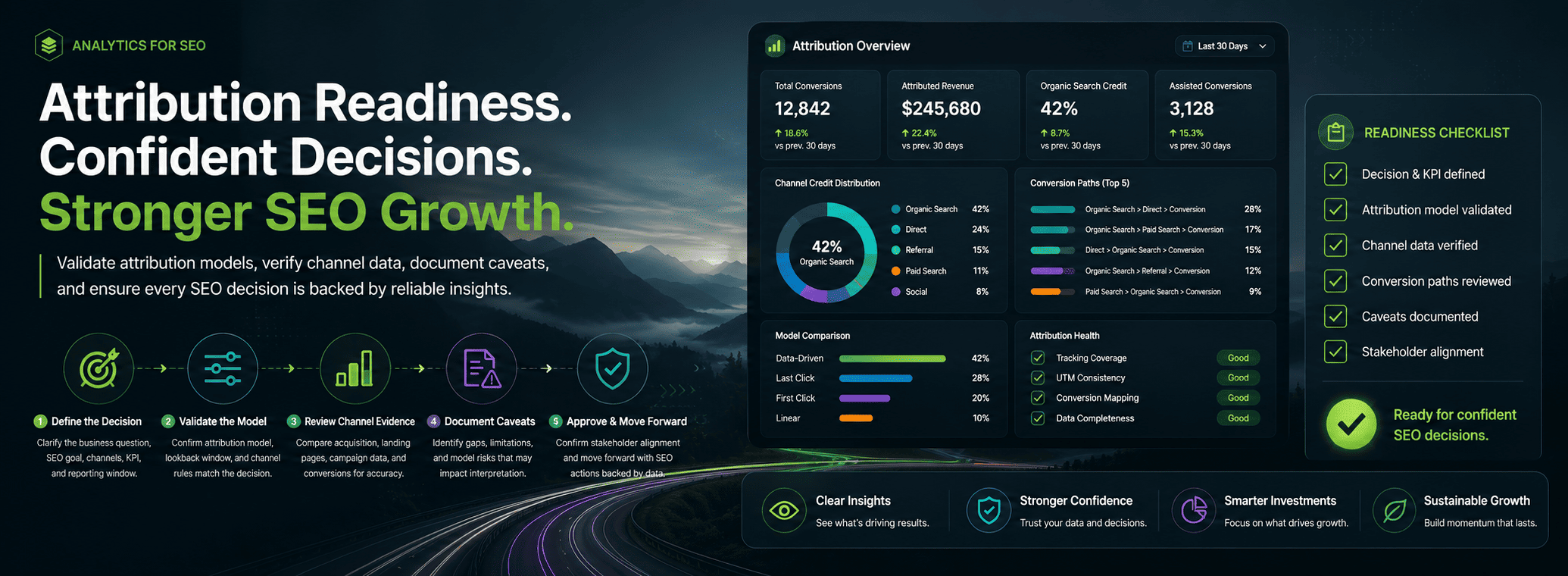
Attribution Evidence Readiness For Growth Decisions
An attribution decision readiness review evaluates whether attribution evidence is strong enough to support a recommendation involving channels, budgets, customer journeys, reporting frameworks, or growth priorities. The workflow focuses on decision readiness rather than attribution reporting alone.
Modern organizations collect attribution signals from analytics platforms, advertising systems, CRM environments, customer journey tools, and conversion reporting infrastructure. While these systems produce large volumes of performance data, the presence of attribution reporting does not automatically mean the resulting recommendation should move into execution.
Attribution frequently contains assumptions, identity limitations, incomplete customer journeys, model-specific bias, consent restrictions, and reporting gaps. A decision readiness review exists to determine whether those limitations are understood well enough to support action.
Define The Exact Recommendation Attribution Is Supposed To Support
The review begins by identifying the recommendation that attribution evidence is expected to justify. Attribution should not be evaluated in isolation from the decision it is influencing.
Many attribution reviews fail because teams begin analyzing channel movement before agreeing on the actual decision under consideration. Different recommendations require different levels of evidence, confidence, and supporting context.
- Define the recommendation before reviewing attribution outputs.
- Identify the business objective affected by the decision.
- Document expected operational impact.
- Separate reporting questions from action questions.
- Assign ownership for the recommendation under review.
A recommendation involving budget allocation typically requires different attribution confidence than a recommendation involving reporting annotations or exploratory analysis.
Validate Source Completeness Before Interpreting Attribution
Attribution quality depends heavily on source completeness. Missing sources frequently create stronger distortion than attribution model choice itself.
The review should determine whether all critical sources required to evaluate customer acquisition, engagement, conversion, and revenue contribution are available before interpretation begins.
- Review analytics platform coverage.
- Confirm conversion visibility.
- Validate revenue context availability.
- Check CRM and customer lifecycle sources.
- Identify missing journey touchpoints.
Incomplete evidence should remain visible throughout the review process. Attribution recommendations become significantly less reliable when major touchpoints remain unmeasured.
Review Attribution Model Assumptions Before Accepting Findings
Attribution models represent analytical assumptions rather than objective truth. Every attribution framework distributes credit differently, which means recommendations may change depending on the model selected.
The readiness review therefore evaluates whether attribution findings remain stable across the assumptions embedded within the reporting model.
- Review attribution methodology.
- Validate channel-credit allocation rules.
- Compare model outputs where appropriate.
- Document assumptions affecting interpretation.
- Keep model caveats attached to findings.
This stage prevents attribution outputs from being treated as absolute measurements when they are actually model-generated interpretations of customer behavior.
Evaluate Lookback Windows And Reporting Scope
Lookback windows influence which touchpoints receive credit and which interactions disappear from the customer journey. Small adjustments to attribution windows can significantly alter channel performance conclusions.
The review should determine whether the selected reporting window accurately reflects the customer journey being evaluated.
- Review attribution windows.
- Compare short and long conversion paths.
- Validate reporting-period alignment.
- Document excluded interactions.
- Assess window-related bias.
A channel appearing ineffective within a short lookback window may demonstrate substantial influence when customer journeys are reviewed more completely.
Review Identity Boundaries And Consent Constraints
Modern attribution environments operate within identity restrictions that affect how customer journeys are reconstructed. Consent settings, browser limitations, cross-device behavior, and privacy controls all influence attribution visibility.
The readiness review evaluates whether identity constraints materially affect the recommendation under consideration.
- Review user identification methods.
- Validate consent-dependent measurement.
- Assess cross-device visibility limitations.
- Identify anonymous journey gaps.
- Document privacy-related reporting caveats.
Identity limitations should remain visible whenever attribution findings influence investment, reporting, or optimization decisions.
Compare Attribution Findings Against Business Context
Attribution evidence should never be interpreted independently from business conditions. Performance movement may reflect pricing changes, inventory constraints, promotional activity, market conditions, or operational factors that attribution systems cannot fully explain.
- Review revenue and margin context.
- Assess operational influences.
- Compare customer behavior trends.
- Evaluate external business factors.
- Validate consistency with observed outcomes.
This comparison ensures attribution findings remain grounded within the broader commercial environment rather than becoming isolated reporting conclusions.
Separate Attribution Evidence From Recommended Action
One of the most important controls in an attribution decision readiness review is maintaining separation between analytical findings and implementation decisions.
Attribution may support a conclusion without automatically approving an action. Recommendations should remain reviewable even when attribution confidence appears strong.
- Document evidence separately from recommendations.
- Keep caveats attached to proposed actions.
- Distinguish findings from execution plans.
- Maintain reviewer visibility.
- Require approval before implementation.
This governance step prevents attribution reports from bypassing review processes simply because performance movement appears persuasive.
Keep Caveats Visible During Stakeholder Reviews
Decision-makers should see attribution limitations alongside attribution findings. Caveats should remain attached to recommendations throughout the review process rather than being hidden within supporting documentation.
- Document source gaps.
- Highlight model limitations.
- Surface identity constraints.
- Show unresolved questions.
- Separate confidence from certainty.
Visible caveats improve trust by helping stakeholders understand both the strengths and limitations of the evidence being presented.
Approval-Gated Attribution Reviews Protect Decision Quality
Attribution findings often influence marketing investment, channel prioritization, reporting frameworks, customer journey optimization, and executive communication simultaneously. For that reason, attribution recommendations should remain approval-gated before action occurs.
- Assign ownership.
- Document reviewer acceptance.
- Track approval state.
- Identify unresolved dependencies.
- Keep follow-up actions visible.
Approval gating protects organizations from acting on attribution evidence that appears complete but still contains unresolved assumptions or reporting limitations.
Operational Importance Of Attribution Decision Readiness Reviews
Modern growth organizations depend on attribution systems to understand customer acquisition, channel performance, conversion behavior, and revenue contribution. An attribution decision readiness review ensures those systems provide evidence strong enough to support action before budgets, priorities, reporting structures, or customer journey initiatives are changed.
Instead of treating attribution reports as self-validating evidence, organizations establish governance boundaries around source completeness, attribution methodology, identity visibility, business context, and approval ownership.
This creates an operational environment where attribution findings remain reviewable, caveated, accountable, and decision-ready before recommendations move into execution.