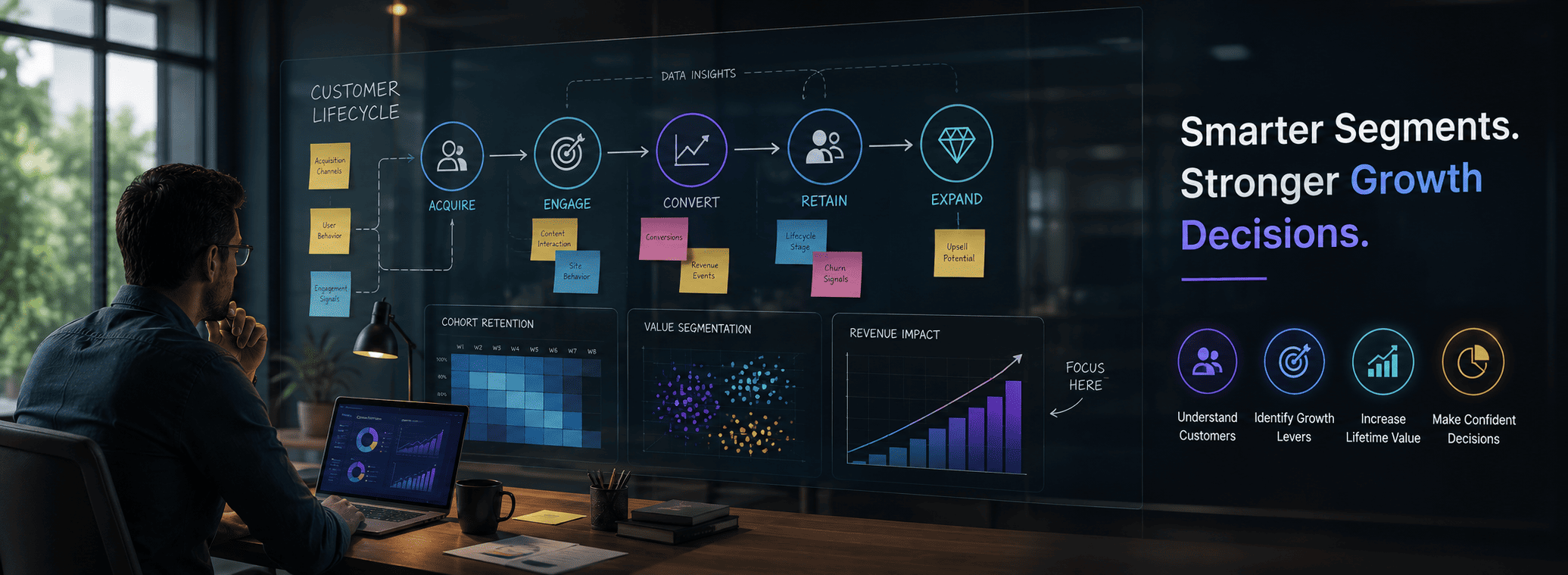
Cohort Customer Value Segmentation Review Workflow
Customer value segmentation reviews help analytics teams understand how different user groups contribute to revenue, retention, and long-term business growth. Instead of treating all users equally, segmentation workflows identify which cohorts generate higher engagement, stronger retention, and more profitable customer journeys.
This workflow supports SEO and analytics teams by connecting acquisition behavior, conversion quality, and lifecycle value into structured customer intelligence. It enables more accurate prioritization across campaigns, landing pages, and growth channels.
Step 1: Define Cohort Segmentation Logic
Start by identifying how customers will be grouped. Segments may be based on acquisition source, first purchase timing, behavioral activity, geographic region, subscription tier, or engagement frequency.
- Define segmentation dimensions clearly
- Separate new, active, dormant, and returning cohorts
- Align segmentation rules across analytics and CRM systems
- Ensure cohort windows remain consistent over time
Step 2: Review Customer Value Signals
Evaluate which metrics best represent customer value within each cohort. Common indicators include lifetime value, repeat purchase frequency, average order value, retention rate, and assisted conversion contribution.
- Measure revenue contribution by cohort
- Analyze retention trends across acquisition periods
- Identify high-performing engagement segments
- Compare value distribution across traffic sources
Step 3: Validate Behavioral Patterns
Behavioral diagnostics reveal how users interact with products, content, and conversion journeys. Reviewing engagement depth helps determine whether customer value aligns with expected usage patterns.
- Track repeat visits and session frequency
- Review engagement progression across lifecycle stages
- Analyze feature usage or product interaction intensity
- Identify low-retention behavior clusters
Step 4: Connect Segments to SEO and Acquisition Strategy
Segmentation reviews become more valuable when connected directly to acquisition channels and SEO performance. This allows teams to identify which organic search strategies attract the most profitable customer groups.
- Compare cohort quality across landing pages
- Evaluate retention from branded vs non-branded traffic
- Map customer value against content themes
- Prioritize SEO campaigns generating higher-value users
Step 5: Operationalize Reporting and Monitoring
Create recurring dashboards and reporting frameworks that continuously monitor cohort movement, customer value trends, and lifecycle shifts. Ongoing segmentation reviews improve forecasting accuracy and strategic decision-making.
- Build automated cohort reporting dashboards
- Monitor customer migration between segments
- Track changes in lifetime value over time
- Standardize segmentation governance across teams
Why This Workflow Matters
Without customer value segmentation, organizations often optimize for traffic volume instead of long-term profitability. Cohort-based analysis provides deeper visibility into sustainable growth, helping teams focus on customer quality, retention potential, and revenue efficiency rather than isolated conversion metrics.