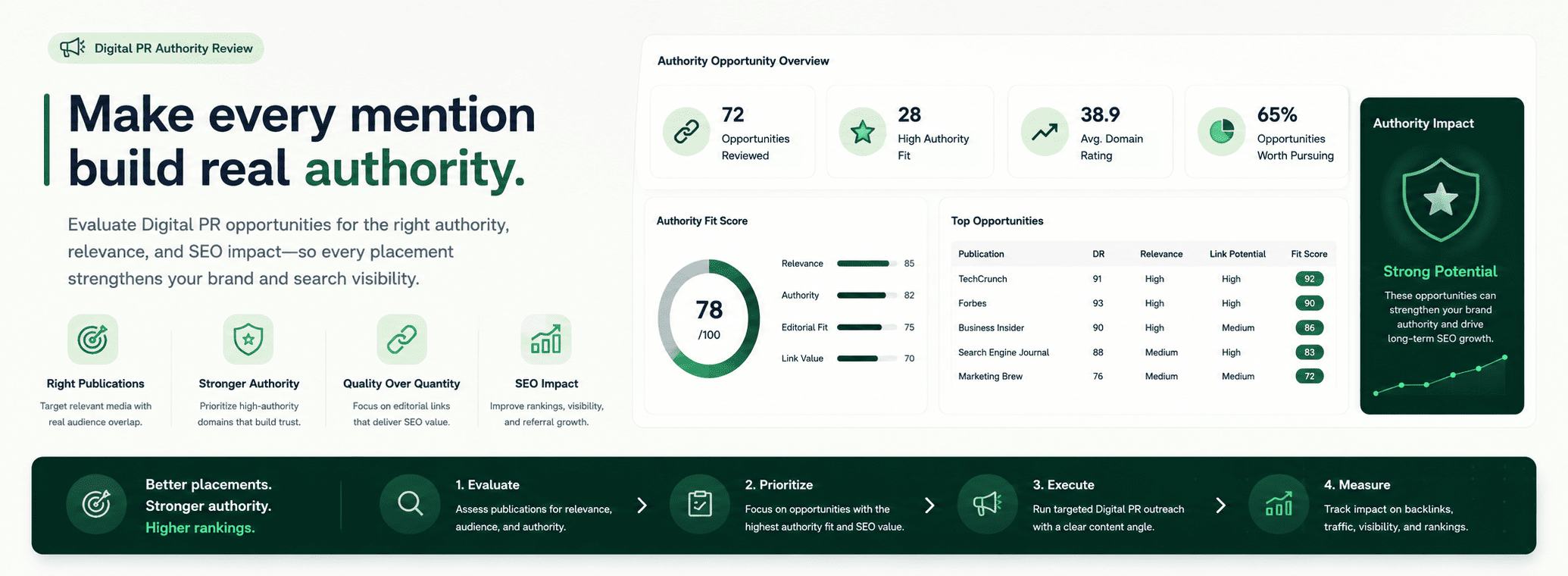
What Is a Digital PR Authority Fit Review?
A Digital PR Authority Fit Review is a diagnostic workflow used to determine whether a digital PR opportunity aligns with brand expertise, audience expectations, publication requirements, and organizational approval standards before outreach begins. The purpose of the review is not simply to acquire links, mentions, or placements. The purpose is to determine whether the proposed authority-building activity creates genuine value for the publication audience while supporting long-term visibility, trust, and search performance.
Many outreach initiatives fail because teams focus on acquisition opportunities before evaluating fit. A publication may be authoritative but irrelevant to the intended audience. A quote may be accepted but unsupported by evidence. A backlink opportunity may exist but provide little strategic value. The review process helps separate meaningful authority-building opportunities from activities driven primarily by link acquisition intent.
By introducing a structured approval workflow, organizations can evaluate digital PR opportunities consistently, document caveats, and ensure outreach decisions remain aligned with business goals rather than short-term SEO objectives.
Step 1: Evaluate the Authority Angle
Every successful digital PR initiative begins with a credible authority angle. Before reviewing publications, outreach tactics, or contribution formats, teams should determine whether the proposed angle demonstrates expertise, original insight, useful commentary, proprietary data, or audience value.
An authority angle should answer a simple question: why would an editor, journalist, industry publication, or audience member care about this information?
Strong authority angles often include:
- Original research and data.
- Industry expertise and commentary.
- Unique operational insights.
- Useful resources or tools.
- Educational content.
- Evidence-backed observations.
Weak authority angles frequently focus on obtaining a mention rather than contributing useful information. When the value proposition exists only to acquire a backlink, the recommendation should remain on hold.
Step 2: Match the Opportunity to the Publication and Audience
Not every authority opportunity belongs in every publication. A highly credible publication may still represent a poor fit if the audience, editorial standards, or content expectations do not align with the proposed contribution.
The review should evaluate:
- Publication topic relevance.
- Audience overlap.
- Editorial standards.
- Content style expectations.
- Industry alignment.
- Brand compatibility.
A publication with strong authority but poor audience fit may create visibility without creating meaningful influence. The review should prioritize relevance over raw authority metrics.
Step 3: Validate Asset Quality and Supporting Proof
Many digital PR campaigns rely on assets such as research reports, data studies, calculators, tools, templates, expert commentary, case studies, lists, and contributed content. Before these assets support outreach, reviewers should determine whether the supporting evidence remains strong enough for the intended context.
The workflow should examine:
- Data freshness.
- Evidence quality.
- Methodology transparency.
- Source reliability.
- Claim validation.
- Context preservation.
A strong asset in one context may become weak when reused elsewhere. Repurposed materials should be reviewed carefully to ensure they still support the claims being made during outreach.
Step 4: Review Contribution Format Suitability
Different authority-building opportunities require different contribution formats. The review should determine whether the chosen format aligns with both audience expectations and editorial requirements.
Common formats include:
- Expert quotes.
- Contributed articles.
- Original research.
- Industry commentary.
- Resource recommendations.
- Tool submissions.
- Directory listings.
- Case-study contributions.
The format should enhance the authority angle rather than weaken it. A strong research asset may lose credibility if converted into an overly promotional contributed article.
Step 5: Evaluate Brand Mention and Link Opportunity Quality
Not every mention deserves follow-up. Not every backlink opportunity justifies outreach. The review should assess whether the opportunity creates value for both the audience and the organization.
Factors to evaluate include:
- Audience benefit.
- Editorial context.
- Topical relevance.
- Brand alignment.
- Relationship implications.
- Long-term authority value.
Unlinked mentions may justify outreach when the relationship remains positive and the additional reference improves the reader experience. Conversely, aggressive follow-up can introduce reputational risk without creating meaningful value.
Step 6: Separate Research from Outreach Execution
One of the most important governance principles in digital PR is separating opportunity identification from execution approval. Analysts may identify promising opportunities, but outreach should remain approval-gated until reviewers evaluate supporting evidence and accept the associated risks.
The workflow should distinguish between:
- Research findings.
- Draft recommendations.
- Outreach planning.
- Approved communication.
- Execution ownership.
This separation improves accountability and ensures outreach activities remain reviewable before external communication begins.
Common Failure Modes in Digital PR Reviews
Several recurring issues frequently cause digital PR initiatives to underperform or create unnecessary risk.
- Link-first thinking.
- Poor audience alignment.
- Weak supporting evidence.
- Outdated assets.
- Unsubstantiated claims.
- Publication mismatch.
- Improper asset reuse.
- Unclear ownership.
- Relationship risk.
- Approval bypasses.
These failure modes often create the appearance of opportunity while reducing the actual value of the authority-building effort.
Approve, Hold, Revise, or Reject
The final objective of the Digital PR Authority Fit Review is to produce a decision-ready recommendation.
- Approve: The opportunity aligns with audience needs, publication standards, and authority goals.
- Revise: The opportunity has potential but requires modifications.
- Hold: Evidence remains incomplete or caveats remain unresolved.
- Reject: The opportunity introduces more risk than value.
The recommendation should document the authority angle, supporting proof, publication fit, audience relevance, caveats, ownership, and next-step actions.
Why the Workflow Matters
Digital PR Authority Fit Review is not a link-building checklist. It is a governance process designed to ensure authority-building efforts remain aligned with audience value, editorial quality, and business objectives. By validating authority angles, publication fit, evidence quality, contribution formats, and approval boundaries before outreach occurs, organizations can build stronger authority signals while reducing the risk associated with low-quality promotional activity.