GA4 Foundation Engagement Signal Review
Review whether GA4 engagement, landing-page, page, event, and conversion evidence is strong enough to support a page or content recommendation.
Decide whether engagement, landing-page, page, event, and conversion evidence is reliable enough to support a page or content recommendation.
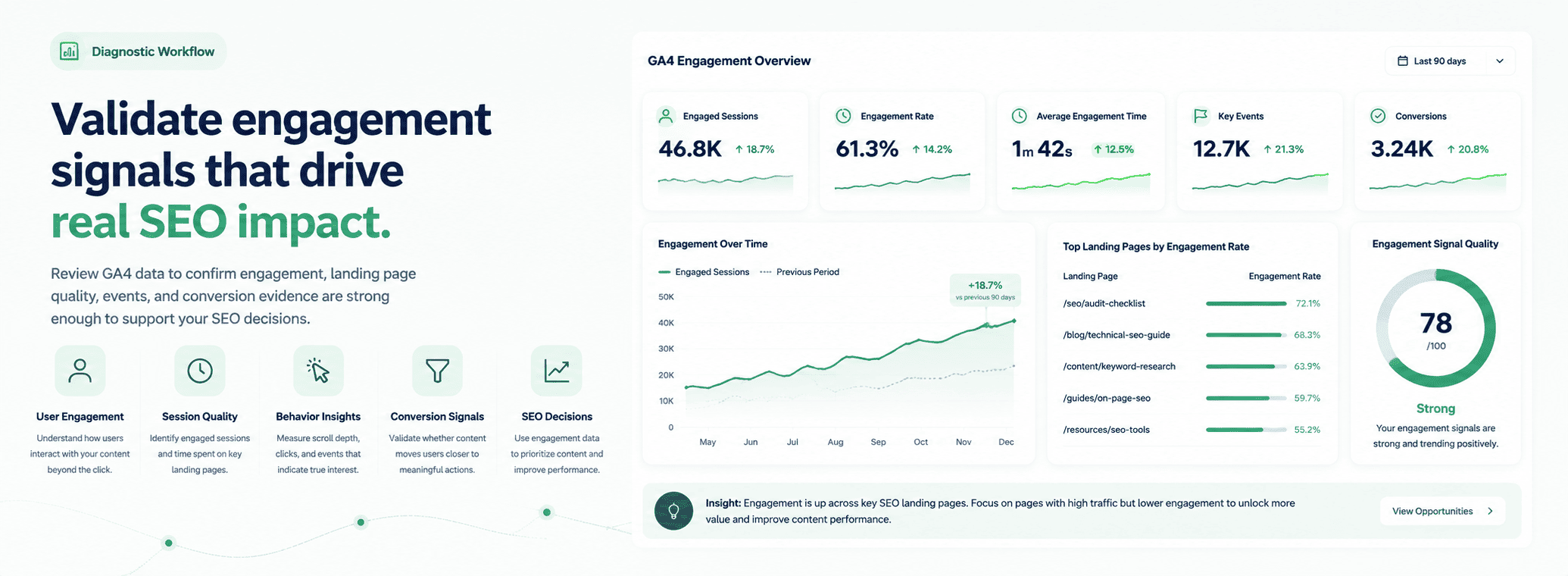
Three steps to a confident decision
Understand which business situation this page was built for and confirm it matches your current context.
Go item by item — each check has a clear pass/hold condition so you know exactly what qualifies.
Use the growth decision statement and analyst questions to brief your team and move forward with confidence.

GA4 Foundation Engagement Signal Review
Decide whether engagement, landing-page, page, event, and conversion evidence is reliable enough to support a page or content recommendation.
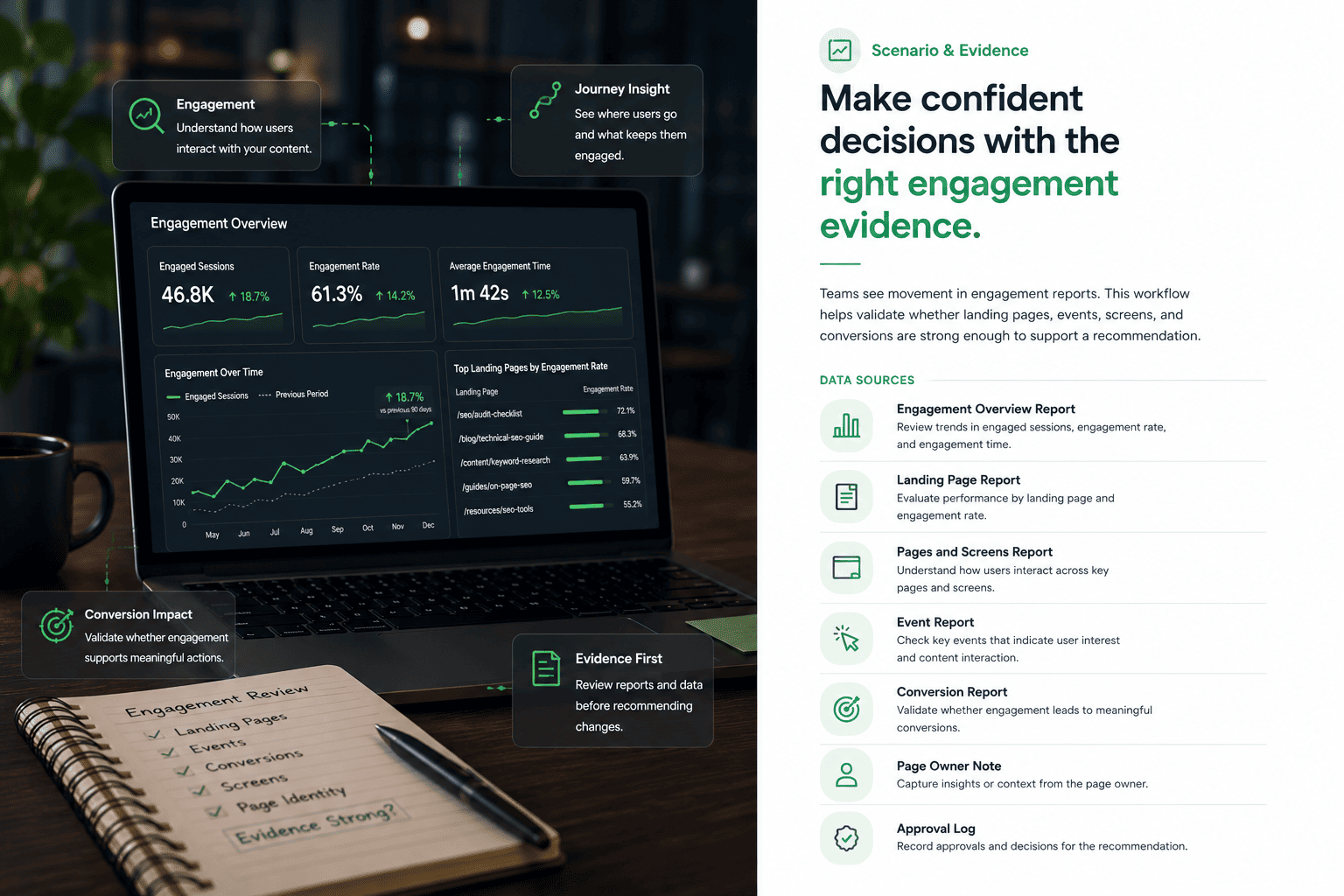
What this page helps a team decide
A content, SEO, or growth team sees movement in engagement reports, but needs to know whether landing-page identity, pages and screens evidence, event meaning, and conversion role are strong enough before recommending a page or content change.
- engagement overview report
- landing page report
- pages and screens report
- event report
- conversion report
- page owner note
- approval log
What analysts ask before deciding
What decision is the SEO lead trying to make for ga4 foundation engagement signal: approve, hold, or send back for evidence?
Which input would make the marketer trust the ga4 foundation engagement signal read enough to change the page, link, or indexation decision?
What caveat should stay visible before the team changes the page, link, or indexation decision?
Who owns the next action if the review is approved, and what stays on hold if it is not?
What usually goes wrong
- The diagnostic workflow is treated as generic content instead of a growth decision.
- The recommendation skips the source caveat, so the next step looks safer than the evidence allows.
- Follow-up moves forward before the reviewer accepts the approval rule.
What 10x.in checks
- Check whether engagement movement reflects the reviewed audience, date range, and report scope before interpreting page quality.
- Confirm that landing-page rows, query strings, not-set values, and page ownership identify the page being recommended.
- Separate page path, page title, screen, and app evidence before using pages and screens movement as content evidence.
- Review whether engagement events and conversions represent meaningful behavior before using them as proof for a content or page action.
- Separate the observed engagement finding from the page, content, campaign, or tracking action it might imply.
OpenAnalyst should review GA4 Foundation Engagement Signal Review, compare the decision evidence with the caveats, and keep the next recommendation approval-gated until the reviewer accepts it.
FAQ
How do we know engagement evidence can support a page recommendation?
Engagement evidence can support a page recommendation when engagement scope, landing-page identity, page path or title meaning, event role, conversion role, missing evidence, owner, and approval state are all visible. The reviewer should be able to trace the recommendation from report scope to page identity to behavior proof. If any of those links are assumed, the memo should say what is missing and keep the action caveated.
When should landing-page identity keep follow-up on hold?
Landing-page identity should keep follow-up on hold when query strings, not set rows, page path, page title, or ownership make it unclear which page would receive the content or SEO action. The point is not to wait for perfect reporting. The point is to avoid assigning a page change when the report cannot identify the page well enough for an owner to approve it.
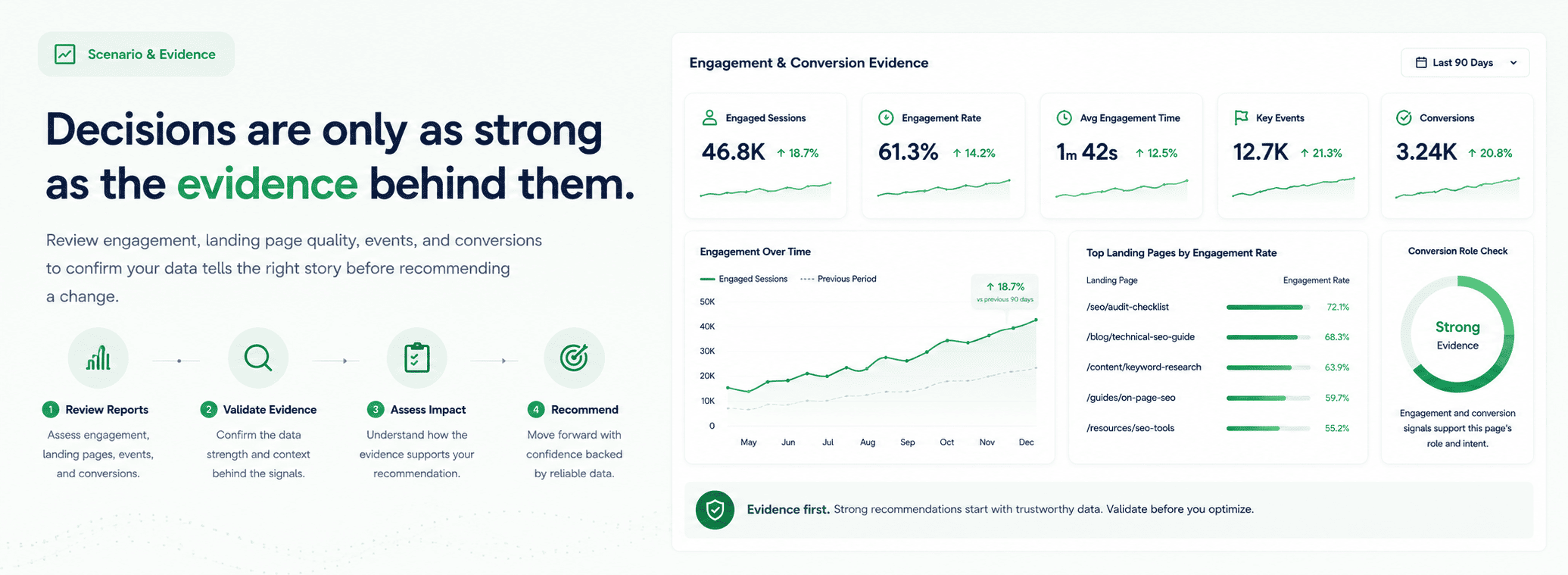
What Is a GA4 Foundation Engagement Signal Review?
A GA4 Foundation Engagement Signal Review is a diagnostic workflow used to determine whether engagement evidence is reliable enough to support a page recommendation, content recommendation, SEO adjustment, or growth decision. Before teams react to changes in engagement rate, engaged sessions, page interactions, event activity, or conversion behavior, they need confidence that the underlying evidence accurately represents user behavior and can be tied to a specific page, audience, and business objective.
Many engagement reviews fail because teams treat movement in GA4 reports as proof of content quality. A rise in engagement does not automatically indicate a successful content experience. A decline in engagement does not automatically indicate poor performance. Reporting scope, audience composition, landing-page identification, event configuration, and conversion logic can all influence the observed signal.
The purpose of this workflow is to separate measurement observations from content recommendations. The review should determine whether engagement evidence is decision-ready, whether important caveats remain unresolved, or whether additional validation is required before action is approved.
Step 1: Validate Engagement Report Scope
The first stage of the review focuses on understanding what the engagement report actually represents. Engagement metrics can change significantly depending on audience selection, reporting period, traffic source, segment definition, and comparison window.
Before interpreting movement, reviewers should confirm:
- The reporting period under review.
- The audience segment included in the analysis.
- The acquisition sources represented in the report.
- The comparison period used for evaluation.
- The specific business question being investigated.
A recommendation should not move forward if the engagement signal changes meaning when the report scope changes. The reviewer must first establish that the observed movement reflects the intended audience and reporting context.
Step 2: Confirm Landing-Page Identity
One of the most common causes of weak engagement recommendations is uncertainty around page identity. Teams frequently identify an engagement opportunity without confirming exactly which page generated the signal.
GA4 landing-page reports may contain query-string variations, duplicate paths, "not set" rows, parameterized URLs, or ownership ambiguity. If these issues are not resolved, a recommendation can easily be assigned to the wrong page.
The review should validate:
- Landing-page path consistency.
- Query-string handling.
- Ownership of the affected page.
- URL normalization logic.
- Whether "not set" values influence the findings.
A content recommendation should remain on hold until the reviewer can clearly identify the page that would receive the proposed action.
Step 3: Separate Landing-Page Evidence from Pages and Screens Evidence
Landing-page reports and Pages & Screens reports answer different questions. Landing-page reports focus on where sessions begin. Pages & Screens reports focus on content interaction regardless of entry point.
Confusing these reports often leads to incorrect recommendations. A page may appear successful because users interact with it after entering elsewhere. Another page may appear weak despite serving as an important acquisition entry point.
The workflow should distinguish:
- Entry-page performance.
- Content-consumption behavior.
- Navigation-path influence.
- Page-title reporting.
- Screen-based interaction reporting.
Only after these reporting scopes are separated should engagement movement be interpreted as evidence for a content decision.
Step 4: Evaluate Event Meaning Before Interpreting Engagement
Engagement events provide behavioral signals, but not every event represents meaningful progress. Some events indicate genuine user interest. Others exist only for diagnostic or tracking purposes.
Reviewers should evaluate:
- Whether the event represents meaningful user behavior.
- Whether the event supports the business question.
- Whether event definitions remain stable over time.
- Whether implementation changes influenced the signal.
- Whether event volume reflects genuine engagement.
A recommendation should not rely on event counts alone. The review must determine whether the observed events provide useful evidence for the proposed action.
Step 5: Review Conversion Role and Business Impact
Many engagement investigations eventually lead to conversion-focused decisions. However, engagement metrics and conversion metrics serve different analytical purposes and should not be treated as interchangeable signals.
The reviewer should determine:
- Whether conversions support the engagement finding.
- Whether conversion changes align with engagement movement.
- Whether the conversion is decision-driving or diagnostic.
- Whether attribution logic influences interpretation.
- Whether business outcomes reinforce the recommendation.
A page may generate strong engagement without creating meaningful business value. Conversely, a page with average engagement may contribute significantly to conversions. Both scenarios require different recommendations.
Common Failure Modes in Engagement Analysis
Several recurring issues frequently create misleading engagement conclusions. Identifying these failure modes is a critical part of the review process.
- Undefined page ownership.
- Misinterpreted engagement events.
- Query-string fragmentation.
- Audience-segment inconsistencies.
- Improper report comparisons.
- Attribution misunderstandings.
- Event-definition changes.
- Tracking implementation updates.
- Mixed reporting scopes.
- Conversion-role confusion.
These issues can make engagement movement appear more meaningful than the underlying evidence supports.
Separate Findings from Recommendations
One of the most important responsibilities of the workflow is separating observed behavior from the actions it might imply. An engagement finding should never automatically become a content recommendation.
The review should document:
- The observed signal.
- The evidence supporting the signal.
- The caveats affecting interpretation.
- The recommendation under consideration.
- The additional evidence required for approval.
This separation reduces the risk of converting uncertain measurements into operational changes.
Approve, Hold, or Request Additional Evidence
The final output of the GA4 Foundation Engagement Signal Review should be a decision-ready status.
- Approve: Engagement evidence supports the recommendation.
- Hold: Material caveats affect confidence.
- Request Evidence: Additional validation is required.
The decision should identify the affected page, supporting evidence, unresolved caveats, ownership, and next-step actions.
Why This Workflow Matters
A GA4 Foundation Engagement Signal Review is not designed to measure engagement for its own sake. Its purpose is to determine whether engagement evidence is reliable enough to influence content strategy, SEO prioritization, page optimization, or growth planning. By validating report scope, page identity, event meaning, conversion relevance, and recommendation readiness before action occurs, organizations can make more defensible decisions while reducing the risk of acting on misleading engagement signals.