Measurement Confidence Readiness Review
Review measurement confidence before using analytics movement to support campaign, page, reporting, or tracking decisions.
Decide whether connected analytics data is reliable enough to support a growth recommendation before changing campaigns, pages, reporting, or tracking plans.
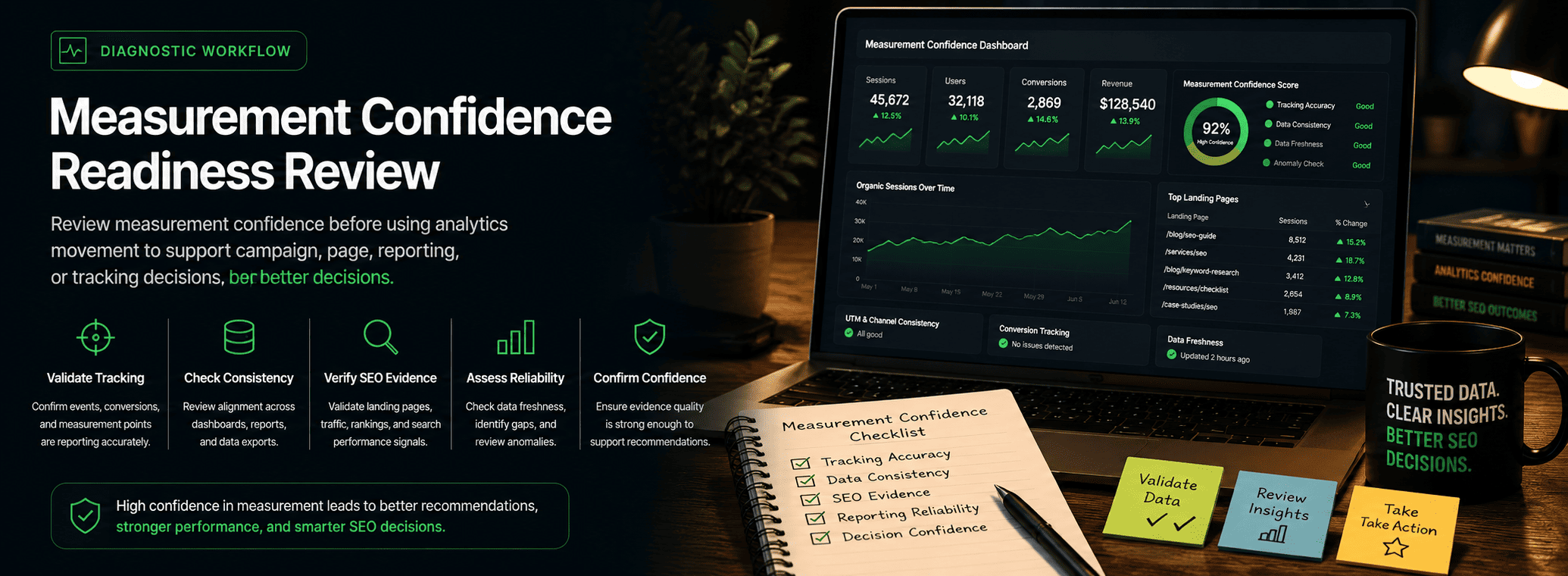
Three steps to a confident decision
Understand which business situation this page was built for and confirm it matches your current context.
Go item by item — each check has a clear pass/hold condition so you know exactly what qualifies.
Use the growth decision statement and analyst questions to brief your team and move forward with confidence.

Measurement Confidence Readiness Review
Decide whether connected analytics data is reliable enough to support a growth recommendation before changing campaigns, pages, reporting, or tracking plans.

What this page helps a team decide
The SEO lead sees analytics movement or conflicting reports, but needs to know whether collection quality, precision, sampling, modeling, and caveats are strong enough to use in the decision, but the review has to connect the signal to the page, link, or indexation decision.
- Analytics property settings.
- Tag manager configuration.
- Event inventory.
- Reporting extract.
- Traffic quality notes.
- Approval log.
What analysts ask before deciding
What decision is the SEO lead trying to make for measurement confidence: approve, hold, or send back for evidence?
Which input would make the marketer trust the measurement confidence read enough to change the page, link, or indexation decision?
What caveat should stay visible before the team changes the page, link, or indexation decision?
Who owns the next action if the review is approved, and what stays on hold if it is not?
What usually goes wrong
- The SEO lead treats source readiness and caveat labeling as settled before checking the connected analytics source is fresh, scoped, and reliable enough before interpreting movement.
- The recommendation skips the event and parameter decision quality caveat, so the next step looks safer than the evidence allows.
- Follow-up moves forward before the approval-gated analytics recommendation approval rule is accepted.
What 10x.in checks
- Check whether the connected analytics source is fresh, scoped, and reliable enough before interpreting movement.
- Review whether the events and parameters used in the decision match the business question and have been tested recently.
- Separate the measured finding from the action it might imply so the team can review the caveat before execution.
- Separate decision-driving conversions from diagnostic events and caveated attribution signals.
- Connect ad cost and creative promise to the post-click path before blaming the campaign.
OpenAnalyst should review Measurement Confidence Readiness Review, compare the decision evidence with the caveats, and keep the next recommendation approval-gated until the reviewer accepts it.
FAQ
How do we decide whether measurement confidence is high enough to act?
Confidence is high enough when collection scope, event meaning, source freshness, sampling or modeling caveats, and approval state are all explicit enough that the recommendation would not change after basic setup review. In this review, the answer should be tied back to the operating rule rather than left as advice. The analyst should state what changes, what stays held, and what evidence would make the recommendation stronger.
What is the difference between accuracy and precision in this review?
Accuracy asks whether the data reflects real user behavior; precision asks whether the measurement is consistent enough to compare over time. A recommendation can use directional precision while still carrying an accuracy caveat. In this review, the answer should be tied back to the operating rule rather than left as advice. The analyst should state what changes, what stays held, and what evidence would make the recommendation stronger.
When should a sampled or modeled report stay out of the decision?
Keep it out when the decision needs exact counts, the sampled segment is small or unstable, consent modeling changes the audience, or a raw export is needed to validate the movement. In this review, the answer should be tied back to the operating rule rather than left as advice. The analyst should state what changes, what stays held, and what evidence would make the recommendation stronger.
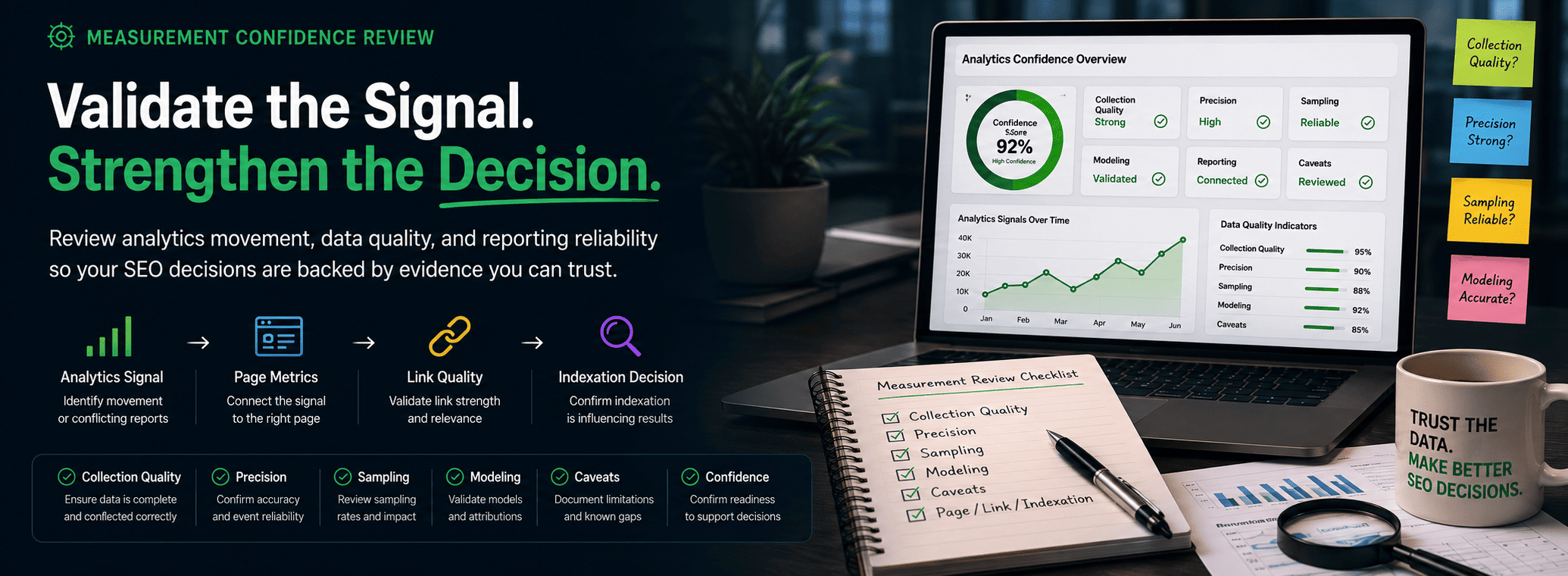
What Is a Measurement Confidence Readiness Review?
A Measurement Confidence Readiness Review is a diagnostic workflow used to determine whether analytics data is reliable enough to support SEO, campaign, reporting, content, or tracking decisions. Before teams react to traffic movement, conversion changes, ranking shifts, or engagement trends, they need confidence that the underlying measurement system is collecting, processing, and reporting data correctly.
The purpose of this workflow is not to explain performance. Its purpose is to evaluate whether the evidence itself is trustworthy enough to support a recommendation. If measurement confidence is weak, the recommendation should remain approval-gated until the underlying issues are resolved.
Step 1: Validate Analytics Source Readiness
The first stage of the review focuses on the analytics source itself. Before interpreting trends, reviewers should verify that the connected reporting environment is current, properly configured, and relevant to the business question being evaluated.
- Review analytics property configuration.
- Confirm reporting freshness.
- Validate data retention settings.
- Check account access and governance controls.
- Verify the reporting scope matches the decision being considered.
If source readiness cannot be confirmed, downstream analysis should remain on hold until reporting reliability is established.
Step 2: Review Event and Conversion Quality
A recommendation can only be trusted when the events and conversions used to support it accurately represent user behavior. Event collection should be reviewed before performance movement is interpreted as a business signal.
- Validate event definitions.
- Review conversion configuration.
- Check parameter collection quality.
- Identify missing or duplicated events.
- Confirm event testing was completed recently.
The workflow should distinguish between decision-driving conversions and diagnostic events that provide supporting context.
Step 3: Evaluate Accuracy and Precision
Measurement confidence depends on both accuracy and precision. Accuracy determines whether the data reflects real-world behavior. Precision determines whether measurements remain consistent enough to support comparisons over time.
- Review known tracking limitations.
- Compare reporting outputs across sources.
- Identify inconsistencies between dashboards and exports.
- Validate historical trend stability.
- Document unresolved accuracy concerns.
A recommendation may support directional analysis while still carrying important accuracy caveats that should remain visible.
Step 4: Review Sampling, Modeling, and Attribution Caveats
Many analytics platforms rely on sampling, attribution modeling, consent adjustments, and estimation techniques. These mechanisms can influence reported outcomes and should be evaluated before recommendations move into execution.
- Identify sampled reports.
- Review modeled conversions.
- Validate attribution methodology.
- Assess consent-mode impact.
- Document caveats that affect interpretation.
The workflow should prevent teams from treating estimated or modeled outputs as exact measurements when decision quality depends on precision.
Step 5: Separate Findings from Actions
A measured signal does not automatically justify a business action. The review should separate observed behavior from the recommendation it might imply.
- Separate reporting findings from execution plans.
- Evaluate whether the proposed action matches the evidence.
- Review alternative explanations for the signal.
- Document decision dependencies.
- Identify evidence gaps requiring additional validation.
This prevents teams from converting measurement observations directly into campaign, page, tracking, or reporting changes without sufficient review.
Approve, Hold, or Request Additional Evidence
The final output of the Measurement Confidence Readiness Review should be a decision-ready status supported by documented evidence and caveats.
- Approve: Data quality is strong enough to support the recommendation.
- Hold: Caveats materially affect confidence and require resolution.
- Request Evidence: Additional validation is needed before the recommendation can proceed.
A complete review should document source readiness, event quality, reporting limitations, sampling considerations, attribution caveats, approval status, ownership, and next-step actions. This ensures growth recommendations remain evidence-driven before changes are made to campaigns, pages, reporting systems, or tracking configurations.