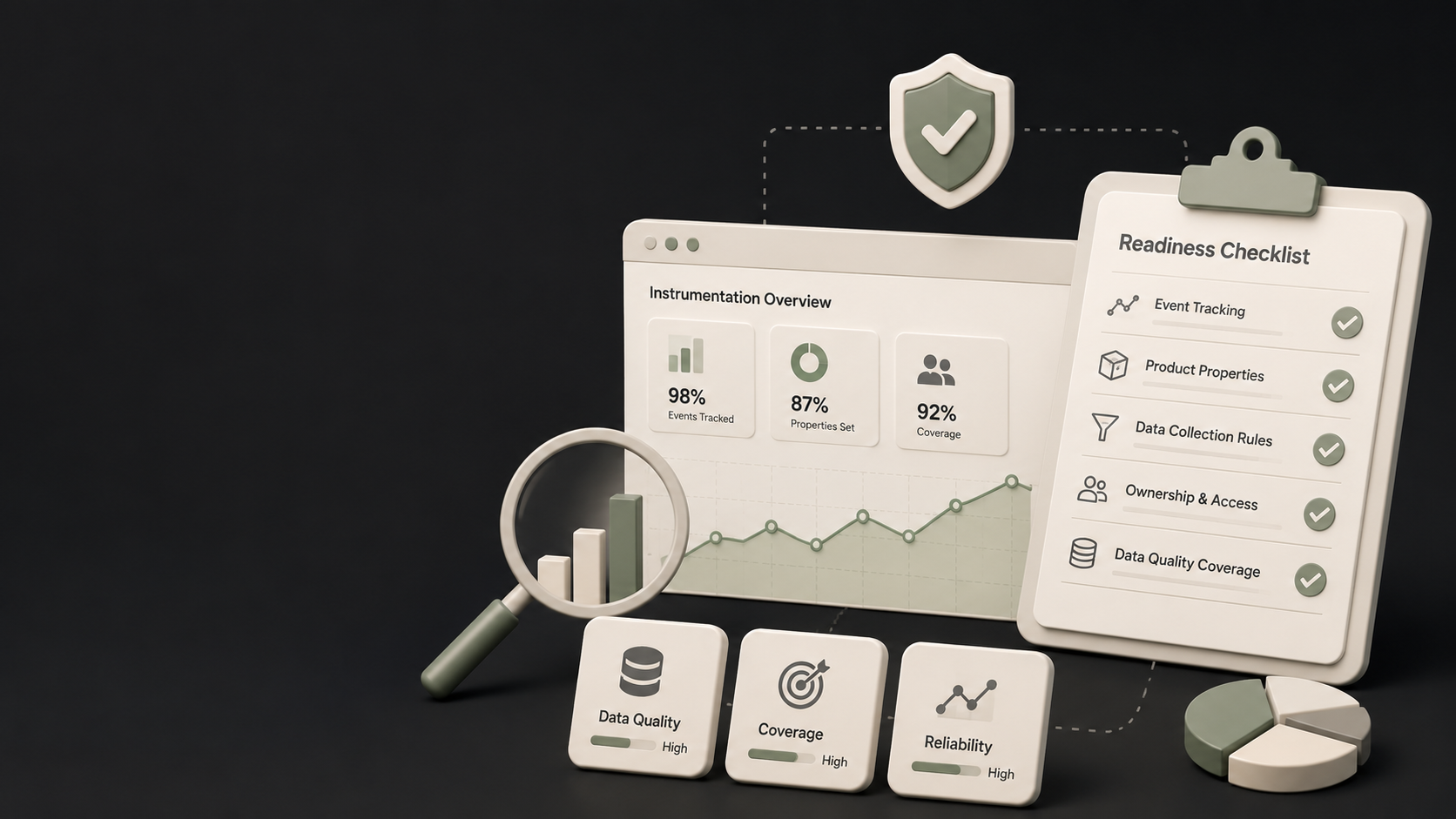
What this workflow decides
This workflow helps ecommerce, product analytics, and growth teams decide whether instrumentation evidence is reliable enough to support a product analytics recommendation before the organization changes roadmap priorities, onboarding flows, activation strategy, funnel optimization, experimentation plans, retention analysis, or reporting direction.
The review is not asking the analyst to produce a generic analytics audit or list every possible tracking issue. The workflow exists to answer a more important operational question:
Can the organization trust the product behavior evidence enough to approve the next product, analytics, or growth decision?
The recommendation should only move forward when event scope, required properties, identity logic, collection rules, implementation proof, ownership, and approval state are clear enough for a reviewer to approve action without guessing.
The final output should become a decision-ready instrumentation readiness memo that explains:
- What behavior is being measured.
- What evidence supports the recommendation.
- What collection weakness or caveat still exists.
- What operational risk remains.
- Who owns the next action.
- Whether the recommendation is approved, held, or sent back for more evidence.
Why instrumentation readiness matters
Product analytics recommendations are only as reliable as the instrumentation underneath them.
If events are incomplete, duplicated, mislabeled, delayed, or disconnected from identity logic, the organization may optimize the wrong experience, approve the wrong roadmap investment, or misunderstand actual customer behavior.
Instrumentation readiness protects the organization from acting on behavioral signals that appear trustworthy but are operationally weak.
For example:
Without a readiness review, those weaknesses can become roadmap decisions, prioritization mistakes, or misleading executive recommendations.
- A funnel report may show onboarding drop-off even though event firing breaks between devices.
- A feature adoption report may overstate engagement because duplicate events inflate usage counts.
- A retention dashboard may misclassify users because anonymous and authenticated identities are not reconciled properly.
- An activation analysis may rely on properties that are inconsistently populated across environments.
When to use this workflow
Use this workflow when a product, analytics, growth, or ecommerce team wants to use behavioral product data to support a recommendation, but needs to confirm that the instrumentation layer is reliable first.
Common situations include:
The workflow becomes especially important when multiple tracking systems, collection layers, identity rules, or implementation teams influence the behavioral evidence being reviewed.
- Reviewing onboarding or activation performance.
- Analyzing checkout or conversion funnel behavior.
- Evaluating feature adoption.
- Comparing cohort retention performance.
- Investigating product engagement patterns.
- Prioritizing roadmap changes.
- Preparing an experimentation recommendation.
- Validating a product analytics dashboard before executive review.
Inputs the analyst should inspect
The analyst should compare the recommendation against implementation proof rather than assuming dashboards or event labels are already trustworthy.
Each source should help the reviewer understand whether the instrumentation contract actually supports the recommendation being proposed.
- Event taxonomy
- Tracking plan
- Collection layer
- Property definitions
- Identity rules
- Implementation notes
- Owner approval note
How to evaluate instrumentation readiness
The first step is verifying that the tracked events actually represent the behavior being analyzed.
Generic or ambiguous events should not support operational recommendations.
For example:
The event definition should match the business question being asked. If the relationship between the event and the product behavior is weak, the recommendation should remain in review.
The tracking plan should explain:
The analyst should verify that the tracking plan still reflects the live implementation.
- A “button_click” event may not indicate successful activation.
- A “checkout_view” event may not indicate meaningful purchase intent.
- A “session_start” event may not represent product engagement.
- A “signup_started” event may not represent completed onboarding.
- What events exist.
- Why they exist.
- Which systems collect them.
- Which properties are required.
- How the events support operational reporting.
- Required properties exist consistently.
Checks before approval
Verify event, property, identity, and owner scope before interpreting product behavior. Confirm that required properties support the operational question being asked. Name the collection weakness that could reverse the recommendation. Convert instrumentation gaps into reviewed implementation tasks. Keep caveats visible beside the recommendation. Ensure implementation evidence exists for critical events.
Document ownership and approval state clearly.
- Verify event, property, identity, and owner scope before interpreting product behavior.
- Confirm that required properties support the operational question being asked.
- Name the collection weakness that could reverse the recommendation.
- Convert instrumentation gaps into reviewed implementation tasks.
- Keep caveats visible beside the recommendation.
- Ensure implementation evidence exists for critical events.
- Document ownership and approval state clearly.
Common failure modes
The workflow becomes a generic analytics audit instead of a decision review. The recommendation assumes dashboards are trustworthy without validating instrumentation. The memo hides collection weaknesses that weaken confidence in the recommendation. The identity model changes the meaning of the analysis but is ignored. Tracking gaps are treated as minor issues instead of operational blockers.
Implementation evidence is missing. The next owner or approval state is unclear.
- The workflow becomes a generic analytics audit instead of a decision review.
- The recommendation assumes dashboards are trustworthy without validating instrumentation.
- The memo hides collection weaknesses that weaken confidence in the recommendation.
- The identity model changes the meaning of the analysis but is ignored.
- Tracking gaps are treated as minor issues instead of operational blockers.
- Implementation evidence is missing.
- The next owner or approval state is unclear.
Recommended output
The final instrumentation readiness memo should include:
This structure keeps behavioral recommendations operationally reviewable instead of turning them into generic product analytics observations.
10X should keep instrumentation recommendations approval-gated until the reviewer accepts the evidence, caveat, owner, implementation proof, and operational risk.
- The operational decision being evaluated.
- The relevant event scope.
- The required properties.
- The collection caveat.
- The identity limitation if one exists.
- The implementation proof reviewed.
- The affected operational recommendation.
- The owner responsible for follow-up.
- The approval state.
What happens next
If the review is approved, the organization can move forward with the product analytics recommendation using the documented event scope, implementation proof, ownership structure, and caveat.
If the review is not approved, the instrumentation weakness should become a reviewed implementation task before roadmap, activation, experimentation, retention, or funnel optimization decisions move forward.
The goal of this workflow is not only better tracking. The goal is trustworthy behavioral evidence that product, analytics, ecommerce, and growth teams can use confidently in operational decision-making.
Sample review note
10X should review Product Analytics Instrumentation Readiness Review, compare the decision evidence with the caveats, and keep the next recommendation approval-gated until the reviewer accepts it.