Product Metric Monitoring Readout Review
Decide whether product metric movement is meaningful enough to brief the team, adjust the roadmap, or keep the metric in monitoring.
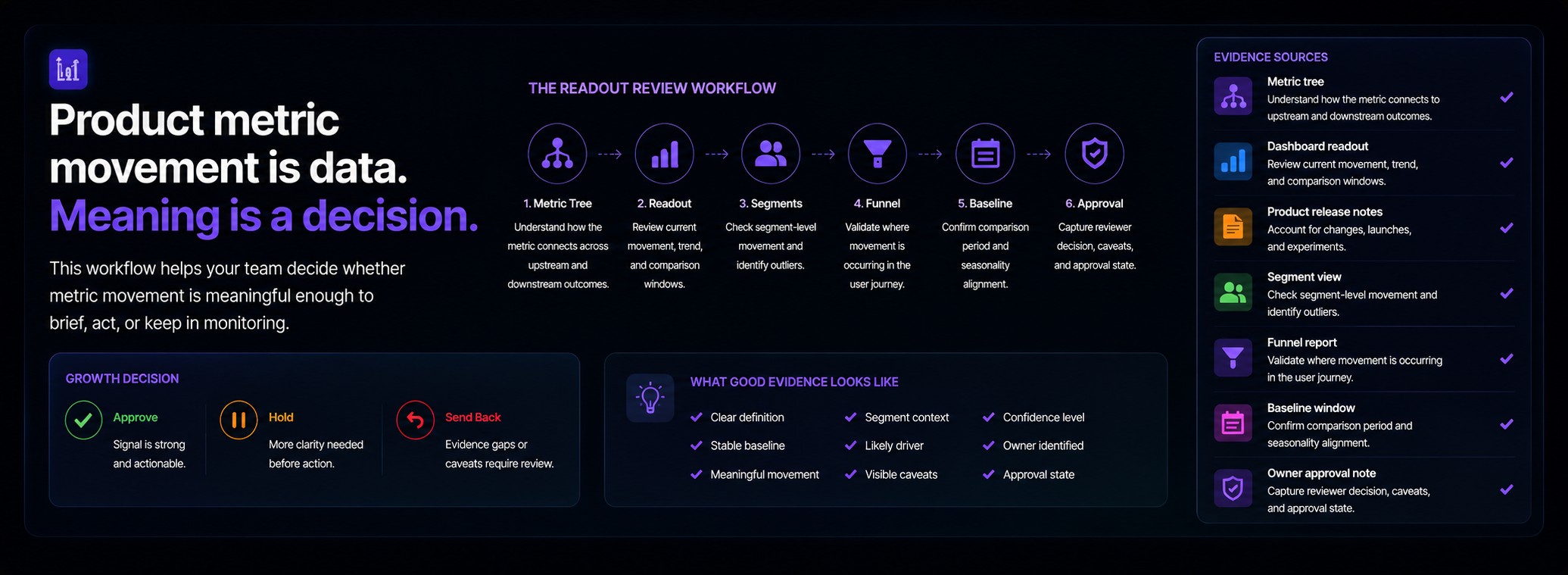
Decide whether product metric movement is meaningful enough to brief the team, adjust the roadmap, or keep the metric in monitoring. The proof gate for this route is: Metric readout memo with definition, baseline, movement, segment caveat, likely driver, owner, and approval state.. The page is not asking the analyst to produce a generic audit. It is asking for a decision-ready product analytics memo that can be reviewed by a product, analytics, or growth owner.

Three steps to a confident decision
Understand which business situation this page was built for and confirm it matches your current context.
Go item by item — each check has a clear pass/hold condition so you know exactly what qualifies.
Use the growth decision statement and analyst questions to brief your team and move forward with confidence.

Product Metric Monitoring Readout Review
Decide whether product metric movement is meaningful enough to brief the team, adjust the roadmap, or keep the metric in monitoring. The proof gate for this route is: Metric readout memo with definition, baseline, movement, segment caveat, likely driver, owner, and approval state.. The page is not asking the analyst to produce a generic audit. It is asking for a decision-ready product analytics memo that can be reviewed by a product, analytics, or growth owner.

What this page helps a team decide
A product team has a weekly or launch readout and needs to explain movement in activation, engagement, retention, conversion, or revenue metrics without overstating the signal.
- metric tree
- dashboard readout
- product release notes
- segment view
- funnel report
- baseline window
- owner approval note
What analysts ask before deciding
What decision is the ecommerce marketer trying to make for product metric monitoring readout: approve, hold, or send back for evidence?
Which input would make the marketer trust the product metric monitoring readout read enough to change the page, link, or indexation decision?
What caveat should stay visible before the team changes the page, link, or indexation decision?
Who owns the next action if the review is approved, and what stays on hold if it is not?
What usually goes wrong
- The diagnostic workflow is treated as generic content instead of a growth decision.
- The recommendation skips the source caveat, so the next step looks safer than the evidence allows.
- Follow-up moves forward before the reviewer accepts the approval rule.
What 10x.in checks
- Verify metric definition, baseline, segment scope, and owner before briefing movement.
- Translate movement into likely driver, caveat, and confidence state.
- Separate briefing from action so the owner can approve roadmap, product, or campaign follow-up.
OpenAnalyst should review Product Metric Monitoring Readout Review, compare the decision evidence with the caveats, and keep the next recommendation approval-gated until the reviewer accepts it.
FAQ
When is product metric movement ready to brief?
It is ready when the metric definition is stable, the comparison window is clear, movement exceeds an agreed threshold, and segment caveats are visible. Without those conditions, the signal belongs in monitoring. The practical test is whether the evidence, caveat, and owner are clear enough for a reviewer to approve the next step without guessing.
What should a readout do when the baseline is missing?
It should hold the recommendation and ask for a baseline or comparison window. Movement without a baseline can still be watched, but it should not trigger roadmap or growth action. The practical test is whether the evidence, caveat, and owner are clear enough for a reviewer to approve the next step without guessing.
How should segment caveats affect the readout?
If one segment or driver explains the movement, the recommendation should be scoped to that context. Aggregate claims should stay caveated until the broader population is checked. The practical test is whether the evidence, caveat, and owner are clear enough for a reviewer to approve the next step without guessing.
Can a dashboard screenshot be enough?
No. The readout needs a definition, baseline, movement read, caveat, likely driver, owner, and approval state before it supports action. The practical test is whether the evidence, caveat, and owner are clear enough for a reviewer to approve the next step without guessing.
Product Metric Monitoring Readout For Growth Decisions
A product metric monitoring readout review evaluates whether metric movement is meaningful enough to brief the team, adjust the roadmap, or keep the signal in monitoring. The review separates observed movement from interpretation so the team does not escalate a dashboard fluctuation into a roadmap change before validating the evidence.
Many teams react too quickly to temporary movement without confirming metric definition stability, baseline quality, segment behavior, likely drivers, or confidence state. The readout exists to slow that reaction down and produce a decision-ready memo that can be reviewed by a product, analytics, or growth owner.
- Define the metric and the specific movement under review.
- Confirm whether the signal supports briefing, action, or monitoring.
- Separate dashboard visibility from decision readiness.
- Assign ownership for the next approved action.
- Document the hold condition if evidence is incomplete.
A decision to brief the team or adjust the roadmap should not be triggered by every metric movement. It should be triggered by evidence that the definition, baseline, segment scope, driver, and confidence state support a meaningful readout.
Confirm Metric Definition Stability Before Interpreting Movement
Many monitoring failures occur because teams compare metrics whose definition, tracking logic, attribution behavior, or calculation structure changed during the comparison period. A metric that appears to move may actually reflect a definition change rather than a behavioral shift.
The review confirms the metric definition, calculation methodology, tracking consistency, reporting source alignment, and time-window stability. If the definition changed recently, the movement should remain caveated until the comparison becomes reliable.
- Verify the metric definition has not changed during the period.
- Confirm calculation methodology and tracking logic are stable.
- Check reporting source alignment across comparison periods.
- Review time-window consistency for the metric.
- Document definition changes that could explain the movement.
Metric definition should be confirmed before movement is interpreted. An unstable definition makes every downstream comparison unreliable regardless of how large the movement appears.
Validate The Baseline Window
Movement becomes meaningful only when compared against a stable baseline. Comparison periods should be aligned for seasonality, campaign overlap, launch timing, and historical variance. If the baseline is missing or unstable, the metric belongs in monitoring rather than action.
The review confirms whether the comparison window is clean and comparable. A sudden increase in engagement during a launch week may look significant, but without a matched comparison period, the signal may be temporary or misleading.
- Confirm comparison periods are aligned and comparable.
- Check for seasonality effects on the baseline.
- Review campaign and launch overlap in the comparison window.
- Evaluate historical variance for the metric.
- Document baseline gaps before approving the readout.
A stable baseline ensures the movement signal is real rather than an artifact of poor comparison. Movement without a baseline can be watched but should not trigger roadmap or growth action.
Separate Meaningful Signal From Expected Variance
Not all movement deserves escalation. Expected variance, temporary volatility, tracking instability, and operational anomalies can produce dashboard movement that looks significant but remains inside normal ranges. The review distinguishes between noise and a meaningful behavioral change.
The workflow should avoid turning every dashboard fluctuation into a roadmap discussion. If the movement remains inside normal variance ranges, the recommendation may stay in monitoring rather than triggering a team briefing.
- Compare current movement against historical variance ranges.
- Identify whether movement exceeds an agreed significance threshold.
- Separate temporary volatility from sustained behavioral change.
- Check for tracking instability that could explain the fluctuation.
- Document signal-versus-noise assessment before escalating.
Signal should be confirmed before action. Reacting to normal variance as if it were meaningful change creates false narratives and wastes team attention on movement that reverts without intervention.
Identify The Likely Driver Behind The Movement
Movement should connect to a likely operational or product driver whenever possible. The review compares the metric movement against product releases, UX updates, experiment launches, traffic changes, acquisition campaigns, technical incidents, and pricing changes.
If the reviewer cannot explain the likely driver, the recommendation should remain partially held. Unexplained movement should not automatically trigger roadmap changes or team briefings. The driver provides the causal link that transforms observation into actionable insight.
- Compare movement timing against product release notes.
- Check for UX updates or experiment launches in the period.
- Review traffic changes and acquisition campaign activity.
- Identify technical incidents that could explain the shift.
- Document driver uncertainty when a cause cannot be identified.
A likely driver gives the readout explanatory power. Movement without an identified cause should carry lower confidence and may belong in monitoring until the driver becomes clear.
Review Segment-Level Patterns Before Generalizing
Aggregate metrics often hide important segment differences. A product may show stable activation overall while declining sharply for mobile users, specific acquisition channels, or particular subscription tiers. The review inspects segment-level behavior before making claims about the broader population.
If one segment or driver explains most of the movement, the recommendation should stay scoped to that context. Aggregate claims should remain caveated until the broader population is checked. Generalizing a segment-specific signal produces recommendations that break when applied outside the affected group.
- Review device segments for divergent movement patterns.
- Check user cohort and lifecycle stage behavior.
- Evaluate traffic-source and geographic differences.
- Compare subscription tier and plan-type segments.
- Document segment caveats before making aggregate claims.
Segment review ensures the readout does not overstate a narrow signal. A movement driven by one segment should be reported as such, and action should be scoped accordingly rather than applied across the entire product.
Translate Movement Into A Confidence State
The readout should communicate confidence clearly. Confidence depends on metric stability, tracking reliability, segment consistency, baseline quality, and operational alignment. The review assigns a confidence level so the reader understands whether the signal is strong enough to support the recommended action.
If confidence remains weak, the workflow should prevent the team from overreacting. A low-confidence signal may warrant continued monitoring or additional validation but should not trigger roadmap changes, team briefings, or campaign adjustments.
- Assign a confidence level based on evidence quality.
- Confirm metric stability and tracking reliability for the period.
- Evaluate segment consistency across the movement.
- Review baseline quality and its impact on confidence.
- Document confidence limitations before recommending action.
Confidence state should match the evidence quality. A strong signal with high confidence supports action. A weak signal with low confidence should stay in monitoring or trigger additional validation rather than immediate follow-up.
Keep Metric Caveats Visible During The Review
Decision-makers should see monitoring limitations alongside the movement findings. Caveats around tracking limitations, segment instability, baseline uncertainty, release overlap, sampling issues, and confidence constraints should remain attached to the recommendation throughout the review process.
If caveats disappear from the readout, the next step looks safer than the evidence allows. Each finding should carry its limitation so the reviewer can weigh confidence alongside the observed movement.
- Document tracking limitations that affect the movement signal.
- Surface segment instability that could change conclusions.
- Highlight baseline uncertainty and release overlap effects.
- Make sampling issues explicit before approving action.
- Separate confidence from certainty in every finding.
Visible caveats improve trust by helping stakeholders understand the limitations behind the metric movement. The review should not approve roadmap changes or team briefings when significant caveats remain unresolved.
Approval-Gated Readouts Protect Product Decision Quality
Product metric movement influences roadmap priorities, team briefings, campaign launches, and growth investments simultaneously. An approval-gated review ensures the team does not confuse dashboard visibility with decision readiness when interpreting metric movement.
The reviewer should approve only the next step supported by visible metric evidence. If definition stability, baseline quality, segment review, driver identification, or confidence state evidence is not visible, the output should be a hold or monitoring note rather than a roadmap or briefing approval.
- Assign an owner for the next approved product action.
- Document reviewer acceptance of the metric evidence and caveats.
- Track approval state before roadmap or campaign changes.
- Identify unresolved metric dependencies that could block success.
- Keep follow-up actions visible until metric evidence improves.
Approval gating protects product teams from acting on metric movement when the underlying definition, baseline, segment, driver, and confidence evidence remains incomplete. The review should answer a clear decision: brief the team, adjust the roadmap, or keep the metric in monitoring.