Visualization Readiness Determines Whether Reporting Can Influence Action
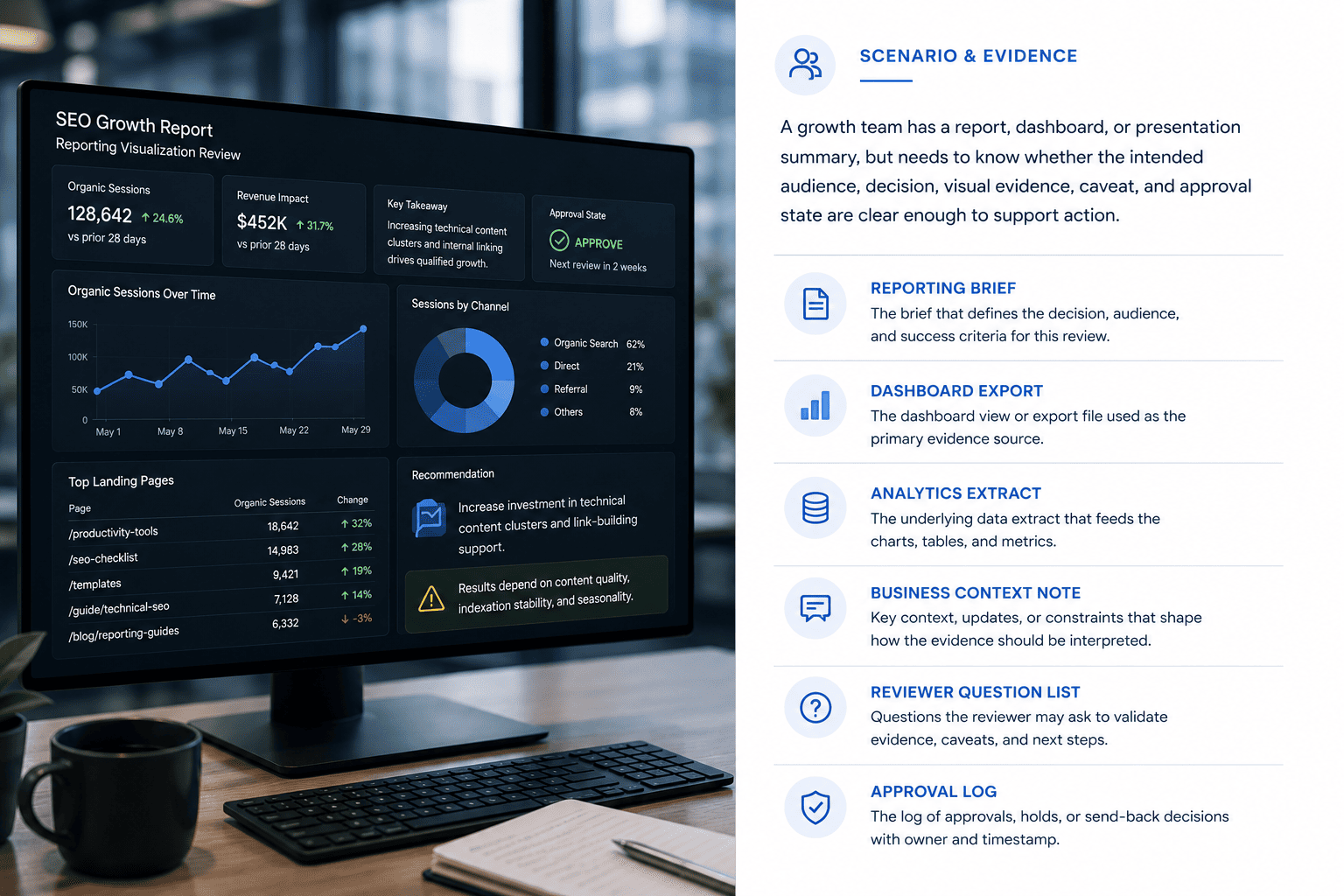
A reporting visualization readiness review evaluates whether a dashboard, report, or presentation artifact communicates evidence clearly enough for stakeholders to make operational growth decisions. The workflow focuses on interpretation reliability rather than reporting availability. A dashboard may contain accurate data while still failing the decision process if the reviewer cannot identify the recommendation, caveat, ownership boundary, or approval state quickly enough to act responsibly.
The objective of the workflow is not visual polish. It is operational clarity. Every chart, table, summary block, and annotation should reduce interpretation effort while preserving the uncertainty attached to the recommendation.
Identify The Reviewer And The Decision Before Reviewing The Visualization
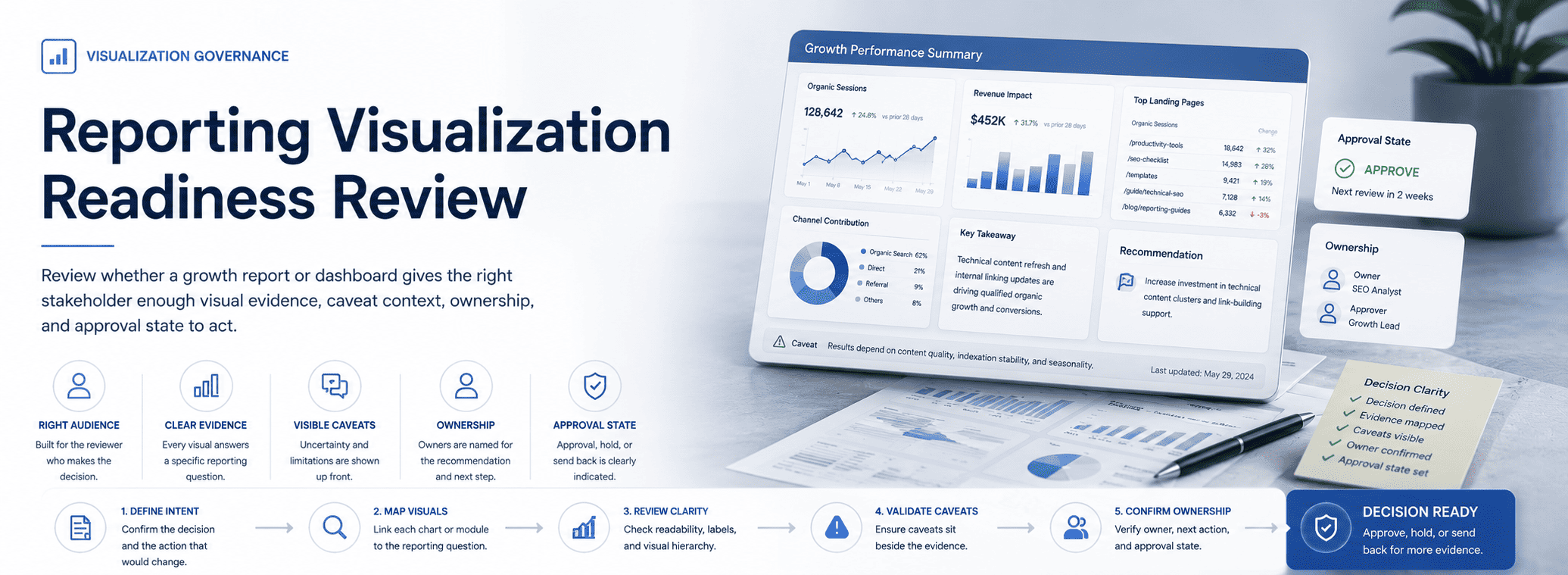
The workflow begins by validating who the visualization is intended for and what decision the artifact expects them to make. Reporting artifacts frequently fail because they attempt to support monitoring, analysis, executive review, and approval workflows simultaneously.
- Document the intended reviewer and approval owner.
- Define the exact decision the visualization supports.
- Separate informational dashboards from decision-request artifacts.
- Identify what operational action changes if the evidence is accepted.
- Confirm whether the recommendation requires approval, observation, or escalation.
Without reviewer alignment, dashboards accumulate excessive context while still failing to answer the operational question stakeholders actually need resolved.
Map Every Visual Element To A Reporting Question
The review then evaluates whether every chart, table, comparison block, or visual module supports a specific reporting question. Visualizations should exist to answer operational uncertainty rather than decorate reporting interfaces.
- Map charts to explicit decision questions.
- Review whether metrics support the stated recommendation.
- Remove visual modules that do not influence interpretation.
- Validate whether supporting context appears beside the evidence.
- Check whether trend comparisons remain operationally understandable.
This mapping stage prevents reporting environments from becoming visually dense but operationally unclear. Excess visual complexity increases interpretation time and weakens recommendation trust during stakeholder reviews.
Review Whether Visual Design Reduces Interpretation Effort
A visualization readiness review treats layout, spacing, labels, annotations, and visual emphasis as operational infrastructure. Visual design choices directly affect how quickly reviewers detect caveats, identify changes, and interpret evidence.
The workflow should validate:
- chart readability and label clarity
- visual hierarchy and emphasis
- contrast between evidence and decoration
- annotation visibility
- caveat placement
- color consistency across related comparisons
- layout sequencing around the recommendation flow
A persuasive chart becomes operationally dangerous when visual styling amplifies confidence faster than the underlying evidence justifies. The review therefore separates visual persuasion from analytical trustworthiness.
Keep Caveats Beside Recommendations
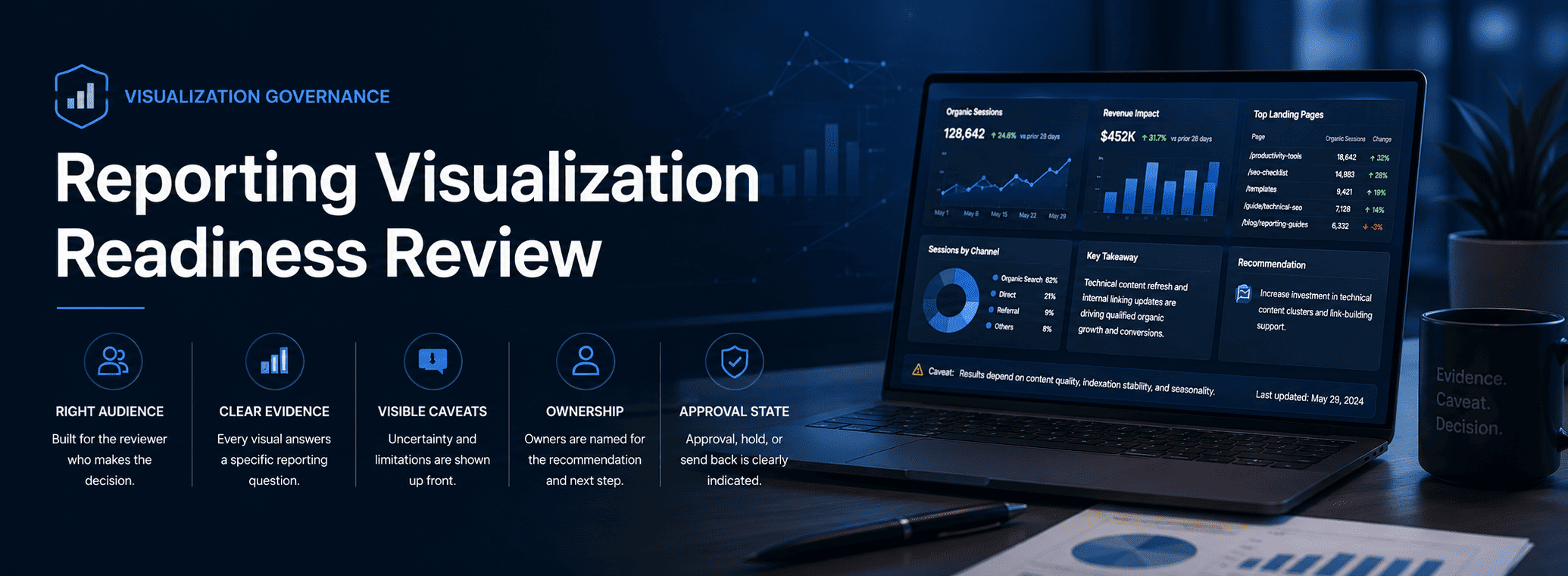
One of the primary goals of the workflow is ensuring that uncertainty remains visible during the decision process. Caveats should appear beside the recommendation itself rather than inside disconnected notes or secondary documentation.
- Place caveats near charts affecting the recommendation.
- Keep data limitations visible during approvals.
- Document unresolved dependencies directly beside conclusions.
- Show freshness status and source conditions.
- Identify interpretation risks before escalation occurs.
This governance approach prevents reviewers from treating dashboards as unconditional truth. Recommendations remain operationally reviewable because evidence and uncertainty remain linked inside the same artifact.
Separate Monitoring Dashboards From Approval Memos
The workflow distinguishes ongoing monitoring environments from approval-oriented decision artifacts. Monitoring dashboards support observation and recurring review, while decision memos support approval or rejection of a next action.
A monitoring dashboard may contain useful evidence while still being unsuitable for approval workflows because it lacks:
- explicit recommendation ownership
- approval status visibility
- rollback conditions
- next-step accountability
- decision framing
This separation prevents operational confusion where stakeholders mistake recurring performance monitoring for approval-ready growth recommendations.
Validate Ownership And Approval Visibility
Visualization readiness depends on whether ownership and approval boundaries remain visible during review. Stakeholders must understand who prepared the recommendation, who approves it, and what remains blocked until approval occurs.
- Display recommendation ownership clearly.
- Show approval state beside the recommendation.
- Identify what actions remain on hold.
- Document escalation pathways for unresolved questions.
- Keep governance notes visible during stakeholder review.
Without visible ownership, recommendations become difficult to operationalize because accountability disappears once the dashboard circulates between teams.
Operational Importance Of Visualization Readiness Reviews
Growth teams increasingly depend on dashboards and reporting presentations to justify campaign movement, prioritization changes, SEO updates, and reporting cadence decisions. Visualization readiness reviews ensure these artifacts remain operationally interpretable before stakeholders act on them.
Instead of treating dashboards as passive reporting surfaces, the workflow positions them as governed decision systems requiring evidence alignment, interpretation clarity, ownership visibility, and approval boundaries.
This creates reporting environments where visual evidence remains reviewable, caveated, operationally accountable, and approval-gated before recommendations influence growth execution.