SEO Prioritization Depends On Analytics Readiness
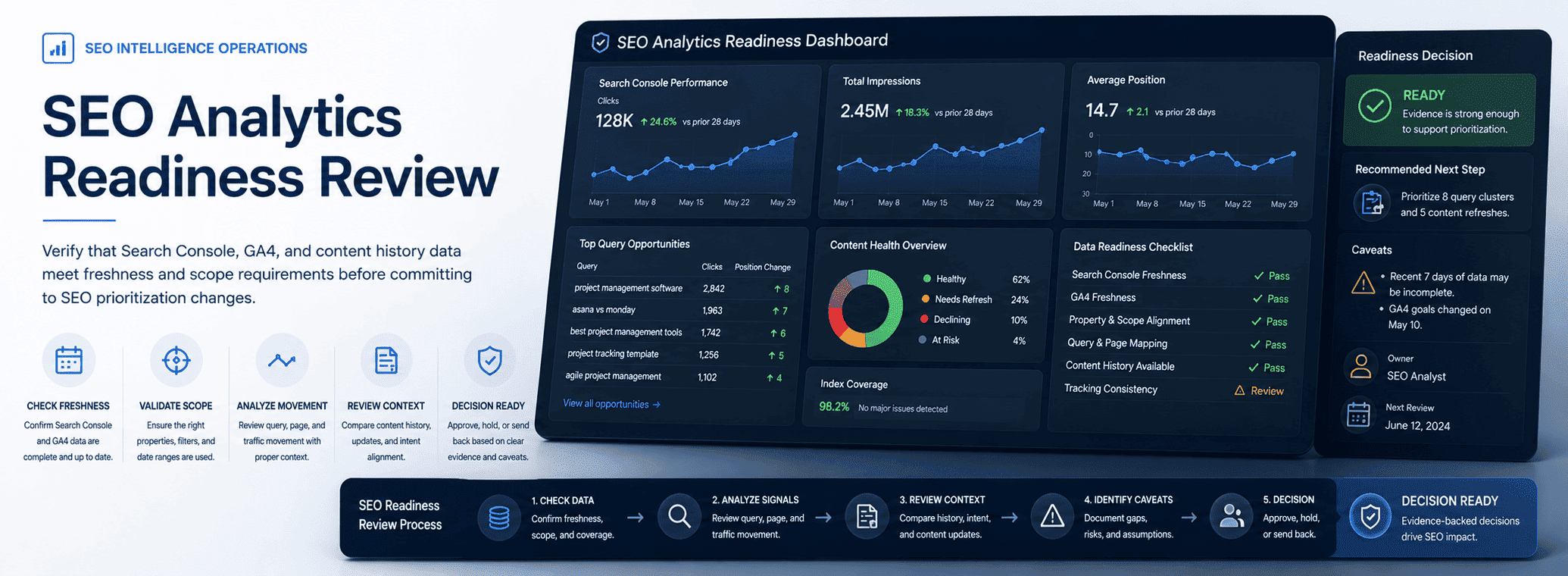
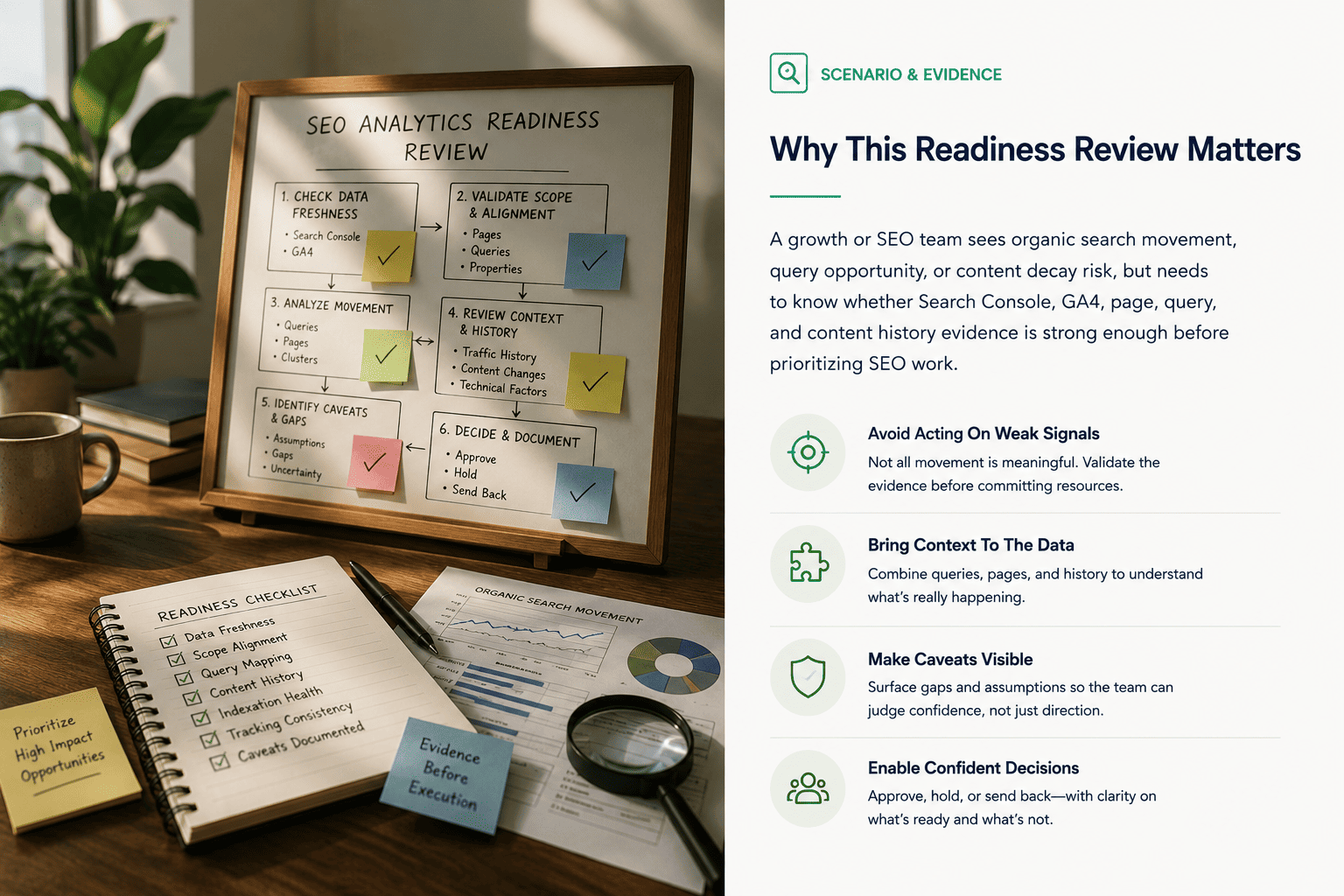
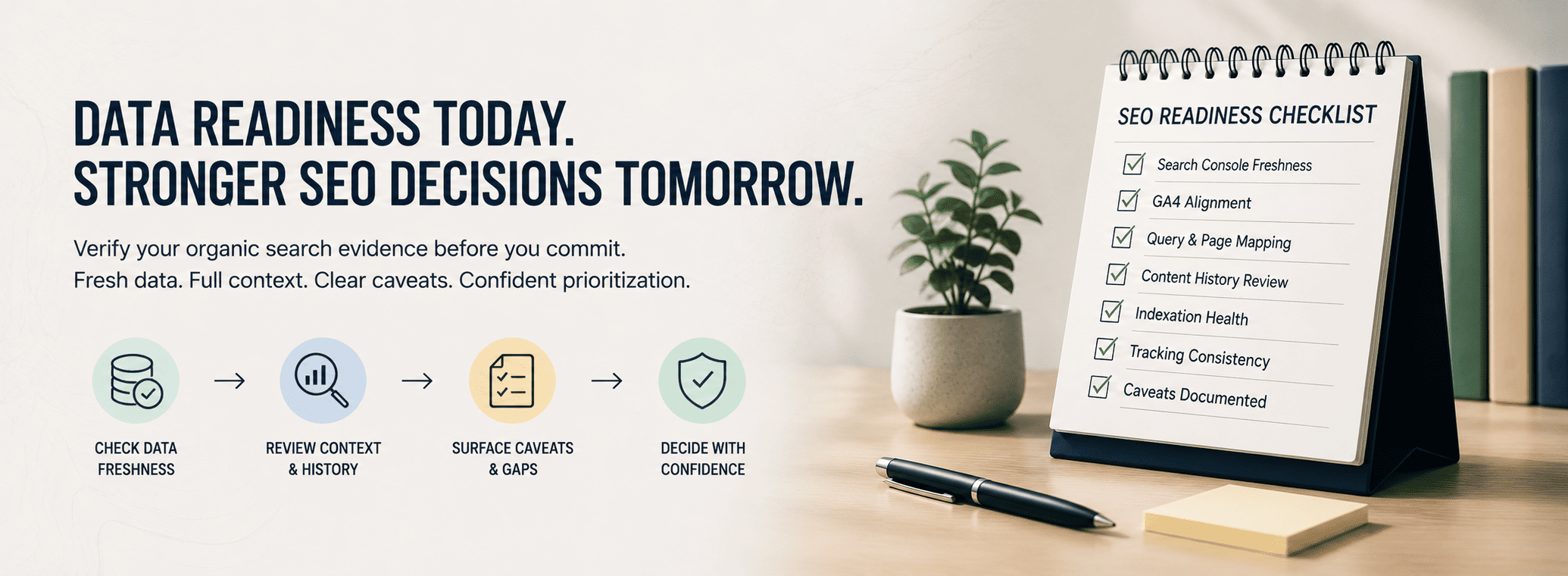
An SEO analytics readiness review evaluates whether organic search evidence is reliable enough to support prioritization decisions before teams commit resources to technical SEO, content refreshes, page consolidation, or query-cluster expansion. The workflow focuses on evidence trustworthiness before strategic movement occurs.
Organic search environments generate large volumes of signals across Search Console, GA4, content systems, and historical reporting layers. However, reporting availability alone does not guarantee readiness for decision-making. Search movement can appear meaningful while still lacking freshness, scope alignment, or contextual evidence necessary for operational prioritization.
Validate Search Console And GA4 Freshness Before Interpretation
The workflow begins by confirming whether Search Console and GA4 exports are fresh enough to support the decision window under review. SEO prioritization becomes unreliable when recent data gaps, incomplete exports, or property inconsistencies distort movement interpretation.
- Verify Search Console exports cover the required review period.
- Check whether GA4 properties align with the evaluated pages.
- Review freshness lag before interpreting recent movement.
- Confirm page and query scope consistency across systems.
- Document missing intervals, partial exports, or sampling caveats.
This stage prevents teams from reacting to incomplete search visibility patterns or misaligned analytics environments. Freshness validation establishes the minimum evidence threshold required before deeper prioritization analysis begins.
Group Pages And Queries Around Intent And Business Relevance
SEO opportunities should not be evaluated as isolated keywords or standalone URLs. The readiness review therefore groups pages and queries according to intent, movement patterns, and business relevance before determining prioritization direction.
- Cluster related queries around search intent.
- Group pages by business role and traffic behavior.
- Separate informational, transactional, and navigational movement.
- Review whether search growth aligns with business value.
- Identify query clusters affected by the same content dependency.
This grouping process prevents prioritization distortion caused by isolated metrics. A page may show traffic growth while simultaneously losing visibility across high-value query groups that matter more strategically.
Compare Query Movement Against Page History
The workflow then evaluates whether search movement reflects meaningful opportunity, temporary volatility, seasonal shifts, or historical performance cycles. Query movement should always be interpreted alongside page context and traffic history.
The review should validate:
- historical traffic stability
- ranking volatility patterns
- query-position movement
- seasonality impact
- content update history
- technical changes affecting visibility
- indexation and crawl conditions
This comparison stage prevents teams from treating temporary fluctuations as structural SEO opportunities. Historical context reduces overreaction and protects prioritization stability.
Separate Decision Signals From Diagnostic Signals
SEO reporting environments frequently mix directional evidence with diagnostic analytics. The readiness review distinguishes between metrics that justify prioritization changes and metrics that only explain behavior after investigation begins.
- Separate prioritization-driving metrics from exploratory diagnostics.
- Identify attribution signals requiring caveats.
- Review whether conversion metrics influence prioritization directly.
- Keep exploratory annotations separate from decision evidence.
- Document uncertainty beside directional recommendations.
This separation ensures prioritization recommendations remain operationally focused instead of becoming overloaded with secondary reporting details that weaken decision clarity.
Review Content History Before Recommending Refresh Or Consolidation
Content refresh and consolidation decisions should account for historical updates, structural dependencies, and previous optimization attempts before recommendations move into approval review.
- Review historical content modifications.
- Check whether prior refreshes affected visibility positively or negatively.
- Identify overlapping content competing for similar intent.
- Validate whether consolidation risk affects existing rankings.
- Compare content age against query movement trends.
A page showing performance decline may reflect outdated intent alignment, technical degradation, SERP competition changes, or internal cannibalization rather than content quality alone.
Keep Caveats Visible During Prioritization Reviews
The readiness review ensures uncertainty remains visible throughout the prioritization process. Caveats should remain attached to the recommendation so reviewers understand which conditions could reverse the proposed action.
- Document incomplete evidence beside findings.
- Keep freshness gaps visible during review.
- Show unresolved attribution dependencies.
- Identify assumptions affecting prioritization confidence.
- Separate directional confidence from operational certainty.
This governance structure prevents SEO recommendations from appearing more certain than the supporting evidence allows.
Approval-Gated Reviews Protect SEO Resource Allocation
SEO prioritization decisions often affect engineering resources, content operations, crawl management, and reporting workflows simultaneously. The readiness review therefore keeps recommendations approval-gated before operational execution occurs.
- Separate analytical findings from implementation authority.
- Assign ownership before prioritization changes move forward.
- Require reviewer acceptance before execution.
- Document what remains on hold during caveated reviews.
- Maintain rollback visibility around strategic changes.
The workflow protects operational stability by ensuring that prioritization movement remains evidence-backed, reviewable, and governed before teams commit capacity.
Operational Importance Of SEO Analytics Readiness Reviews
Modern SEO operations depend on integrated analytics environments spanning Search Console, GA4, historical reporting systems, and content intelligence workflows. An SEO analytics readiness review ensures these systems produce evidence strong enough to support prioritization decisions responsibly.
Instead of reacting to isolated traffic movement or ranking changes, teams establish operational trust boundaries around freshness, scope, context, and evidence alignment before strategic actions move into execution.
This creates a governed SEO decision environment where recommendations remain reviewable, caveated, operationally accountable, and approval-gated before affecting growth prioritization.