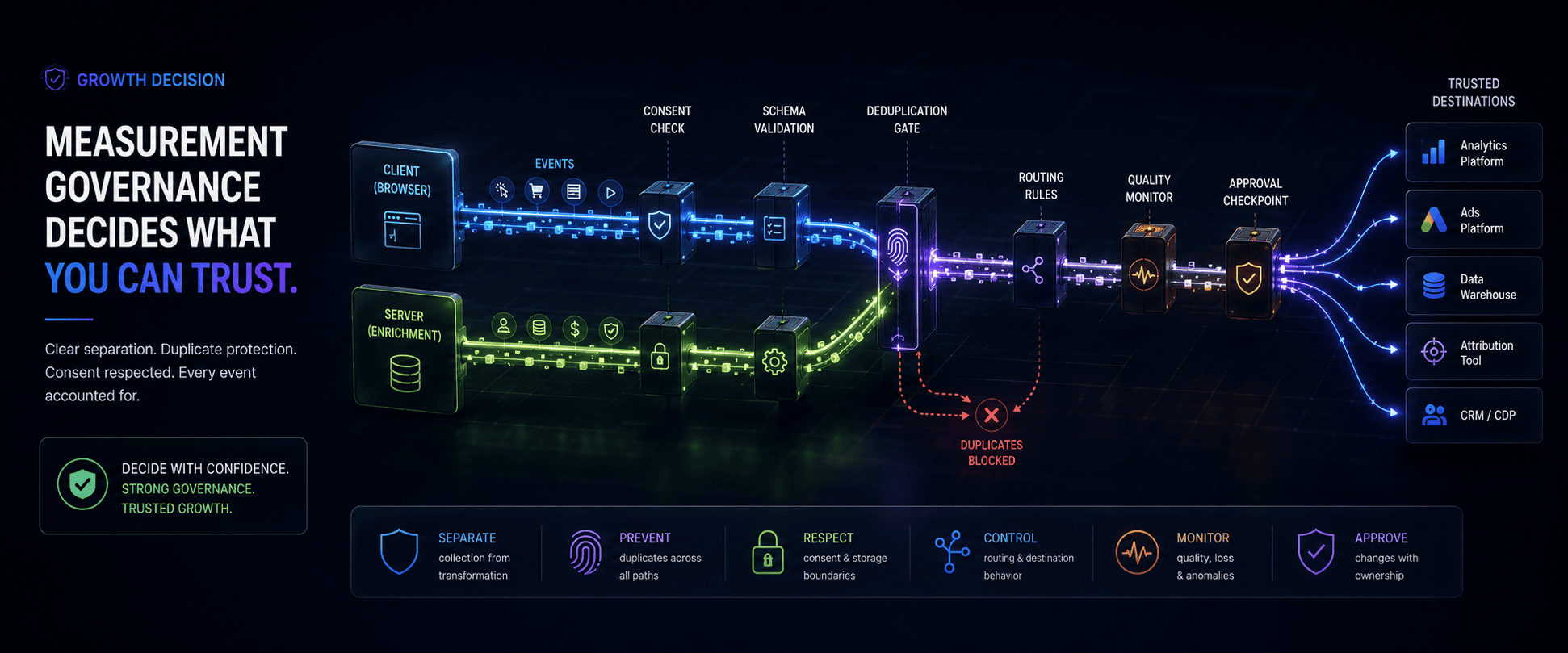
Measurement Governance Requires Separation Between Collection And Transformation
A server and client measurement governance review evaluates whether browser-side collection, server-side enrichment, destination routing, and attribution logic are separated clearly enough to support trusted reporting decisions. The workflow focuses on governance boundaries before analytics evidence influences attribution, optimization, or SEO prioritization.
Modern analytics environments increasingly combine browser events, server dispatch systems, identity layers, consent handling, and enrichment pipelines into a shared reporting infrastructure. Without governance separation, teams lose visibility into where signals originate, how they transform, and whether duplicate or inflated reporting enters downstream systems.
Define Browser-Side Collection Responsibilities First
The workflow begins by identifying which user behaviors the browser is responsible for collecting before any backend enrichment occurs. Browser-side collection should remain limited to observable client interactions rather than inferred or transformed reporting logic.
This stage establishes a traceable evidence baseline before data enters enrichment pipelines or server-side transformations.
- Map events captured directly inside the browser.
- Document which user actions trigger measurement collection.
- Review client-side dependencies affecting dispatch behavior.
- Separate observable actions from derived calculations.
- Validate how consent state alters client collection.
Separate Server Enrichment From Original User Evidence
Server-side systems frequently modify, enrich, join, or reroute collected events before they reach analytics destinations. The review therefore validates whether transformed evidence remains distinguishable from the original browser signal.
Without this separation, analysts may interpret transformed values as direct user behavior even when the signal originated from backend inference or post-processing logic.
- Document all enrichment and transformation steps.
- Review backend joins affecting attribution logic.
- Separate calculated values from collected behavior.
- Validate ownership of server-side transformation rules.
- Track which downstream systems inherit enriched data.
Review Deduplication Rules Across Dispatch Paths
Measurement governance reviews must validate whether the same user action can enter reporting systems through multiple pathways simultaneously. Duplicate conversion behavior is one of the most damaging governance failures because it inflates attribution confidence across all channels.
The workflow should validate:
This review prevents situations where browser events and server dispatches both count the same conversion independently. Inflated conversion counts distort optimization logic, reporting accuracy, and budget allocation simultaneously.
- client dispatch timing
- server dispatch timing
- event identifiers
- deduplication rules
- destination-specific processing
- retry behavior
- fallback routing logic
Validate Cookie, Storage, And Consent Dependencies
Measurement reliability depends heavily on browser storage availability, identifier persistence, consent state, and protocol behavior. Governance reviews therefore evaluate how storage conditions affect signal continuity and reporting interpretation.
This stage prevents reporting gaps caused by storage restrictions, consent interruptions, or client-side execution failures that silently reduce attribution visibility.
- Review first-party identifier dependencies.
- Check localStorage and cookie persistence behavior.
- Validate consent-state transitions during collection.
- Identify browser conditions that suppress measurement.
- Document protocol limitations affecting evidence continuity.
Review Every Analytics Destination Receiving Event Data
A governance review treats every analytics destination as a reporting dependency rather than a passive endpoint. Teams should understand where collected or enriched signals propagate after dispatch occurs.
One transformed signal can propagate across multiple advertising, reporting, or optimization systems simultaneously. Governance visibility therefore extends beyond the original collection layer.
- Inventory all analytics destinations receiving events.
- Review which systems inherit enriched values.
- Check whether downstream destinations modify incoming signals.
- Validate destination-specific attribution processing.
- Document reporting caveats introduced after dispatch.
Require Monitoring Windows And Rollback Visibility
Measurement governance reviews should never authorize immediate implementation changes without monitoring visibility, rollback planning, and approval ownership. Reporting infrastructure changes can silently affect attribution systems long before dashboards visibly break.
This governance layer prevents irreversible analytics changes from reaching production without operational safeguards.
- Assign ownership before deployment approval.
- Define monitoring windows after implementation.
- Keep rollback procedures documented and accessible.
- Track release notes beside governance findings.
- Require approval review before production rollout.
Keep Caveats Attached To Attribution Recommendations
Attribution recommendations should retain all known uncertainty beside the reporting evidence itself. Caveats help reviewers understand whether measurement inflation, suppression, or dispatch inconsistency could alter optimization decisions.
This ensures governance reviews remain operationally trustworthy instead of presenting analytics evidence as unconditional truth.
- Document unresolved duplicate risks.
- Keep consent-related limitations visible.
- Surface monitoring gaps beside conclusions.
- Identify enrichment assumptions affecting attribution.
- Separate directional confidence from reporting certainty.
Operational Importance Of Measurement Governance Reviews
Modern growth systems increasingly depend on interconnected browser collection, server dispatching, enrichment pipelines, and multi-destination reporting architectures. A server and client measurement governance review ensures these systems remain interpretable, auditable, and operationally governable before analytics evidence influences attribution or optimization decisions.
Instead of treating event collection as a technical implementation detail, the workflow positions measurement architecture as a strategic governance system requiring ownership visibility, caveat documentation, rollback planning, and approval-gated change management.
This creates a reporting environment where attribution evidence remains reviewable, traceable, operationally accountable, and protected against silent duplication or transformation risk before downstream decisions move into production.
Sample review note
10X should review Server And Client Measurement Governance Review, compare the decision evidence with the caveats, and keep the next recommendation approval-gated until the reviewer accepts it.