Shopify Authority Link Quality Review For SEO Decisions
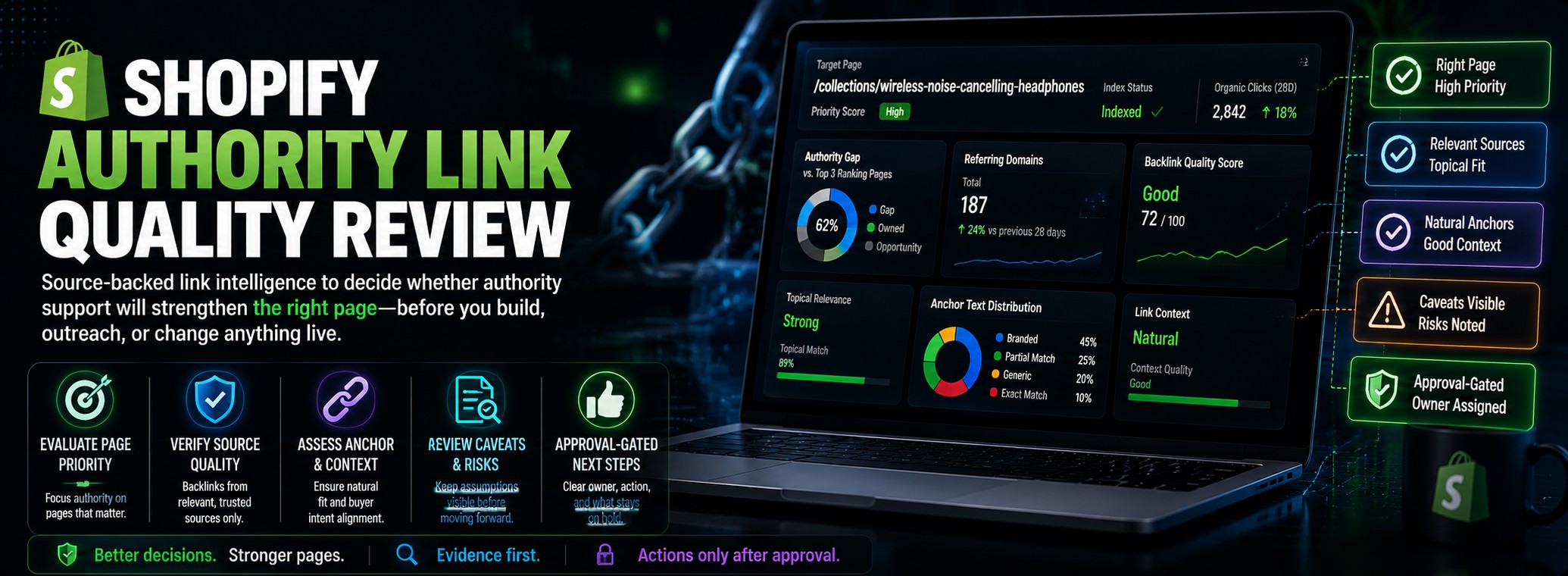
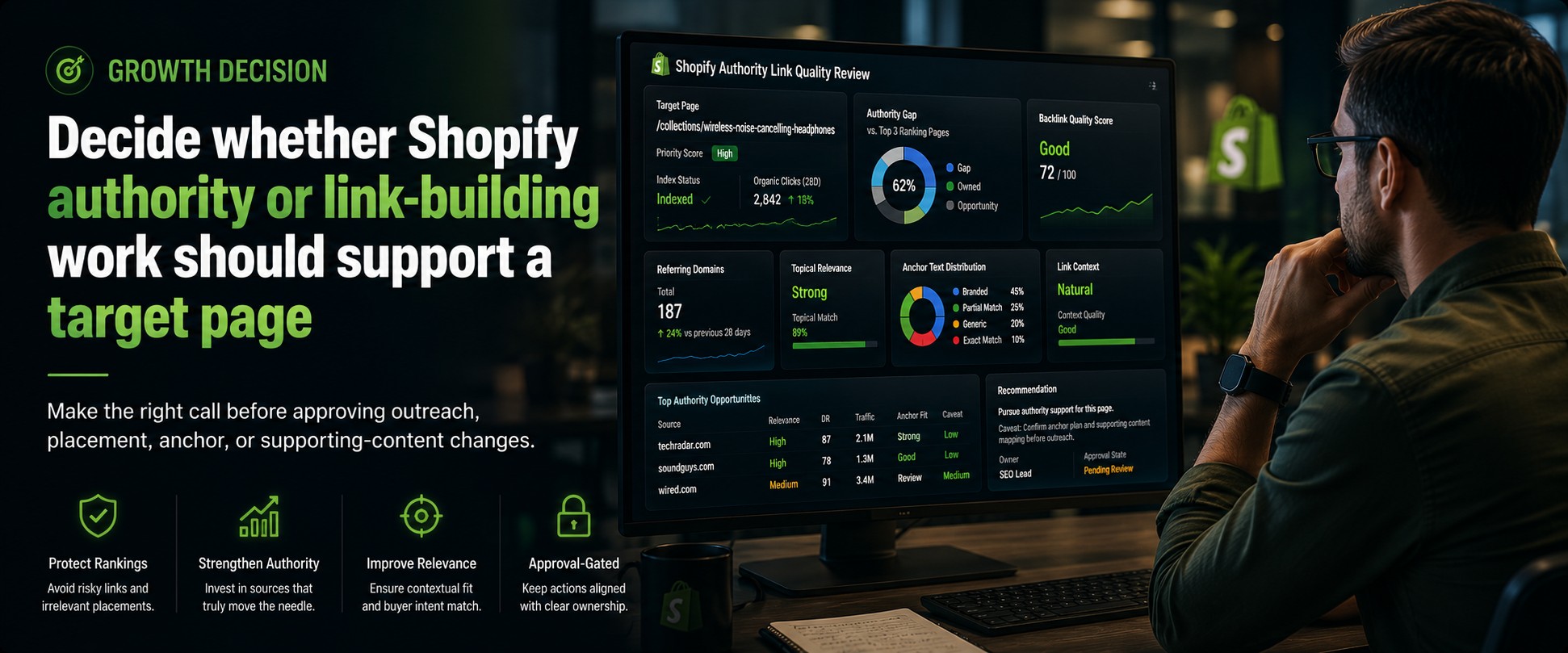
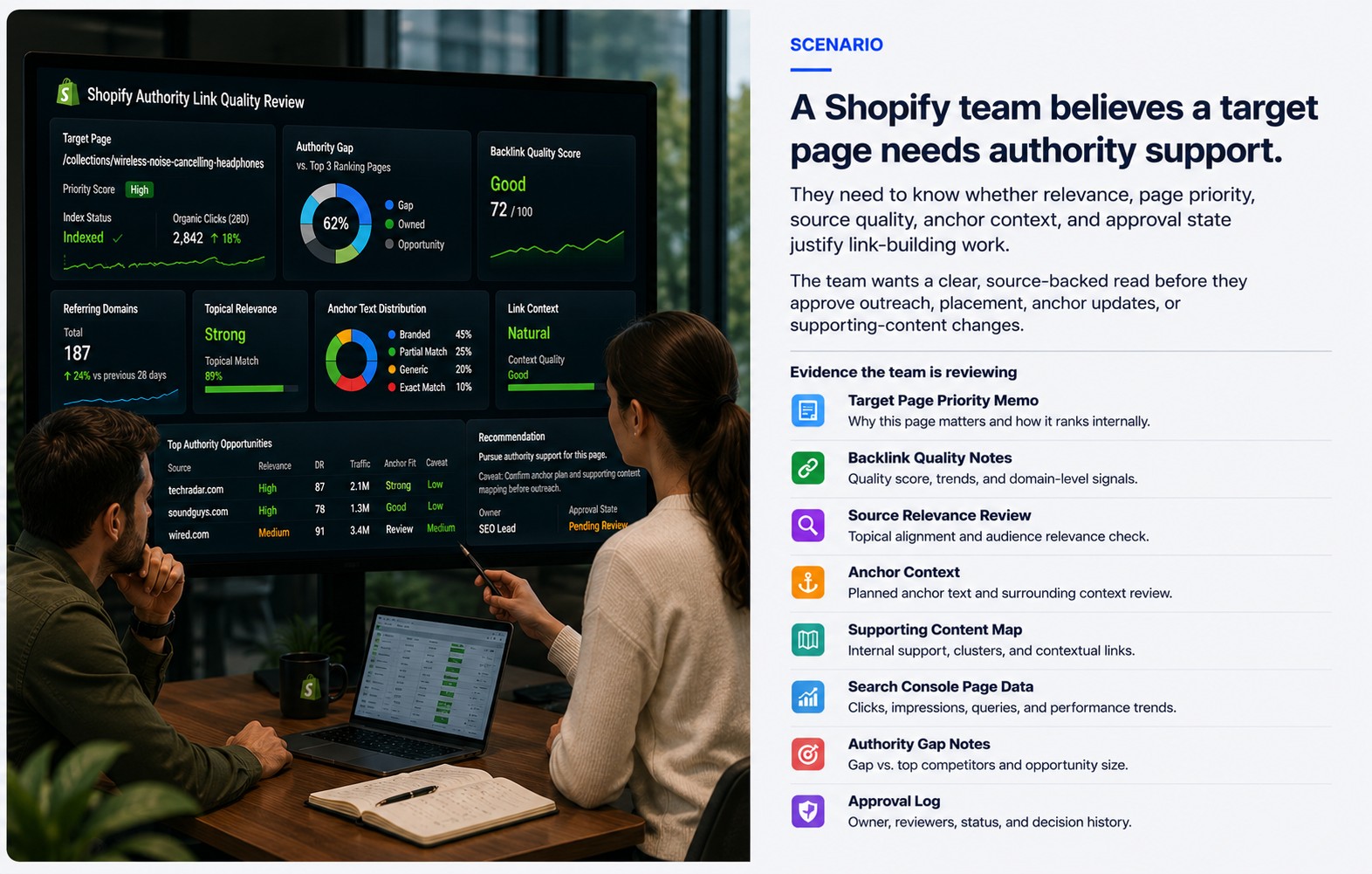
A Shopify authority link quality review evaluates whether a target page needs authority support and whether the proposed link-building evidence justifies outreach, placement, anchor, or supporting-content changes. The review separates page readiness, source relevance, and anchor context from the action that might follow, so the team does not commit link-building resources before validating the evidence.
Link-building can consume significant operational time and external relationship effort. Before the team invests those resources, the review confirms that the target page is important enough, ready enough, and supported by evidence that the candidate placement will strengthen Shopify search visibility rather than producing a low-relevance signal.
- Define the authority recommendation before reviewing link candidates.
- Identify whether the target page needs authority support to rank.
- Separate page readiness checks from link-building execution.
- Assign ownership for the next approved authority action.
- Document the hold condition if the review is not approved.
A decision to pursue link-building should not be driven by the availability of outreach opportunities alone. It should be driven by evidence that the target page is ready to receive authority support and the candidate placement carries enough relevance and quality to justify the investment.
Confirm Target Page Readiness Before Approving Authority Work
A target page should not receive authority investment before it passes technical, content, and internal-link readiness checks. Building links to a page that is not ready to convert authority into ranking improvement wastes both the link-building effort and the authority signal itself.
The review evaluates whether the target page is technically sound, content-complete, and internally linked well enough to benefit from external authority support. If the page has indexing issues, thin content, or weak internal link structure, those constraints should be resolved before outreach begins.
- Verify the target page is indexed and crawlable.
- Confirm content quality and depth support the authority investment.
- Review internal link structure for the target page and related content.
- Check for technical SEO issues that could suppress ranking benefit.
- Document page readiness gaps before approving link-building work.
Authority work should start after page readiness is confirmed rather than before. A page that cannot convert authority into ranking benefit should be improved first, and the link-building recommendation should be held until those improvements are complete.
Evaluate Source Relevance Against The Target Page
A link candidate with strong domain metrics but weak topical relevance may produce a low-value signal for the target Shopify page. Authority quality depends on relevance as much as on domain strength. A link from a high-authority source in an unrelated topic space does not carry the same weight as a link from a contextually aligned source.
The review evaluates whether the candidate placement shares topical alignment with the target page content, audience, and buyer intent. Relevance should be confirmed before domain metrics are used to justify the link-building decision.
- Confirm the candidate source shares topical alignment with the target page.
- Evaluate whether the source audience matches the Shopify customer profile.
- Review content context around the proposed placement location.
- Identify relevance gaps that could weaken the authority signal.
- Document source relevance caveats before approving placement.
A useful link candidate has topical relevance, quality context, and a clear target page fit. When relevance is weak, the recommendation should stay caveated or be rejected, regardless of how strong the domain metrics appear.
Review Anchor Text And Contextual Alignment
Anchor text and surrounding content context determine how search engines interpret the authority signal being passed to the target page. Anchor text that does not match the target page content, buyer intent, or query space can produce a misaligned signal that confuses rather than strengthens search visibility.
The review evaluates whether the proposed anchor text, surrounding context, and placement environment support the target page naturally. Anchor text should describe the page accurately without appearing manipulated or disconnected from the surrounding content.
- Review proposed anchor text for relevance to the target page.
- Confirm surrounding content context aligns with the placement intent.
- Evaluate whether the anchor profile supports natural language patterns.
- Identify anchor mismatches that could weaken the authority signal.
- Document anchor context caveats before approving link placement.
Anchor context should match the target page and buyer intent. A placement with strong metrics but misaligned anchor text produces less authority benefit than a contextually appropriate placement with moderate domain metrics.
Validate Target Page Priority Against Authority Investment
Not every Shopify page needs authority-building investment. Some pages can rank through content quality, internal linking, and technical optimization alone. The review evaluates whether the target page is important enough to the Shopify store's revenue, traffic, or conversion goals to justify dedicated link-building work.
Page priority should be assessed against the operational cost of link-building. Outreach, relationship management, and placement negotiation consume resources that could be applied elsewhere. The review confirms that the page justifies the investment.
- Confirm the target page supports revenue, traffic, or conversion goals.
- Evaluate whether organic visibility improvement on this page matters.
- Compare the target page priority against other authority candidates.
- Identify pages that could benefit from authority work with less investment.
- Document page priority rationale before approving link-building resources.
Authority investment should be directed toward pages that produce measurable Shopify business impact. Pages with low priority should be deprioritized even if link candidates are available.
Assess Backlink Quality And Source Health
Backlink quality depends on more than domain authority metrics. Source health signals include traffic consistency, indexation status, content freshness, spam score, and link profile integrity. A source that carries strong domain metrics but declining traffic, thin content, or a weak link profile may contribute less authority than surface-level metrics suggest.
The review evaluates whether the candidate source maintains healthy SEO signals beyond the domain authority number. Source health should be confirmed independently before the placement is approved as evidence of authority improvement.
- Review source domain traffic consistency and trend direction.
- Confirm the source page is indexed and actively maintained.
- Evaluate source link profile for spam risk or manipulation signals.
- Check content freshness and relevance over time.
- Document source health caveats before approving the placement.
A placement from a source with strong metrics but declining health may add less authority than expected. Source quality should be confirmed independently rather than assumed from a single metric.
Inspect Supporting Content And Internal Link Readiness
Authority links pass value through the site's internal link graph. If the target page sits in a weak internal link structure, the external authority signal may not distribute effectively across the Shopify store. Supporting content, category pages, and related product pages should be internally linked well enough to receive and circulate the authority benefit.
The review maps the internal link structure around the target page and evaluates whether supporting content is in place to maximize the authority signal. Internal link gaps should be resolved before external authority investment begins.
- Map internal link structure around the target Shopify page.
- Confirm supporting content pages are internally linked to the target.
- Evaluate whether the internal link graph can distribute authority effectively.
- Identify internal link gaps that could diminish authority benefit.
- Document internal link readiness before approving external link-building.
External authority only produces full benefit when the internal link structure is ready to receive and circulate it. Internal link gaps should be closed before the team commits external link-building resources.
Keep Authority Evidence Caveats Visible During The Review
Decision-makers should see authority evidence limitations alongside authority findings. Caveats around page readiness, source relevance, anchor context, source health, and internal link structure should remain attached to the recommendation throughout the review process.
Burying caveats in supporting documentation creates a false impression of link quality that leads to premature outreach approval. Each finding should carry its limitation so the reviewer can weigh confidence alongside the evidence.
- Document which authority signals are incomplete or unverified.
- Surface source relevance gaps that could weaken the recommendation.
- Highlight anchor context limitations that affect placement quality.
- Make page readiness caveats explicit before approving outreach.
- Separate confidence from certainty in every authority finding.
Visible caveats improve trust by helping stakeholders understand both the strengths and limitations of the link-building evidence. The review should not approve outreach or placement when significant caveats remain unresolved.
Approval-Gated Link Reviews Protect SEO Investment Quality
Link-building decisions carry operational cost, external reputation risk, and long-term SEO impact. An approval-gated review ensures the team does not confuse candidate availability with authority evidence when deciding whether to commit outreach, placement, or supporting-content resources.
The reviewer should approve only the next step supported by visible authority evidence. If page readiness, source relevance, anchor context, or source health evidence is not visible, the output should be a hold note rather than a link-building approval. Outreach and placement work should stay held until the reviewer accepts the target page, relevance standard, anchor plan, and owner.
- Assign an owner for the next approved authority action.
- Document reviewer acceptance of the authority evidence and caveats.
- Track approval state before outreach or placement begins.
- Identify unresolved authority dependencies that could block success.
- Keep follow-up actions visible until authority evidence improves.
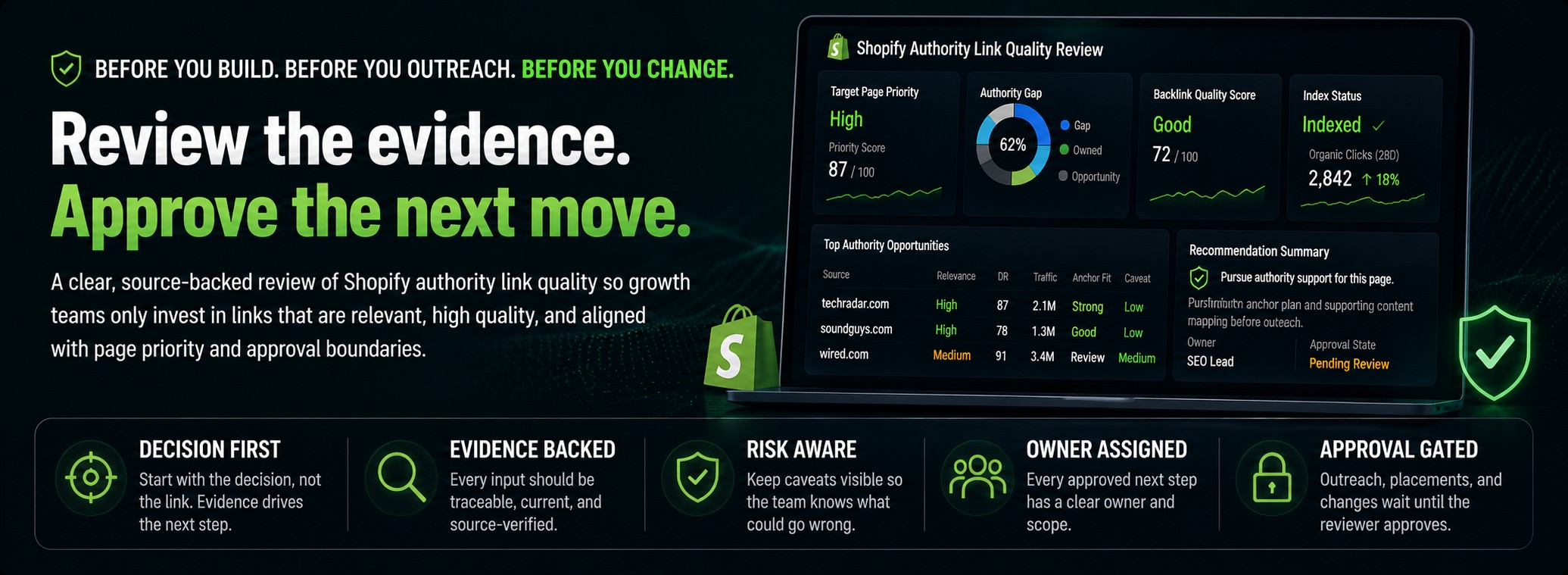
Approval gating protects Shopify teams from acting on link-building opportunities when the underlying authority evidence remains incomplete. The review should answer a clear decision: approve, hold, or send back for more evidence before link-building resources are committed.