Shopify Product Page SEO Conversion Review
Decide whether a Shopify product page should own a query, support a collection page, or receive proof, schema, media, and link updates before SEO changes proceed.
Decide whether a Shopify product page should be optimized for search visibility, conversion support, or collection-page support before changing page copy, schema, images, reviews, or internal links.

Three steps to a confident decision
Understand which business situation this page was built for and confirm it matches your current context.
Go item by item — each check has a clear pass/hold condition so you know exactly what qualifies.
Use the growth decision statement and analyst questions to brief your team and move forward with confidence.

Shopify Product Page SEO Conversion Review
Decide whether a Shopify product page should be optimized for search visibility, conversion support, or collection-page support before changing page copy, schema, images, reviews, or internal links.
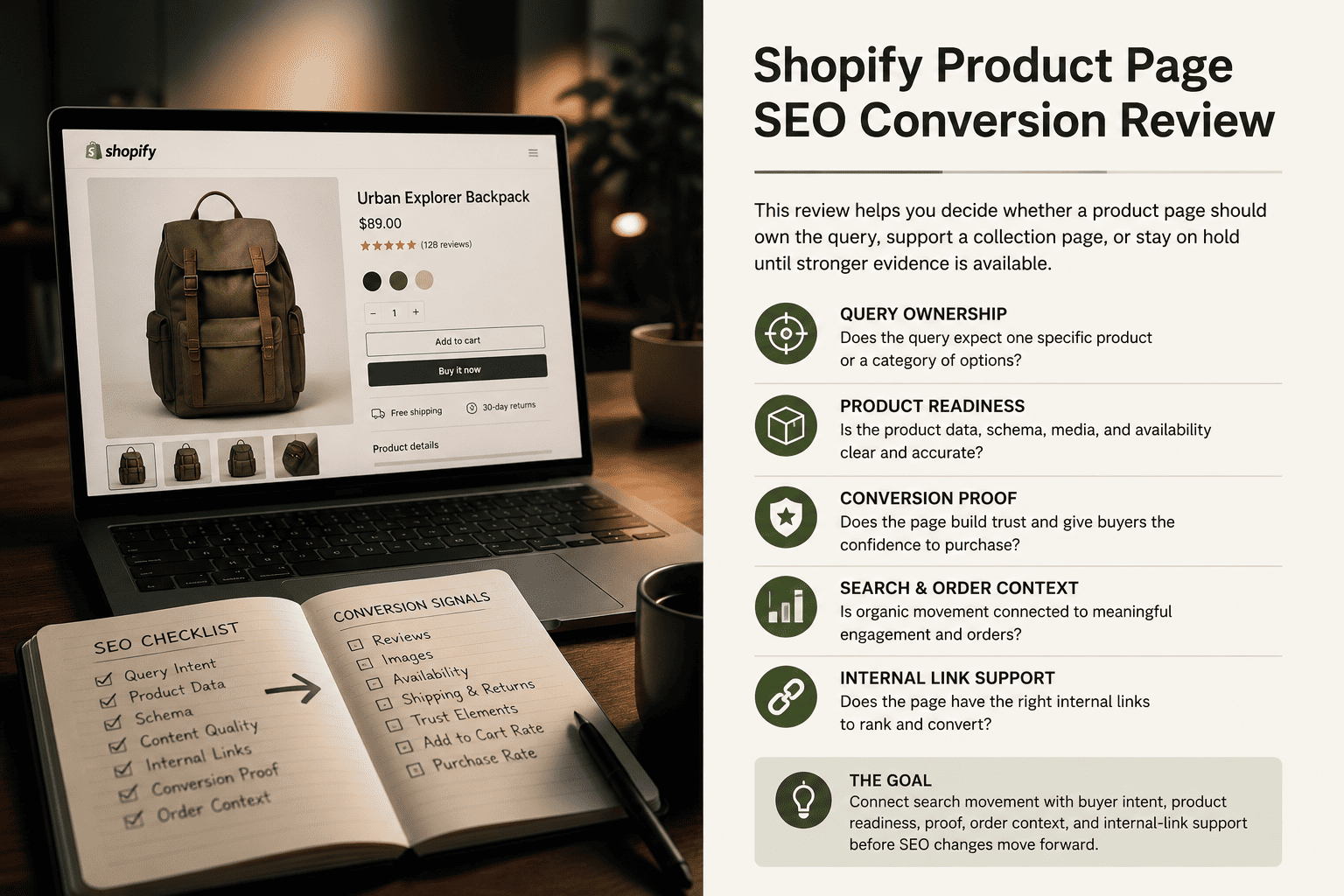
What this page helps a team decide
A Shopify product page has organic search, ranking, or conversion movement, but the team needs to know whether the product page itself should receive SEO work or support a higher-intent collection page.
- product page inventory
- query and ranking table
- Search Console page data
- GA4 organic traffic data
- product availability and order context
- conversion context
- structured data status
- review and image coverage
- internal link map
- approval log
What analysts ask before deciding
What decision is the ecommerce marketer trying to make for shopify product page seo conversion: approve, hold, or send back for evidence?
Which input would make the marketer trust the shopify product page seo conversion read enough to change the page, link, or indexation decision?
What caveat should stay visible before the team changes the page, link, or indexation decision?
Who owns the next action if the review is approved, and what stays on hold if it is not?
What usually goes wrong
- The diagnostic workflow is treated as generic content instead of a growth decision.
- The recommendation skips the source caveat, so the next step looks safer than the evidence allows.
- Follow-up moves forward before the reviewer accepts the approval rule.
What 10x.in checks
- Decide whether the product page is the right search target for the query.
- Review whether the page gives enough proof and purchase context for the buyer to act.
- Check whether product data and media are complete enough for search interpretation and buyer confidence.
- Confirm that the product page receives useful internal links from collections, related products, and supporting content.
- Check whether the product page should own the query or support a collection page.
- Review whether product details, reviews, images, and schema support both search interpretation and buyer confidence.
- Connect product-page search movement to order context and internal-link support before approving follow-up.
OpenAnalyst should review Shopify Product Page SEO Conversion Review, compare the decision evidence with the caveats, and keep the next recommendation approval-gated until the reviewer accepts it.
FAQ
Can OpenAnalyst change product page copy without approval?
No. It should produce a reviewable optimization note with the evidence, caveat, and owner before any copy or data change moves forward. Product page edits affect search targeting and buyer confidence, so the approval state has to be explicit.
When should a product page be optimized for SEO?
Optimize it when the query is product-specific, the product data is reliable, proof coverage is strong enough, and internal links support the page. Otherwise, the team may create traffic without a clear path to orders.
What if a collection page already ranks for the query?
The recommendation should compare intent fit, product specificity, and revenue context before shifting work from the collection to the product page. If the query is broad, the collection may remain the better primary target.
Why include conversion evidence in an SEO page?
Product-page SEO should not only create visits; it should support qualified buyers with proof, media, reviews, availability, and clear purchase context. Conversion evidence keeps ranking work from masking trust or product-data gaps.
What should the proof artifact show?
It should show query fit, product proof, schema or media caveat, internal-link support, recommendation, owner, and approval state. That makes the output usable as a decision record.

Shopify Product Page SEO Conversion Review
A Shopify product page should not automatically receive SEO work just because it has rankings, impressions, or organic traffic. Product pages serve a specific role: they help buyers evaluate one item and decide whether to purchase it. Sometimes a product page should own the search query. Other times, the query is broader and a collection page should remain the primary SEO target while the product page supports conversion, proof, and internal discovery.
The Shopify Product Page SEO Conversion Review helps ecommerce teams decide whether a product page should be optimized for search visibility, conversion support, or collection-page support before changing copy, schema, images, reviews, or internal links. The goal is to connect search movement with buyer intent, product readiness, proof coverage, order context, and internal-link support before SEO changes move forward.
If the product page is not the right search target, the recommendation should stay caveated. The next action may be collection-page support, product proof improvement, schema repair, media cleanup, or internal-link review instead of direct SEO optimization.
What This Workflow Decides
The workflow answers one practical question: should the Shopify product page own the query, support a collection page, or remain on hold until stronger evidence is available? A product page can be valuable without being the primary SEO target for every query it touches.
- Approve product-page SEO: The query is product-specific, the page has proof, product data, and internal-link support.
- Hold: Search or conversion movement is visible, but product proof, schema, order context, or attribution is incomplete.
- Support collection page: The query is broad or category-led, so the product page should reinforce a collection target.
- Send back for evidence: The team needs stronger Search Console, GA4, product, schema, media, or order data before action.
Decide Whether The Product Page Should Own The Query
The first review is query ownership. A product page should own the query when the searcher is looking for a specific product, model, SKU, product name, distinct feature, or purchase-ready item. If the query is category-led, comparison-led, or exploratory, the collection page may be the better primary target.
- Does the query mention a specific product, model, ingredient, feature, or SKU?
- Would a buyer expect one product page or a set of options?
- Is a collection page already ranking for the query?
- Does the product page answer the search intent better than the collection?
- Does the ranking trend show the product page gaining qualified visibility?
If the query is broad, forcing the product page to own it may weaken relevance. In that case, the product page should support the collection through internal links, related product context, and stronger conversion proof.
Review Product Data And Search Interpretation
Product-page SEO depends on clear product data. Search engines and buyers both need to understand what the item is, what it does, whether it is available, and why it fits the buyer’s need. A product page with weak data may attract traffic but fail to support confidence.
- Product title and description are specific and complete.
- Availability, price, variants, sizes, or options are accurate.
- Product attributes match the search query and buyer expectation.
- Structured data status is valid for product, offer, review, and availability fields where applicable.
- Images and media show the product clearly enough for evaluation.
If product data is incomplete or schema is unreliable, the review should keep the recommendation caveated before copy, indexation, or link changes proceed.
Check Conversion Proof And Buyer Confidence
Product-page SEO should not only create visits. It should support qualified buyers with proof, reviews, media, availability, and clear purchase context. A page may rank but still underperform if the buyer does not trust the product or understand the reason to buy.
- Are reviews, ratings, testimonials, or proof elements visible?
- Do images show the product, use case, scale, or detail clearly?
- Does the page explain shipping, returns, guarantees, or purchase risk?
- Does the description answer likely objections?
- Does GA4 or product-page analytics show meaningful engagement before purchase?
If conversion evidence is weak, the next action may be proof improvement rather than SEO copy expansion. Ranking work can mask trust or product-data gaps when the page is not ready to convert.
Connect Search Movement To Order Context
Search Console and ranking data can show visibility, but Shopify order context shows whether the product creates business value. The reviewer should connect organic movement with product availability, order quality, revenue contribution, and conversion behavior before approving follow-up.
- Does organic traffic reach the product page from relevant queries?
- Do visitors add to cart, begin checkout, or purchase?
- Is the product in stock and commercially important?
- Does order context support prioritizing this product now?
- Are attribution or sample-size caveats visible?
If the page gains traffic but does not produce buyer behavior, the recommendation should stay held while the team reviews product fit, proof, and page intent.
Review Internal Link Support
A product page should receive useful internal links from collections, related products, navigation paths, and supporting content when it is commercially important. Internal links help buyers find the product and help search engines understand how it fits the store structure.
- Does the relevant collection link to the product clearly?
- Do related products create useful comparison paths?
- Does supporting content link to the product when the buyer intent fits?
- Does the internal link map show the product is reachable?
- Would additional links support the buyer path or only add SEO clutter?
If the product page is isolated, content edits may not be enough. The team may need internal-link architecture work before page-level optimization.
Separate Product Work From Collection Support
A product page may not need to own the query to be useful. It can support a collection page by strengthening product proof, improving media, clarifying variants, and linking back to the right category. This is especially important when the collection should own broad search demand but product pages help buyers complete the purchase decision.
- Product-page ownership: Use when the query is specific and purchase-ready.
- Collection support: Use when the query is broad, category-led, or comparison-based.
- Conversion support: Use when the page needs proof, media, reviews, or purchase context before SEO expansion.
Final Approval Rule
A Shopify Product Page SEO Conversion Review should end with a clear approve, hold, collection-support, or send-back decision. Approve product-page SEO only when query fit, product data, proof coverage, schema, media, order context, and internal-link support all point toward the same next action.
If the query belongs to a collection page, keep the product recommendation focused on support. If product proof or conversion context is weak, hold SEO changes until the reviewer accepts the caveat and owner. OpenAnalyst can draft the optimization note, but copy, schema, media, and link changes should remain approval-gated.