Technical Indexation Risk Review
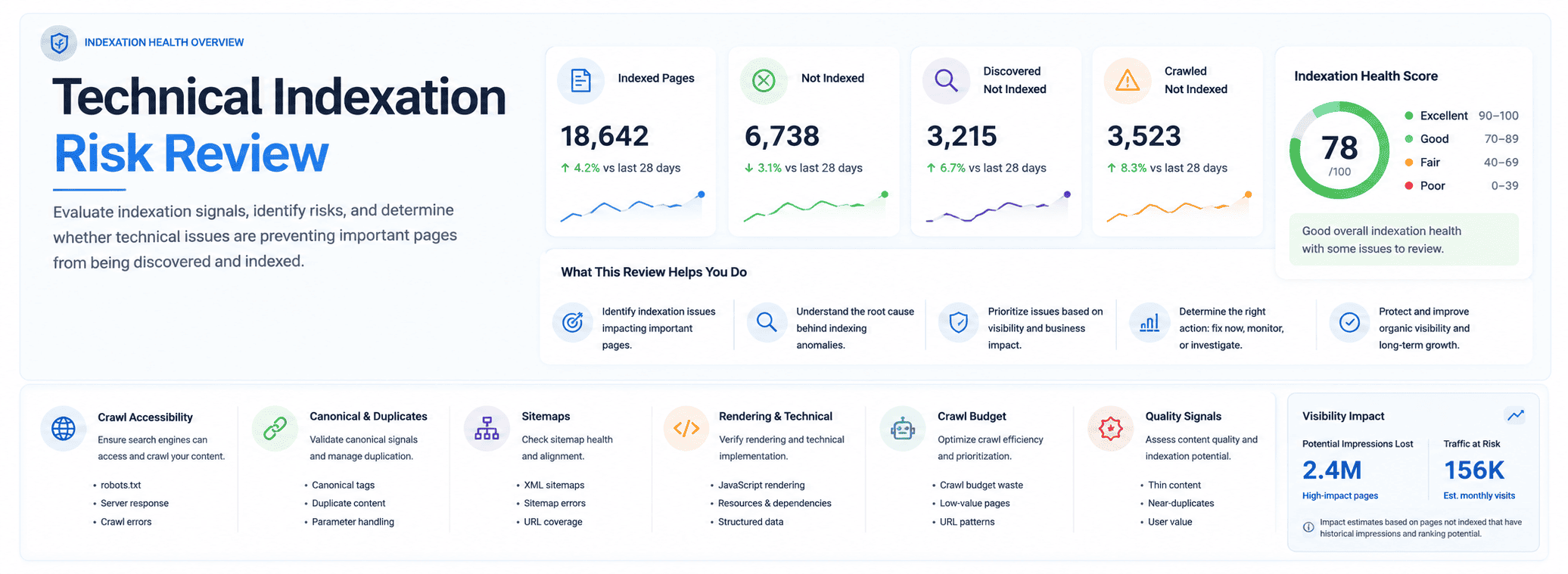
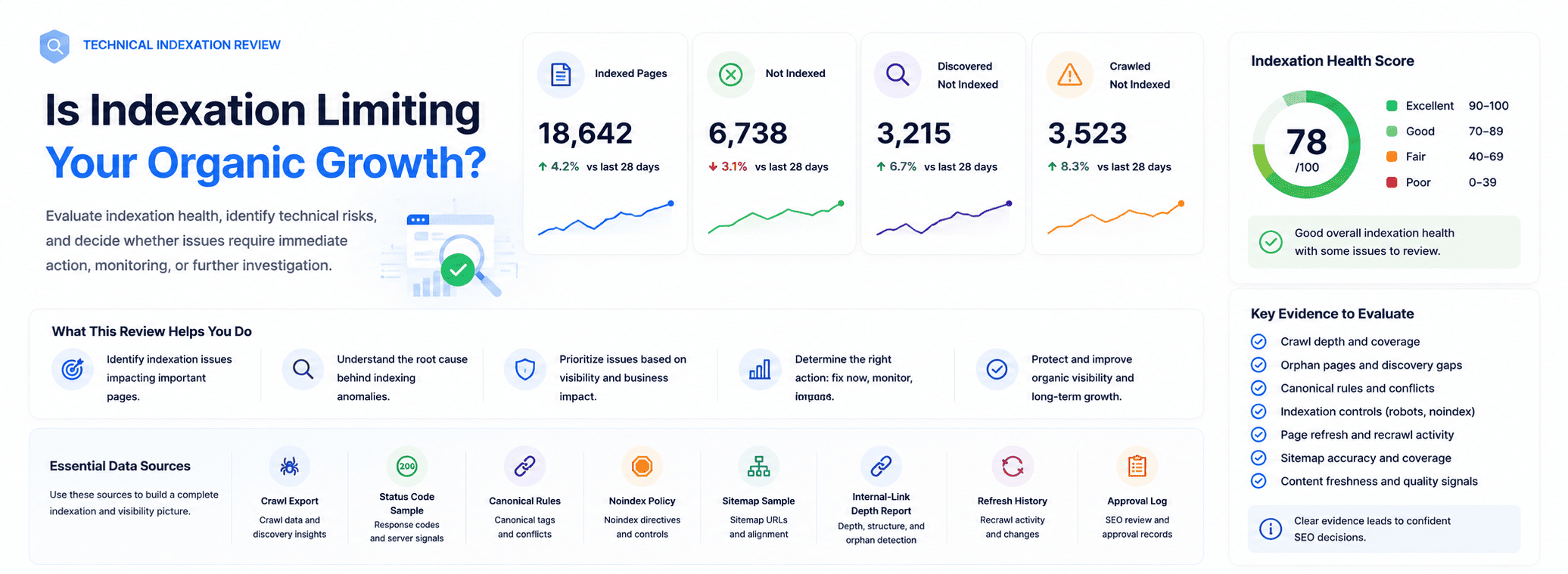
Technical indexation issues can significantly reduce organic search visibility even when content quality, keyword targeting, and authority signals remain strong. Pages that are not indexed cannot rank, generate impressions, or contribute to organic traffic growth. However, not every indexing anomaly represents a serious SEO problem. A Technical Indexation Risk Review helps determine whether observed indexation signals indicate a genuine visibility threat, a temporary search engine behavior, a crawl limitation, or a technical implementation issue requiring intervention.
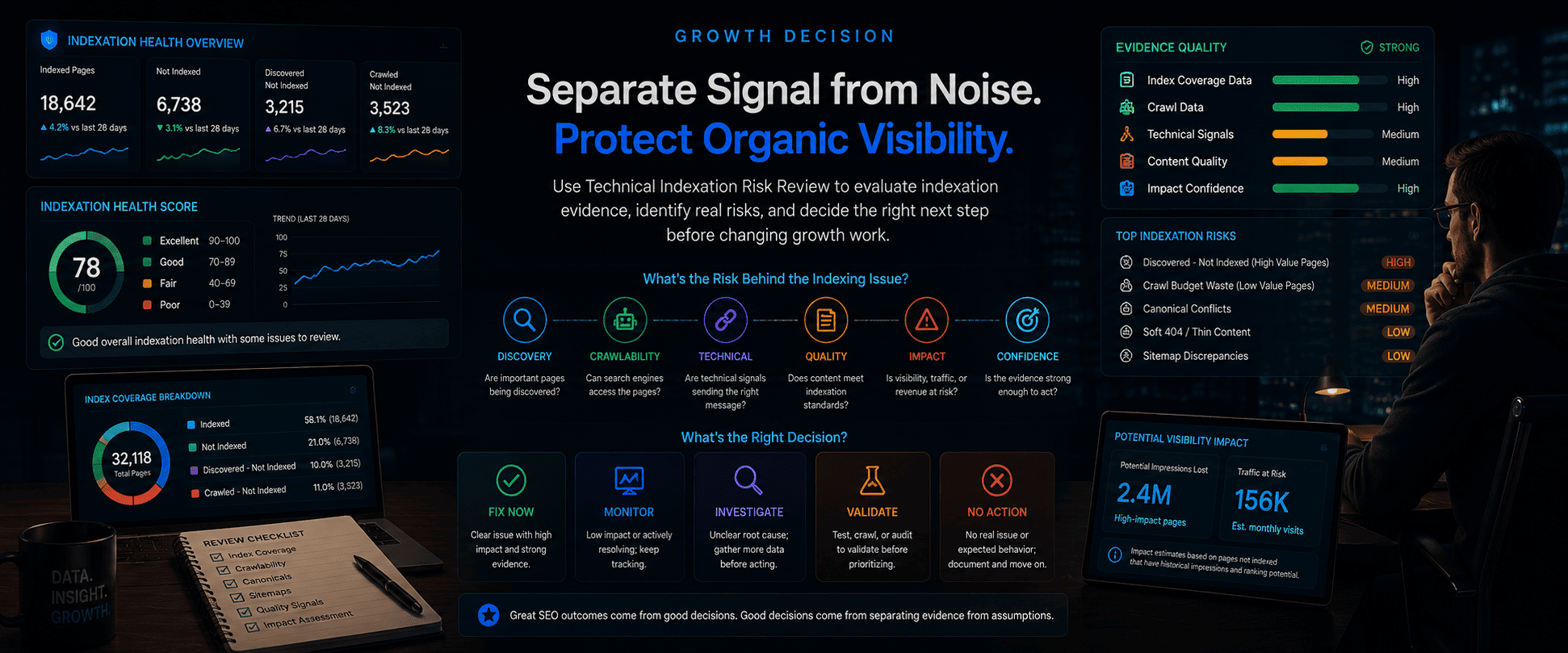
The objective is not to react to every indexing fluctuation. The objective is to understand whether available evidence supports immediate remediation, ongoing monitoring, or additional investigation. A structured review prevents teams from allocating resources toward low-impact indexing anomalies while ensuring that significant visibility risks are identified and addressed quickly.
Why Indexation Reviews Matter
Search engines constantly crawl, evaluate, and index web pages. During this process, pages may enter or leave the index for a variety of reasons including technical errors, duplicate content, crawl prioritization decisions, canonical conflicts, redirects, rendering issues, or quality assessments. Without proper analysis, organizations may mistake normal search engine behavior for a critical SEO issue or overlook problems that are actively reducing visibility.
A diagnostic review helps separate observed evidence from assumptions and ensures that remediation efforts focus on the highest-risk constraints affecting organic performance.
Step 1: Assess Index Coverage Trends
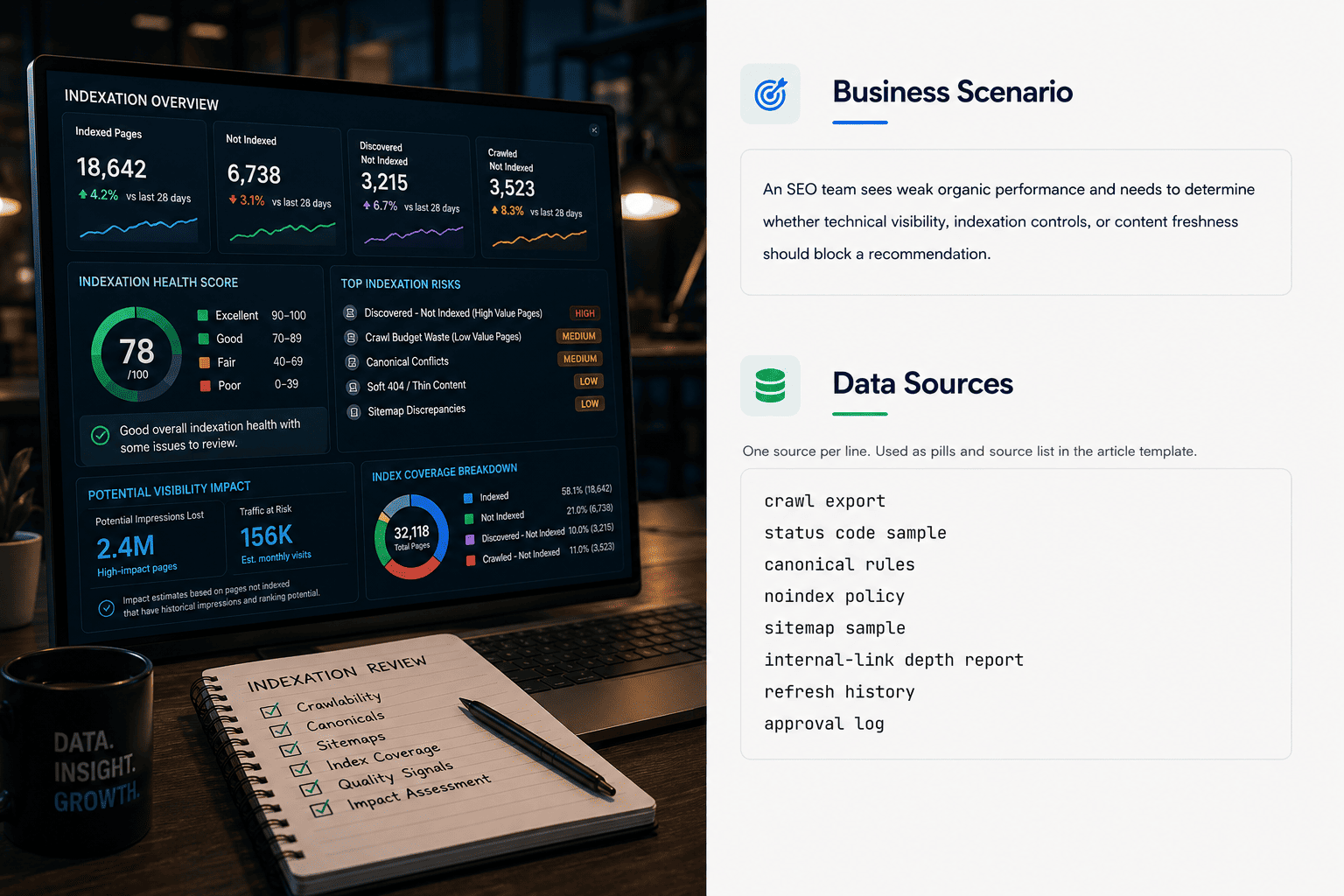
The review begins by examining indexed page counts, excluded page categories, discovered-but-not-indexed URLs, crawled-but-not-indexed URLs, and historical indexation trends. Understanding the scale and direction of change provides essential context before deeper investigation begins.
A sudden decline in indexed pages may indicate a technical issue, while stable fluctuations may simply reflect normal search engine processing behavior.
Step 2: Identify High-Risk Page Groups
Not all indexing issues carry the same business impact. The review should prioritize revenue-generating pages, high-traffic content, strategic landing pages, category pages, and key conversion assets before investigating lower-priority URLs.
Visibility loss affecting important business pages generally requires faster action than issues isolated to low-value or archival content.
Step 3: Review Crawl Accessibility
Search engines cannot index pages they cannot access. The review should evaluate robots.txt directives, crawl restrictions, authentication barriers, server response behavior, and technical accessibility issues that may prevent discovery or crawling.
Crawl accessibility analysis often reveals foundational issues that affect large sections of a website simultaneously.
Step 4: Validate Canonical Implementation
Incorrect canonical signals frequently create indexation confusion. Pages may be excluded from the index because search engines believe another URL represents the preferred version. The review should assess canonical tags, internal linking consistency, parameter handling, and duplicate content signals.
Canonical conflicts can unintentionally suppress valuable pages from search results.
Step 5: Analyze Sitemap Integrity
XML sitemaps provide search engines with important discovery signals. The review should verify that sitemaps contain indexable URLs, exclude unnecessary pages, remain current, and align with site architecture.
Large discrepancies between sitemap URLs and indexed URLs often provide clues about deeper technical issues.
Step 6: Evaluate Rendering and Technical Dependencies
Modern websites often depend heavily on JavaScript and dynamic rendering. Search engines may struggle to process critical content if rendering requirements are not handled properly. The review should evaluate rendered content visibility, resource loading, structured data availability, and client-side dependencies.
Rendering failures can prevent important content from being evaluated and indexed correctly.
Step 7: Investigate Crawl Budget Constraints
Large websites frequently encounter crawl prioritization challenges. Excessive duplicate URLs, parameter variations, thin content, faceted navigation, and low-value pages can consume crawl resources that would otherwise be allocated to important content.
The review should determine whether crawl budget limitations are contributing to delayed discovery or indexation issues.
Step 8: Assess Quality and Duplication Signals
Search engines evaluate content quality before deciding whether pages deserve indexation. Thin content, near-duplicate pages, low-value templates, and weak user experiences may reduce indexing likelihood even when technical implementation appears correct.
Quality assessment helps determine whether the root cause is technical, content-related, or a combination of both.
Step 9: Measure Organic Visibility Impact
Technical issues should be evaluated according to business impact. The review should estimate lost impressions, affected keywords, traffic exposure, conversion risk, and revenue implications associated with indexation problems.
Understanding impact helps prioritize remediation efforts and communicate urgency to stakeholders.
Step 10: Produce a Risk Recommendation
The final objective is to determine whether the observed issue requires immediate remediation, ongoing monitoring, additional validation, or no action. Recommendations should clearly identify supporting evidence, affected assets, implementation requirements, expected outcomes, and unresolved uncertainties.
A strong recommendation acknowledges both evidence quality and remaining limitations rather than overstating confidence.
Common Technical Indexation Risks
Organizations frequently encounter indexation challenges caused by robots.txt errors, canonical conflicts, sitemap inconsistencies, rendering problems, duplicate content, crawl budget waste, redirect chains, noindex directives, and content quality limitations. Many of these issues can suppress visibility long before traffic declines become obvious.
Regular reviews help organizations identify these risks before they affect rankings, traffic, and business outcomes.
Conclusion
A Technical Indexation Risk Review helps SEO teams determine whether indexing anomalies represent meaningful visibility threats or normal search engine behavior. By evaluating crawl accessibility, canonical implementation, sitemap integrity, rendering performance, crawl budget allocation, content quality, and business impact, organizations can prioritize remediation efforts based on evidence rather than assumptions. The result is a clearer understanding of indexation health and a more reliable path toward sustainable organic growth.