Commerce Transaction Analysis Readiness For SEO Decisions
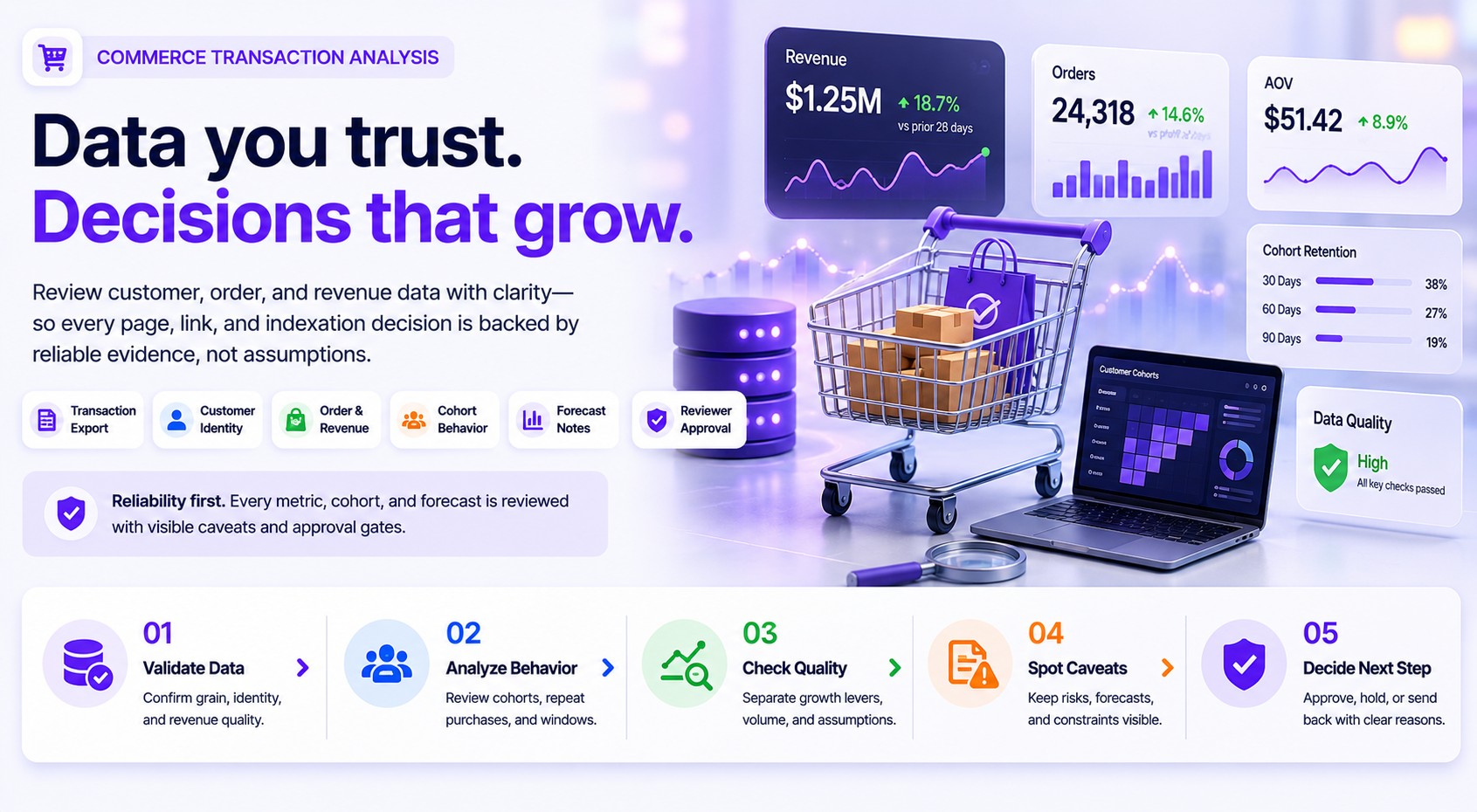
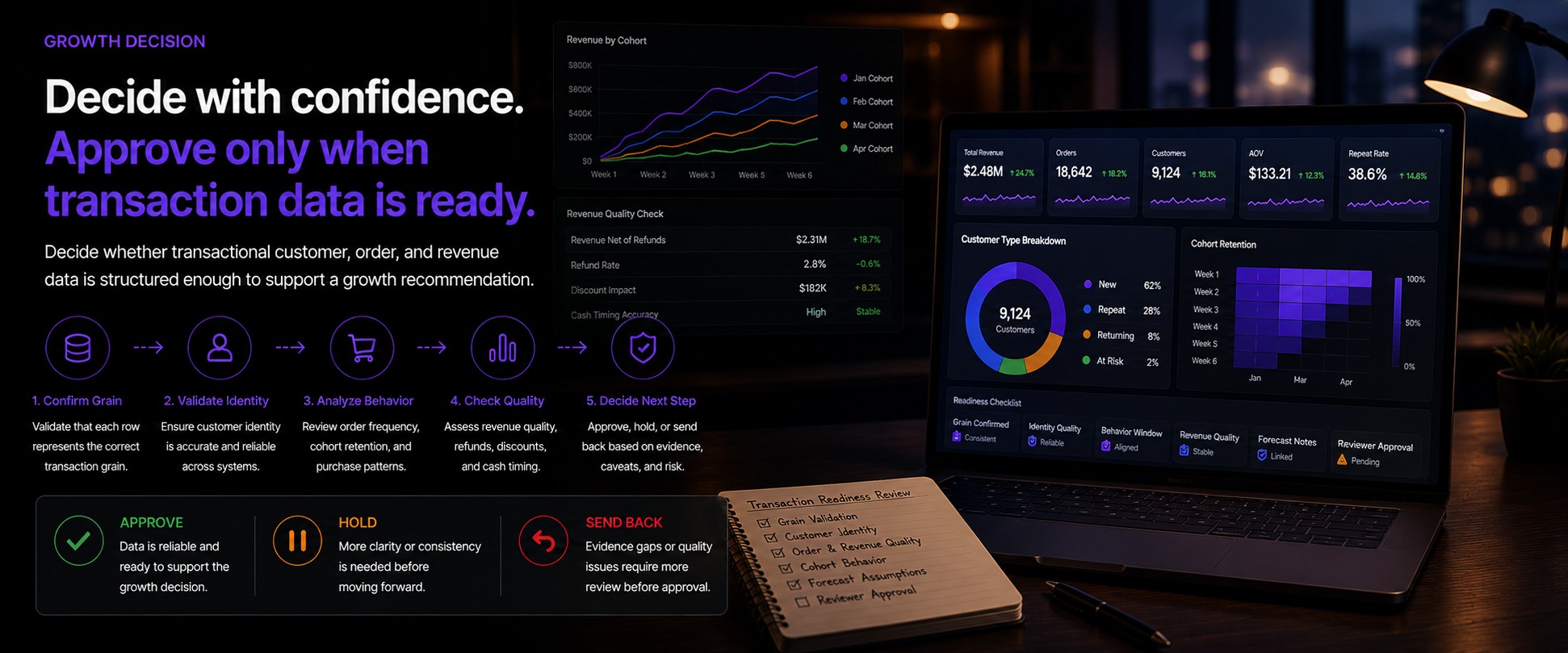
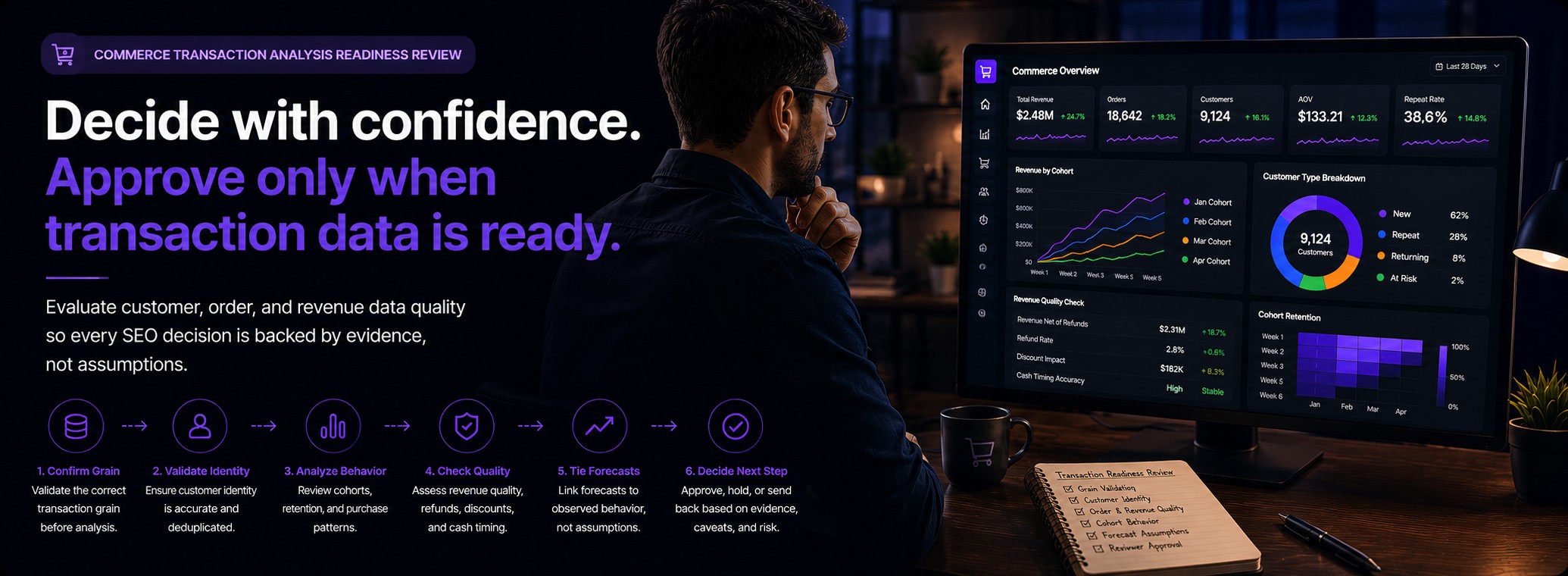
A commerce transaction analysis readiness review evaluates whether customer, order, and revenue data is structured clearly enough to support a page, link, indexation, or forecasting recommendation. The review separates visible transaction evidence from assumptions about revenue quality, cohort behavior, and customer identity before the team acts on the data.
Many SEO recommendations fail because teams treat transaction exports as self-validating evidence without confirming what each row represents, whether customer identities are stable, or whether revenue growth reflects durable behavior rather than temporary conditions. The review ensures those questions are answered before the recommendation moves forward.
- Define the growth recommendation before reviewing transaction data.
- Identify whether the data supports the specific page or indexation decision.
- Separate observed transaction behavior from forecast assumptions.
- Assign ownership for the next approved action.
- Document the hold condition if evidence is incomplete.
A decision to change pages, links, or indexation should not be driven by the presence of transaction data alone. It should be driven by evidence that the data grain, customer identity, cohort behavior, and revenue quality are reliable enough to support the recommendation.
Confirm Transactional Grain Before Using The Data
The first check confirms what each row in the dataset actually represents. Many reporting errors occur because teams assume the dataset represents orders when it actually contains line items, customer-period summaries, subscription events, or blended transaction states.
If the grain is unclear, every downstream metric becomes unreliable. Counting line items as orders inflates conversion interpretation, while treating blended customer summaries as transactional records hides instability in repeat-purchase behavior.
- Confirm whether each row is an order, line item, or summary.
- Check for mixed grains within the same dataset.
- Validate the transaction export against known order counts.
- Identify subscription or recurring events that may inflate volume.
- Document grain assumptions before approving any analysis.
Transaction grain must be confirmed before the data is used as evidence for a growth recommendation. An unclear grain makes every subsequent metric and conclusion unreliable.
Validate Customer Identity Quality
Growth analysis depends on understanding whether the same customer appears consistently across the dataset. Weak customer identity creates duplicate records, inflates buyer counts, and makes cohort behavior impossible to trust.
The review inspects customer ID stability, email normalization, duplicate handling, guest checkout treatment, and cross-device identity quality. If identity quality is weak, repeat-purchase analysis becomes unreliable regardless of how strong other signals appear.
- Verify customer IDs are stable across the transaction history.
- Check email normalization for duplicate detection.
- Review guest checkout identity handling.
- Assess cross-device identity quality.
- Document identity gaps that could inflate buyer counts.
Customer identity quality should be confirmed before cohort behavior analysis begins. Unstable identities artificially inflate growth signals and produce recommendations that break under closer examination.
Separate Customer Growth From Revenue Growth
Revenue growth can come from more customers, more orders per customer, higher revenue per order, subscription expansion, or temporary promotional behavior. Each source carries different strategic implications for SEO and content investment decisions.
The review distinguishes which growth lever is driving the revenue movement. A recommendation that assumes durable customer acquisition while the increase comes from higher average order value or short-term discounts becomes unstable when the underlying behavior reverts.
- Identify whether growth comes from new or returning customers.
- Separate order frequency from revenue-per-order changes.
- Evaluate whether subscription expansion explains the movement.
- Check for promotional distortion in the reporting period.
- Document the growth source before approving scaling decisions.
The growth lever driving revenue should be identified before the team changes page investment, internal linking, or indexation strategy. Misidentifying the lever produces recommendations that collapse when the temporary condition ends.
Review Cohort Behavior Consistency
Cohort analysis reveals whether customer behavior remains stable over time. The review inspects repeat purchase windows, retention patterns, repurchase timing, customer lifespan, churn movement, and cohort-level revenue quality.
If cohort behavior changes significantly across periods, historical performance does not support forward-looking assumptions. Unstable cohorts should be treated as evidence limitation rather than proof of scalable growth.
- Compare repeat purchase windows across cohort periods.
- Evaluate retention stability over time.
- Check whether churn movement is consistent or accelerating.
- Review cohort-level revenue quality for deterioration.
- Document cohort instability before approving forecasts.
Cohort consistency should be confirmed before historical performance is used to justify future growth assumptions. Inconsistent cohort behavior weakens every forecast that depends on past patterns.
Inspect Revenue Quality Before Forecasting
Revenue totals alone do not guarantee healthy growth. Refund behavior, cash timing, delayed revenue recognition, subscription churn, promotional distortion, discount dependency, and average order value movement should all be reviewed before the team treats revenue as durable evidence.
If revenue quality weakens while top-line sales increase, the recommendation should remain caveated. Many forecasting errors occur because teams treat unstable cash behavior as proof of sustainable growth.
- Review refund rates and their impact on net revenue.
- Check for delayed or accelerated revenue recognition.
- Evaluate discount dependency and its effect on margin.
- Assess average order value movement for stability.
- Document revenue quality caveats before approving forecasts.
Revenue quality should be confirmed independently from revenue volume. A revenue increase driven by promotional activity or favorable cash timing does not support the same growth conclusion as durable customer behavior.
Validate The Behavior Window
Cohort analysis only works when customer behavior is measured across consistent windows. If comparison periods are misaligned, retention timing mismatches the reporting period, or seasonality distorts the comparison, the analysis produces misleading conclusions.
Comparing a 30-day cohort against a 90-day cohort creates false assumptions about growth quality or customer retention. The behavior window should be confirmed before cohort comparisons are used as evidence.
- Confirm comparison periods are aligned across cohorts.
- Check that retention timing matches the reporting window.
- Evaluate seasonality effects on the comparison.
- Identify window mismatches that distort cohort conclusions.
- Document window caveats before approving cohort-based recommendations.
A consistent behavior window ensures cohort comparisons remain valid. Mismatched windows produce false signals about growth quality regardless of how precise the underlying data appears.
Keep Transaction Caveats Visible During The Review
Decision-makers should see evidence limitations alongside transaction findings. Caveats around data grain, customer identity, cohort behavior, revenue quality, and window alignment should remain attached to the recommendation throughout the review process.
Burying caveats creates a false impression of analytical readiness. Each finding should carry its limitation so the reviewer can weigh confidence alongside the evidence.
- Document which transaction signals are incomplete or unverified.
- Surface data grain assumptions that could change conclusions.
- Highlight cohort behavior gaps that weaken the recommendation.
- Make revenue quality caveats explicit before approving action.
- Separate confidence from certainty in every finding.
Visible caveats improve trust by helping stakeholders understand the limitations behind the transaction evidence. The review should not approve recommendations when significant caveats remain unresolved.
Approval-Gated Transaction Reviews Protect SEO Decision Quality
Commerce transaction data influences content investment, page priority, and revenue forecasting simultaneously. An approval-gated review ensures the team does not confuse data availability with analytical readiness when deciding whether to change pages, links, or indexation based on transaction signals.
The reviewer should approve only the next step supported by visible transaction evidence. If data grain, customer identity, cohort stability, or revenue quality evidence is not visible, the output should be a hold note rather than a recommendation approval.
- Assign an owner for the next approved SEO action.
- Document reviewer acceptance of the transaction evidence.
- Track approval state before page or indexation changes.
- Identify unresolved data dependencies that could block success.
- Keep follow-up actions visible until evidence improves.
Approval gating protects teams from acting on transaction data when the underlying grain, identity, cohort, and revenue quality evidence remains incomplete. The review should answer a clear decision: approve, hold, or send back for more evidence before SEO recommendations move forward.