Ecommerce Ads Analysis for Growth Teams
Decide whether ecommerce ad performance is constrained by product feed quality, paid-search setup, paid-social creative testing, landing path friction, order economics, lifecycle recovery, or measurement confidence before changing spend.
Decide whether ecommerce ad performance is constrained by product feed quality, paid-search setup, paid-social creative testing, landing path friction, order economics, lifecycle recovery, or measurement confidence before changing spend.
Three steps to a confident decision
Understand which business situation this page was built for and confirm it matches your current context.
Go item by item — each check has a clear pass/hold condition so you know exactly what qualifies.
Use the growth decision statement and analyst questions to brief your team and move forward with confidence.

Ecommerce Ads Analysis for Growth Teams
Decide whether ecommerce ad performance is constrained by product feed quality, paid-search setup, paid-social creative testing, landing path friction, order economics, lifecycle recovery, or measurement confidence before changing spend.

What this page helps a team decide
Decide whether ecommerce ad performance is constrained by product feed quality, paid-search setup, paid-social creative testing, landing path friction, order economics, lifecycle recovery, or measurement confidence before changing spend.
- Related reports and decision memos
- Workflow and checklist pages
- Connected marketing evidence
What analysts ask before deciding
What decision should the marketer make first for ecommerce ads analysis: approve, hold, or investigate?
Which connected source would make the ecommerce ads analysis recommendation trustworthy enough to change the next marketing action?
What caveat should stay visible before spend, content, reporting, or workflow changes?
Who owns the next approved action, and what stays on hold if evidence is incomplete?
What usually goes wrong
- The marketer treats ecommerce ads analysis as a channel tactic before checking which source should drive the decision.
- The team changes spend, page, workflow, or reporting language before the evidence owner has accepted the caveat.
What 10x.in checks
- OpenAnalyst compares the hub's reports, workflows, and checklists to find the strongest decision input.
- OpenAnalyst keeps the approval caveat attached to the recommendation until the marketer can name the owner and next action.
Review ecommerce ads analysis signals, name the caveat, and draft one recommendation the marketer can approve, hold, or assign.
FAQ
What should the reviewer approve after the checklist?
For Ecommerce Ads Analysis for Growth Teams, the reviewer should approve only the next step tied to evidence coverage. If the required evidence for evidence coverage is not visible, the output should be a hold note.
Can OpenAnalyst make the change automatically?
No. For Ecommerce Ads Analysis for Growth Teams, OpenAnalyst can draft the recommendation or follow-up, but execution stays approval-gated.

Ecommerce Ads Analysis
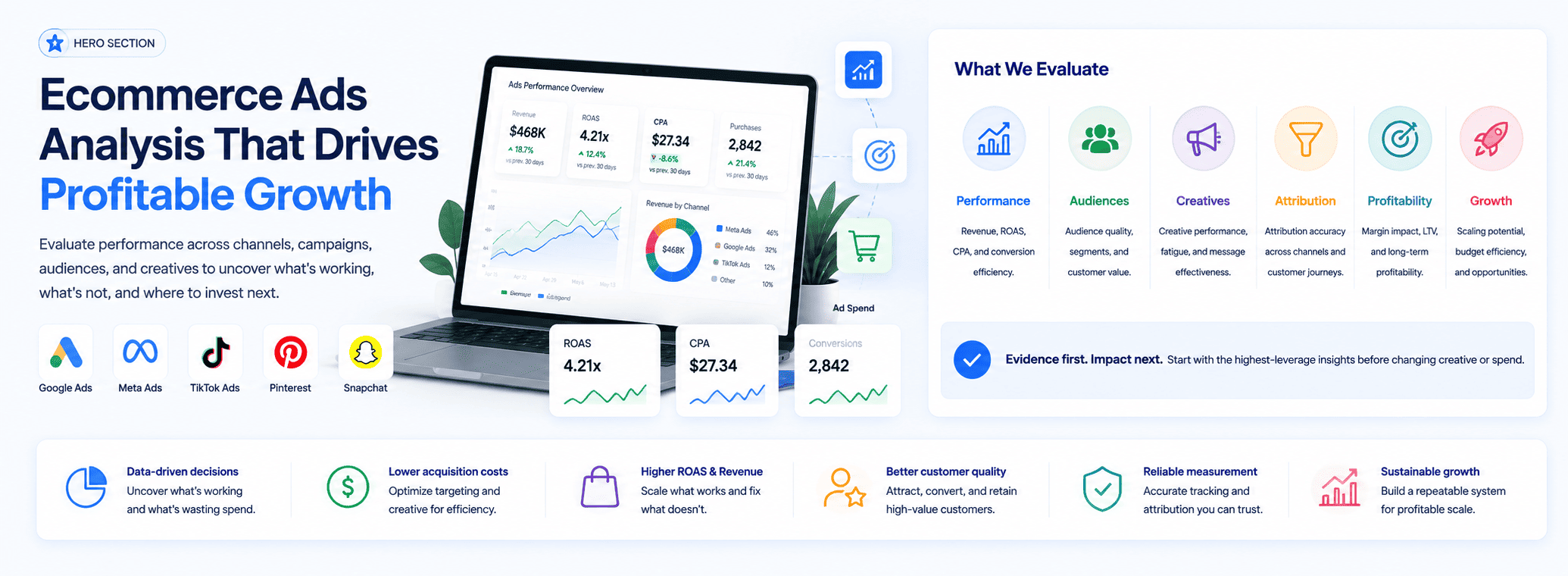
Ecommerce advertising is one of the most measurable growth channels available to modern businesses, but it is also one of the easiest channels to misinterpret. Teams often focus on isolated metrics such as ROAS, cost per acquisition, click-through rate, or conversion rate without understanding how those metrics interact with customer acquisition economics, attribution models, margin structures, and long-term business outcomes. Ecommerce Ads Analysis provides a structured framework for evaluating whether paid advertising performance supports profitable and scalable growth.
The purpose of ecommerce ads analysis is not simply to determine whether campaigns generate revenue. The objective is to understand whether advertising investment creates sustainable business value. Strong-looking performance can sometimes hide poor customer quality, attribution inflation, audience saturation, or profitability challenges. Conversely, campaigns that appear inefficient on the surface may contribute significant long-term customer value when analyzed correctly.
Why Ecommerce Ads Analysis Matters
Paid advertising often represents one of the largest growth investments for ecommerce brands. Decisions involving budget allocation, creative strategy, channel expansion, audience targeting, and bidding structures can significantly influence revenue outcomes. Without a structured analysis process, teams may increase spending based on misleading signals or reduce investment in campaigns that support long-term growth.
Ecommerce ads analysis helps organizations distinguish between media efficiency metrics and business performance metrics. This distinction is essential because campaign success should ultimately be evaluated according to business outcomes rather than advertising platform metrics alone.
Understanding the Ecommerce Advertising Funnel
Ecommerce advertising performance should be evaluated across the entire customer journey rather than at a single conversion point. Prospective customers typically move through stages of awareness, consideration, evaluation, purchase, retention, and repeat purchase. Advertising influences different stages in different ways.
Upper-funnel campaigns may generate traffic and awareness without immediately producing purchases. Mid-funnel campaigns often drive engagement and product consideration. Lower-funnel campaigns typically focus on conversion and revenue generation. A complete analysis evaluates how campaigns contribute across the funnel rather than rewarding only last-click outcomes.
Evaluating Traffic Quality
Not all traffic carries the same value. Ecommerce ads analysis should begin with an assessment of traffic quality rather than conversion performance alone. High traffic volume may appear positive while hiding engagement issues that reduce revenue potential.
Key indicators include bounce rates, session duration, page depth, product engagement, add-to-cart behavior, checkout initiation, and returning visitor activity. Understanding traffic quality helps determine whether campaign targeting is attracting qualified customers or generating low-intent visits.
Analyzing Customer Acquisition Cost
Customer acquisition cost remains one of the most important metrics in ecommerce advertising. However, acquisition costs should always be interpreted within the context of customer value, contribution margins, and retention performance.
A higher acquisition cost may be acceptable when customer lifetime value supports profitability. Conversely, a low acquisition cost may still create financial challenges if acquired customers rarely return or generate minimal revenue. Effective analysis evaluates acquisition efficiency alongside customer economics.
Understanding Return on Ad Spend
ROAS is often treated as the primary advertising metric, but it should not be used in isolation. Return on ad spend measures revenue generated relative to advertising costs, yet it does not account for margins, operational expenses, fulfillment costs, or retention performance.
Different businesses require different ROAS thresholds depending on product economics. A campaign producing a lower ROAS may still be profitable if margins are strong, while a campaign generating a high ROAS may underperform if product costs are significant.
Attribution and Measurement Accuracy
One of the biggest challenges in ecommerce advertising is attribution reliability. Customers frequently interact with multiple marketing channels before completing a purchase. Paid social campaigns, search advertising, email marketing, organic search, and direct visits often contribute to the same customer journey.
Attribution models can significantly influence reported campaign performance. Last-click attribution may undervalue upper-funnel activities, while platform-specific attribution can overstate advertising impact. Ecommerce ads analysis should evaluate attribution methodology and identify measurement limitations before making optimization decisions.
Creative Performance Analysis
Creative assets often determine advertising success more than audience targeting or bidding strategies. Effective creative analysis evaluates how messaging, visual presentation, offers, and product positioning influence customer behavior.
Key indicators include click-through rates, engagement patterns, landing page interactions, conversion rates, and audience fatigue signals. Reviewing creative performance helps identify which messages resonate most effectively with target audiences.
Audience Quality and Segmentation
Different audience segments frequently produce different business outcomes. New customer acquisition campaigns may behave differently from remarketing campaigns. High-intent audiences often generate stronger conversion performance than broad prospecting segments.
Ecommerce ads analysis should compare audience performance according to acquisition cost, conversion quality, average order value, repeat purchase behavior, and lifetime value. Segment-level analysis often reveals opportunities that are hidden within aggregate reporting.
Conversion Rate Analysis
Advertising performance should not be evaluated independently from website performance. Campaigns can drive qualified visitors while conversion issues within the ecommerce experience suppress results. Product pages, checkout processes, pricing structures, shipping policies, and site usability all influence final outcomes.
Analyzing conversion rates alongside advertising metrics helps identify whether performance constraints originate from media acquisition or from the ecommerce experience itself.
Customer Lifetime Value and Profitability
The most sophisticated ecommerce advertising programs evaluate customer lifetime value rather than immediate revenue alone. Some acquisition campaigns intentionally accept lower short-term returns because acquired customers generate substantial future revenue through repeat purchases.
Understanding lifetime value allows businesses to make more informed investment decisions and evaluate campaigns according to long-term profitability rather than short-term efficiency metrics.
Scaling Opportunities and Constraints
As advertising budgets increase, campaign performance often changes. Audience saturation, rising acquisition costs, creative fatigue, and competitive pressures can reduce efficiency. Ecommerce ads analysis should identify both growth opportunities and scaling limitations.
Evaluating impression share, audience reach, frequency levels, competitive conditions, and creative refresh requirements helps determine whether campaigns can support additional investment.
Common Ecommerce Advertising Mistakes
Organizations frequently make decisions based on incomplete data. Common mistakes include optimizing exclusively for ROAS, ignoring profitability, relying on inaccurate attribution models, failing to segment audiences, overlooking customer lifetime value, and focusing on platform metrics instead of business outcomes.
Many advertising challenges originate from measurement issues rather than actual performance problems. Careful analysis helps prevent costly optimization errors.
Building a Reliable Ecommerce Ads Framework
A strong analysis framework combines advertising data, website behavior data, ecommerce revenue reporting, customer records, attribution insights, and profitability measurements. By integrating multiple data sources, organizations gain a more complete understanding of campaign performance and business impact.
The most effective ecommerce teams evaluate advertising decisions according to customer quality, acquisition efficiency, profitability, retention outcomes, and long-term revenue contribution rather than relying on a single performance metric.
Conclusion
Ecommerce Ads Analysis provides the structure required to evaluate advertising performance beyond platform-level metrics. By examining traffic quality, acquisition costs, attribution reliability, customer value, conversion behavior, profitability, and scaling opportunities, organizations can make more informed decisions about media investment. The result is a more accurate understanding of advertising effectiveness and a stronger foundation for sustainable ecommerce growth.