Ecommerce Creative Testing Review
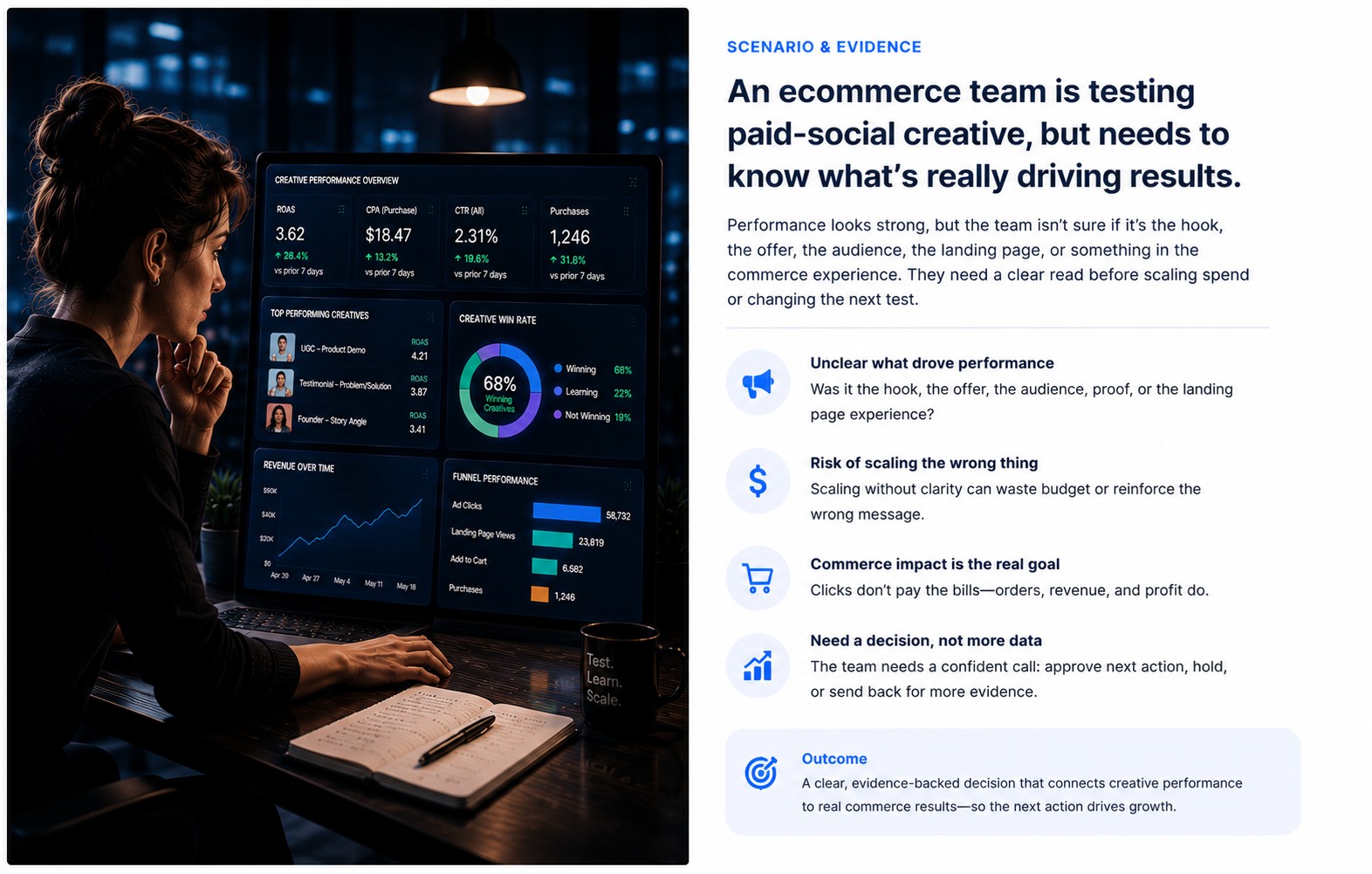
Creative testing is one of the most important growth activities for an ecommerce team, but it is easy to misread. A paid-social ad may win on click-through rate without producing qualified buyers. Another ad may look expensive but drive stronger order quality. A test may seem to prove that one hook works, even though the offer, audience, landing page, and proof all changed at the same time.
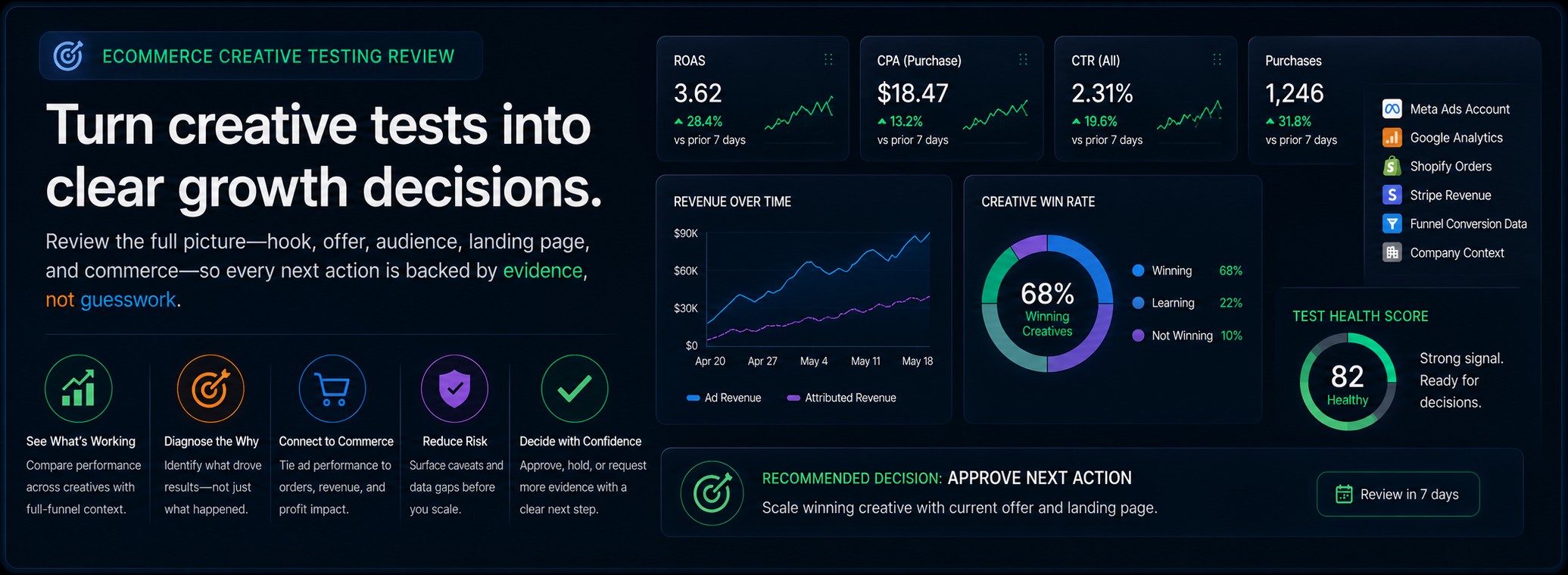
The Ecommerce Creative Testing Review helps teams decide whether a creative test has enough signal, audience context, offer clarity, and commerce evidence to support the next action. That next action may be scaling spend, launching another variation, changing the offer, updating the landing page, holding the test, or sending it back for cleaner evidence.
The goal is not to slow growth down. The goal is to make sure the team understands what the test is actually saying before changing spend, storefront, merchandising, or offer decisions.
What This Workflow Decides
The workflow answers one practical question: is the creative test result strong enough to approve the next action, or should the decision stay caveated? A useful review does not simply name the winning ad. It explains what changed, what the buyer responded to, what evidence supports the read, and what still needs approval.
- Approve: The test isolates a clear variable and commerce evidence supports the next step.
- Hold: The signal is promising, but the test window, audience, revenue quality, or post-click path is unclear.
- Send back for evidence: The result cannot be trusted because the test design or source data is incomplete.
- Re-scope: The issue belongs to offer, landing page, audience, funnel, or commerce quality rather than creative alone.
Evidence To Review Before Acting
A creative test should be reviewed with platform, funnel, and commerce context. Meta Ads account data may show cost and engagement, but Shopify, Stripe, Google Analytics, and funnel data show whether the ad created useful business movement.
- Meta Ads account data: Spend, impressions, reach, frequency, CTR, CPC, CPA, ROAS, and creative-level conversions.
- Creative testing plan: Hypothesis, changed variable, audience, test window, budget, and expected learning.
- Google Analytics behavior: Landing engagement, session quality, product views, add-to-cart behavior, and conversion paths.
- Shopify orders: Order volume, average order value, products purchased, discount usage, and customer quality.
- Stripe revenue: Collected revenue, failed payments, refunds, payment timing, and revenue confirmation.
- Funnel conversion data: Where users drop after the click, from landing page to checkout.
- Company context: Margin, inventory, fulfillment, product quality, brand direction, and operating constraints.
When these sources align, the recommendation can be stronger. When they conflict, the caveat should stay visible.
Confirm The Test Is Actually Reusable
A creative test is useful when it explains which message, offer, format, or proof element moved the result. It is less useful when too many variables changed at once. If one ad used a new hook, different product angle, different offer, different audience, and different landing page, the team may know which ad won but not why it won.
- Was the test comparing one clear variable?
- Was the test window long enough to read?
- Was the budget large enough for directional confidence?
- Did the audience remain stable?
- Did the landing page and offer stay consistent?
- Can the learning be reused in the next creative brief?
If the changed variable is unclear, the review should recommend a retest or hold note instead of declaring a winner.
Map Creative To Buyer Belief
Every ecommerce creative should move a buyer belief or objection. A hook may grab attention, but the message still needs to make the buyer believe something useful: that the problem matters, the product fits, the proof is credible, the offer is fair, or the next step is worth taking.
The reviewer should map the creative message to the belief it was supposed to move. If the ad promises convenience, the landing page should continue that same idea. If the ad leads with proof, the product page should support the proof. If the ad speaks to a specific objection, the post-click path should answer that objection instead of switching to a generic product pitch.
- What buyer belief was the creative trying to change?
- Which objection did the ad address?
- Did the proof support the claim?
- Did the post-click page continue the same promise?
- Did the product page answer the next buyer question?
Connect Ad Cost To The Post-Click Path
Rising cost does not always mean the campaign is broken. It may reflect auction pressure, audience fatigue, weak message match, offer weakness, or post-click conversion problems. Before blaming the campaign, the review should connect ad cost and creative promise to the landing page, product page, checkout, and revenue quality.
If users click but leave quickly, the creative may be attracting curiosity without qualified intent, or the page may fail to continue the message. If users add to cart but do not purchase, checkout, shipping, pricing, or trust may be the constraint. If purchases happen but revenue quality is weak, the issue may be discount depth, product mix, refunds, or low-margin orders.
- High click, low order: Check landing context, offer clarity, and product-page trust.
- Low click, strong order quality: Test hook, format, or audience expansion carefully.
- Good purchases, weak margin: Review product mix, bundle, discount, and cash timing.
- Rising cost, stable conversion: Check audience saturation and bid pressure before changing creative.
Approve, Hold, Or Send Back
At the end of the review, the team should choose one clear decision. Approval should mean the next action is supported by visible evidence and the caveat does not change the recommendation. A hold means the result may be promising, but the team should not scale or change the storefront yet. A send-back decision means the test needs cleaner evidence before the learning can be reused.
- Approve scale: Creative performance, post-click behavior, Shopify orders, and revenue quality support a controlled spend increase.
- Approve next variation: The test identifies a clear hook, proof, offer, or angle worth developing.
- Hold action: Commerce evidence, result window, or post-click behavior is not strong enough.
- Send back: The test changed too many variables or lacks source evidence.
Approval Boundary
OpenAnalyst can compare the evidence, identify the caveat, and draft a recommendation, but execution should remain approval-gated. Creative testing affects budget, storefront decisions, brand positioning, and revenue outcomes, so a reviewer must accept the next action before spend, creative production, or page changes move forward.
A strong review names the owner, the approved next step, and what stays on hold. If post-click evidence is missing, page or offer review should happen before campaign settings change. If commerce quality is unclear, spend should not scale until Shopify, Stripe, or funnel evidence supports the decision.
Final Decision Rule
An Ecommerce Creative Testing Review prevents the team from declaring a creative winner before the result is understood. The best test does more than show which ad performed better. It explains what the market responded to, which buyer belief moved, what evidence supports the next action, and what caveat remains.
When the signal is clear, approve the next step. When evidence is incomplete, hold the decision. When the test design is unclear, send it back for better evidence before changing spend or launching the next test.