Email Revenue Analysis for Ecommerce Growth Teams
Decide which lifecycle flows, campaigns, segments, and revenue signals need review before changing email strategy.
Decide which lifecycle flows, campaigns, segments, and revenue signals need review before changing email strategy.

Three steps to a confident decision
Understand which business situation this page was built for and confirm it matches your current context.
Go item by item — each check has a clear pass/hold condition so you know exactly what qualifies.
Use the growth decision statement and analyst questions to brief your team and move forward with confidence.

Email Revenue Analysis for Ecommerce Growth Teams
Decide which lifecycle flows, campaigns, segments, and revenue signals need review before changing email strategy.
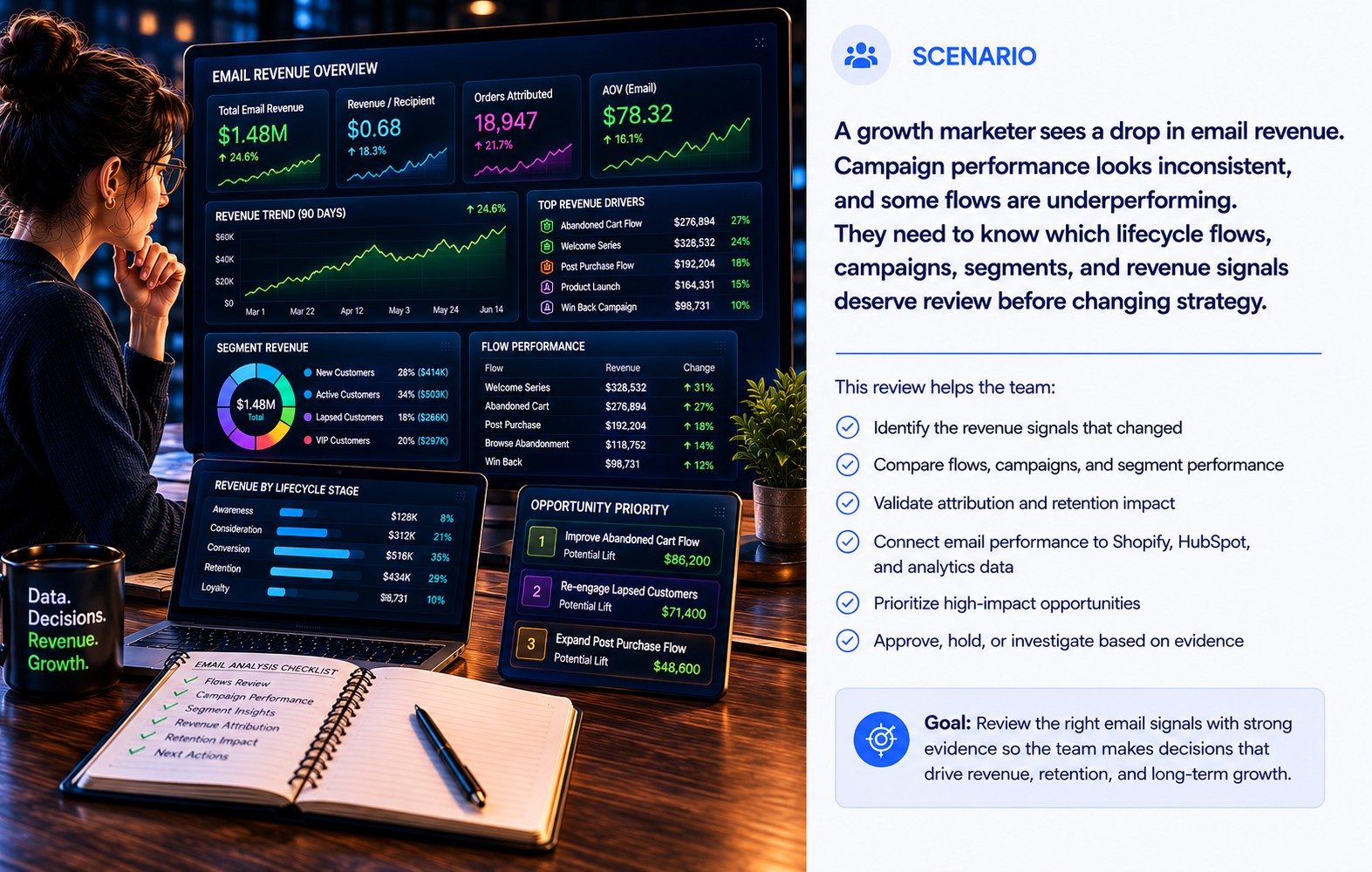
What this page helps a team decide
Decide which lifecycle flows, campaigns, segments, and revenue signals need review before changing email strategy.
- Related reports and decision memos
- Workflow and checklist pages
- Connected marketing evidence
What analysts ask before deciding
What decision should the marketer make first for email revenue analysis: approve, hold, or investigate?
Which connected source would make the email revenue analysis recommendation trustworthy enough to change the next marketing action?
What caveat should stay visible before spend, content, reporting, or workflow changes?
Who owns the next approved action, and what stays on hold if evidence is incomplete?
What usually goes wrong
- The marketer treats email revenue analysis as a channel tactic before checking which source should drive the decision.
- The team changes spend, page, workflow, or reporting language before the evidence owner has accepted the caveat.
What 10x.in checks
- OpenAnalyst compares the hub's reports, workflows, and checklists to find the strongest decision input.
- OpenAnalyst keeps the approval caveat attached to the recommendation until the marketer can name the owner and next action.
Review email revenue analysis signals, name the caveat, and draft one recommendation the marketer can approve, hold, or assign.
FAQ
What should the reviewer approve after the checklist?
For Email Revenue Analysis for Ecommerce Growth Teams, the reviewer should approve only the next step tied to evidence coverage. If the required evidence for evidence coverage is not visible, the output should be a hold note.
Can OpenAnalyst make the change automatically?
No. For Email Revenue Analysis for Ecommerce Growth Teams, OpenAnalyst can draft the recommendation or follow-up, but execution stays approval-gated.

Email Revenue Analysis for Ecommerce Growth Teams
Email marketing is one of the highest-leverage growth channels for ecommerce teams, but it can also be easy to misread. Opens, clicks, campaign revenue, and platform attribution all provide useful signals, yet none of them explain the full revenue picture on their own. A campaign may drive sales while weakening margin. A flow may earn clicks while failing to improve repeat purchase behavior. A segment may look active while its buying quality declines.
Email Revenue Analysis helps ecommerce growth teams decide which lifecycle flows, campaigns, segments, and revenue signals need review before changing email strategy. The goal is not to react to one metric. The goal is to identify the strongest decision input, name the caveat, and recommend the next action the marketer can approve, hold, or assign.
This matters because email sits close to revenue. A change to cadence, offer, segmentation, creative, flow logic, or reporting language can affect customer trust, short-term sales, repeat purchases, and long-term profitability. The review should keep recommendations tied to visible evidence before strategy changes move forward.
What Email Revenue Analysis Decides
The core decision is whether the team should approve a change, hold the recommendation, or investigate further. Before changing an email strategy, the marketer needs to know which source should drive the decision: lifecycle flow performance, campaign results, segment behavior, revenue quality, attribution context, or connected marketing evidence.
- Approve: The evidence is strong enough to support the next email action.
- Hold: The required evidence is missing, contradictory, or not accepted by the owner.
- Investigate: The signal is meaningful, but the team needs more context before changing strategy.
- Assign: The recommendation is valid, but another owner must review the next step before execution.
This approval-gated approach prevents the team from treating email revenue analysis as a channel tactic before checking the evidence. A strong recommendation should show what changed, why it matters, what caveat remains, and who owns the next action.
Revenue Signals To Review First
Email teams often begin with channel metrics because they are easy to see. Open rate, click rate, unsubscribe rate, and campaign revenue are useful, but they should be connected to business outcomes before the team acts. The strongest review looks at revenue quality, lifecycle position, and customer behavior together.
- Revenue per recipient: Shows whether a send creates value relative to audience size.
- Revenue per send: Helps compare campaign output across different email types.
- Flow-generated revenue: Shows whether lifecycle automation is contributing consistently.
- Segment revenue: Identifies which customer groups create the strongest return.
- Average order value: Helps reveal whether promotions are increasing or reducing order quality.
- Repeat purchase rate: Shows whether email contributes to retention, not just first purchase.
- Customer lifetime value: Connects email performance to long-term customer quality.
These signals help the team avoid overreacting to surface-level performance. A high-click campaign may not deserve expansion if it attracts discount-sensitive buyers with low repeat purchase behavior. A lower-click lifecycle flow may still deserve attention if it supports high-value repeat purchases.
Lifecycle Flows, Campaigns, And Segments
Email revenue analysis should review both one-time campaigns and automated lifecycle flows. Campaigns can create short-term sales, but flows often shape the customer journey over time. If the team only reviews campaigns, it may miss the automations that support conversion, retention, and repeat purchase behavior.
- Welcome flows: Check whether new subscribers understand the brand, offer, proof, and next step.
- Abandoned cart flows: Review recovery revenue, timing, offer pressure, and checkout friction.
- Browse abandonment flows: Check whether product interest turns into return visits or purchases.
- Post-purchase flows: Review education, cross-sell, support, and repeat purchase contribution.
- Win-back flows: Check whether lapsed customers respond profitably or only return with heavy discounts.
Segment review is equally important. Aggregate email revenue can hide meaningful differences between customer groups. New subscribers, first-time buyers, VIP customers, lapsed customers, high-LTV buyers, and discount-sensitive buyers may respond very differently to the same campaign. The review should identify which segments support the recommendation and which segments need a caveat.
Evidence Sources That Make The Recommendation Trustworthy
A reliable email revenue recommendation should be connected to more than one report. Email platform data may show engagement and attributed revenue, but connected sources can confirm whether the revenue is high quality and whether the customer behavior supports the next action.
- Email platform reports: Opens, clicks, conversions, unsubscribes, deliverability, and attributed revenue.
- Shopify or ecommerce data: Orders, product mix, refunds, repeat purchases, discounts, and average order value.
- Google Analytics: Assisted conversions, traffic paths, landing behavior, and cross-channel context.
- CRM or lifecycle data: Customer stage, lead quality, repeat purchase status, and retention movement.
- Decision memos and reports: Prior recommendations, caveats, owner notes, and approved next steps.
When these sources align, the marketer can trust the recommendation more. When they conflict, the output should be a hold note or investigation plan. For example, if the email platform shows strong revenue but Shopify data shows heavy discounting and weak repeat purchase behavior, the recommendation should stay caveated before the team increases send volume.
Common Failure Modes
The most common mistake is changing email strategy before the evidence owner has accepted the caveat. This can happen when a campaign performs well, a flow declines, or a stakeholder wants a fast answer. Speed is useful, but only when the decision source is clear.
- Optimizing opens instead of revenue quality.
- Increasing send volume without checking audience fatigue.
- Changing flows before reviewing lifecycle stage behavior.
- Reading attributed revenue without checking discounts, refunds, or repeat purchases.
- Comparing campaigns without separating new buyers, returning buyers, and VIP customers.
- Changing reporting language before the caveat and owner are named.
Email revenue analysis should keep the recommendation attached to the risk. If the evidence is incomplete, the next step should not be a strategy change. It should be a clearer review of the missing source.
Approval-Gated Next Action
OpenAnalyst can compare related reports, workflow pages, checklist pages, and connected marketing evidence to find the strongest decision input. It can draft the recommendation, explain the caveat, and name the likely owner. Execution should remain approval-gated until the marketer accepts the next action.
- Approve a campaign change when revenue quality and segment behavior support it.
- Hold a flow change when attribution or lifecycle evidence is incomplete.
- Investigate when campaign revenue and retention signals disagree.
- Assign the next action when another owner controls the required evidence.
Final Takeaway
Email Revenue Analysis helps ecommerce growth teams move beyond isolated email metrics and review the revenue signals that actually guide strategy. By comparing lifecycle flows, campaigns, segments, attribution, and business-quality data, the team can decide what deserves action and what should stay on hold.
The strongest recommendation is not simply “email revenue is up” or “campaign performance is down.” It is a reviewable decision that names the evidence, keeps the caveat visible, assigns an owner, and gives the marketer one approved next step before changing email strategy.