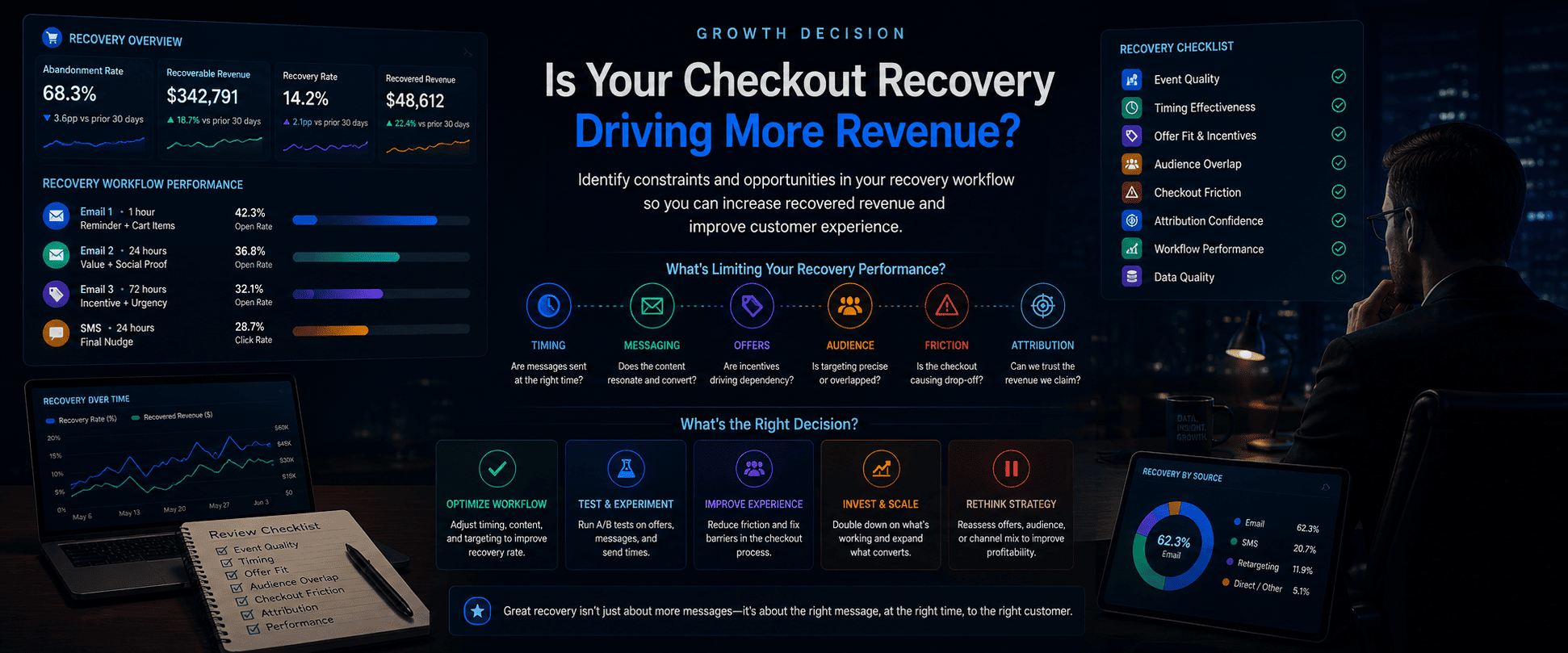
Abandoned Checkout Recovery Review
Abandoned checkout recovery is one of the highest-leverage revenue opportunities available to ecommerce and subscription businesses. Unlike acquisition campaigns that attempt to create new demand, recovery programs focus on customers who have already demonstrated strong purchase intent by adding products to a cart and entering the checkout process. However, not every abandoned checkout sequence deserves optimization or expansion. A structured abandoned checkout recovery review helps determine whether existing recovery performance supports changes to timing, messaging, incentives, segmentation, or workflow design.
The objective of the review is not simply to measure abandonment volume. The goal is to understand whether the recovery system is successfully converting lost demand into revenue and whether observed performance supports operational changes. Strong-looking recovery metrics can sometimes hide attribution issues, discount dependency, weak segmentation, or customer experience problems that reduce long-term profitability. A diagnostic review separates observed outcomes from assumptions and helps teams prioritize actions with confidence.
Why Checkout Recovery Reviews Matter
Most checkout abandonment is not caused by a single issue. Customers may leave because of shipping costs, payment friction, account requirements, pricing concerns, product comparison behavior, delivery uncertainty, technical issues, or simple distraction. Recovery workflows attempt to bring these customers back through email, SMS, retargeting, incentives, or personalized reminders.
Without a structured review, teams often react to recovery rates alone. This can lead to unnecessary discounts, excessive message frequency, poor customer experiences, or revenue claims that are not supported by attribution evidence. A review ensures that optimization decisions are based on measurable business outcomes rather than isolated performance metrics.
Step 1: Measure Checkout Abandonment Volume
The review begins by understanding the scale of the opportunity. Teams should evaluate the total number of checkout starts, abandonment rates, completed purchases, and lost revenue associated with abandonment. The purpose is to determine whether recovery optimization represents a meaningful business opportunity.
High abandonment rates do not automatically indicate a problem. Different industries, products, and customer journeys naturally produce different abandonment patterns. Benchmarking performance against historical data often provides more useful context than external comparisons.
Step 2: Quantify Recoverable Revenue
Not all abandoned revenue is realistically recoverable. Some customers abandon intentionally and never intended to complete a purchase. Others simply require additional time before converting. The review should estimate realistic recovery potential based on historical behavior and previous recovery performance.
Understanding recoverable revenue helps prioritize optimization efforts and prevents unrealistic expectations regarding campaign performance.
Step 3: Review Recovery Workflow Performance
The next step is evaluating the effectiveness of the existing recovery workflow. This includes delivery rates, open rates, click rates, conversion rates, recovery rates, recovered revenue, and downstream customer behavior. These metrics help determine whether the current workflow successfully influences purchase decisions.
Performance should be evaluated across individual workflow steps rather than only at the aggregate level. This often reveals specific messages or stages that contribute most to recovery outcomes.
Step 4: Analyze Timing Effectiveness
Message timing plays a significant role in checkout recovery performance. Customers who receive reminders shortly after abandonment may behave differently than customers contacted several hours or days later. The review should compare recovery rates across different timing intervals to identify patterns.
In some situations, earlier contact improves recovery rates. In others, customers require more time before returning. Timing decisions should be supported by evidence rather than assumptions.
Step 5: Evaluate Messaging Strategy
Recovery performance is heavily influenced by message content. Effective workflows often address objections, reinforce value, reduce uncertainty, and provide a clear path back to checkout. The review should evaluate whether messaging aligns with customer concerns and purchase intent.
Messages that focus only on urgency or discounts may recover revenue in the short term while weakening long-term customer economics. Understanding message effectiveness helps balance conversion performance and profitability.
Step 6: Assess Incentive Dependency
Many recovery programs rely on discounts to encourage purchases. While incentives can increase conversion rates, they may also reduce margins and train customers to delay purchases until offers appear. The review should determine how much recovered revenue depends on incentives and whether alternative approaches can achieve similar results.
Businesses should understand whether customers are responding to the reminder itself or to the incentive attached to the reminder. This distinction directly affects profitability and future strategy.
Step 7: Review Segment-Level Performance
Different customer groups often behave differently during recovery campaigns. New customers may require reassurance and trust signals, while returning customers may respond more strongly to convenience-focused messaging. Segment-level analysis helps identify where recovery efforts generate the strongest results.
Segmentation commonly includes new versus returning customers, product categories, order value ranges, geographic regions, and acquisition channels. Understanding these differences improves targeting and workflow efficiency.
Step 8: Investigate Checkout Friction
Recovery performance cannot be evaluated independently from the checkout experience itself. A recovery campaign may appear weak when the real problem exists inside the checkout process. High shipping costs, limited payment methods, slow page performance, technical errors, or confusing user experiences can reduce conversion rates regardless of recovery quality.
The review should examine session recordings, funnel analytics, customer feedback, and technical performance data to identify potential friction points.
Step 9: Validate Attribution Confidence
Recovered revenue claims often depend on attribution methodology. A customer who receives a recovery email may later return through another channel before purchasing. Without clear attribution rules, revenue may be overreported or underreported.
The review should verify attribution windows, campaign tracking, email platform reporting, analytics integrations, and transaction validation. Budget and optimization decisions should be based on trusted measurement systems.
Step 10: Produce a Recovery Recommendation
The final stage is developing a recommendation supported by evidence. The recommendation may involve adjusting timing, updating messaging, improving segmentation, redesigning incentives, fixing checkout friction, or maintaining the current workflow. Recommendations should clearly identify supporting evidence, expected impact, ownership responsibilities, and implementation risks.
Where uncertainty exists, the review should document caveats rather than present conclusions with excessive confidence. This creates better decision quality and more reliable optimization outcomes.
Common Recovery Bottlenecks
Abandoned checkout programs frequently underperform because of delayed messaging, weak segmentation, excessive reliance on discounts, poor checkout experiences, inaccurate attribution, or limited understanding of customer intent. Identifying these bottlenecks often produces larger gains than simply increasing message volume.
Organizations that regularly review recovery workflows are more likely to improve both conversion rates and customer economics because optimization efforts remain focused on the most important constraints.
Conclusion
An Abandoned Checkout Recovery Review helps organizations determine whether recovery performance supports changes to timing, messaging, incentives, segmentation, or workflow design. By evaluating abandonment volume, revenue opportunity, workflow effectiveness, customer behavior, attribution quality, and checkout friction, teams can make evidence-based decisions that improve both conversion performance and revenue recovery. The result is a recovery strategy that maximizes revenue opportunity while maintaining customer experience and long-term profitability.
Sample review note
10X should compare Low recovery revenue with Audience or timing mismatch, name the caveat that could change the abandoned checkout recovery recommendation, and keep follow-up approval-gated.