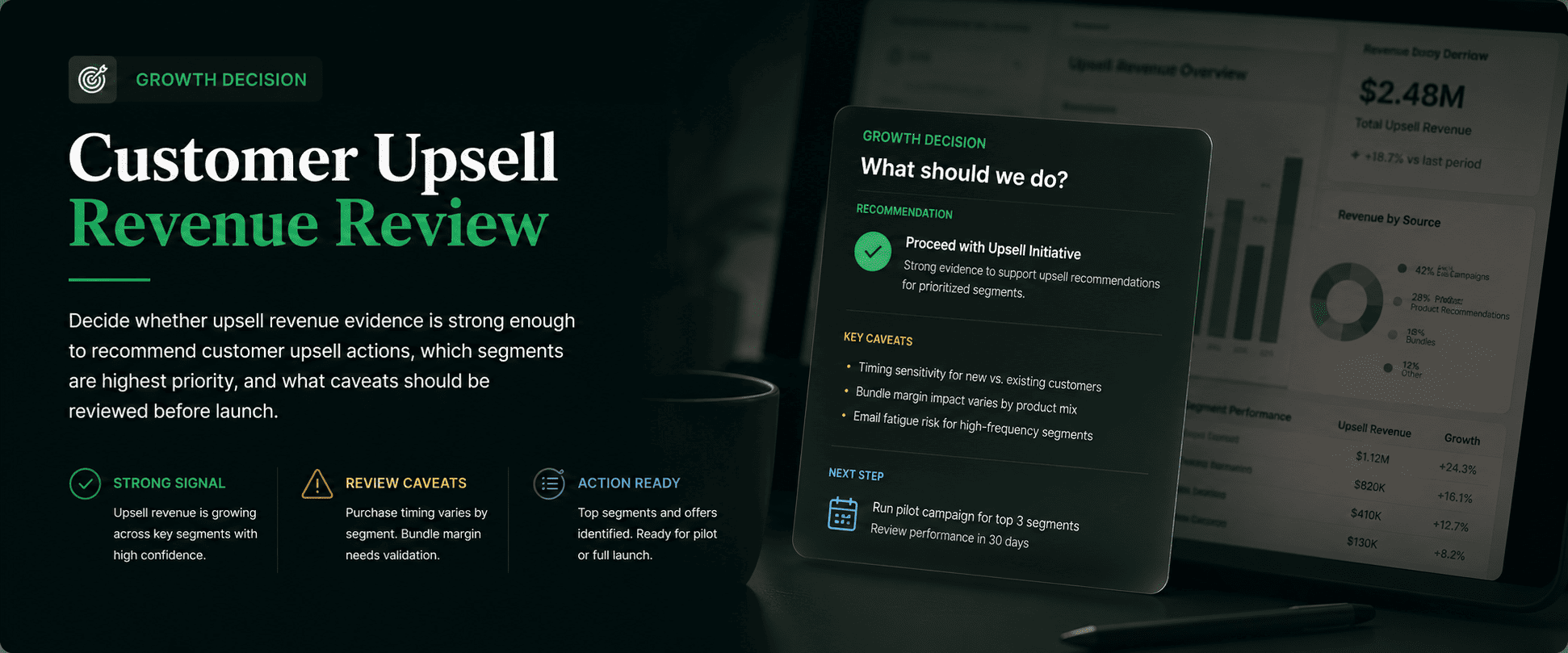
Define What The Customer Upsell Revenue Review Decides
A customer upsell revenue review evaluates whether upsell recommendations should be driven by product adjacency, purchase timing, customer value, or bundle economics before the team changes flow, segment, or send decisions. The review separates visible purchase behavior from assumptions about what customers will buy next, so the lifecycle marketer does not commit campaign resources before validating the evidence.
The goal is not to identify every possible upsell opportunity across the customer base. The goal is to determine which evidence signal is strong enough to support the next approved email revenue action. The review produces a bounded recommendation: approve the next step, hold the action, or return the decision to evidence collection with a named caveat.
A decision to launch upsell campaigns should not be driven by the presence of complementary products in the catalog alone. It should be driven by evidence that the product adjacency is real, the timing is right, the customer segment can capture the value, and the bundle economics support profitable expansion.
- Define the upsell recommendation before reviewing customer data.
- Identify which evidence signal should drive the next flow or send decision.
- Separate complementary item signals from coincidental purchase patterns.
- Assign ownership for the next approved upsell action.
- Document the hold condition if evidence is incomplete.
Evaluate Product Adjacency Before Recommending Complementary Items
Product adjacency determines whether two items share a genuine purchase connection rather than appearing together by coincidence. The review analyzes which products are commonly purchased together, when that pattern holds across customer segments, and whether the relationship supports a meaningful upsell recommendation.
Treating every co-purchased pair as an upsell opportunity produces low-converting campaigns that waste email sends and dilute customer trust. Adjacent products should demonstrate repeatable, segment-specific purchase behavior before being incorporated into upsell flows.
Product adjacency should be confirmed through purchase data rather than catalog assumptions. A product that frequently appears in the same order as another product is not automatically a useful upsell recommendation if the purchase timing does not support sequential buying behavior.
- Identify which products are commonly purchased together across Shopify orders.
- Confirm the adjacency pattern holds across multiple purchase periods.
- Evaluate whether the relationship supports a natural upsell recommendation.
- Separate genuine product adjacency from coincidental pairing.
- Document adjacency gaps before approving upsell campaign logic.
Validate Purchase Timing For Upsell Offer Placement
Purchase timing determines when a customer is most likely to convert on an upsell offer. An upsell recommendation delivered too early may reach a customer who has not yet used the initial purchase. An upsell delivered too late may reach a customer who has already found the complementary solution elsewhere.
The review evaluates purchase interval data to identify the optimal timing window for upsell offers. Timing should be validated against customer behavior rather than set by campaign convenience or inventory pressure.
An upsell offer delivered at the right time converts significantly better than the same offer delivered too early or too late. Purchase timing should be validated from actual customer behavior before the team commits to a campaign send schedule.
- Review purchase interval patterns between initial and subsequent orders.
- Identify when customers are most likely to accept an upsell offer.
- Evaluate whether timing varies across customer segments and product categories.
- Confirm the timing window supports the email send cadence.
- Document timing gaps before approving the upsell flow schedule.
Assess Customer Value And Segment Prioritization
Not every customer segment carries equal upsell potential. The review compares segments by order value, repeat purchase behavior, lifetime contribution, and upsell response history to determine which groups should receive priority in upsell flows and campaigns.
Targeting low-value segments with aggressive upsell offers can suppress engagement without producing meaningful revenue lift. The review ensures upsell investment is directed toward segments that can capture the additional value and sustain the expanded relationship.
Customer value analysis should inform which segments receive upsell offers, not just which products are recommended. A strong product adjacency paired with a low-value segment may produce less incremental revenue than a moderate adjacency paired with a high-potential segment.
- Compare customer segments by order value and repeat purchase frequency.
- Evaluate lifetime contribution across HubSpot customer records.
- Review upsell campaign performance by segment from email platform data.
- Identify segments with the highest capacity for value expansion.
- Document segment prioritization rationale before approving send decisions.
Review Bundle Economics For Revenue Lift Potential
Bundle economics determine whether an upsell recommendation produces incremental profit rather than revenue substitution. The review evaluates pricing structure, margin impact, discount sensitivity, and revenue lift assumptions before the team approves bundle-based upsell offers.
A bundle that increases revenue but decreases margin may generate top-line growth while weakening unit economics. The review confirms that bundle pricing supports profitable expansion rather than volume growth at the expense of contribution margin.
Bundle economics should be confirmed before the team builds upsell campaigns around bundled offers. A bundle that looks strong on revenue may create profitability problems when discount sensitivity and margin impact are included in the analysis.
- Review pricing structure for proposed upsell bundles.
- Evaluate margin impact across Stripe revenue data.
- Confirm discount levels do not erode contribution margin.
- Validate revenue lift assumptions against historical bundle performance.
- Document bundle economic caveats before approving offer logic.
Confirm Campaign Performance And Offer Logic
Previous upsell campaign performance provides evidence about which offers, flows, and segments produce the strongest response. The review analyzes historical email platform data to validate whether the current upsell recommendation is supported by campaign evidence or represents an untested assumption.
An upsell recommendation that has never been tested in a campaign should carry lower confidence than one backed by performance data. The review separates proven offer logic from untested hypotheses so the marketer can weigh evidence quality alongside the recommendation.
Campaign performance data should inform which upsell offers move forward. An offer that looks strong on paper but has no campaign evidence should be flagged as untested and held until a limited send produces performance data.
- Review historical upsell campaign performance from email platform data.
- Evaluate which offer types produce the strongest customer response.
- Compare open, click, and conversion rates across upsell flows.
- Identify offer logic that has not yet been validated in campaigns.
- Document campaign performance gaps before approving new send decisions.
Inspect Revenue Measurement Across Connected Sources
Upsell revenue should be measurable across connected systems before the team commits to scaling the recommendation. Email platform attribution, Shopify order data, Stripe revenue records, Google Analytics behavior, and BigQuery or spreadsheet models should produce consistent revenue signals for the upsell flow being evaluated.
When reporting systems produce conflicting revenue figures, the team should hold the recommendation until measurement alignment is confirmed. A recommendation built on conflicting revenue data cannot survive the review process.
Measurement alignment should be confirmed before the team changes flow logic, segment targeting, or send decisions. Inconsistent revenue data produces unreliable recommendations regardless of how strong the product adjacency or timing evidence appears.
- Compare email platform revenue attribution against Shopify order data.
- Validate Stripe revenue records align with reported upsell performance.
- Review Google Analytics behavior for upsell conversion path visibility.
- Confirm BigQuery or spreadsheet models produce consistent revenue figures.
- Document measurement gaps before approving upsell flow changes.
Keep Upsell Evidence Caveats Visible During The Review
Decision-makers should see evidence limitations alongside upsell findings. Caveats around product adjacency uncertainty, purchase timing variability, segment size limitations, bundle economics assumptions, and measurement gaps should remain attached to the recommendation throughout the review process.
Burying caveats in supporting documentation creates a false impression of upsell readiness that leads to premature campaign launches. Each finding should carry its limitation so the reviewer can weigh confidence alongside the evidence.
Visible caveats improve trust by helping stakeholders understand both the strengths and limitations of the upsell evidence. The review should not approve campaign launches when significant caveats remain unresolved.
- Document which upsell signals are incomplete or unverified.
- Surface product adjacency assumptions that could change the recommendation.
- Highlight timing windows that may shift across customer segments.
- Make bundle economic caveats explicit before approving offers.
- Separate confidence from certainty in every upsell finding.
Approval-Gated Upsell Reviews Protect Email Revenue Quality
Upsell recommendations carry campaign investment cost, customer relationship risk, and email list health impact. An approval-gated review ensures the team does not confuse complementary product existence with upsell evidence when deciding whether to change flow logic, segment targeting, or send schedules.
The reviewer should approve only the next step that is supported by visible product adjacency, purchase timing, customer value, and bundle economics evidence. If the required evidence is not visible, the output should be a hold note rather than a campaign approval. The recommendation should stay caveated until the relevant evidence is checked and the reviewer accepts the next action.
Approval gating protects email revenue teams from acting on complementary product signals when the underlying purchase behavior, timing, value, and economics evidence remains incomplete. The review should answer a clear decision: approve, hold, or send back for more evidence before upsell campaigns launch.
- Assign an owner for the next approved upsell campaign action.
- Document reviewer acceptance of the upsell evidence and caveats.
- Track approval state before flow, segment, or send changes.
- Identify unresolved upsell dependencies that could block success.
- Keep follow-up actions visible until upsell evidence improves.
Sample review note
10X should compare Complementary item with Higher order value, name the caveat that could change the customer upsell revenue recommendation, and keep follow-up approval-gated.