Customer Winback Revenue Review
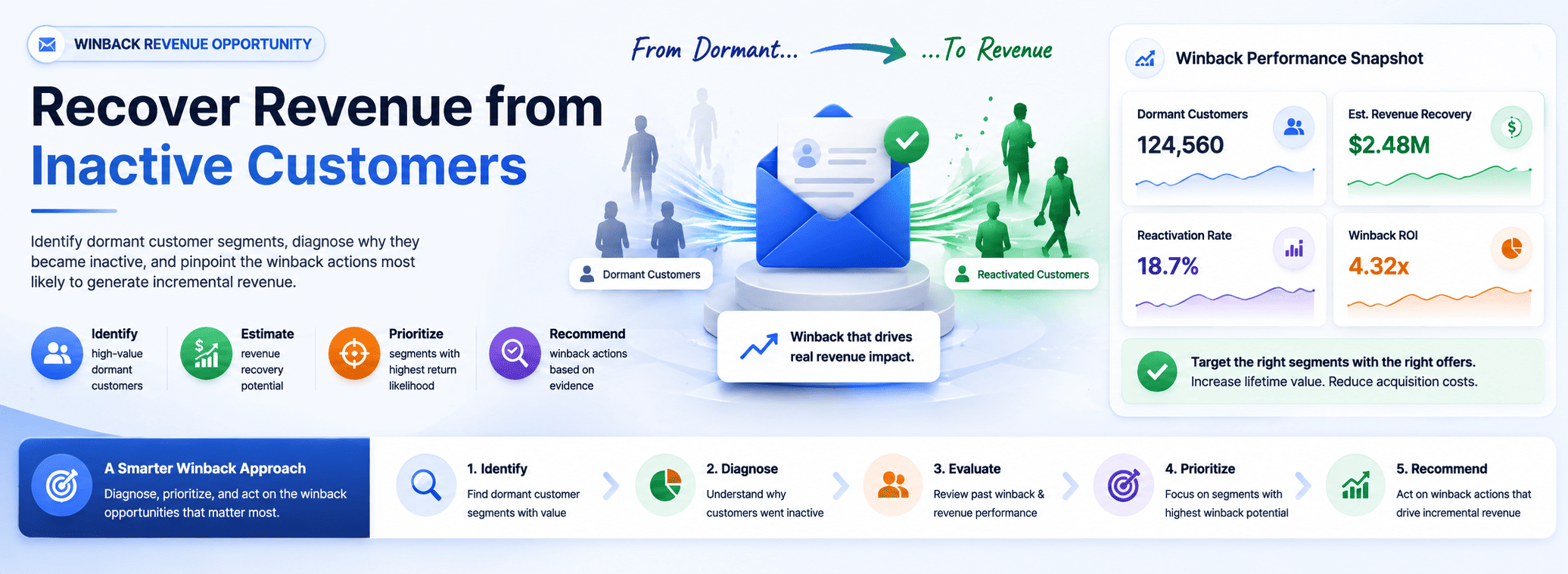
Customer acquisition often receives the majority of marketing attention, but many organizations overlook a significant source of potential revenue that already exists within their customer base. Dormant customers represent people who have previously purchased, subscribed, engaged, or generated revenue but have since become inactive. A customer winback revenue review is designed to determine whether these inactive customers represent a meaningful revenue recovery opportunity and whether investing in reactivation efforts is likely to generate measurable business results. Rather than immediately launching discount campaigns or promotional sequences, the review focuses on understanding why customers became inactive, which segments have the highest probability of returning, and whether the expected revenue justifies the required investment.
The goal is not simply to increase email sends or engagement metrics. The objective is to identify revenue that can realistically be recovered through targeted winback efforts. Effective diagnostic workflows separate assumptions from evidence and help teams avoid investing resources into audiences that have little likelihood of reactivating. By systematically reviewing customer behavior, purchase history, engagement patterns, and previous campaign performance, organizations can prioritize the opportunities most likely to create incremental revenue.
Why Customer Winback Analysis Matters
Acquiring a new customer often requires significantly more investment than retaining or reactivating an existing one. Previous customers are already familiar with the brand, have demonstrated buying intent, and may require less persuasion than a completely new prospect. However, not every inactive customer should be treated as a viable winback opportunity. Some customers may have permanently churned, switched providers, changed business priorities, or simply no longer fit the target market. A structured review helps determine where reactivation efforts should be focused and where resources are better allocated elsewhere.
Revenue recovery initiatives are most effective when they target customers who have both historical value and a realistic probability of returning. Without this analysis, organizations risk sending generic campaigns that generate activity without producing meaningful business outcomes. A diagnostic review ensures that winback decisions are grounded in customer behavior and revenue evidence rather than assumptions.
Step 1: Identify Dormant Customer Segments
The first step is defining what inactivity means for the business. Different organizations have different customer lifecycles. An ecommerce customer who has not purchased in ninety days may be considered dormant, while a B2B customer may naturally purchase only once every six months. The inactivity threshold should reflect normal purchasing behavior rather than an arbitrary timeframe.
Once inactivity definitions are established, customers should be segmented according to historical value, purchase frequency, product category, engagement history, and recency. High-value customers who recently became inactive often represent a stronger winback opportunity than low-value customers who have been inactive for several years. Segmenting customers correctly prevents teams from treating all dormant users as equal opportunities.
Step 2: Quantify Revenue Recovery Potential
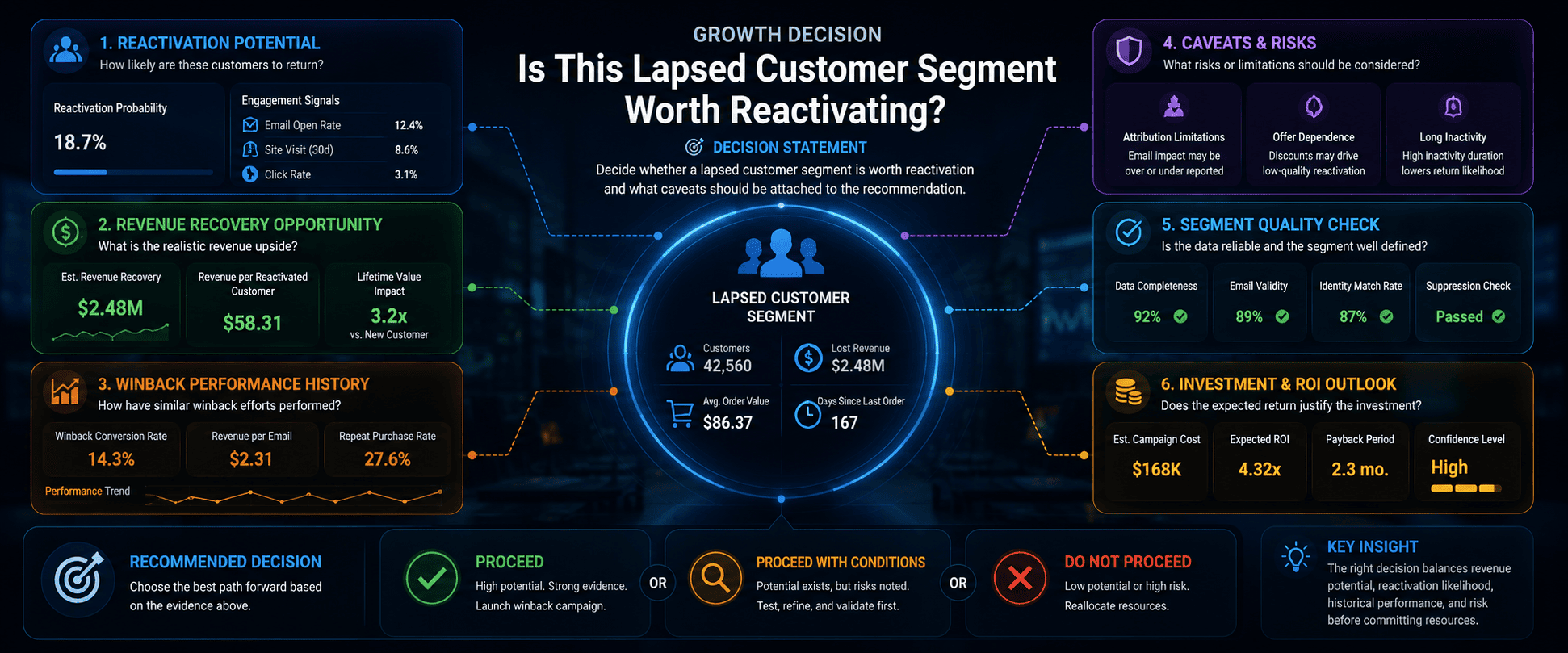
Before launching a winback initiative, teams should estimate how much revenue could realistically be recovered. This involves analyzing historical customer spending, average order value, repeat purchase behavior, and customer lifetime value. The objective is to understand the financial impact of reactivation rather than focusing solely on customer counts.
For example, a dormant segment containing one thousand customers may appear attractive at first glance. However, if historical purchase values are low and repeat behavior is weak, the revenue opportunity may be limited. Conversely, a smaller group of former high-value customers may represent a far larger recovery opportunity despite having fewer contacts. Revenue recovery potential should guide prioritization decisions throughout the workflow.
Step 3: Diagnose Why Customers Became Inactive
Understanding the cause of inactivity is often more valuable than measuring inactivity itself. Customers rarely disengage for a single reason. Common drivers include product dissatisfaction, changing needs, competitive alternatives, poor onboarding experiences, declining engagement, pricing concerns, or simply a lack of relevant communication. Each cause requires a different response strategy.
Reviewing support tickets, customer feedback, survey responses, purchase history, and engagement trends can help identify patterns. If inactivity is concentrated among customers who experienced onboarding issues, the solution may involve education and support rather than promotional discounts. If inactivity coincides with pricing changes, a different retention strategy may be necessary. Accurate diagnosis improves both campaign relevance and revenue outcomes.
Step 4: Review Historical Winback Performance
Previous winback campaigns often provide valuable evidence about future performance. Organizations should analyze historical open rates, click rates, conversion rates, recovered revenue, and customer retention following reactivation. The objective is to determine which approaches have previously generated sustainable outcomes.
Some campaigns may successfully reactivate customers but produce only short-term purchases. Others may generate lower response rates while producing customers who remain active for extended periods. Reviewing historical performance helps identify which strategies create lasting business value rather than temporary engagement spikes.
Step 5: Evaluate Segment-Level Reactivation Probability
Not all dormant customers have the same likelihood of returning. Customers who purchased recently and frequently are generally more likely to reactivate than customers who have been inactive for extended periods. Likewise, customers who continue opening emails or visiting the website may demonstrate stronger intent than customers who show no engagement activity.
Segment-level analysis should consider recency, frequency, monetary value, engagement behavior, product usage patterns, and historical responsiveness. These signals help estimate reactivation probability and prioritize segments with the highest expected return. The goal is to focus effort where the likelihood of success is supported by evidence.
Step 6: Assess Offer and Messaging Effectiveness
Many organizations assume that discounts are the primary solution for customer reactivation. In reality, different segments respond to different incentives. Some customers may require educational content, product updates, loyalty benefits, exclusive access, or personalized recommendations. Others may respond only when presented with a compelling financial incentive.
A thorough review examines which messages, offers, and content types historically drive reactivation. Understanding customer motivations allows teams to create more relevant campaigns while protecting margins and avoiding unnecessary discounts. The objective is not simply to generate clicks but to encourage profitable customer behavior.
Step 7: Validate Attribution and Revenue Measurement
Winback revenue analysis requires reliable measurement systems. Without accurate attribution, organizations may overestimate or underestimate the impact of reactivation campaigns. Teams should verify tracking systems, attribution windows, campaign tagging, CRM integrations, and revenue reporting processes before making decisions based on performance data.
Attribution validation is particularly important when customers interact with multiple channels before purchasing. Revenue credited to an email campaign may actually be influenced by paid advertising, direct visits, sales outreach, or product updates. Accurate measurement ensures that recovery decisions are based on trustworthy evidence.
Step 8: Estimate Expected Return on Reactivation Investment
Reactivation campaigns require resources including creative development, segmentation work, email deployment, incentives, and operational support. Before moving forward, teams should compare expected revenue recovery against these costs. This analysis helps determine whether the initiative represents an efficient use of resources.
Organizations should model multiple scenarios ranging from conservative to optimistic outcomes. Revenue forecasts should consider response rates, conversion rates, average order values, retention rates, and margin impact. A realistic estimate helps stakeholders understand both potential upside and associated risks.
Step 9: Prioritize High-Confidence Opportunities
After analyzing customer behavior, historical performance, revenue potential, and attribution quality, the next step is prioritization. Not every identified opportunity deserves immediate action. Teams should rank segments according to expected revenue impact, implementation effort, confidence level, and strategic importance.
High-confidence opportunities typically involve customers with strong historical value, recent inactivity, measurable engagement signals, and proven campaign responsiveness. Lower-confidence opportunities may require additional evidence before resources are committed. Prioritization ensures that the most valuable opportunities receive attention first.
Step 10: Produce a Clear Recommendation
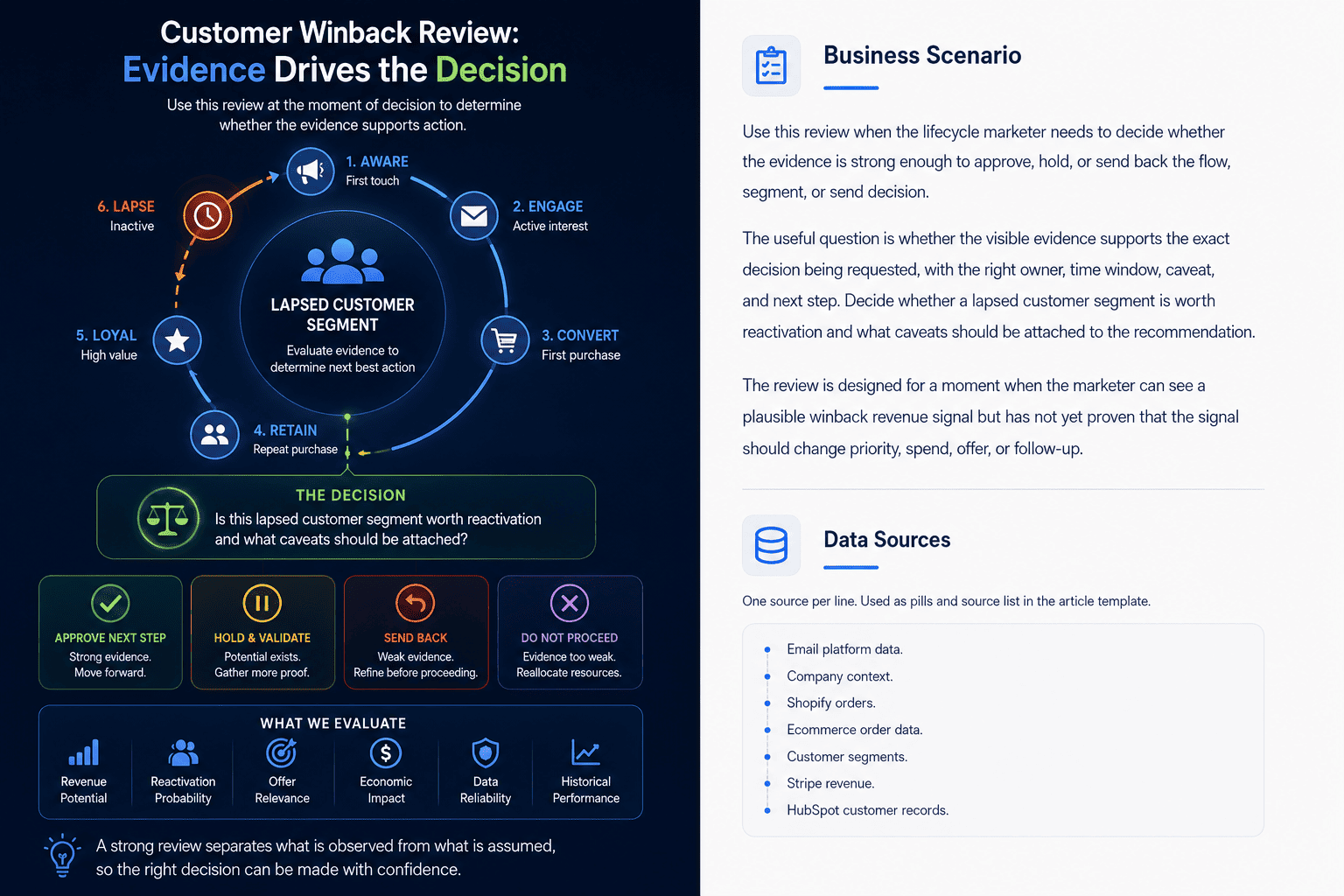
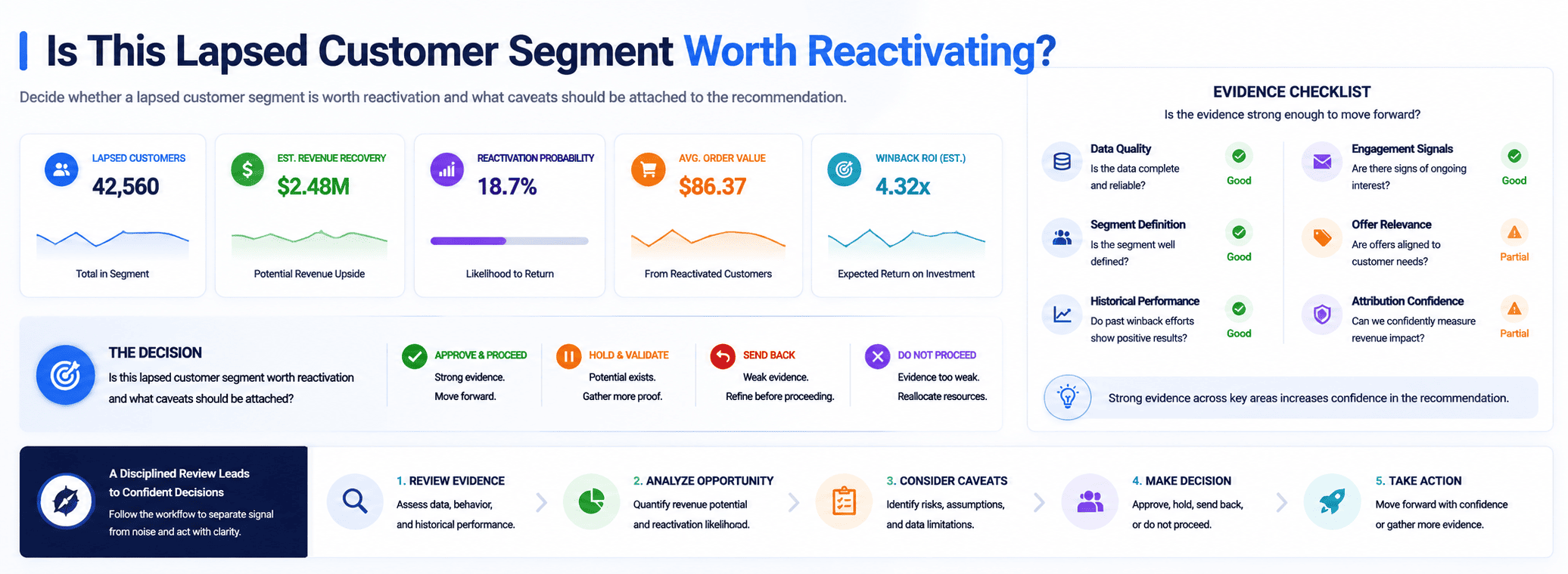
The final outcome of the customer winback revenue review should be a practical recommendation supported by evidence. The recommendation may be to launch a targeted winback campaign, test a specific offer, conduct additional customer research, improve measurement systems, or delay action until further evidence is collected. The review should clearly identify expected outcomes, associated risks, ownership responsibilities, and success metrics.
A useful recommendation does not attempt to guarantee results. Instead, it provides a structured path forward based on the strongest available evidence. This allows marketing, CRM, lifecycle, and revenue teams to make informed decisions while maintaining confidence in the reasoning behind those decisions.
Conclusion
Customer winback revenue reviews help organizations determine whether dormant customers represent a meaningful and achievable revenue opportunity. By systematically diagnosing inactivity causes, evaluating segment potential, reviewing historical performance, validating measurement systems, and estimating financial impact, teams can focus on the opportunities most likely to generate incremental revenue. The result is a more disciplined approach to customer reactivation, one that prioritizes evidence over assumptions and directs resources toward initiatives with the highest probability of creating sustainable business value.