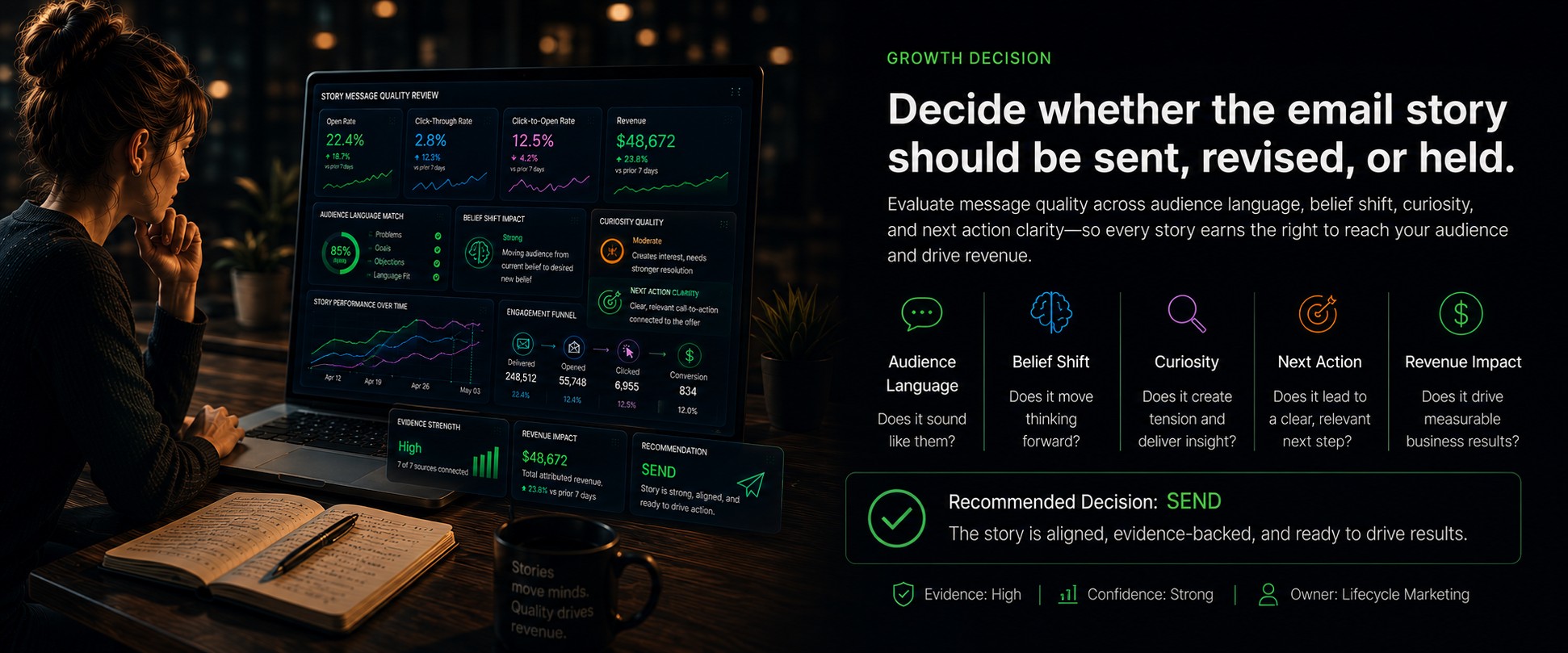
Ecommerce Product Selection Readiness Review
Choosing an ecommerce product is not only a creative decision. It is a growth decision, margin decision, operations decision, and traffic-readiness decision. A product may look promising in a trend report, competitor store, supplier catalog, ad library, or social post, but that does not mean it is ready for a store build, product page, offer test, advertorial, or paid traffic plan.
The Ecommerce Product Selection Readiness Review helps a growth team decide whether a product idea has enough evidence to move forward. Instead of approving products based on novelty or surface-level demand, the review checks demand signal, buyer problem intensity, sourcing caveats, margin context, differentiation, and approval state before resources are committed.
The goal is simple: decide whether the product idea should be approved, held, or sent back for evidence before store build and traffic planning begin.
What This Workflow Decides
This workflow answers one practical question: is the product ready for the next build or traffic step, or does the team need stronger validation first? That decision matters because a weak product selection can waste creative time, media budget, page design effort, supplier coordination, and operational focus.
A product can be promising without being ready for every next step. It may be ready for customer research but not paid traffic. It may be ready for supplier review but not a full funnel build. The review should protect the team from treating every positive signal as full approval.
- Approve: The product has enough demand, buyer urgency, margin context, differentiation, and operational readiness for the next step.
- Hold: The product may be promising, but important evidence is missing or contradictory.
- Send back for evidence: The team needs specific validation before approving page, offer, or traffic work.
- Reject or replace: The product does not appear strong enough for the intended build or campaign decision.
Evidence Sources To Review
No single input proves that a product is ready. A strong review compares demand, cost, margin, creative promise, buyer intent, and operational readiness. The team should use connected evidence instead of relying only on trend interest or competitor visibility.
- Shopify: Comparable SKU history, order patterns, product tracking, and store demand signals.
- Meta Ads: Audience cost benchmarks, category competition, and creative patterns.
- Google Analytics: Traffic patterns, referral quality, and existing visitor interest.
- Search Console: Search demand volume, query intent, and organic interest.
- Product-page analytics: Conversion benchmarks from similar pages or funnels.
- Order data: Margin actuals, refund rates, repeat purchase signals, and cash timing.
- Creative library: Existing hooks, proof elements, product images, UGC, or tested angles.
- Customer research: Buyer problem intensity, objections, language, and decision triggers.
Review Demand And Problem Intensity
A product idea should show visible demand before the team invests in store build or traffic planning. Demand can come from search behavior, competitor traction, comparable SKU performance, customer questions, category growth, ad account history, or direct buyer research. The reviewer should ask whether demand is specific and connected to a real buying situation.
Broad interest is not enough. The team needs to understand who wants the product, why they want it, when they care, and what problem or desire creates urgency. Search Console may show related queries. Shopify may show comparable products with order history. Meta Ads may show that the category can attract attention. Customer research can show whether the problem is painful enough for buyers to act.
If demand evidence is weak, the next step should be validation work, not store build. That may include search analysis, competitor review, customer interviews, survey collection, or a small test designed to isolate demand.
- Is there visible search or shopping demand?
- Does the product solve a frequent, painful, emotional, or expensive problem?
- Do customer reviews or research repeat the same need?
- Is the buyer context specific enough for page and ad planning?
- Would weak demand require validation before build work starts?
Check Differentiation And Offer Fit
The team should not only ask whether people want the product. It should ask why they would buy this version, from this store, through this offer, now. Differentiation can come from product design, bundle, guarantee, education, proof, convenience, audience focus, trust, customer support, or merchandising. But the difference must be visible enough to appear in ad copy and believable enough to survive comparison.
A product with no clear angle is difficult to sell through paid traffic. The campaign may have to compete only on price, impulse, or novelty, which increases risk. The review should confirm that the product has a clear reason to buy and a path to a believable offer.
If the angle is unclear, the workflow should recommend an offer-positioning review before creative or page work begins.
- What makes the product easier to understand than alternatives?
- What proof would make the offer believable?
- What objection will appear before purchase?
- What angle can appear in ad copy, page headline, and product description?
- What comparison will the buyer make before buying?
Connect Margin, Sourcing, And Operations
A product can have demand and still be a poor selection if the margin does not support acquisition, refunds, shipping, discounts, payment timing, or customer support. Ecommerce product selection must connect creative promise to commercial reality.
Order data is important here. The reviewer should check margin actuals from comparable products, refund rates, average order value, shipping costs, supplier pricing, and cash timing. Paid traffic puts pressure on margin, so the product needs enough gross margin, bundle potential, upsell value, or repeat purchase opportunity to support the test.
If supplier or margin assumptions are not confirmed, approval should remain limited. The workflow can approve further validation, but it should not approve full traffic planning until key constraints are visible.
- Are supplier costs and delivery timelines confirmed?
- Is the margin strong enough for expected traffic costs?
- Are refund, quality, or compliance risks visible?
- Is inventory or fulfillment ready for the next step?
- Is there a named owner for sourcing and execution?
Review Creative, Page, And Traffic Readiness
A product that cannot be explained clearly may struggle in paid traffic. The creative team needs hooks, proof, objections, use cases, comparison points, customer language, and visual demonstrations. Creative readiness does not mean the ads are already built. It means the product has enough message material to justify creative work.
The product page must also support the ad promise. If the product requires education but the team plans to send traffic to a thin product page, the review should flag that mismatch. Product-page analytics and tracking events from similar funnels can help estimate whether the post-click path is strong enough.
- Does the creative message map to a buyer belief or objection?
- Is there enough proof for the product claim?
- Does the page format match buyer awareness and product complexity?
- Can tracking events show product view, add to cart, checkout, and purchase?
- Does ad cost context support the planned offer and margin?
Approval Boundary
This workflow should remain approval-gated. 10X can review the evidence, compare sources, surface caveats, and suggest a next step, but the recommendation should not automatically become an execution instruction. A human reviewer must accept the action before the team proceeds.
If a supporting input is missing, the output should name the gap clearly. Acting on incomplete evidence creates false confidence, so the team should either find the missing input or explicitly accept the risk.
Final Decision Rule
The Ecommerce Product Selection Readiness Review prevents the team from turning a product idea into a campaign too early. If demand is visible, problem intensity is clear, differentiation is believable, margin context is acceptable, sourcing caveats are known, and an owner is assigned, the product can move forward with a clear approval state.
If those conditions are not met, the recommendation should stay caveated. The team should hold the decision, collect missing evidence, refine the product angle, or send the idea back for validation before investing in store build or traffic planning.
Sample review note
10X should review Email Story Message Quality Review, compare the decision evidence with the caveats, and keep the next recommendation approval-gated until the reviewer accepts it.