Lifecycle Email Account Audit
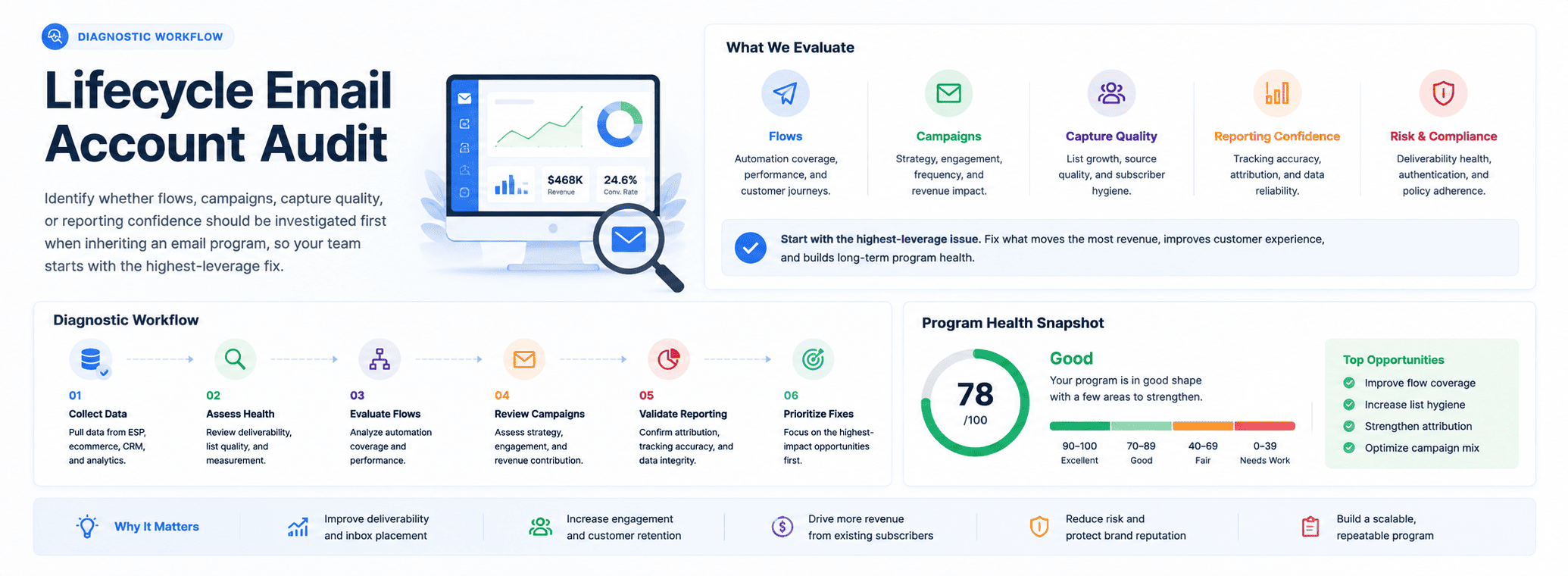
Lifecycle email marketing often becomes one of the highest-return channels in a business because it reaches customers who have already demonstrated interest, intent, or purchase behavior. However, many lifecycle programs gradually become inefficient without obvious warning signs. Revenue may plateau, engagement may decline, automations may become outdated, and reporting may lose reliability. A Lifecycle Email Account Audit helps determine whether the email program is healthy enough to support future growth or whether structural issues are limiting performance.
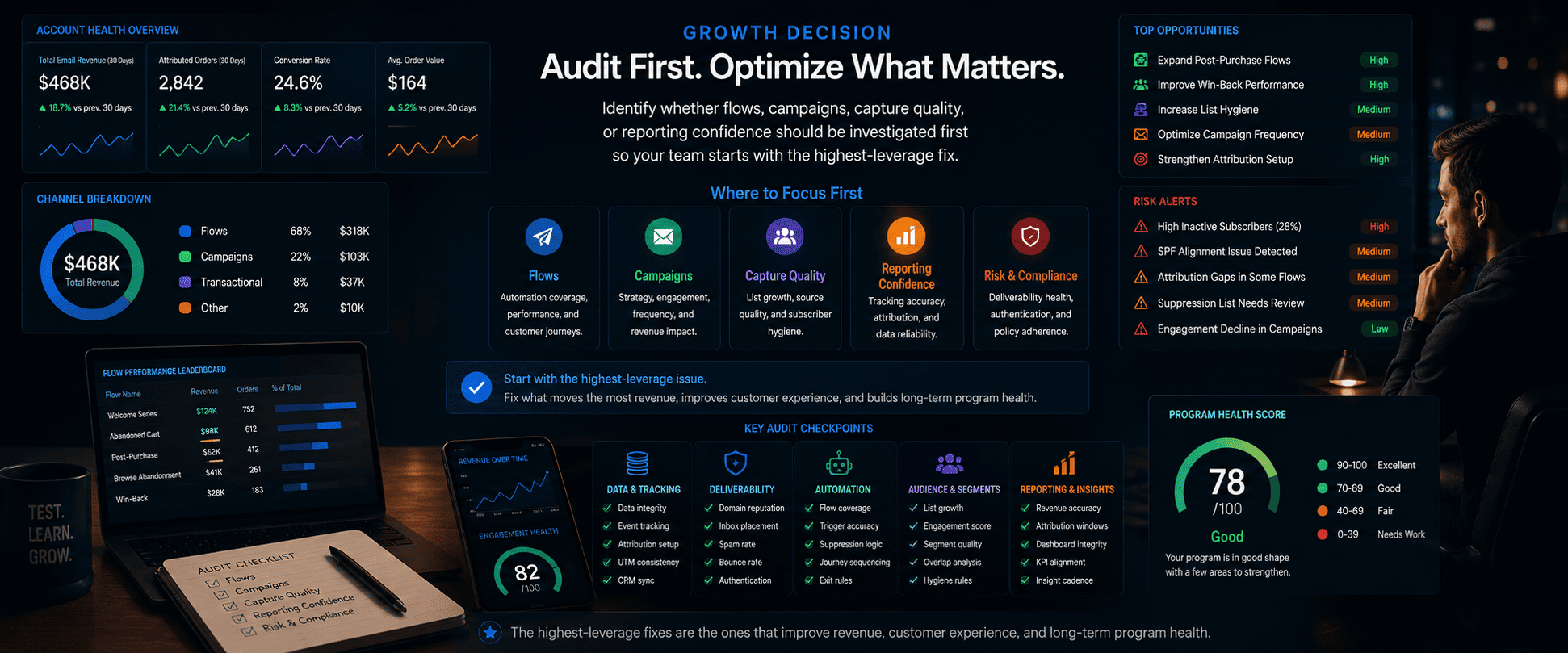
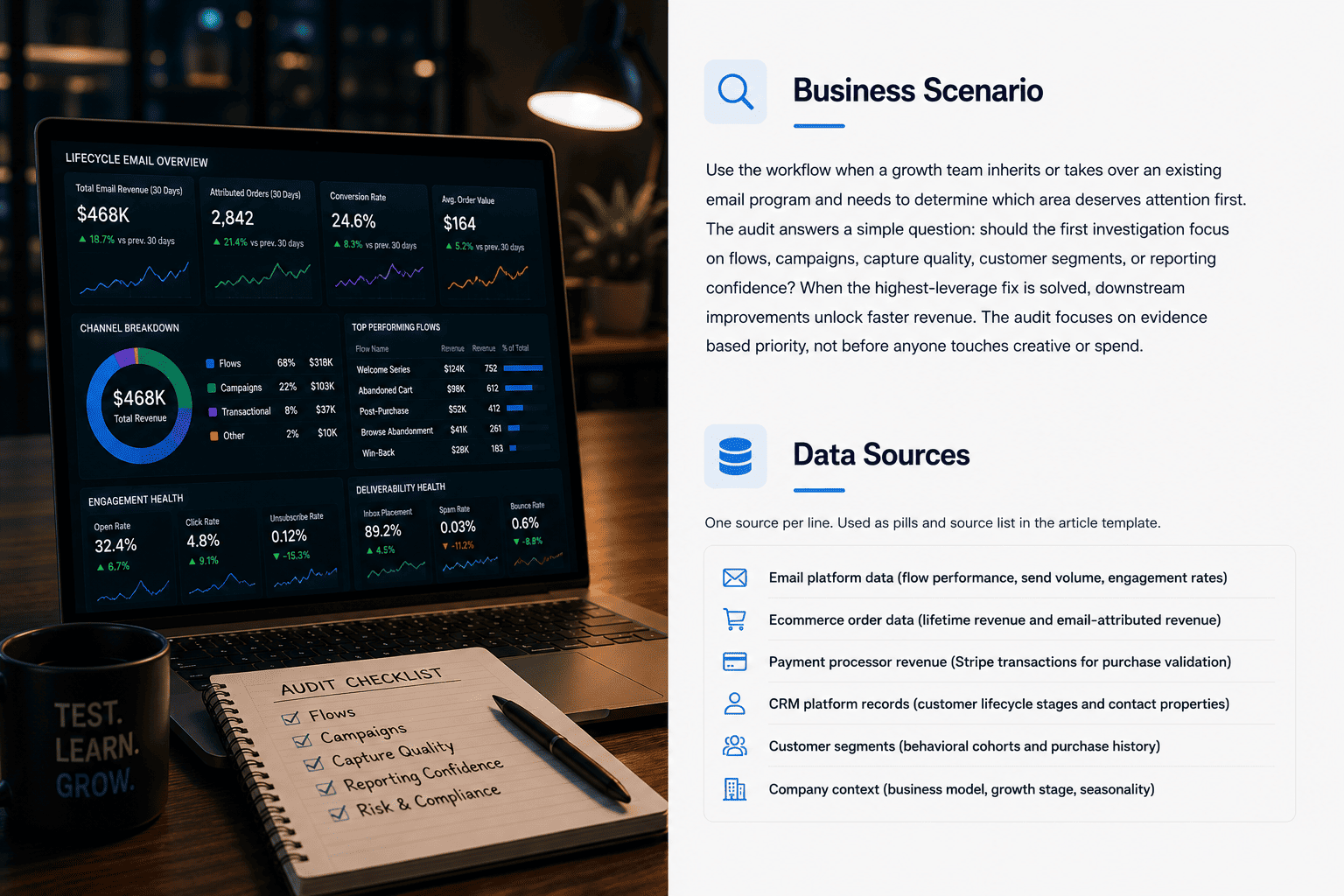
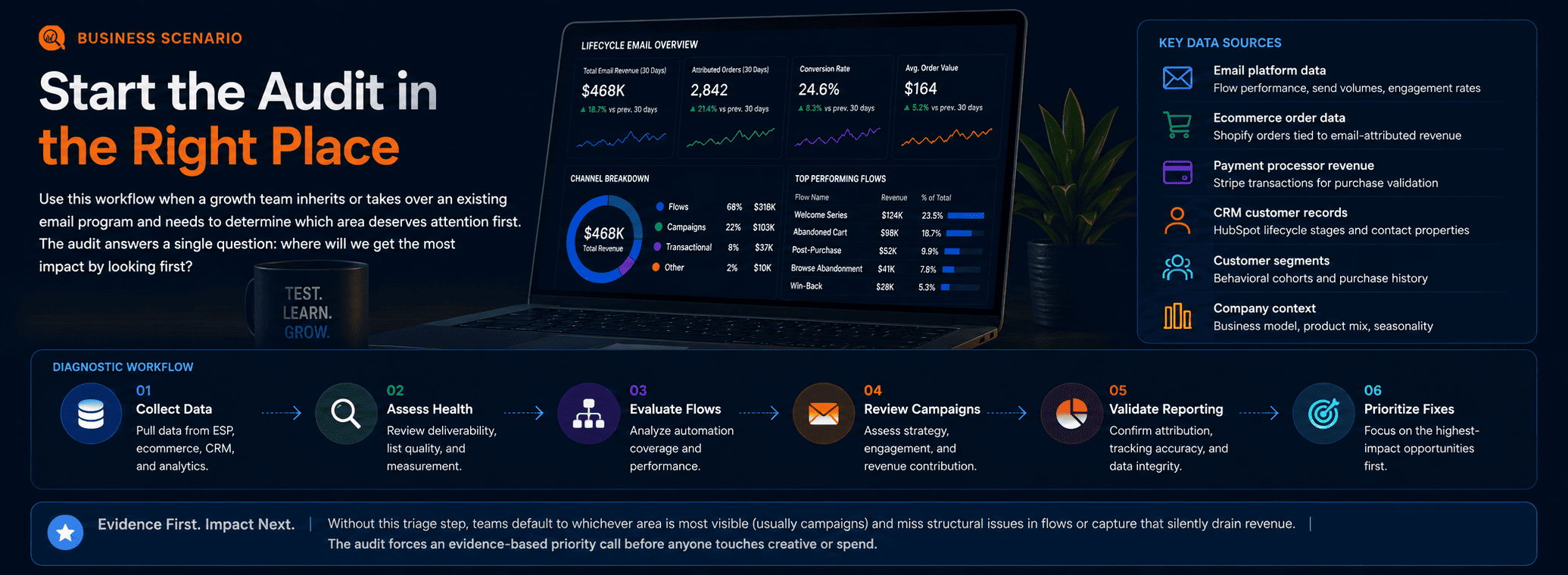
The purpose of the audit is not simply to review email metrics. The objective is to evaluate whether the entire lifecycle email ecosystem is functioning as intended. This includes deliverability, automation coverage, segmentation quality, revenue attribution, measurement integrity, operational processes, and customer experience. A structured audit provides evidence for future optimization decisions while preventing teams from making changes based on incomplete information.
Why Lifecycle Email Audits Matter
Many email programs evolve over years of campaigns, automation launches, segmentation updates, and platform changes. During this process, workflows are added, rules become outdated, audiences overlap, and tracking implementations drift from their original purpose. Teams often focus on open rates and revenue numbers without evaluating whether the system underneath remains healthy.
An audit identifies weaknesses before they become expensive. Instead of reacting to declining performance after revenue drops, organizations can proactively evaluate account health and address issues that restrict growth.
Audit Area 1: Deliverability Health
Deliverability forms the foundation of lifecycle email performance. Messages that never reach the inbox cannot generate engagement or revenue regardless of content quality. The audit should evaluate domain reputation, sender reputation, spam complaint rates, bounce rates, unsubscribe patterns, and authentication configuration.
Strong engagement metrics can sometimes hide deliverability deterioration if only highly engaged subscribers continue receiving messages. Reviewing inbox placement and audience reach helps determine whether performance reflects genuine program strength or shrinking exposure.
Audit Area 2: Subscriber List Quality
List quality directly influences engagement, revenue, and deliverability. Over time, inactive subscribers accumulate and reduce overall performance. The audit should examine subscriber growth, inactivity levels, acquisition sources, suppression logic, and list hygiene practices.
A healthy list consists of subscribers who have provided permission, demonstrated engagement, and remain relevant to business objectives. Poor list quality often creates downstream issues that affect every lifecycle program.
Audit Area 3: Lifecycle Flow Coverage
One of the most common audit findings is incomplete automation coverage. Customers move through multiple lifecycle stages, but many accounts only support a small portion of the customer journey. Missing automations create revenue leakage and inconsistent customer experiences.
The audit should review welcome flows, abandoned browse sequences, abandoned cart programs, checkout recovery, post-purchase journeys, replenishment campaigns, win-back workflows, loyalty communications, referral programs, and retention sequences. Coverage gaps often reveal significant growth opportunities.
Audit Area 4: Flow Performance Evaluation
Existing automations should be evaluated independently rather than grouped into aggregate account performance. Individual workflows frequently behave very differently from one another. A welcome flow may perform exceptionally well while a win-back program produces minimal value.
The audit should evaluate conversion rates, revenue contribution, click performance, audience reach, timing effectiveness, and workflow completion behavior. Understanding flow-level performance improves prioritization decisions.
Audit Area 5: Segmentation Quality
Effective lifecycle marketing depends on delivering relevant messages to the appropriate audience. Segmentation failures often create message fatigue, lower engagement, and reduced conversion performance. The audit should review segmentation logic, audience overlap, behavioral triggers, lifecycle stage definitions, and personalization strategies.
Clear segmentation improves customer experience while increasing operational efficiency across the account.
Audit Area 6: Revenue Attribution Review
Email revenue reporting often varies across platforms because attribution rules differ. A lifecycle email program may appear highly successful or significantly underperforming depending on the attribution model used. The audit should evaluate attribution windows, reporting methodology, platform consistency, and transaction validation.
The objective is to determine whether reported revenue accurately reflects customer behavior and business impact.
Audit Area 7: Campaign Strategy Assessment
Campaign performance should be evaluated separately from automated flows. Broadcast campaigns often consume significant operational effort and can influence customer engagement patterns across the entire account. The audit should review send frequency, content strategy, promotional dependence, audience targeting, and performance consistency.
Organizations frequently discover that campaign volume has increased while incremental business impact has remained flat.
Audit Area 8: Customer Experience Consistency
Email programs should be evaluated from the customer's perspective rather than solely through performance metrics. Customers often receive messages from multiple automations, campaigns, and segments simultaneously. Without proper governance, communication becomes repetitive and confusing.
The audit should examine message overlap, frequency controls, content consistency, journey sequencing, and lifecycle alignment. A strong customer experience supports both short-term revenue and long-term retention.
Audit Area 9: Measurement and Tracking Validation
Reliable decision-making requires reliable measurement. The audit should verify tracking implementation, event collection accuracy, conversion reporting, ecommerce integration, CRM synchronization, and automation trigger reliability.
Many lifecycle programs contain hidden measurement issues that distort reporting and create misleading optimization priorities. Identifying these problems early improves future decision quality.
Audit Area 10: Operational Readiness
Lifecycle performance depends not only on technology but also on operational processes. The audit should review ownership structure, approval workflows, testing processes, documentation quality, reporting cadence, and optimization procedures.
Strong operational systems enable continuous improvement and reduce the likelihood of performance degradation over time.
Common Issues Found During Lifecycle Audits
Most lifecycle email audits uncover recurring patterns. Common findings include outdated automations, overlapping segments, inconsistent attribution, inactive subscriber accumulation, weak win-back strategies, missing post-purchase experiences, deliverability concerns, insufficient testing practices, and undocumented business rules. While these issues rarely cause immediate failure, they often reduce revenue efficiency and slow optimization progress.
How to Prioritize Audit Findings
Not every issue requires immediate action. Findings should be prioritized according to business impact, implementation effort, revenue exposure, customer experience risk, and measurement confidence. High-impact deliverability problems generally require urgent attention, while lower-impact workflow refinements may be scheduled into future optimization cycles.
A structured prioritization framework helps teams focus resources on the constraints most likely to influence revenue performance.
Conclusion
A Lifecycle Email Account Audit provides a systematic method for evaluating the health of an email marketing program before major optimization decisions are approved. By reviewing deliverability, segmentation, automation coverage, revenue attribution, measurement integrity, customer experience, and operational readiness, organizations gain a clearer understanding of both performance strengths and growth constraints. The result is a more reliable lifecycle program capable of supporting sustainable revenue growth and better customer engagement over time.