How to design the thank-you moment before selling anything else
The post-purchase communication that arrives immediately after a customer completes a transaction is highest-open-rate message the customer will ever receive from brand, and using it to sell immediately is fastest way to reduce lifetime value. The reviewer should confirm that the first post-purchase message is designed to build confidence and deliver value rather than to pitch a second purchase. The customer has just spent money. They are experiencing buyer's remorse risk. They need confirmation that they made a good decision, that the product will arrive as described, and that help is available if something goes wrong. A message that immediately pitches an upsell signals that the brand values the next transaction more than current customer.
The reviewer should check if thank-you message includes specific purchase confirmation the customer needs: what they bought, when it will arrive, how to access it if it is digital, who to contact if there is a problem, and what to expect next. A thank-you message that contains only a generic thank you and a link to store is missing each piece of information the customer wants at the moment of highest engagement. The reviewer should test the post-purchase flow by completing a purchase and reading each message in the first twenty-four hours. If any message in the first twenty-four hours asks for a second purchase before first purchase has been confirmed and the customer's confidence has been addressed, the reviewer should hold the upsell or cross-sell message and require the thank-you sequence to be rebuilt around confidence and education before any revenue-generating message is inserted.
- Confirm the first post-purchase message builds confidence and delivers value rather than pitching a second purchase.
- Verify thank-you message includes product confirmation, arrival timeline, access instructions, and support contact.
- Test full twenty-four-hour post-purchase flow by completing a purchase and reading each message in sequence.
- Hold any revenue message in the first twenty-four hours if the thank-you hasn't addressed buyer confidence and confirmation.
How to identify the right cross-sell based on adjacent product need
A cross-sell succeeds when it recommends a product that solves an adjacent problem the customer will encounter while using the purchased product. A cross-sell fails when it recommends a product that is only related by category but doesn't solve a problem the purchased product creates. The reviewer should verify that each cross-sell recommendation is based on product context: what the customer bought, what they will need to use it effectively, and what they are likely to need within the usage window of the purchased product. A customer who buys a camera needs a memory card. A customer who buys a desk needs a chair. A customer who buys a shirt doesn't need another shirt of a different color unless the first shirt creates a specific gap that the second shirt fills.
The reviewer should also check the timing of the cross-sell message. A cross-sell sent before customer has received and used the first product is asking the customer to buy an accessory for something they haven't yet experienced. A cross-sell sent after the return window has closed ensures the customer is committed to first product before being asked to commit to a second. The reviewer should segment cross-sell timing by product category and delivery timeline. A digital product that is delivered instantly can support a cross-sell within hours. A physical product that takes seven days to ship should not receive a cross-sell until after delivery confirmation. If cross-sell recommendations aren't based on product context or the timing doesn't account for delivery and usage windows, the reviewer should hold the cross-sell sequence and require product-context mapping and timing segmentation before any cross-sell message is sent.
- Verify each cross-sell solves an adjacent problem the purchased product creates, not just a category relationship.
- Map what the customer will need to use the purchased product effectively and recommend only those products.
- Segment cross-sell timing by product category and delivery timeline, holding until after delivery for physical products.
- Hold cross-sell sequence if recommendations aren't product-context-based or timing ignores delivery windows.
How to determine upsell timing confidence before pitching a higher tier
An upsell offers the customer a higher-value version of what they already bought, and the timing determines if offer lands as an upgrade or as a regret trigger. The reviewer should confirm that the upsell is timed after the customer has had enough experience with purchased product to value an upgrade, not before. A customer who bought the basic plan and receives an upsell for premium plan three days later hasn't yet experienced the limitations that would make the upgrade worth the price difference. They experience the offer as the brand telling them they bought the wrong version.
The reviewer should also check if upsell is based on usage signals rather than a time-based trigger. A customer who hasn't logged in since purchasing should not receive an upsell because they haven't yet extracted value from basic version. A customer who has hit a usage limit should receive an upsell at the moment the limit creates friction because the upgrade solves an active problem. The reviewer should verify that the upsell timing is driven by product usage data, not by a fixed number of days after purchase. If timing confidence is based on a calendar rather than usage signals, or if the upsell window overlaps with return or refund period, the reviewer should hold the upsell and require usage-based triggering and post-return-window timing before upsell is activated.
- Confirm the upsell is timed after the customer has enough product experience to value the upgrade, not before.
- Trigger upsells from usage signals such as feature limits reached, not from a fixed number of days after purchase.
- Verify upsell window starts after the return or refund period closes to prevent buyer's remorse amplification.
- Hold upsell if timing is calendar-based rather than usage-based or overlaps with return window.
How to define winback conditions before a customer is marked lapsed
A winback campaign that triggers on wrong inactivity signal sends discount offers to customers who were about to purchase at full price, and a winback that triggers too late sends offers to customers who have already switched to a competitor. The reviewer should confirm that the inactivity definition is based on customer's normal purchase cadence, not on a generic threshold. A customer who purchases each ninety days and hasn't purchased in one hundred and twenty days is lapsed. A customer who purchases once per year and hasn't purchased in one hundred and twenty days is between cycles and should not receive a winback offer.
The reviewer should also check what the winback offer contains. A winback that offers a discount trains the customer to wait for discount, reducing full-price purchase frequency for customers who would have returned without the offer. A winback that offers value rather than a price reduction such as early access to a new product, a content resource, or an invitation to a customer community reactivates the relationship without devaluing the product. The reviewer should verify that the winback segmentation distinguishes between customers who lapsed because they found a competitor, because the product no longer meets their need, and because they forgot. A discount offer is appropriate for forgot segment and inappropriate for competitor segment where a discount can't compete with a fundamentally different product. If the inactivity definition isn't based on purchase cadence data or the winback offer is a generic discount without segment differentiation, the reviewer should hold the winback and require cadence-based segmentation and segment-specific offers before activation.
- Define inactivity based on customer's normal purchase cadence, not a generic days-since-last-purchase threshold.
- Segment lapsed customers by reason: forgot, competitor switch, or product no longer relevant, and offer accordingly.
- Use value-based winback offers for high-LTV segments to avoid training full-price customers to wait for discounts.
- Hold winback if segmentation isn't cadence-based or the offer is a generic discount without reason differentiation.
How to gate the post-purchase sequence and close the revenue review
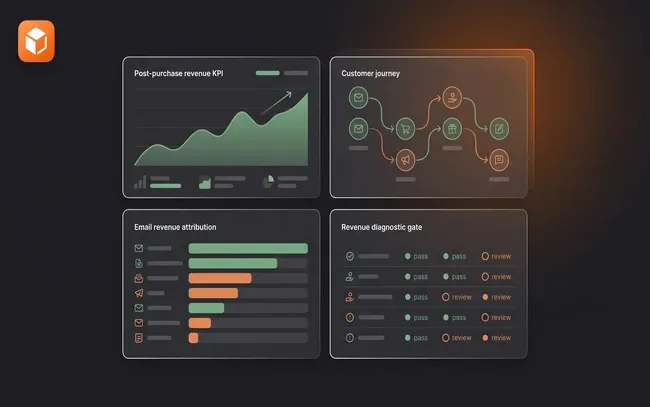
The final gate confirms that the post-purchase communication strategy is sequenced correctly across customer lifecycle and that revenue-generating messages are placed at points where the customer has enough context and confidence to receive them. The reviewer should produce a post-purchase map that shows the timing of each message from purchase through the winback window, labels each message by purpose including confidence, education, cross-sell, upsell, and winback, and identifies any point where a revenue message appears before a confidence or education message. A sequence that sends a cross-sell before delivery confirmation or an upsell before customer has used the product is out of order.
The reviewer should produce one of three outputs. Approved when the thank-you sequence builds confidence before any revenue ask, cross-sell recommendations are based on adjacent product context with delivery-aware timing, upsell triggers are driven by usage signals after the return window closes, winback segmentation is cadence-based with reason-differentiated offers, and full sequence map shows revenue messages appear only after confidence and education stages. Held when any gate fails and the missing context, data, or timing fix is named with an owner. Returned when the post-purchase sequence has accumulated enough misordered messages that rebuilding from thank-you forward is more efficient than incremental fixes. No post-purchase message should be activated without reviewer acceptance of full sequence map.
- Produce post-purchase map showing each message timing and purpose from purchase through the winback window.
- Flag point where a revenue message appears before a confidence or education message and reorder the sequence.
- Produce approved, held, or returned based on whether all four revenue-review gates pass with documented sequence timing.
- Return the sequence when misordered messages have accumulated enough that rebuilding from thank-you is more efficient.
Sample Review Note
All four diagnostic gates were checked for this Post-Purchase Revenue review. The thank-you moment was verified by confirming the first message builds confidence through purchase confirmation, delivery timeline, access instructions, and support contact, and testing full twenty-four-hour flow confirmed no revenue ask appears before buyer confidence is addressed. Cross-sell recommendations were validated by mapping each recommendation to an adjacent product need the purchased product creates, segmenting timing by delivery and usage windows, and holding any recommendation that was category-based rather than product-context-based. Upsell timing confidence was confirmed by verifying triggers are driven by usage signals rather than a fixed calendar, and the upsell window was verified to start after the return period closes. Winback conditions were defined by basing inactivity on purchase cadence, segmenting lapsed customers by reason, and using value-based offers for high-LTV segments to avoid discount training. full post-purchase sequence map was produced showing each message timing and purpose, and any revenue message appearing before a confidence stage was flagged and reordered.
Recheck triggers include a product line change that shifts adjacent product relationships, a delivery or fulfillment timeline change, a new product tier or pricing change that alters upsell eligibility, a purchase cadence pattern shift in the customer base, a customer segment migration that changes the winback segmentation, or a post-purchase engagement rate drop below the threshold that signals the sequence has lost relevance. If a recheck is needed, any post-purchase message activation or modification should be paused until the reviewer accepts the updated evidence and the revised sequence map.