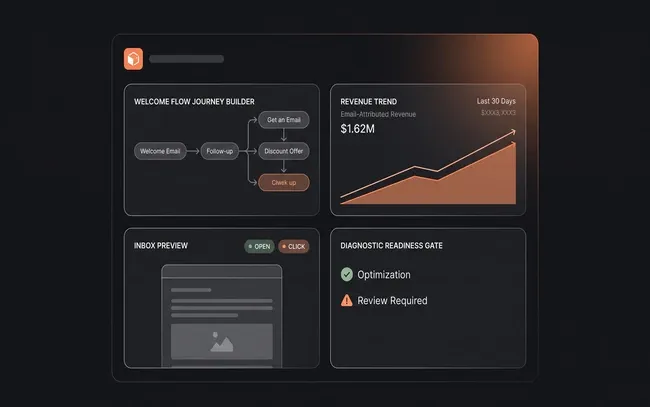
How to diagnose why subscribers joined and what they expected
A welcome flow that sends a generic thank-you message without referencing how the subscriber joined or what they were promised will produce low engagement because the subscriber opened the email expecting specific value they signed up for and received a generic greeting instead. The reviewer should diagnose why subscribers joined by tracing the entry source including the lead magnet, the signup form promise, or the purchase trigger and verifying the welcome flow's first message delivers on that specific promise.
The reviewer should check if entry source and the first message are aligned. A subscriber who signed up for a pricing guide should receive a welcome email that delivers the pricing guide in the first message, not a brand story that delays the promised value. If the entry source and the welcome message are misaligned, the reviewer should hold the flow and require entry-to-message alignment before flow is evaluated for revenue.
- Trace each subscriber's entry source including the lead magnet, form promise, or purchase trigger.
- Verify first welcome message delivers on specific promise the entry source made to subscriber.
- Flag flow where the entry promise and the first message are misaligned and the lead magnet is delayed.
- Hold flow if the entry source and welcome message aren't aligned on specific value promised.
How to verify the subscriber understood value before offer
A welcome flow that sends a purchase offer before subscriber has understood the value of the product will generate low conversion because the subscriber is being asked to buy before they know why they should. The reviewer should verify that the subscriber understood the value by checking if flow includes value-delivery messages before offer message. A value-delivery message explains what the product does, who it helps, and what outcome it produces without asking for a purchase.
The reviewer should check the sequencing including how many value messages precede the first offer. A flow with zero value messages before offer is asking for a purchase from a subscriber who only knows the lead magnet value, not the product value. If the subscriber hasn't received enough value context before offer, the reviewer should hold the flow and require value sequencing before offer.
- Check how many value-delivery messages precede the first purchase offer in the welcome flow sequence.
- Verify each value message explains what the product does, who it helps, and what outcome it produces.
- Flag flow where the first offer appears before subscriber has received any product-value context.
- Hold flow if value delivery is insufficient and the subscriber is asked to purchase without value context.
How to check whether urgency helped or hurt the welcome conversion
A welcome flow that applies urgency including a limited-time discount or a countdown timer may increase short-term conversion while reducing long-term customer quality by attracting buyers who purchased for discount and will not repurchase. The reviewer should check whether urgency helped or hurt the welcome conversion by comparing the conversion rate with and without urgency and the repeat purchase rate for urgency-acquired customers versus non-urgency-acquired customers.
The reviewer should also verify that the urgency offer is aligned with subscriber's decision timeline. A subscriber who just joined and needs time to evaluate the product may convert later without urgency. Applying a one-day discount to a subscriber who needs a week to decide will either force a premature purchase or lose the subscriber when the discount expires. If urgency is hurting repeat purchase quality or is misaligned with decision timeline, the reviewer should hold the urgency element and recommend removal or adjustment.
- Compare repeat purchase rate for urgency-acquired customers versus non-urgency-acquired customers.
- Check urgency timeline matches the subscriber's expected decision timeline for product category.
- Flag urgency element that drives short-term conversion at the expense of long-term customer quality.
- Hold urgency element if it reduces repeat rate or is misaligned with product's decision timeline.
How to map next journey and gate the welcome diagnosis
The final gate maps what journey comes next for subscriber after the welcome flow including if subscriber enters a nurture sequence, is handed off to a sales motion, or is moved to a regular promotional cadence. The reviewer should confirm that the handoff from welcome flow to next journey is defined, the next journey's first message is triggered correctly, and the subscriber isn't dropped into a gap between sequences.
The reviewer should produce approved when the entry-to-message alignment, value sequencing, urgency quality, and journey handoff all pass, or held with specific gap named if any element fails. A welcome flow that ends without a defined next journey will produce subscribers who received a good welcome and then silence.
- Define next journey including nurture, sales, or promotional cadence that follows the welcome flow.
- Verify handoff trigger fires and the next journey's first message is sent without a gap or delay.
- Produce approved or held with named gap if any welcome-diagnosis element fails.
- Don't treat the welcome flow as complete if the next journey is undefined and the handoff isn't tested.
Sample Review Note
All four diagnostic gates were checked for this Welcome Flow Revenue Diagnosis. Entry sources were traced to verify the first welcome message delivers on specific promise including the lead magnet or signup form value. Value delivery was verified by checking the number of value messages before first offer and confirming the subscriber has product context before being asked to purchase. Urgency was evaluated by comparing repeat purchase rates for urgency-acquired versus non-urgency customers and checking timeline alignment with decision cycle. The next journey was mapped by defining the sequence that follows the welcome flow and verifying the handoff trigger fires without gaps. The output was produced as approved or held with named gap.
Recheck triggers include an entry source change, a welcome message revision, a value sequence modification, an urgency element change, or a journey handoff update. If a recheck is needed, the welcome flow should not be modified until the reviewer accepts the updated evidence.