Which Facebook Ads Metrics Matter for Growth Analysis?
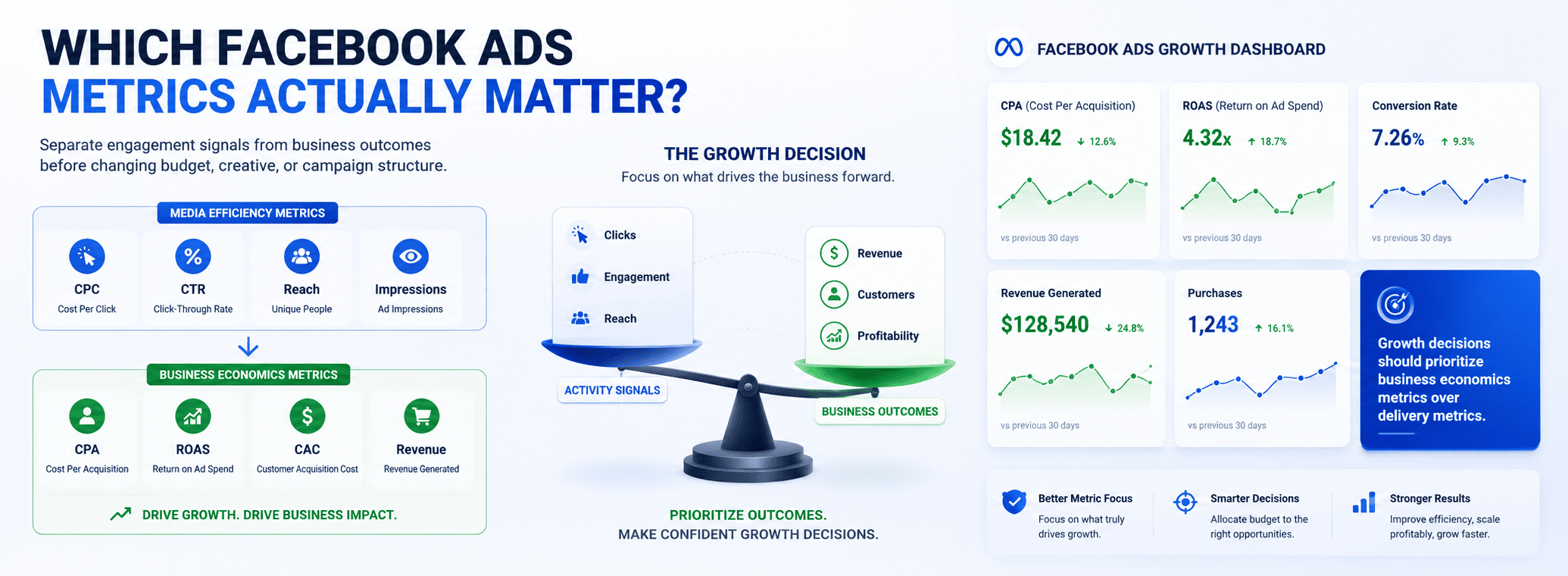
Separate media efficiency metrics from business economics metrics before deciding whether Facebook Ads performance supports a spend, creative, or structure change.
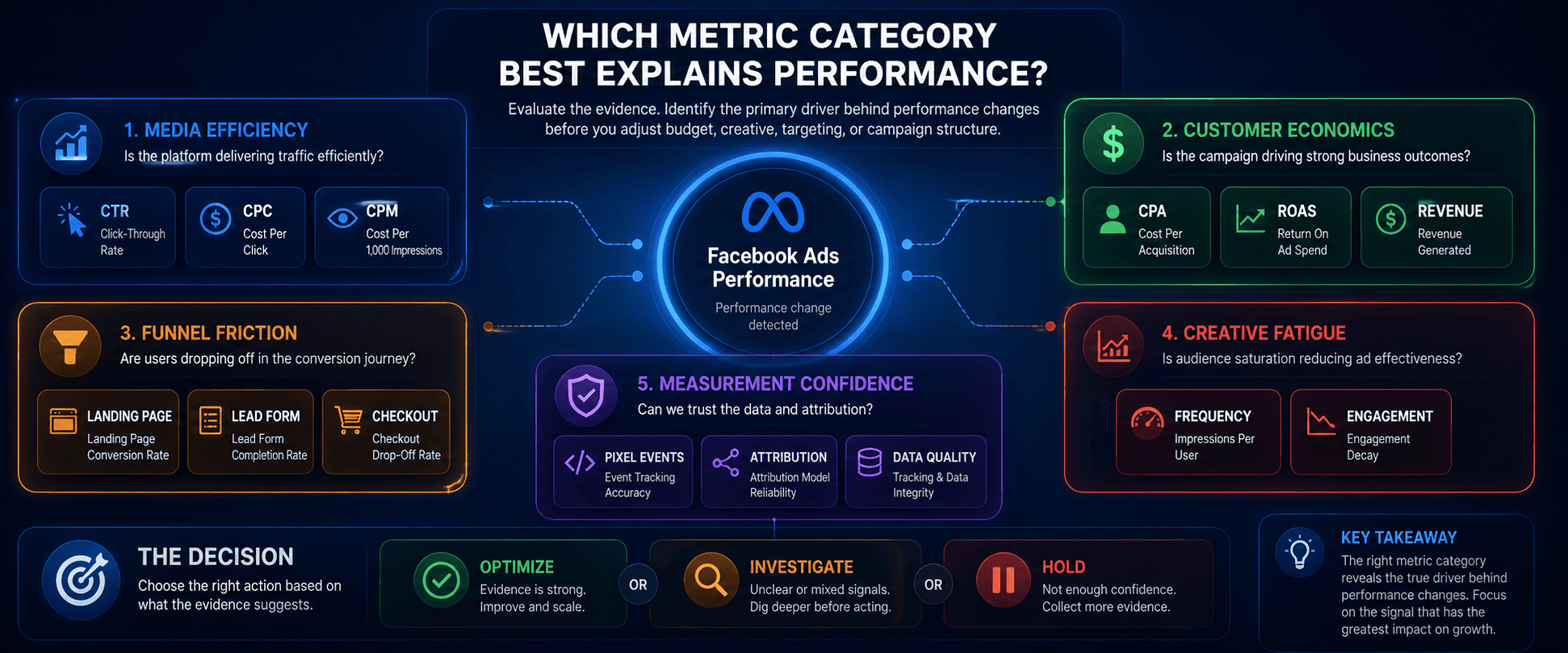
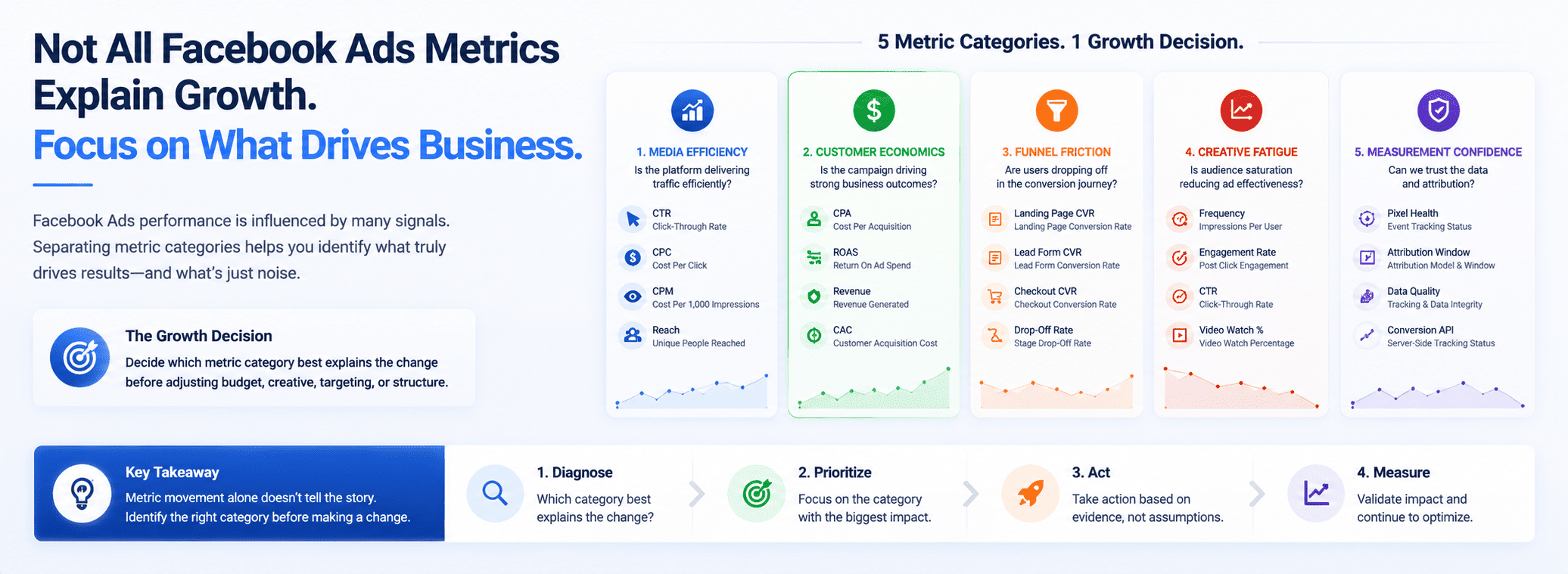
Decide whether Facebook ads metrics point to media efficiency, customer economics, funnel friction, fatigue, or measurement confidence.
Three steps to a confident decision
Understand which business situation this page was built for and confirm it matches your current context.
Go item by item — each check has a clear pass/hold condition so you know exactly what qualifies.
Use the growth decision statement and analyst questions to brief your team and move forward with confidence.
Which Facebook Ads Metrics Matter for Growth Analysis?
Decide whether Facebook ads metrics point to media efficiency, customer economics, funnel friction, fatigue, or measurement confidence.
What this page helps a team decide
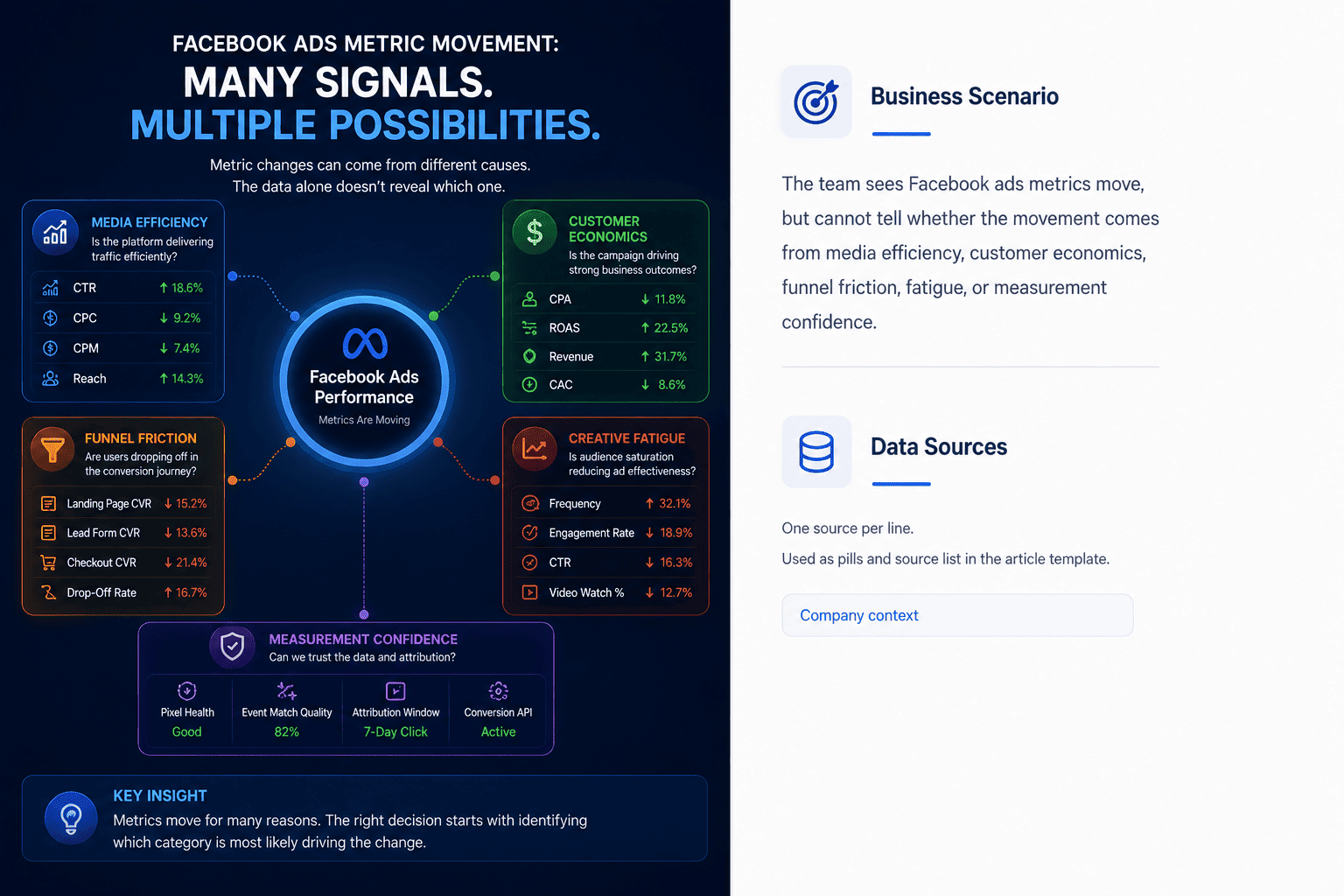
The team sees Facebook ads metrics move, but cannot tell whether the movement comes from media efficiency, customer economics, funnel friction, fatigue, or measurement confidence.
- company context
What analysts ask before deciding
What decision is the paid media lead trying to make for which facebook ads metrics matter for growth ?: approve, hold, or send back for evidence?
Which input would make the marketer trust the which facebook ads metrics matter for growth ? read enough to change the campaign, budget, or creative decision?
What caveat should stay visible before the team changes the campaign, budget, or creative decision?
Who owns the next action if the review is approved, and what stays on hold if it is not?
What usually goes wrong
- The growth question is treated as generic content instead of a growth decision.
- The recommendation skips the source caveat, so the next step looks safer than the evidence allows.
- Follow-up moves forward before the reviewer accepts the approval rule.
What 10x.in checks
- Connect ad cost and creative promise to the post-click path before blaming the campaign.
- Separate decision-driving conversions from diagnostic events and caveated attribution signals.
- Connect campaign or funnel movement with commerce and payment context before judging quality.
- Check whether budget pressure is caused by volume, quality, bid constraints, or a missing business context source.
- Separate platform efficiency from business economics before recommending spend movement.
- Identify which constraint changed before treating the drop as a creative, budget, or account problem.
OpenAnalyst should review Which Facebook Ads Metrics Matter for Growth Analysis?, compare the decision evidence with the caveats, and keep the next recommendation approval-gated until the reviewer accepts it.
FAQ
Which single metric matters most for Facebook Ads growth analysis?
No single metric drives all decisions. Budget decisions require economics metrics. Creative decisions require efficiency and fatigue metrics. Structure decisions require measurement confidence. The right metric depends on the decision being made. If forced to choose one prerequisite: measurement confidence — because all other metrics are only useful when the measurement is trustworthy.
How do I know if my metrics are trustworthy?
Compare Meta-reported conversions with your downstream source of truth (Shopify orders, CRM leads, Stripe payments). If discrepancy is under 20%, the measurement is directionally reliable. If over 30%, investigate before making decisions. Check UTM survival, pixel firing, and CAPI deduplication as common failure points.
When should I stop looking at metrics and start investigating?
When metrics disagree with each other (high ROAS but declining revenue), when the team cannot explain a change, or when a metric moved but no campaign change happened. Contradictory or unexplained signals indicate either a measurement problem or an external factor — both require investigation before action.
Can I make budget decisions based on CPA alone?
Only if CPA is connected to margin. A $50 CPA is great for a product with $200 margin and terrible for a product with $60 margin. CPA without margin context is a media efficiency metric, not a business decision metric. Always check: "Can the business sustain this acquisition cost given actual unit economics?"
Which Facebook Ads Metrics Matter for Growth Analysis?
Growth teams often review Facebook Ads performance using dozens of available metrics, but not every metric deserves equal weight when making decisions about budget allocation, creative direction, audience targeting, or campaign structure. A common mistake is treating platform efficiency metrics and business outcome metrics as if they provide the same level of insight. While Facebook Ads can generate impressive click-through rates, low costs, or strong engagement numbers, these indicators alone do not prove that a campaign is contributing to sustainable business growth. The most valuable growth analysis begins by separating metrics that describe advertising activity from metrics that demonstrate measurable business impact.
Why Metric Selection Matters
Facebook Ads reports contain hundreds of performance indicators. Without a clear framework, teams can easily optimize for numbers that look positive but fail to improve revenue, lead quality, customer acquisition efficiency, or profitability. Growth analysis is not about finding the highest-performing metric. It is about identifying which metrics best explain whether advertising investment is creating meaningful business outcomes. The right metrics help decision-makers understand if additional spending should be approved, if creative strategy requires adjustment, or if audience targeting is attracting the wrong type of user.
Media Efficiency Metrics
Media efficiency metrics measure how effectively Facebook delivers advertisements to the target audience. These metrics help teams understand platform performance but should rarely be treated as final indicators of success. Common examples include impressions, reach, frequency, click-through rate, cost per click, and engagement rate. These measurements provide visibility into campaign delivery and user interaction but do not confirm whether business objectives are being achieved.
For example, a campaign may generate a high click-through rate because the creative is highly engaging. However, if those clicks fail to produce qualified leads, purchases, or revenue, the metric becomes less useful from a growth perspective. Media efficiency metrics are valuable diagnostic tools, but they should support decision-making rather than drive it.
Business Economics Metrics
Business economics metrics connect advertising activity to measurable business outcomes. These are the metrics that growth teams should prioritize when evaluating long-term campaign performance. Examples include cost per acquisition, customer acquisition cost, return on ad spend, revenue generated, lead-to-customer conversion rate, pipeline contribution, customer lifetime value, and payback period.
These metrics answer questions that directly impact business decisions. Can the campaign scale profitably? Is customer acquisition sustainable? Does additional spend create incremental revenue? Business economics metrics provide stronger evidence because they reflect outcomes rather than engagement signals.
The Most Important Facebook Ads Metrics for Growth Analysis
Cost Per Acquisition (CPA)
Cost per acquisition measures how much advertising spend is required to generate a desired outcome. Depending on the business model, this outcome may be a purchase, qualified lead, booked consultation, trial signup, or subscription. CPA helps teams understand acquisition efficiency and compare campaign performance across audiences, creatives, and time periods.
A lower CPA is not automatically better. Growth teams must evaluate CPA relative to customer value and profitability. A campaign with a higher CPA may still outperform alternatives if it attracts higher-value customers or generates stronger retention outcomes.
Return on Ad Spend (ROAS)
ROAS measures revenue generated for every unit of advertising spend. This metric is frequently used to evaluate advertising efficiency because it directly connects investment and revenue generation. However, ROAS should not be viewed in isolation. Businesses with recurring revenue models, long sales cycles, or complex attribution paths may require additional context before making scaling decisions.
Strong ROAS can justify additional investment, while declining ROAS may indicate creative fatigue, audience saturation, increased competition, or changing market conditions.
Conversion Rate
Conversion rate measures the percentage of users who complete a desired action after clicking an advertisement. This metric helps identify whether traffic quality aligns with landing page experience and offer relevance. A campaign may generate low-cost traffic, but if conversion rates remain weak, the underlying issue may exist beyond the advertising platform.
Growth teams often analyze conversion rates alongside audience segments, device categories, landing pages, and creative variations to identify performance bottlenecks.
Customer Acquisition Cost (CAC)
CAC extends beyond platform reporting by incorporating broader acquisition expenses. While CPA focuses on campaign-level outcomes, CAC provides a more comprehensive view of customer acquisition economics. This metric is especially important when evaluating long-term growth sustainability.
If CAC continues to increase while customer value remains unchanged, scaling efforts may become less efficient. Monitoring CAC helps organizations maintain profitability while expanding acquisition volume.
Lead Quality Metrics
Lead generation campaigns often produce large volumes of submissions that never convert into revenue. For this reason, lead quality metrics are essential. Growth teams should evaluate qualified lead rates, sales acceptance rates, meeting booking rates, pipeline contribution, and customer conversion rates rather than relying solely on cost per lead.
A campaign generating fewer leads may outperform another campaign if those leads consistently move through the sales process and generate revenue.
Metrics That Can Be Misleading
Click-Through Rate (CTR)
CTR measures how frequently users click advertisements after viewing them. Although CTR can indicate creative relevance and audience engagement, it does not guarantee business value. High CTR campaigns sometimes attract curiosity clicks rather than purchase intent.
Cost Per Click (CPC)
Low CPC often appears positive, but inexpensive clicks have limited value if they fail to convert. Teams should evaluate CPC as a delivery metric rather than a growth metric.
Reach and Impressions
Reach and impressions help explain campaign exposure, but visibility alone does not produce revenue. These metrics are useful for diagnosing delivery issues and audience saturation but should not determine growth decisions independently.
Engagement Metrics
Likes, comments, shares, and reactions can signal audience interest, yet they rarely provide sufficient evidence for budget allocation decisions. Engagement metrics should be considered supporting indicators rather than primary growth metrics.
A Practical Framework for Metric Prioritization
Growth teams can simplify Facebook Ads analysis by organizing metrics into three layers. The first layer includes delivery metrics such as impressions, reach, frequency, and CPC. The second layer includes behavioral metrics such as CTR, landing page engagement, and conversion rate. The third layer includes business metrics such as CPA, ROAS, CAC, revenue contribution, and customer value. Decision-making should prioritize the third layer while using the first two layers to diagnose performance drivers.
This framework prevents teams from overreacting to surface-level performance changes and encourages evidence-based optimization. When evaluating whether to increase budget, launch new creative, expand targeting, or restructure campaigns, the most reliable answers come from business economics metrics rather than engagement indicators.
Making Better Growth Decisions
The most important Facebook Ads metrics are the ones that connect advertising activity to measurable business outcomes. While media efficiency metrics provide valuable context, they should not outweigh evidence related to revenue, acquisition efficiency, lead quality, or customer value. Effective growth analysis separates platform performance from business performance and evaluates both through a structured framework. By focusing on metrics such as CPA, ROAS, CAC, conversion rate, and revenue contribution, organizations can make more confident decisions about scaling campaigns, improving efficiency, and allocating marketing resources where they create the greatest impact.