Why a Facebook Ads performance memo matters
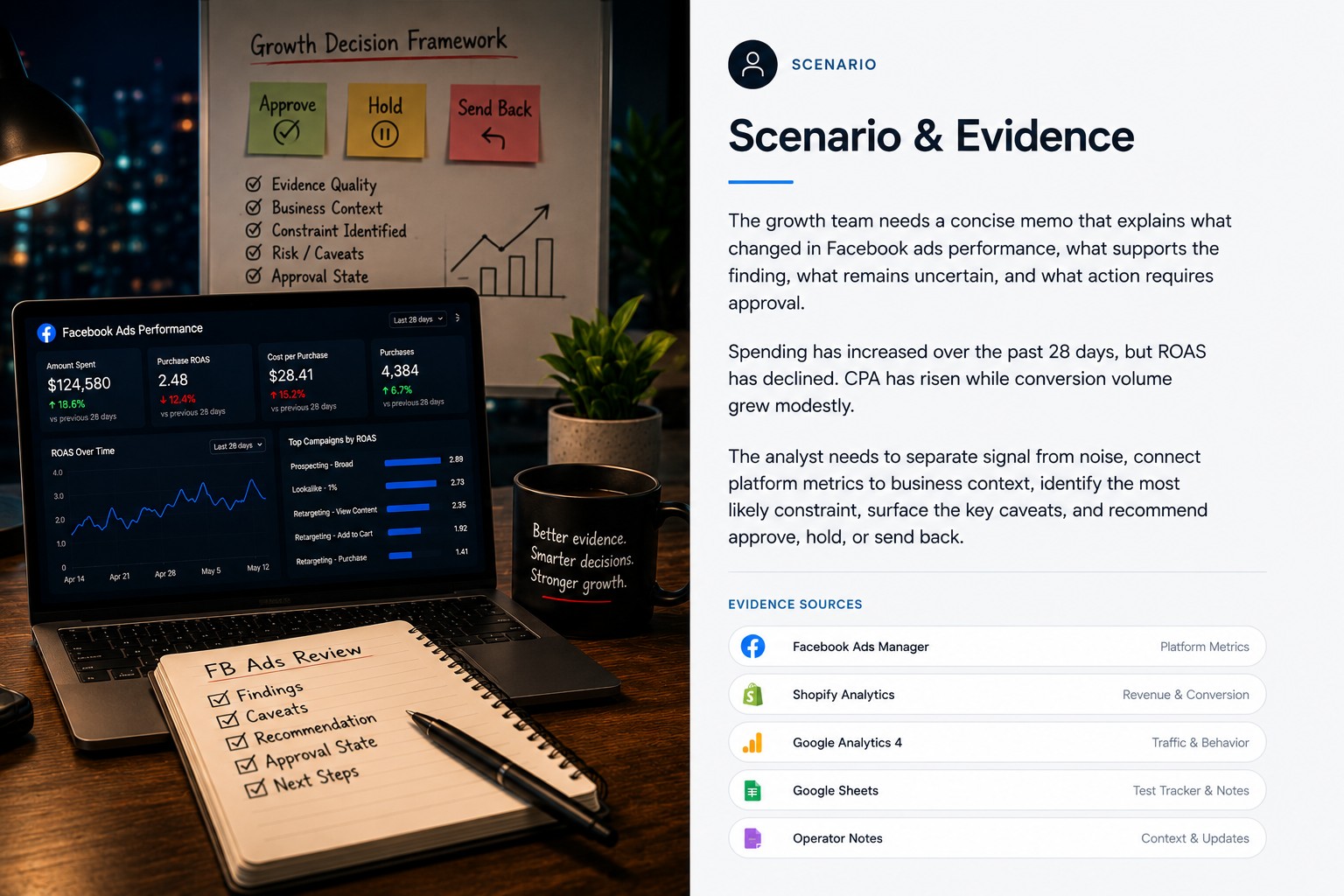
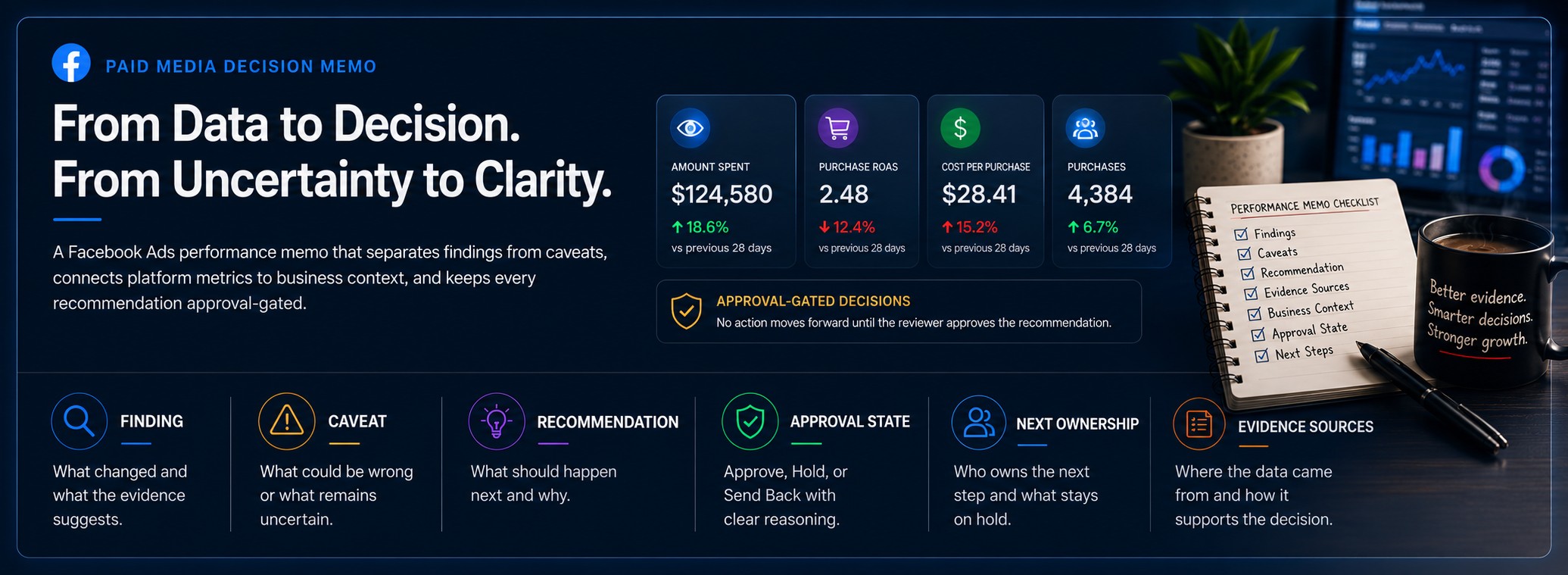
A Facebook Ads performance review should not end with a dashboard screenshot, a ROAS number, or a vague statement like “performance dropped this week.” The useful output is a decision memo that explains what changed, what evidence supports the interpretation, what remains uncertain, and what should happen next.
The purpose of the memo is not reporting. The purpose is decision quality.
Most paid media mistakes happen because teams move from observation to action too quickly. Cost per acquisition rises, so budgets get cut. CTR improves, so spend increases. Creative fatigue appears, so the team replaces ads immediately. These actions may feel responsive, but without context they often solve the wrong problem.
A performance memo slows the decision down just enough to separate evidence from assumption. It forces the analyst to explain:
- What actually changed
- What likely caused the change
- What remains uncertain
- What action should or should not happen next
This matters because Facebook Ads performance exists inside a larger system. Platform metrics can improve while business economics worsen. Conversion rates can fall because of landing page friction rather than media quality. A campaign can appear weak because tracking is broken rather than because demand disappeared.
The memo protects the organization from making expensive decisions based on incomplete interpretations.
The role of the performance memo
A dashboard describes what happened. A performance memo explains what it means.
This difference is critical.
A dashboard might show:
- CPA increased 28%
- CTR improved 11%
- Frequency increased from 2.1 to 3.8
- ROAS declined
Those metrics are useful, but they are not decisions. The memo converts those observations into operational judgment.
For example:
CPA increased after scaling spend into broader audiences, but CTR improvement suggests creative engagement is still healthy. The current evidence points more strongly toward audience quality degradation than creative fatigue. Hold further budget increases until landing page quality and audience overlap are reviewed.
That statement is more valuable than raw reporting because it:
- interprets the signal
- separates evidence from uncertainty
- explains the likely constraint
- prevents premature action
What the memo should answer
A useful Facebook Ads performance memo should answer four core questions.
1. What decision is the team trying to make?
The analyst must identify the actual decision under review. Examples include:
- Should spend increase?
- Should the campaign pause?
- Should creative be replaced?
- Should audience targeting change?
- Should the offer be revised?
Without a decision target, the memo becomes generic commentary.
2. What evidence supports the interpretation?
The memo should identify which signals support the current read. Evidence may include:
- Meta Ads Manager metrics
- creative-level engagement patterns
- landing page behavior
- Shopify or CRM revenue movement
- sales feedback
- attribution comparisons
The goal is not to collect more numbers. The goal is to determine whether the interpretation is reliable enough for action.
3. What caveat remains unresolved?
Every performance interpretation contains uncertainty. The memo should make that uncertainty visible instead of hiding it.
For example:
Meta reports stable ROAS, but Shopify revenue declined 18%. The discrepancy may reflect attribution lag or tracking error. Budget expansion should remain paused until the discrepancy is explained.
The caveat changes the safety of the recommendation.
4. Who owns the next action?
A decision memo should always end with operational ownership.
Someone must own:
- the investigation
- the revision
- the approval
- the implementation
Otherwise the memo becomes analysis without execution.
What evidence should be reviewed
Meta Ads Manager
Meta Ads Manager provides the visible advertising signals:
- CPM
- CTR
- CPC
- CPA
- frequency
- ROAS
- conversion volume
These metrics help identify where the performance movement occurred. However, platform metrics alone are not sufficient for business interpretation.
A high-performing ad account can still produce poor business outcomes if:
- lead quality declines
- margin structure changes
- retention weakens
- tracking breaks
- the offer becomes misaligned
Company context
Company context explains what the platform cannot.
For example:
- inventory issues
- pricing changes
- landing page edits
- sales process shifts
- fulfillment delays
- seasonality changes
Without business context, the analyst may incorrectly blame the campaign for a downstream operational issue.
Creative review
Creative should be reviewed separately from targeting and economics.
A weak creative interpretation usually happens when teams confuse:
- fatigue
- audience saturation
- poor offer fit
- weak positioning
- landing page friction
The memo should identify which constraint actually changed before recommending creative replacement.
Separating findings from caveats
The strongest performance memos clearly separate findings from caveats.
Finding
The finding describes what the analyst currently believes is true based on the evidence.
Example:
CTR and hook retention improved across the newest creative batch, suggesting the current audience still responds to the messaging angle.
Caveat
The caveat explains what could invalidate the interpretation.
Despite improved engagement, conversion efficiency declined after click-through. The issue may exist on the landing page or inside offer alignment rather than inside ad creative.
The caveat protects the team from false confidence.
Most bad growth decisions happen because caveats disappear during reporting.
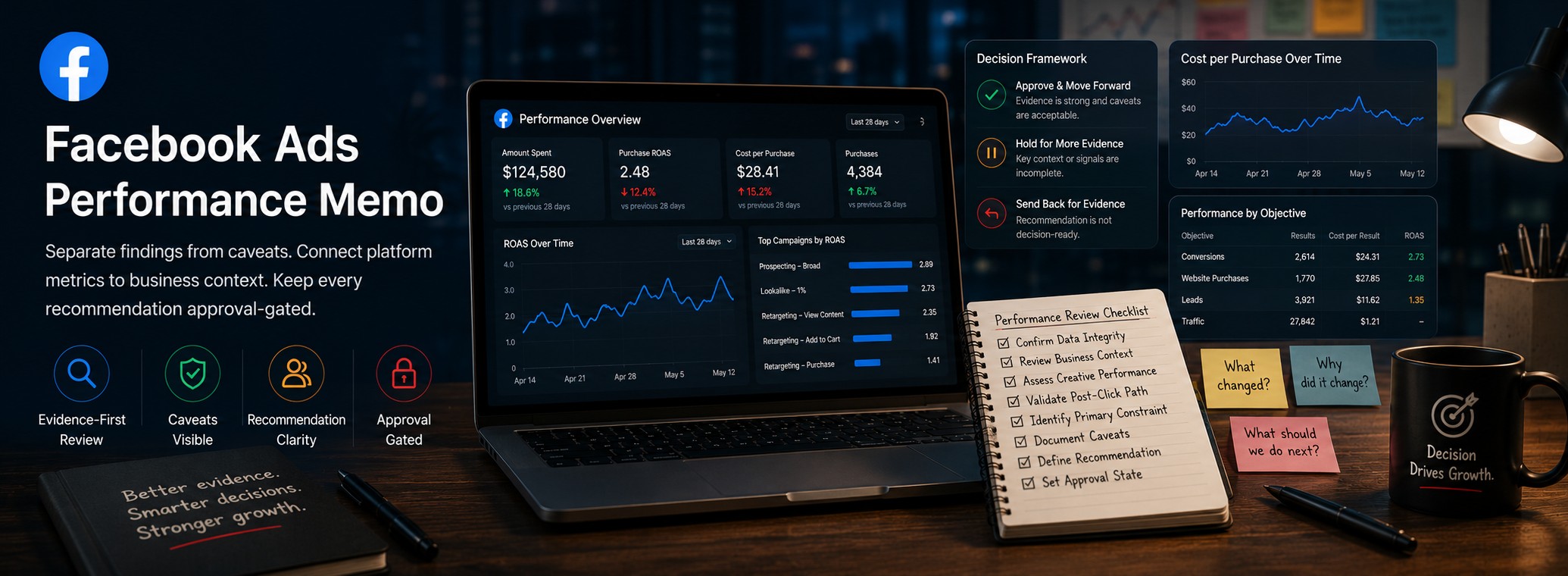
Approval states
The memo should conclude with a clear approval state.
Approved
Use this when evidence is strong enough to support action.
Example:
Approved: Increase spend gradually on the new creative set while monitoring frequency and conversion quality.
Held
Use this when the interpretation is plausible but not yet reliable enough for action.
Held: Attribution discrepancies between Meta and Shopify remain unresolved. Do not scale spend until tracking quality is confirmed.
Sent back for evidence
Use this when the recommendation lacks sufficient support.
Sent back: Creative fatigue has been assumed but not isolated. Additional testing is required before replacing the current campaign structure.
Common performance memo mistakes
Treating the memo as generic content
A memo is not a blog post. It should exist to support a decision.
Weak memos summarize metrics without identifying:
- the actual constraint
- the uncertainty
- the decision impact
Skipping the caveat
Many reports contain recommendations without visible risk discussion.
This creates false confidence.
For example:
Increase budget 40% next week.
That statement becomes dangerous when the analyst has not addressed:
- tracking reliability
- audience saturation
- landing page quality
- profit margins
- sales conversion quality
Confusing platform efficiency with business performance
Meta performance can improve while overall business economics worsen.
Examples include:
- higher refund rates
- lower lead quality
- weaker customer retention
- reduced average order value
The memo should separate advertising efficiency from business profitability.
How to evaluate creative correctly
Creative reviews often fail because teams interpret emotional reactions instead of decision signals.
The memo should evaluate:
- whether the hook attracts the correct audience
- whether the promise matches the landing page
- whether the buyer belief is clear
- whether the creative isolates one variable at a time
A good creative test isolates one meaningful decision variable.
For example:
- hook angle
- offer framing
- pain point emphasis
- social proof structure
When multiple variables change simultaneously, the interpretation becomes unreliable.
How to identify the real constraint
The most important question inside a performance memo is:
What actually changed?
The analyst should determine whether the constraint exists inside:
- creative
- audience quality
- economics
- offer fit
- tracking
- landing page conversion
- scale pressure
- account structure
Without identifying the real constraint, optimization becomes random activity.
Example Facebook Ads performance memo
Finding
Recent creative variants improved CTR and lowered CPC, suggesting the new messaging angle increased audience engagement.
Caveat
Despite stronger engagement, Shopify conversion rates declined after click-through. The issue may reflect landing page mismatch or lower traffic quality rather than creative strength.
Recommendation
Hold further budget expansion until landing page performance and attribution consistency are reviewed. Continue running the strongest creative variant at current spend levels while testing post-click alignment.
Approval state
Held pending evidence review.
When should performance memos be written?
Performance memos should not exist on a fixed schedule. They should exist when a decision is about to happen.
Good triggers include:
- budget increases
- creative replacements
- campaign pauses
- major performance shifts
- test conclusions
- attribution discrepancies
The goal is operational clarity, not reporting frequency.
Final field note
OpenAnalyst should review the Facebook Ads Performance Memo, compare the evidence against the caveats, and keep recommendations approval-gated until the reviewer accepts the operational risk.