Facebook Ads Analysis for Growth Teams
Decide whether Facebook ads performance is limited by account setup, budget pacing, creative testing, message fatigue, landing page friction, unit economics, or measurement quality before changing spend.
Decide whether Facebook ads performance is limited by account setup, budget pacing, creative testing, message fatigue, landing page friction, unit economics, or measurement quality before changing spend.

Three steps to a confident decision
Understand which business situation this page was built for and confirm it matches your current context.
Go item by item — each check has a clear pass/hold condition so you know exactly what qualifies.
Use the growth decision statement and analyst questions to brief your team and move forward with confidence.

Facebook Ads Analysis for Growth Teams
Decide whether Facebook ads performance is limited by account setup, budget pacing, creative testing, message fatigue, landing page friction, unit economics, or measurement quality before changing spend.
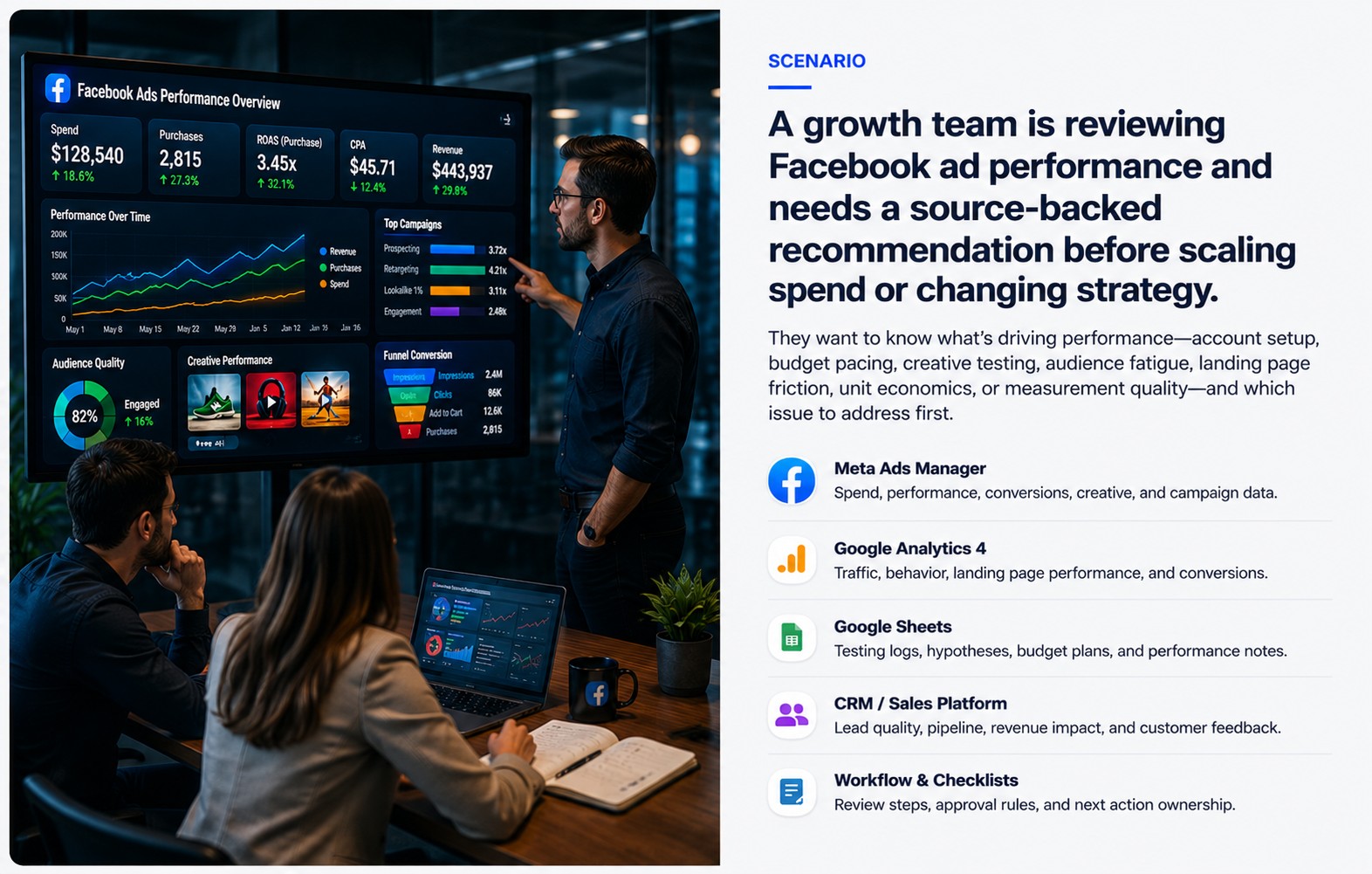
What this page helps a team decide
Decide whether Facebook ads performance is limited by account setup, budget pacing, creative testing, message fatigue, landing page friction, unit economics, or measurement quality before changing spend.
- Related reports and decision memos
- Workflow and checklist pages
- Connected marketing evidence
What analysts ask before deciding
What decision should the marketer make first for facebook ads analysis: approve, hold, or investigate?
Which connected source would make the facebook ads analysis recommendation trustworthy enough to change the next marketing action?
What caveat should stay visible before spend, content, reporting, or workflow changes?
Who owns the next approved action, and what stays on hold if evidence is incomplete?
What usually goes wrong
- The marketer treats facebook ads analysis as a channel tactic before checking which source should drive the decision.
- The team changes spend, page, workflow, or reporting language before the evidence owner has accepted the caveat.
What 10x.in checks
- OpenAnalyst compares the hub's reports, workflows, and checklists to find the strongest decision input.
- OpenAnalyst keeps the approval caveat attached to the recommendation until the marketer can name the owner and next action.
Review facebook ads analysis signals, name the caveat, and draft one recommendation the marketer can approve, hold, or assign.
FAQ
What should the reviewer approve after the checklist?
For Facebook Ads Analysis for Growth Teams, the reviewer should approve only the next step tied to evidence coverage. If the required evidence for evidence coverage is not visible, the output should be a hold note.
Can OpenAnalyst make the change automatically?
No. For Facebook Ads Analysis for Growth Teams, OpenAnalyst can draft the recommendation or follow-up, but execution stays approval-gated.

Define What The Facebook Ads Analysis Decides
Facebook ads performance can decline for multiple reasons simultaneously. Weak results are not always caused by creative quality or budget size. The real constraint is frequently connected to account setup, measurement quality, audience fatigue, landing page friction, conversion tracking gaps, or unclear unit economics.
The Facebook Ads Analysis helps growth teams separate visible performance signals from operational assumptions before changing spend, creative direction, campaign structure, or reporting logic. The output is a source-backed recommendation the reviewer can approve, hold, or send back for investigation.
- Define the growth decision before reviewing campaign performance.
- Identify which connected signal should drive the next action.
- Separate platform metrics from business health signals.
- Assign ownership for the next approved marketing step.
- Document the hold condition if evidence is incomplete.
A decision to change spend or campaign structure should not be driven by surface-level platform metrics alone. It should be driven by evidence that the underlying account setup, audience positioning, conversion flow, and unit economics can support the next action.
Evaluate Account Setup Quality Before Interpreting Performance
Facebook Ads account structure determines whether optimization signals and reporting outputs are accurate enough to support a growth recommendation. Campaign naming conventions, conversion event mapping, attribution settings, audience exclusions, and pixel configuration should all be verified before performance conclusions are drawn.
Weak account structure creates misleading signals even when ads appear profitable on the surface. An account that reports strong ROAS through misconfigured attribution or incomplete conversion tracking may produce confident-looking data that collapses under closer examination.
- Verify campaign naming structure supports accurate reporting.
- Confirm conversion event mapping reflects actual business outcomes.
- Review attribution settings for alignment with the customer journey.
- Validate audience exclusion logic and overlap management.
- Document account structure gaps before approving performance conclusions.
Account setup should be confirmed before the team interprets campaign performance as evidence for a growth decision. An unstable account foundation makes every downstream metric unreliable.
Review Budget Pacing And Spend Efficiency
Budget pacing determines whether spend allocation matches campaign intent and funnel maturity. Growth teams frequently increase spend before confirming whether the current audience, offer, or creative has stabilized. Scaling budget into unstable campaigns amplifies existing weaknesses rather than producing more results.
The analysis evaluates whether current spend levels are supported by validated performance. Budget pacing should follow evidence rather than leading it. When spend allocation races ahead of confirmed audience response and conversion stability, the efficiency conclusions become unreliable.
- Confirm spend allocation matches campaign maturity and intent.
- Evaluate whether budget scaling is supported by stable performance.
- Review pacing against audience fatigue and saturation signals.
- Identify spend inflation that conceals declining efficiency.
- Document pacing caveats before approving additional budget.
Budget should be treated as a lever that amplifies validated performance rather than a mechanism for forcing scale onto unstable campaigns. Spending more on a weak campaign produces larger losses, not better results.
Assess Creative Testing Coverage
Facebook ads performance frequently declines because creative variation stops evolving. When the creative system produces similar ads repeatedly, audience fatigue can appear even when targeting remains unchanged. The review evaluates whether the team is testing new hooks, offers, visual structures, messaging angles, and buyer objections at a cadence that stays ahead of audience saturation.
Creative testing should be treated as a continuous process rather than a one-time setup decision. A campaign that launched with strong creative can deteriorate as the audience encounters the same message repeatedly without variation.
- Review whether the team tests new hooks and messaging angles regularly.
- Evaluate creative variation against audience fatigue trends.
- Confirm testing cadence stays ahead of saturation signals.
- Identify creative gaps that could explain declining engagement.
- Document testing coverage before approving creative direction changes.
Creative testing coverage should be confirmed before the team attributes declining performance to audience exhaustion or targeting issues. A weak creative system can make otherwise functional campaigns look like strategic problems.
Identify Message Fatigue And Audience Saturation
A campaign can continue spending efficiently while gradually losing message effectiveness. Frequency trends, engagement decline, click-through rate movement, and audience overlap should be reviewed together to determine whether weak performance is caused by fatigue, positioning, or reduced audience relevance.
Message fatigue looks different from audience exhaustion and requires different intervention. The analysis separates the two so the team applies the correct fix rather than making changes that fail to address the root cause.
- Review frequency trends against engagement decline patterns.
- Evaluate click-through rate movement across audience segments.
- Assess audience overlap for saturation risk.
- Distinguish message fatigue from positioning weakness.
- Document fatigue evidence before changing targeting or creative strategy.
When message fatigue is the constraint, refreshing creative makes sense. When audience saturation is the constraint, expanding targeting or adjusting audience definition makes sense. Treating both as the same problem leads to ineffective interventions.
Inspect Landing Page Friction
Strong ad performance cannot compensate for a weak landing experience. Page speed, offer clarity, trust signals, mobile responsiveness, checkout friction, and conversion flow consistency should all be reviewed before the team attributes weak conversion rates to campaign quality.
If users click but fail to convert, the issue may exist after the ad interaction rather than inside the campaign itself. The analysis inspects the full click-to-conversion path rather than stopping at the platform performance dashboard.
- Review landing page speed and mobile responsiveness.
- Confirm offer clarity and trust signal visibility.
- Evaluate checkout friction and conversion flow consistency.
- Identify landing page gaps that suppress conversion rates.
- Document friction evidence before approving campaign changes.
A campaign with strong click-through rates and weak conversion rates should trigger a landing page review before the team adjusts targeting, creative, or budget. The problem may not be the ads.
Analyze Unit Economics And CAC Efficiency
Customer acquisition cost, contribution margin, average order value, refund rate, payback period, and lifetime value assumptions should all be reviewed before the team increases spend. The recommendation should not focus only on platform ROAS. The growth decision should consider whether the business model can support additional acquisition volume profitably.
Platform metrics can report strong performance while unit economics deteriorate. A campaign that looks efficient inside Ads Manager may be unprofitable when full customer acquisition cost, fulfillment expense, and refund behavior are included in the calculation.
- Review customer acquisition cost against contribution margin.
- Evaluate average order value and payback period assumptions.
- Confirm refund rate does not undermine acquisition efficiency.
- Validate lifetime value projections against observed customer behavior.
- Document unit economic caveats before approving spend increases.
Spend should only increase when unit economics confirm that additional acquisition volume remains profitable. Platform ROAS alone does not answer the profitability question.
Confirm Measurement And Attribution Quality
The analysis evaluates whether Facebook Ads Manager, Google Analytics, CRM reporting, attribution models, and downstream revenue tracking agree closely enough to support a confident recommendation. When reporting systems produce conflicting signals, the team should hold the next action until measurement quality improves.
Measurement disagreement is itself a signal. When Ads Manager reports one conversion count and CRM reports another, the gap should be investigated before either number is used to justify a growth decision. Treating conflicting data as equally reliable produces recommendations that break under scrutiny.
- Compare Facebook Ads Manager data against Google Analytics.
- Validate CRM reporting aligns with platform conversion counts.
- Review attribution model consistency across reporting systems.
- Confirm downstream revenue tracking matches platform spend data.
- Document measurement gaps before approving decisions based on the data.
Measurement quality should be confirmed before the team changes spend, campaign structure, or reporting narratives. A recommendation built on conflicting data cannot survive the review process.
Keep Evidence Caveats Visible And Actions Approval-Gated
Facebook ads analysis should not become a generic reporting exercise. The review should identify the strongest decision signal, the visible caveat, and the owner responsible for the next approved action. Caveats around account setup, measurement quality, unit economics, and landing page friction should remain attached to the recommendation throughout the review process.
The reviewer should approve only one clear next action tied to the strongest available evidence. If the required evidence for account setup quality, measurement alignment, or unit economics is not visible, the output should be a hold note rather than a spend or campaign change approval.
- Assign an owner for the next approved marketing action.
- Document reviewer acceptance of the evidence and caveats.
- Track approval state before spend or campaign changes.
- Identify unresolved dependencies that could reverse the recommendation.
- Keep follow-up actions visible until evidence improves.
Approval gating protects teams from acting on Facebook Ads performance signals that appear complete but still contain unresolved assumptions about platform configuration, measurement quality, or business model sustainability.