Facebook Ads Account Signal Readiness Review
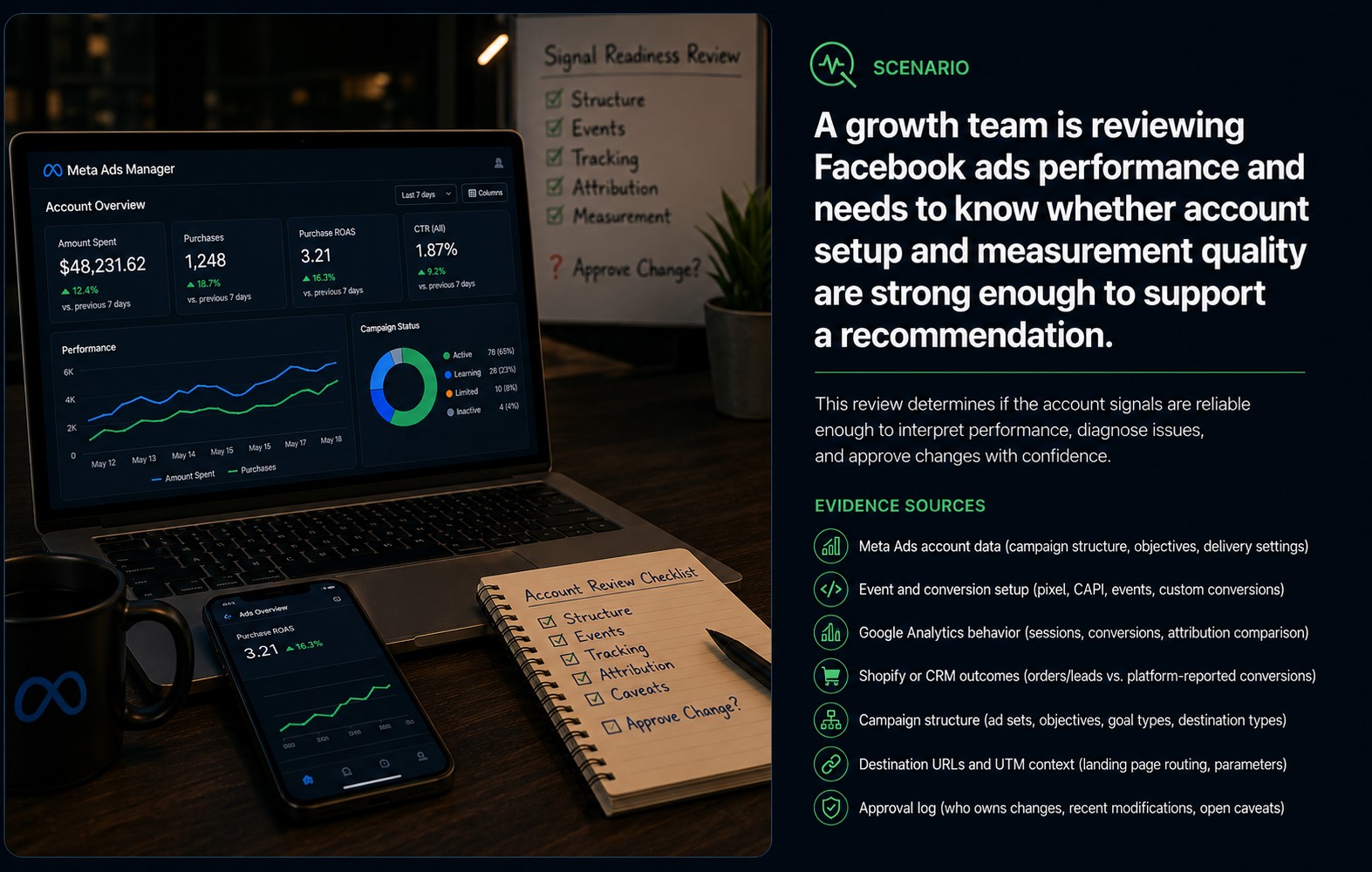
Facebook advertising performance is only as trustworthy as the account signals that support it. Before a growth team increases budgets, pauses campaigns, changes creative strategy, restructures ad sets, or makes optimization decisions, it must first determine whether the account structure, event configuration, attribution setup, and measurement systems are producing reliable information.
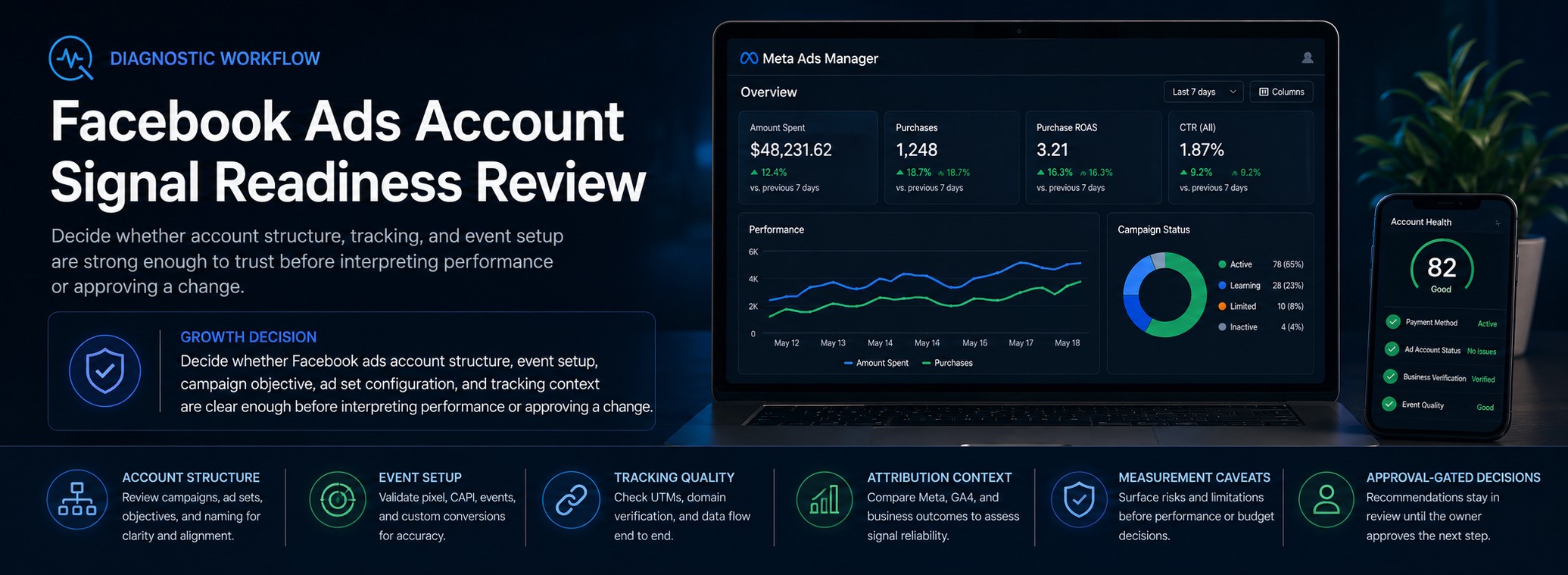
The Facebook Ads Account Signal Readiness Review is a diagnostic workflow designed to answer a simple but critical question: can the team trust the signals being used to evaluate performance?
Many advertisers assume poor results automatically indicate creative problems, audience targeting issues, budget inefficiencies, or bidding mistakes. In reality, a significant percentage of optimization decisions are made using incomplete, delayed, duplicated, or incorrectly attributed data. When this happens, teams risk making expensive account changes based on false conclusions.
This review helps marketers separate genuine performance problems from measurement problems before they take action.
Why Signal Readiness Matters
Meta's advertising system relies heavily on data signals. Every optimization recommendation, learning phase adjustment, audience expansion decision, and automated bidding action depends on signals collected through account structure, tracking events, conversion APIs, and attribution systems.
If those signals are weak or unreliable, the platform can still spend budget, deliver impressions, and report conversions. However, the resulting data may not accurately represent business performance.
Signal readiness exists to ensure that campaign performance is being interpreted through a trustworthy measurement framework.
Without signal readiness, teams often optimize toward metrics that appear healthy but do not correlate with actual business outcomes.
The Core Growth Decision
The purpose of this workflow is not to determine whether campaigns are performing well. Instead, it determines whether the account is capable of producing trustworthy evidence.
The reviewer must decide:
- Is the account structure clear enough to interpret?
- Are events firing correctly?
- Can conversion signals be trusted?
- Does campaign architecture support decision-making?
- Can performance changes be attributed to real marketing actions?
- Should optimization proceed, or should tracking issues be fixed first?
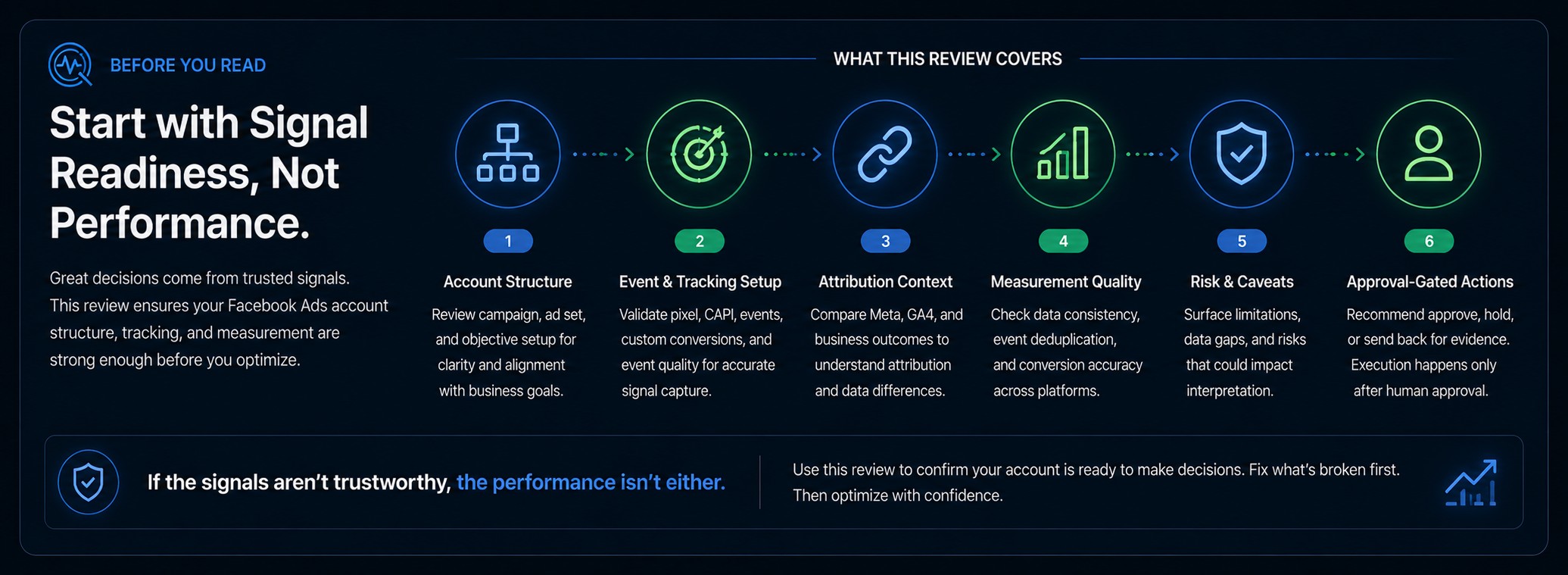
The answer to these questions determines whether the next recommendation should be approved, held, or sent back for additional evidence.
What Makes Facebook Signals Trustworthy?
Trustworthy Facebook advertising signals are accurate, consistent, explainable, and connected to business outcomes.
A healthy account should allow an analyst to understand exactly where conversions originate, how campaigns are structured, which audiences are being targeted, and how attribution is being calculated.
When account data becomes difficult to explain, optimization becomes dangerous.
The reviewer should be able to answer the following questions without guessing:
- Which campaigns drive results?
- Which audiences generate conversions?
- Which events are optimization targets?
- How are conversions measured?
- Which changes influenced performance movement?
- How do Facebook-reported outcomes compare to business outcomes?
Reviewing Account Structure
Account structure determines how easily performance can be interpreted. Poor account architecture often creates confusion because multiple variables change simultaneously.
A clean account structure makes optimization easier by separating campaigns according to objective, audience, offer, funnel stage, or business purpose.
The reviewer should assess whether campaigns are organized logically and whether each campaign has a clearly defined optimization goal.
Questions to Ask
- Do campaign objectives match business goals?
- Are ad sets segmented appropriately?
- Can performance be analyzed without extensive manual interpretation?
- Are naming conventions consistent?
- Are overlapping campaigns competing against each other?
- Are budget allocations aligned with priorities?
If the structure prevents accurate interpretation, the reviewer should recommend fixing architecture before optimizing performance.
Reviewing Campaign Objectives
Campaign objectives influence how Meta's algorithm delivers ads and prioritizes actions.
An account may appear healthy while optimizing toward the wrong objective.
For example, an account seeking purchases may still be running traffic campaigns. In that scenario, low purchase volume may not indicate creative failure. The problem may be that the campaign objective instructs Meta to optimize for clicks rather than purchases.
The reviewer should verify that campaign objectives align with business outcomes.
- Awareness campaigns should support reach goals.
- Traffic campaigns should support visit goals.
- Lead campaigns should support lead generation.
- Sales campaigns should support purchase outcomes.
- Engagement campaigns should support interaction goals.
If objectives are misaligned, performance interpretation becomes unreliable.
Evaluating Event Configuration
Events represent the foundation of Facebook signal quality.
Meta's algorithm uses event data to understand user behavior and improve delivery decisions.
If events are missing, duplicated, delayed, misconfigured, or assigned incorrectly, campaign optimization suffers.
The reviewer should inspect:
- Pixel implementation
- Conversion API configuration
- Purchase events
- Lead events
- Initiate Checkout events
- Add to Cart events
- Custom conversions
- Event prioritization
Each event should accurately represent a meaningful business action.
Pixel and Conversion API Validation
Modern Facebook advertising depends on both browser-side and server-side tracking.
Pixel-only implementations frequently experience data loss because of browser restrictions, privacy changes, and ad blockers.
Conversion API helps restore signal quality by sending event information directly from servers to Meta.
The reviewer should confirm:
- Pixel is firing correctly.
- Conversion API is active.
- Deduplication is functioning.
- Events match business actions.
- Server-side events mirror browser-side events.
- Event match quality is acceptable.
Without these checks, reported conversions may be incomplete or inflated.
Attribution Readiness Review
Attribution discrepancies create some of the most common Facebook optimization mistakes.
Different systems report different numbers because they use different attribution models.
Facebook may credit a conversion while Google Analytics does not. Google Analytics may show revenue that Facebook cannot see. Shopify may report numbers that differ from both systems.
This does not automatically indicate a tracking failure.
The reviewer must determine whether the differences fall within expected attribution behavior or whether a genuine measurement problem exists.
Comparing Facebook, GA4, and Business Outcomes
A signal readiness review should never rely on Facebook Ads Manager alone.
The reviewer should compare Facebook-reported outcomes against:
- Google Analytics sessions
- GA4 conversions
- Shopify purchases
- CRM opportunities
- Lead quality data
- Sales pipeline movement
- Customer acquisition metrics
When multiple systems tell a similar story, confidence increases. When systems disagree significantly, further investigation is required before optimization decisions are approved.
Common Signal Readiness Failure Modes
Failure Mode 1: Optimizing Before Measurement Is Stable
Teams frequently launch optimization initiatives while tracking remains unreliable.
This creates a situation where campaign changes and tracking fixes happen simultaneously. As a result, nobody knows which change influenced performance.
Failure Mode 2: Treating Diagnostic Events as Revenue Events
Many advertisers optimize toward events that are easy to generate rather than events that predict business value.
Page views, landing page visits, and content views may be useful diagnostics but should not automatically become optimization targets.
Failure Mode 3: Ignoring Attribution Caveats
Every measurement system contains limitations. Ignoring attribution caveats often leads teams to overreact to performance fluctuations that are actually measurement artifacts.
Failure Mode 4: Blaming Creative Too Early
Creative is often blamed before tracking quality is validated.
A weak reporting setup can make strong creative appear ineffective.
Decision Framework
The reviewer should categorize findings into three outcomes:
Approve
Signals are trustworthy. Tracking quality is acceptable. Optimization can proceed.
Hold
Critical measurement issues prevent confident interpretation. Fix tracking before making campaign changes.
Send Back for Evidence
Additional validation is required. The reviewer cannot determine whether performance issues stem from account structure, attribution, creative, audience quality, or business context.
Final Takeaway
Facebook Ads Account Signal Readiness Review exists to protect growth teams from making expensive decisions based on unreliable information. Before budgets are changed, campaigns are paused, audiences are expanded, or creative is replaced, the reviewer should first verify that account structure, event tracking, attribution systems, and business outcomes are aligned.
Strong signal readiness creates trustworthy optimization. Weak signal readiness creates false confidence.
OpenAnalyst should review Facebook Ads account structure, event quality, attribution context, and measurement caveats before recommending any optimization action. The final recommendation should remain approval-gated until the reviewer accepts the evidence and associated risks.