Offer Validation Readiness Checklist
Offer validation is a decision gate inside funnel conversion analysis. Before a team builds a full product, changes page copy, increases paid traffic, or launches a stronger experiment, the offer needs visible evidence that buyers understand it, care about it, and show behavior stronger than casual interest.
Many teams move too quickly after early traction. A page gets clicks, a campaign brings traffic, a few people reply positively, or a form receives submissions. Those signals may be useful, but they do not always prove demand. A weak offer can create curiosity without commitment, and a small test can make a risky idea look more validated than it is.
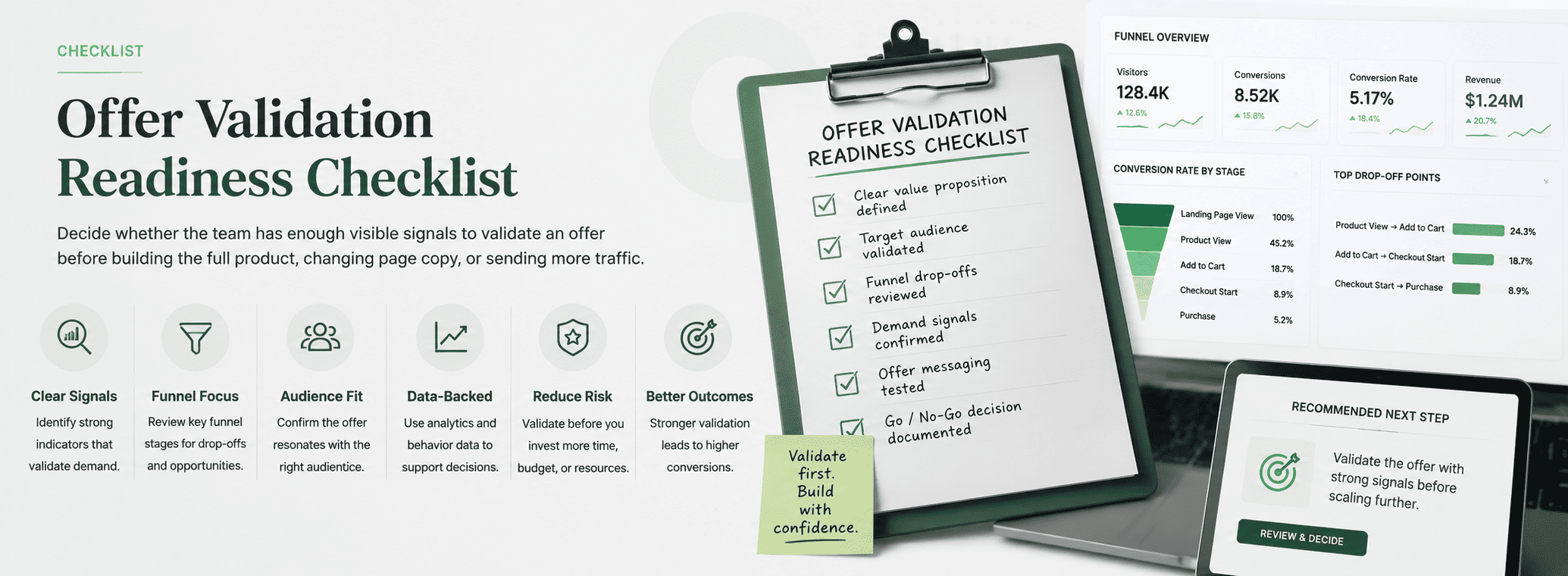
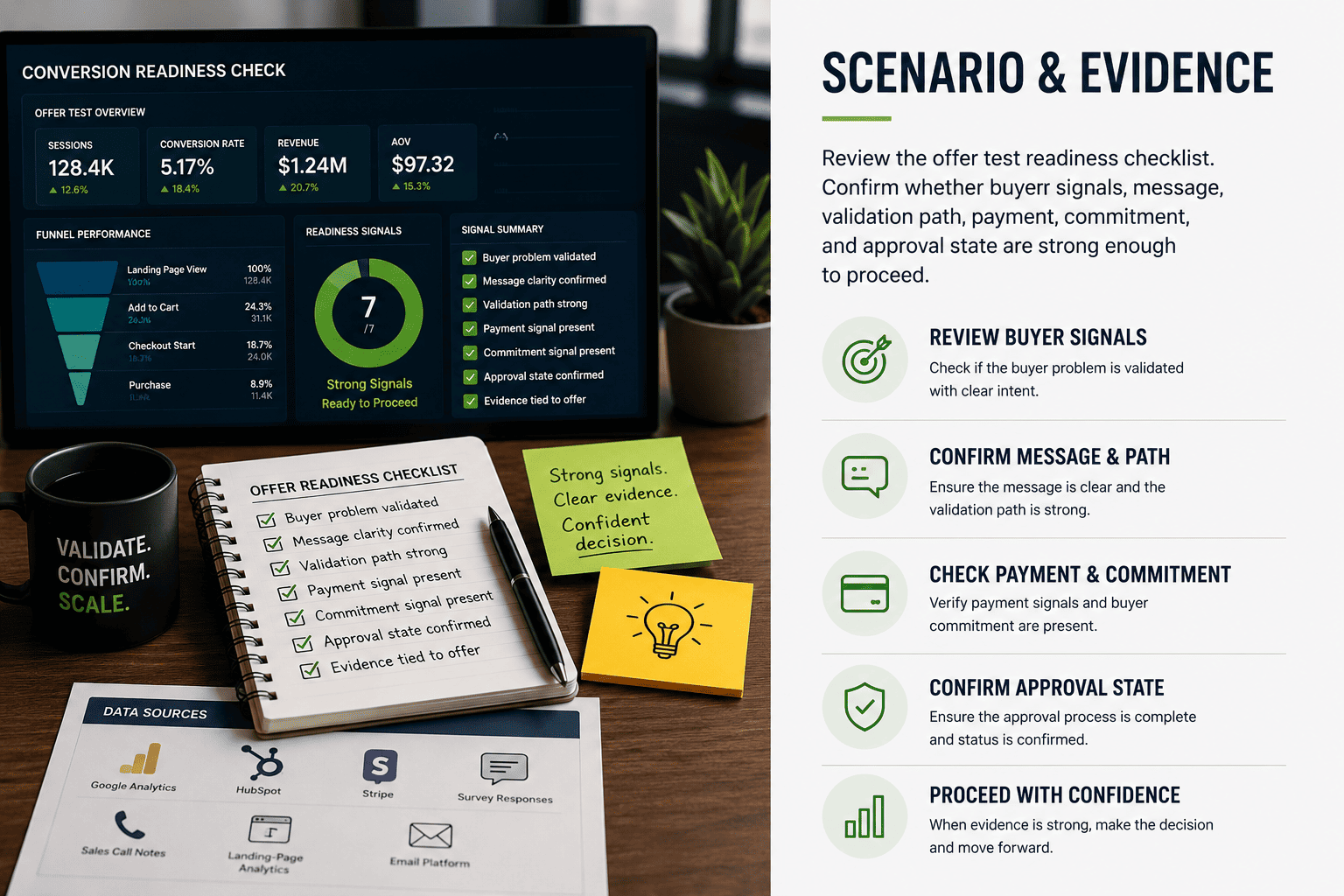
The Offer Validation Readiness Checklist helps the conversion lead decide whether the team should approve the next action, hold the recommendation, or send the test back for evidence. The review should connect buyer problem, message clarity, funnel movement, payment or commitment signals, and approval state before any larger growth action moves forward.
What This Checklist Decides
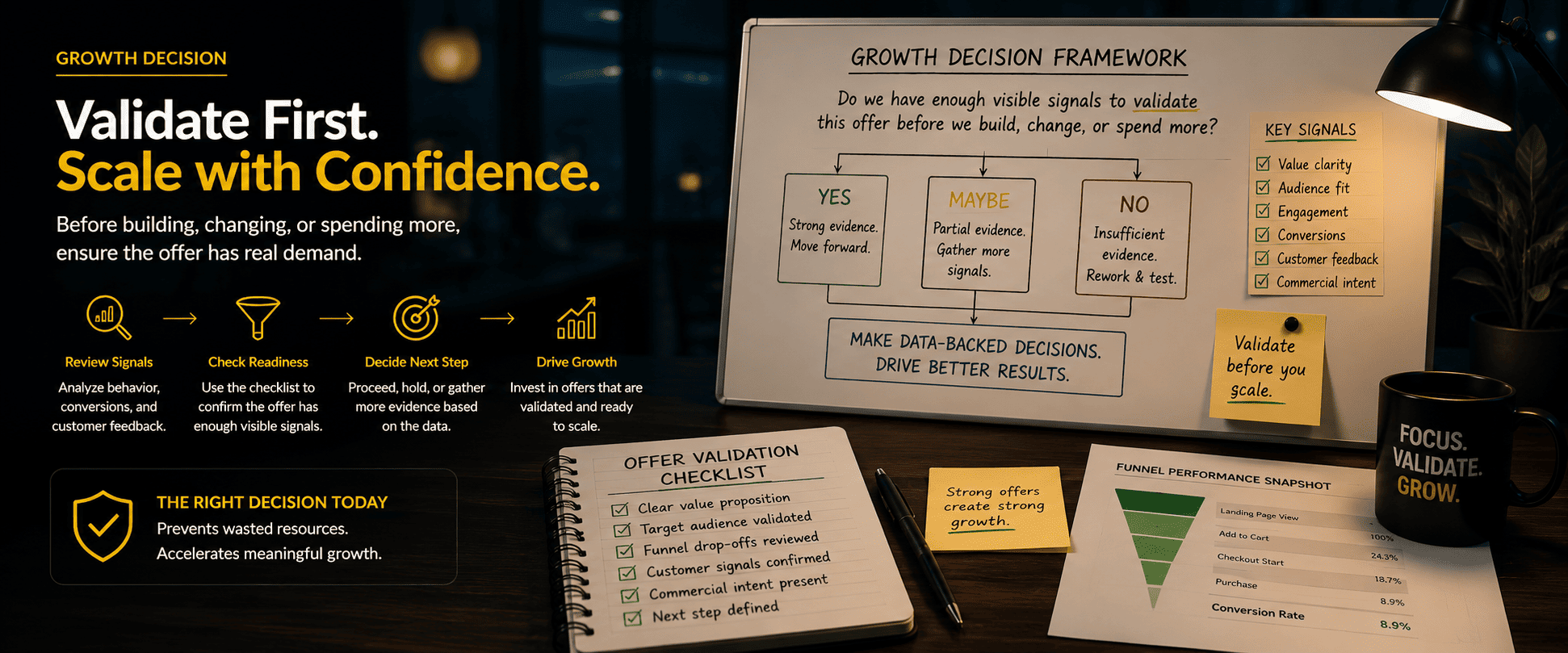
The checklist answers one practical question: does the team have enough visible signals to validate the offer before building, rewriting, or sending more traffic? A pass means the evidence shows real buyer behavior. A hold means the validation path is incomplete or too dependent on assumptions.
- Approve: The offer has clear problem fit, message readiness, funnel movement, and commitment evidence.
- Hold: Signals are promising, but the caveat could change the recommendation.
- Send back for evidence: The team needs stronger analytics, customer research, payment proof, or test data.
- Keep as scenario: The model depends on assumed numbers that have not been verified.
Check The Minimum Validation Signal Set
The first review area is whether the test has enough observable evidence to distinguish real demand from casual interest. Low-effort signals can be useful, but they should not be treated like proof of buyer commitment. A like, click, comment, or page visit may show attention. A booked call, checkout start, payment attempt, qualified lead, or repeated buyer question is a stronger signal.
- Does the test capture behavior that costs time, money, or attention?
- Is there a clear path from interest to commitment?
- Can the team tell who engaged and why?
- Does the signal connect to the page, offer, or experiment decision?
- Would the same evidence still matter if the team removed internal assumptions?
If the validation path cannot capture a commitment signal, the test should stay in planning mode.
Review Message Friction And Belief Gaps
An offer is not validated if buyers cannot understand what problem it solves or why it matters now. The message should build enough emotional and logical belief before asking for action. If the buyer has not been given proof, process clarity, price context, or next-step confidence, sending more traffic may only scale confusion.
- Is the promise clear?
- Does the page explain the problem and pain?
- Does the offer show proof or credibility?
- Is the process or next step easy to understand?
- Are price, effort, or risk concerns addressed?
- Does the CTA match the buyer’s readiness?
When message readiness is weak, the next recommendation should be a message or page review, not more traffic.
Separate Funnel Math From Assumptions
Offer validation often depends on scenario math: traffic units, stage conversion, offer value, expansion path, revenue timing, and confidence labels. Those numbers can be useful, but they must be separated from observed evidence. If the model is sensitive to an assumed conversion rate, order value, close rate, or payback window, the recommendation should remain a scenario until the source is verified.
- Which inputs are observed?
- Which inputs are assumed?
- Which number most changes the scenario?
- Is the time window long enough to trust the pattern?
- Does the confidence label match the strength of the evidence?
This prevents the team from turning optimistic math into an approved growth decision before the underlying source is strong enough.
Review Commerce And Revenue Quality
Revenue-informed analysis should distinguish sales activity from durable revenue quality. A test may generate payments, but the team still needs to review payment signal, cash timing, order quality, margin, refunds, and payback caveats before treating the offer as validated.
- Do Stripe or payment records confirm the revenue signal?
- Does HubSpot or CRM context show qualified buyer movement?
- Do orders, checkout starts, or payment attempts match the offer claim?
- Are margin, refund, or payback risks visible?
- Is the revenue signal durable or only a short-term spike?
If revenue quality or cash timing is missing, avoid turning source movement into a payback conclusion. The recommendation should stay caveated until commerce evidence is reviewed.
Separate Funnel Leaks From Operating Leaks
A weak validation result does not always mean the offer is weak. The problem may be operational. There may be no follow-up owner, no promotion, weak delivery, unclear lead flow, or missing customer-result feedback. The reviewer should separate a funnel leak from an operating leak before recommending a creative or offer change.
- Was the offer actually implemented as planned?
- Did leads receive timely follow-up?
- Was delivery quality visible?
- Was there an owner for the next step?
- Did customer-result feedback reach the reviewer?
If the operating owner or follow-up path is unclear, mark the recommendation as a process fix before a creative fix.
Evidence Sources To Review
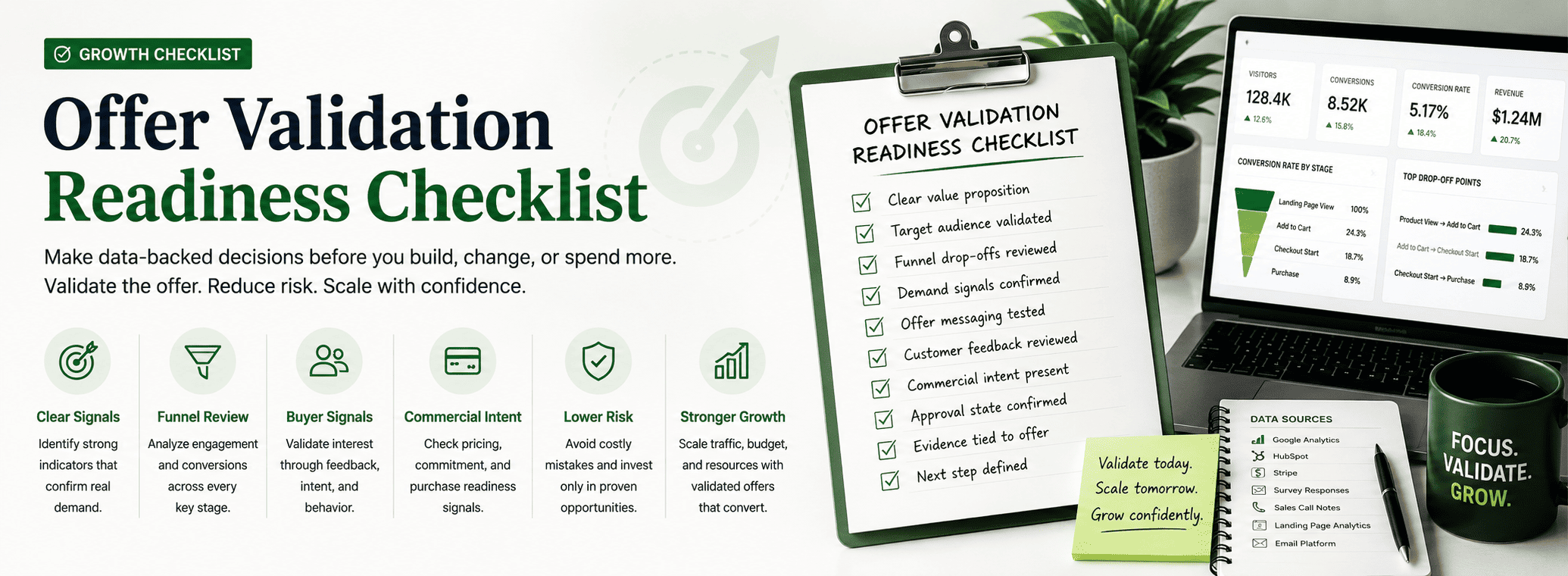
The strongest offer validation review combines behavioral, commercial, and customer evidence. Google Analytics and landing-page analytics show how users behave on the page. HubSpot and sales call notes show buyer state and objections. Stripe shows payment signal and cash timing. Survey responses and email platform data reveal language, intent, and follow-up quality.
- Google Analytics: Traffic quality, page behavior, source patterns, and funnel movement.
- HubSpot: Lead state, qualification, follow-up, and CRM notes.
- Stripe: Payment attempts, successful charges, refunds, and revenue timing.
- Survey responses: Buyer problem, objections, and intent language.
- Sales call notes: Commitment level, confusion, pricing concern, and decision context.
- Email platform: Reply quality, CTA engagement, and segment response.
Final Approval Rule
The Offer Validation Readiness Checklist should end with a clear approve, hold, or send-back decision. Approve only when the offer has enough visible signals to show real buyer demand, clear message fit, meaningful funnel movement, and credible commitment evidence.
If the buyer problem is unclear, the message has belief gaps, the scenario depends on assumptions, revenue quality is missing, or the operating owner is not visible, keep the recommendation caveated. The safest next step is to collect the missing evidence before building the full product, changing page copy, or sending more traffic.